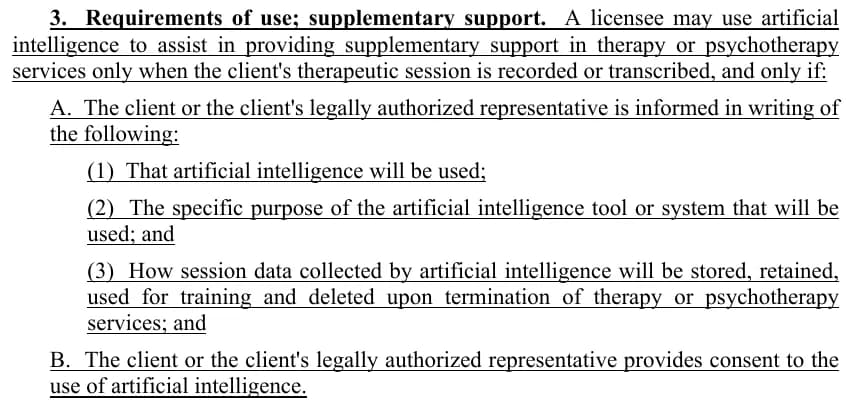
Source: Maine Legislature, Public Law 2025, chapter 687 (LD 2082), page 4, cropped by us on November 8, 2026.
Say a three-clinician counseling practice in Bangor switches on the AI notes feature in its practice software, and the feature records sessions. That is our illustration, not a case. If its clinicians are licensed in Maine, LD 2082 requires that practice to give each client three things in writing and get consent before the first recording.
LD 2082 became Public Law 2025, chapter 687 when the Governor signed it on April 13, 2026 (bill page). I read all 22 pages. It does two separate jobs. It bars anyone except a licensed professional from offering therapy to the public, "including through the use of Internet-based artificial intelligence." And it lets seven licensed professions use AI for notes and similar support, but only on conditions.
The ban is the headline, and it takes under two of the 22 pages. The rest is one notice-and-consent text repeated for seven licensing boards. I compared the seven sentence by sentence. They are the same except for the section number and who counts as "the licensee": the osteopathic and medicine sections add chapters 145 and 145-A, and the psychologists' section adds "privileged to practice." So the test below is the same whether your clinicians are nurses, social workers or psychologists.
Subsection 3 is the clause you operate
Subsection 3 of each licensing section says a licensee "may use artificial intelligence to assist in providing supplementary support in therapy or psychotherapy services only when the client's therapeutic session is recorded or transcribed," and only if the client is informed in writing of three things and consents. "Supplementary support" is defined in the same section to include "client records, including therapy notes." A notes tool is the example the law has in mind.
The third item is the one with teeth. I turned each item into a question for the vendor:
| Written notice item (subsection 3(A)) | What you need from the tool's vendor |
|---|---|
| (1) "That artificial intelligence will be used" | Nothing. You say it. |
| (2) "The specific purpose of the artificial intelligence tool or system" | The tool's name and what it produces: a transcript, a draft note, a summary. |
| (3) How session data "will be stored, retained, used for training and deleted upon termination" | Four separate answers: where it is stored, for how long, whether it trains any model, and when it is deleted after the client leaves. |
Table is ours. The right-hand column is the desk's reading of what a licensee needs to know to write the notice; the statute does not list vendor questions.
Teladoc Health's letter to the committee, dated February 16, 2026, shows what a complete answer to item (3) can look like. It says "no therapy session data is shared with external models and is not used to train those models." That is a company describing its own system, not a finding, and I did not test it. It is useful because it is the kind of sentence a licensee can paste into the notice. If your vendor cannot give you the training and deletion sentence, you cannot write item (3) truthfully. The statute puts that burden on the clinician. In the text I read, the vendor has no duty and no penalty of its own, so the clinician faces board discipline over a tool whose maker never has to answer to Maine.
My reading, not the board's: the trigger is a session that is "recorded or transcribed." A clinician who types or dictates a summary after the session into an AI drafting tool is not literally inside subsection 3. Subsection 2(A) still makes the licensee responsible for "all interactions, outputs and data use," and subsection 6 still applies. The seven boards have to write rules, and I would not plan around that gap.
A terms-of-use click is excluded by name
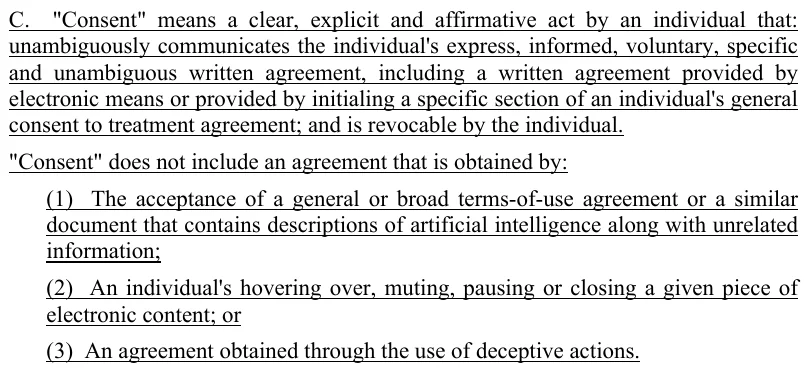
Source: Public Law 2025, chapter 687, page 3, cropped by us on November 8, 2026.
The definition of "consent" is a "written agreement, including a written agreement provided by electronic means or provided by initialing a specific section of an individual's general consent to treatment agreement," and it is "revocable by the individual." It then lists what does not count: accepting "a general or broad terms-of-use agreement or a similar document that contains descriptions of artificial intelligence along with unrelated information," hovering over, muting, pausing or closing content, and anything obtained "through the use of deceptive actions."
Two other subsections shape the form. Subsection 5 says a licensee "may not deny, or refuse to provide" therapy "on the sole basis" that the client has not consented to AI support, so a client who says no still gets seen, with notes written another way. Subsection 11 voids any waiver of the section by a client. In my reading, an intake line such as "by receiving care you waive these protections" would be void under subsection 11.
One detail from the hearing record does not match the final text. Sarah Calder's testimony for MaineHealth, dated February 17, 2026, thanks the sponsor for an amendment clarifying that consent could "be provided verbally or in writing," because many patients cannot print or scan. The chaptered text I read says "written agreement." It solves the printer problem with electronic signature and with initialing a section of the general consent form, not with verbal consent.
The licensee answers, not the tool
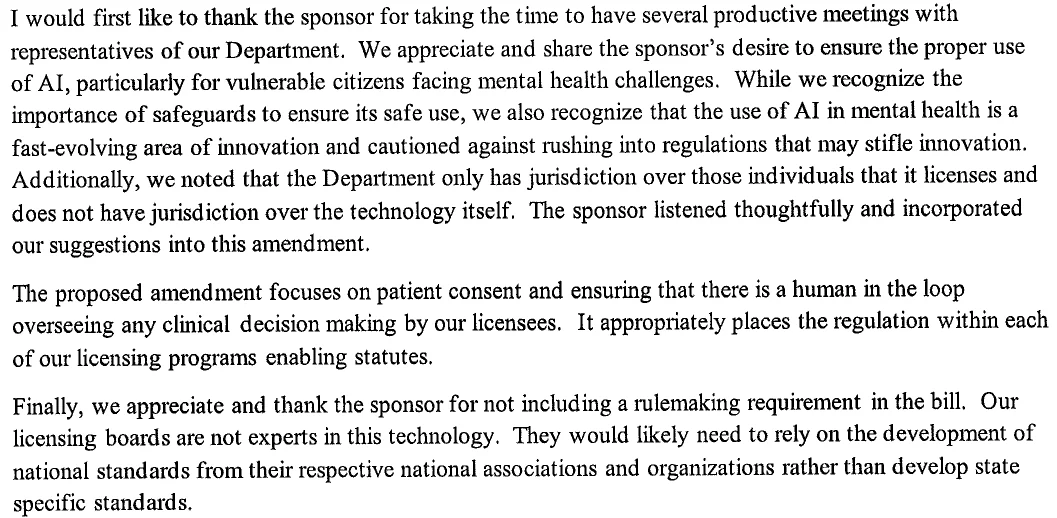
Source: Maine Legislature testimony page, Department of Professional and Financial Regulation, February 17, 2026, cropped by us on November 8, 2026.
The regulator said it plainly. Deputy Commissioner Kristina Lunner told the committee on February 17, 2026 that the Department "only has jurisdiction over those individuals that it licenses and does not have jurisdiction over the technology itself." The law is built to match. The duties are on the licensee. Subsection 6 makes the licensee "ensure that any artificial intelligence technology is compliant with all state and federal confidentiality and privacy laws." A violation is "subject to disciplinary action by the board pursuant to Title 10, section 8003, subsection 5."
For a practice that is a HIPAA covered entity, the federal rule already asks for "satisfactory assurance" before a business associate handles patient information (45 CFR 164.502(e)(1)(i)). Because subsection 6 makes the licensee answer for the tool's compliance, the vendor's ability to give that assurance now bears on the licence in Maine, not only on the contract.
Lunner also thanked the sponsor "for not including a rulemaking requirement in the bill," because the boards "are not experts in this technology." The chaptered text has one anyway: in each of the seven licensing sections, "The board shall adopt rules to implement the requirements of this section," and those are "major substantive rules." I did not find a proposed rule from any of the boards.
The ban is narrower than "Maine bans AI therapy"
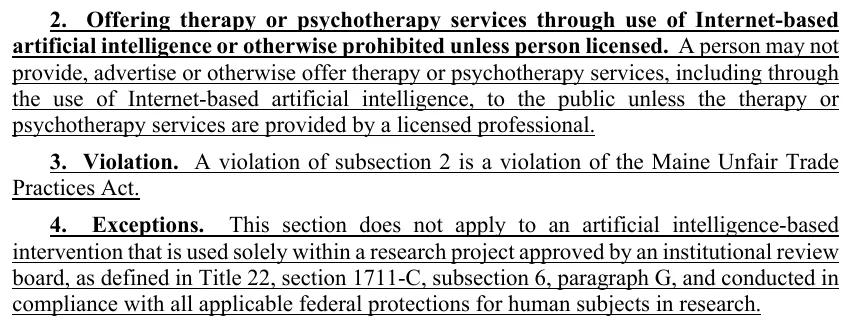
Source: Public Law 2025, chapter 687, page 2, cropped by us on November 8, 2026.
Section 1 of the chapter (10 MRSA section 1500-EE) holds the ban: "A person may not provide, advertise or otherwise offer therapy or psychotherapy services, including through the use of Internet-based artificial intelligence, to the public unless the therapy or psychotherapy services are provided by a licensed professional." The only exception is an intervention used "solely within a research project approved by an institutional review board."
Look at how "therapy or psychotherapy services" is defined: services "provided to diagnose, treat or address an individual's mental health or behavioral health through therapeutic communication." And "therapeutic communication" is an interaction "conducted in a clinical or professional setting." In my reading, an app that offers journaling prompts or meditation outside a clinical setting is not plainly inside the ban, and a chatbot that presents itself as a therapist is. That is an inference from the definitions, and no board or court has applied them.
Enforcement runs through the Maine Unfair Trade Practices Act. The Attorney General can sue for an injunction under Title 5, section 209, and the same section sets a civil penalty of "not more than $10,000" for each intentional violation the Attorney General proves is unfair or deceptive. A private claim under section 213 is open only to someone who bought "primarily for personal, family or household purposes" and "suffers any loss of money or property."
The chapter has a sibling for ordinary customer service. 10 MRSA section 1500-DD, first enacted as section 1500-Y by Public Law 2025, chapter 294 (approved June 12, 2025), bars using a chatbot "in a manner that may mislead or deceive a reasonable consumer into believing that the consumer is engaging with a human being" unless the consumer is told "in a clear and conspicuous manner" that they are not. It has the same enforcement route. In my reading, a chatbot that never passes as a person needs no label under that section. A therapy chatbot gets no such way out: section 1500-EE has no disclosure exception, so a label does not cure it.
What changed between the introduced bill and the law
I compared the 5-page bill printed on January 7, 2026 with the chaptered text.
| Point | Introduced (January 7, 2026) | Chaptered (April 13, 2026) |
|---|---|---|
| Where it lives | One new section, 22 MRSA 1730-B | Eight sections: 10 MRSA 1500-EE plus seven licensing sections in Title 32 |
| Definition of therapy | "diagnose, treat or improve" | "diagnose, treat or address" |
| Penalty | Up to $10,000 per violation, set by the Department after a hearing | Unfair Trade Practices Act for the ban; board discipline for licensees |
| Federal-program exception | AI "authorized or reimbursed" under a CMS program | Gone; only the IRB research exception remains |
| Board rulemaking | None | Each of seven sections: the board "shall adopt rules" |
| Physicians | Excluded unless a psychiatrist | Listed if they specialize in mental disorders |
Checked against the introduced bill (item 1) and the chaptered law (item 3) on the Legislature's LD 2082 page, November 8, 2026.
The Revisor's pages add one flag I did not expect. The sections for osteopathic physicians (32 MRSA 2600-G) and the Board of Licensure in Medicine (3300-J) are marked "TEXT REPEALED 1/1/27 by PL 2025, c. 738." The Chapter 153 contents page, which holds the new Medical Practice Act, lists no AI section. I have not read chapter 738. So for those two boards, the AI support rules carry an end date unless something replaces them.
Outside groups asked for changes and got mixed results. ATA Action's February 13, 2026 letter objected that the bill kept physicians out of "licensed professional" and that "improve" made therapy too broad; the chaptered text lists physicians who specialize in mental disorders and drops "improve." Teladoc asked that a licensee be allowed to direct a patient to an AI system that talks with the patient, under the licensee's oversight. Subsection 4(B) has no such exception: a licensee may not allow AI to "directly interact with clients in any form of therapeutic communication." The Maine Psychological Association opposed the bill outright on February 16, 2026, writing that psychologists "are already subject to a binding ethical code." Psychologists are covered anyway, by section 3820-A.
What I would do this month
If you serve Maine clients and an AI tool records or transcribes sessions, this is the desk's judgment, not legal advice. Ask your counsel and your board.
- Write the three-item notice and put the vendor's four data answers into item (3) in plain words. If the vendor will not state training and deletion in a sentence, leave recording off for Maine clients.
- Add an initialed line to the general consent form for AI support. Keep it apart from your website terms of use.
- Decide now how a client who says no is served. Subsection 5 does not let you refuse care.
- Do not point clients to a chatbot for between-session talk. Subsection 4(B) bars it for licensees, and the exception Teladoc asked for was not adopted.
- Watch for board rules. Each of the seven sections says the board "shall adopt" them.
My take: the ban will produce more headlines, but the notice is where a ten-person practice spends money. Item (3) turns a vendor's data terms into a sentence the clinician signs. I would pick the tool whose vendor can write that sentence, over the one with the better demo.
What I could not confirm
The chapter PDFs I read carry no effective date, and I did not find one on the Legislature's pages, so check the effective date for chapter 687 and chapter 294 before you act. The Legislature labels these documents unofficial. I did not search for board rule proposals, court decisions or enforcement under either section. The February 17 hearing page lists 27 items of written testimony; I read the five letters cited here.
Related Reading
- Illinois HB 1806 AI Therapy Law: Checklist for Small Teams
- Rhode Island AI Therapy Chatbot Laws: What Applies to You
- Utah Mental Health Chatbot Law (HB 452): Checklist
- AI Scribe Privacy: What Canada's Privacy Regulators Expect
- California AB 1979: Health Chatbots and the CMIA
- State Chatbot Disclosure Laws for SaaS Teams (2026)