When Meta launched its Business Agent tool in June 2026, Mark Zuckerberg said the company's agents will "eventually help you run your whole business," as Stuff reported, citing Engadget. Stuff called it "a serious claim, and one that doesn't seem to be entirely (or even remotely) possible right now." Whether or not it holds up, executives heard it. If you work in HR, legal or compliance and AI tools already score, rank or schedule your people, you need a written policy that says what oversight applies, what notice workers get and how they can dispute an outcome.
TL;DR: If AI tools score, rank or cut workers, you need a written policy on notice, human review and appeals. Illinois has required notice of AI use in employment decisions since January 1, 2026. NYC Local Law 144 requires a bias audit and notices. Colorado SB 26-189 adds notice, explanation and human review rights from January 1, 2027, and Connecticut SB 5 adds pre-decision notices from October 1, 2027. This page has a copy-paste policy template with 8 sections.
Why you need this before the first AI-driven layoff
Companies have used AI in workforce decisions for years through applicant tracking systems, performance tools and scheduling software. What is changing is the law around it. Here is what applies today and what is coming, with the source for each.
Illinois (in force since January 1, 2026). Public Act 103-0804, which started as HB 3773, amended the Illinois Human Rights Act. It is now a civil rights violation for an employer "to use artificial intelligence that has the effect of subjecting employees to discrimination on the basis of protected classes" or "to use zip codes as a proxy for protected classes." It is also a violation for an employer "to fail to provide notice to an employee that the employer is using artificial intelligence" for those decisions. The decisions covered are broad: "recruitment, hiring, promotion, renewal of employment, selection for training or apprenticeship, discharge, discipline, tenure or terms, privileges or conditions of employment." The Act applies to any employer with one or more employees in Illinois for 20 or more weeks a year, and it leaves the details of notice (when, how fast, by what means) to rules from the Illinois Department of Human Rights. Our Illinois AI employment disclosure guide covers the notice wording.
New York City (enforced since July 5, 2023). Local Law 144 "prohibits employers and employment agencies from using an automated employment decision tool unless the tool has been subject to a bias audit within one year of the use of the tool," the audit information is public, and "certain notices have been provided to employees or job candidates." If you use a vendor's screening tool for New York City roles, the duty sits with you as the employer, so ask the vendor for the audit.
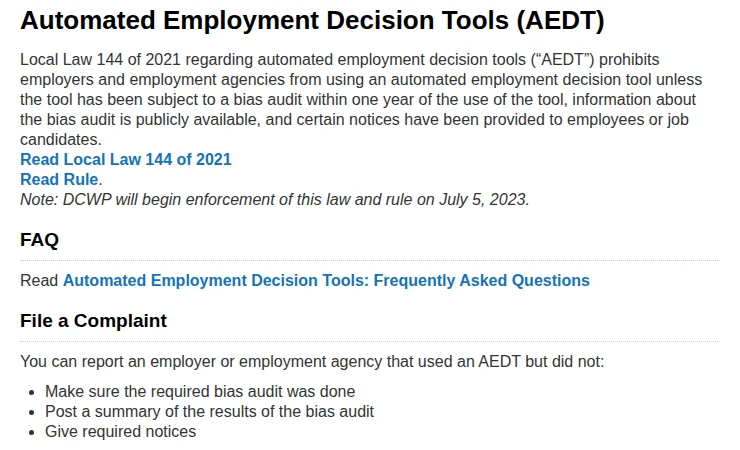 Screenshot: Automated Employment Decision Tools (AEDT), NYC Department of Consumer and Worker Protection.
Colorado (from January 1, 2027). SB 26-189, signed May 14, 2026, covers automated decisions in areas that include "education, employment, housing, financial or lending services, insurance, health-care services." Deployers must give "clear and conspicuous notice to consumers at the point of interaction," and after an adverse outcome, "a plain language description of a covered ADMT's role within 30 days." People can ask for their data and the "correction of factually incorrect personal data," and the Act "grants consumers the right to request meaningful human review and reconsideration" after an adverse decision. Records must be kept "for at least 3 years," and the attorney general enforces it through the Colorado Consumer Protection Act.
Connecticut (pre-decision notices from October 1, 2027). SB 5 was signed May 27, 2026. Morrison Foerster describes its automated employment-related decision technology (AEDT) section as "Effective October 1, 2026 (requirements operative October 1, 2027)." It covers tools whose output is "a substantial factor used to make or materially influence an employment-related decision to hire, fire, promote, discipline, renew employment, or select an individual for training." Employers must tell people in plain language when they are interacting with such a tool, and "before making an employment decision using AEDT," give written notice that includes "the purpose and trade name of the AEDT," the categories and sources of personal data, and a contact. The law also says use of AEDT "is not a defense against a discrimination complaint," and a court "may consider evidence of anti-bias testing." Only the attorney general enforces it, with a 60-day cure period for violations through December 31, 2027. Our Connecticut SB 5 employer checklist has the steps.
Layoffs: federal WARN and California. The federal WARN Act turns on headcount, not on what caused the cuts. The Department of Labor's employer guide says notice is required when a business "with 100 or more full-time workers" (not counting those with less than 6 months on the job or under 20 hours a week) "is laying off at least 50 people at a single site of employment," with mass layoff thresholds of 500 or more workers in a 30-day period, or 50 to 499 if they make up 33% of the site's workforce. Affected workers "are entitled to 60 days' notice." An AI-driven reduction that crosses those lines needs the same notice as any other. California goes further: SB 951, signed September 30, 2026 and operative January 1, 2027, amends Cal/WARN "to require additional notice when a mass layoff, relocation, or termination is caused in whole or substantial part by AI." See our WARN Act and AI displacement guide.

The template
Copy, adapt and date this document for your organization. Replace bracketed fields with your specifics before distributing. This is our suggested structure, not a legal form; have counsel check it against the laws where you employ people. Section 3's notice items (a) to (g) cover what Connecticut's pre-decision notice lists, and the first prohibited use in section 7 covers Illinois's zip code rule.
AI WORKFORCE AUTOMATION GOVERNANCE POLICY
[Company Name]
Version: [MONTH YEAR]
Effective Date: [DATE]
Owner: [HR Director / Chief People Officer]
Review Cycle: Annual, or within 30 days of material change to AI systems used in workforce decisions

---

1. SCOPE

This policy applies to all uses of artificial intelligence, automated decision systems, and AI-assisted tools that influence employment decisions at [Company Name], including but not limited to:

- Candidate screening, ranking, or selection
- Employee performance evaluation or scoring
- Promotion, demotion, or compensation recommendations
- Scheduling, workload allocation, or task assignment affecting compensation
- Workforce reduction analysis or headcount modeling

This policy applies to AI systems built internally and AI tools purchased from vendors. It applies in all jurisdictions where [Company Name] employs workers.

---

2. DEFINITIONS

"AI system" means any automated system that uses machine learning, statistical models, or rules-based logic to generate recommendations, scores, rankings, or decisions about employees or candidates.

"Consequential employment decision" means any decision that affects a worker's hiring, compensation, hours, promotion, demotion, performance classification, or termination.

"Affected worker" means any current employee or job applicant whose employment status is influenced by an AI system covered by this policy.

"Human review" means a qualified human reviewer who has authority to override, modify, or reject an AI system's output before the decision takes effect.

---

3. AI DEPLOYMENT NOTICE REQUIREMENTS

3.1 Before using any AI system in a consequential employment decision, [Company Name] will provide written notice to affected workers that:

  (a) States that AI is used in the relevant process
  (b) Identifies the general category of data inputs the system uses
  (c) Describes the type of output the system generates (score, ranking, flag, recommendation)
  (d) Identifies the name of the vendor or system, if third-party
  (e) States the purpose of the system and the type of decision it supports
  (f) Identifies the sources of the personal data used
  (g) Gives a contact at [Company Name] for questions

3.2 Notice must be provided at least [10] business days before the AI system is first used in a process affecting that worker.

3.3 For new hires and applicants, notice must appear in the job posting or application acknowledgment before the candidate proceeds.

3.4 [Company Name] maintains a list of approved AI systems in workforce use. Deploying an unapproved AI system in a consequential employment decision requires prior approval from [HR Director] and [Legal].

---

4. HUMAN OVERSIGHT MINIMUMS

4.1 No consequential employment decision may be made solely on the basis of an AI system's output without human review.

4.2 For hiring and promotion decisions: a qualified hiring manager or HR professional must review AI outputs before a final decision is communicated to the candidate or employee.

4.3 For performance management decisions (ratings, PIPs, improvement plans): a direct manager and HR business partner must review AI-generated assessments before the assessment is shared with the employee.

4.4 For workforce reduction recommendations: all AI-generated headcount models or role elimination recommendations must be reviewed and approved by at least two levels of management and HR leadership before any notice is issued to affected employees.

4.5 AI systems may not be used as the sole or primary basis for a mass layoff or reduction in force. Human judgment must be documented in the reduction decision record.

---

5. AFFECTED WORKER RIGHTS

Workers affected by a consequential employment decision involving an AI system have the right to:

5.1 Request a written explanation of how the AI system's output contributed to the decision affecting them. [Company Name] will respond within [10] business days.

5.2 Request a human review of any decision they believe was incorrectly influenced by an AI system. This request must be submitted within [30] calendar days of being notified of the decision.

5.3 Receive a copy of any AI-generated score, assessment, or recommendation that directly influenced a hiring rejection or termination decision, subject to applicable legal limitations.

5.4 File a complaint through [Company Name]'s standard HR complaint process if they believe an AI system generated a discriminatory, inaccurate, or unfair output.

---

6. APPEALS PROCESS

6.1 A worker who believes an AI system's output incorrectly affected a consequential employment decision may request a formal appeal within [30] days of the decision.

6.2 Appeals are reviewed by a designated panel consisting of: [HR Business Partner], [Department Head not involved in original decision], and [Legal representative if employment termination is involved].

6.3 The appeal panel will review the original decision, the AI system's output, and any additional information provided by the worker. The panel may request access to the vendor's documentation about how the system generated the output.

6.4 The appeal panel will provide a written decision within [15] business days of receiving the appeal.

6.5 The appeal panel has authority to overturn, modify, or affirm the original decision. Their decision is final within this internal process.

---

7. PROHIBITED USES

[Company Name] prohibits the use of AI systems in workforce decisions for the following purposes:

7.1 Inferring or using protected characteristics (race, gender, age, disability, religion, national origin, sexual orientation, pregnancy status, or any other legally protected characteristic) as inputs to employment decisions, including zip codes or other data used as a proxy for a protected characteristic.

7.2 Generating facial recognition-based assessments of candidate suitability or employee performance.

7.3 Analyzing sentiment, emotion, or personality from video interviews, voice recordings, or written communication without explicit disclosure to the subject.

7.4 Making termination decisions based on AI-generated predictions of future misconduct or performance without independent human assessment.

7.5 Using AI-generated social media analysis or publicly available personal data as inputs to employment decisions.

---

8. REVIEW CADENCE

8.1 This policy will be reviewed annually by HR, Legal, and the relevant department heads.

8.2 Any new AI system deployment in a covered workforce process must be approved before go-live and reflected in the approved systems list within 30 days.

8.3 Following any workforce reduction of 10 or more employees where AI systems were involved in the analysis, HR will conduct a post-action review of the AI systems used and document findings within 60 days.

8.4 [Company Name] will monitor applicable state law changes in all operating jurisdictions and update this policy within 90 days of any new law taking effect.

---

Approved by: _______________________
Title: _______________________
Date: _______________________
How to adapt this template for your size
The template is written for a mid-size employer with a full HR function. Here is how to scale it.
Small teams (under 50 employees)
Sections 3, 4 and 7 are the minimum. You can compress the appeals process to a single designated reviewer (the owner or a senior HR leader) instead of a panel, and expand it as you grow.
Size does not get you out of Illinois: the Human Rights Act covers employers with one or more employees in Illinois for 20 or more weeks a year, so if you use AI in employment decisions there, the notice in section 3 and the zip code rule in section 7 apply to you. See the Illinois AI employment disclosure guide for notice language. If you hire for New York City roles with an automated screening tool, Local Law 144's audit and notice rules apply too.
Mid-size (50 to 500 employees)
Use the template mostly as written. Adjust the review thresholds in section 4 to your management structure. If you have no HR business partners, give the oversight duties to whoever handles employee relations. What matters is that a person with authority to override the AI is in the approval chain before a decision reaches the employee.
If you have Connecticut employees, plan for the pre-decision AEDT notices that apply from October 1, 2027; the Connecticut SB 5 checklist covers them. If you have Colorado employees, the notice, 30-day explanation and human review rights start January 1, 2027.
Enterprise (500+ employees)
At this scale the policy belongs inside your existing HR policy framework. WARN thresholds (at least 50 people at a single site, or a mass layoff of 500 or more in 30 days) are a realistic risk when AI-assisted workforce modeling is in play, and in California, SB 951 adds notice duties when AI causes the layoff. Make the rule in section 4 that AI cannot be the sole basis for a reduction in force non-negotiable and have legal review the documented human approval chain for any AI-assisted reduction in force before it starts.
For operations in several states, the multi-state AI compliance strategy guide explains how to build one policy to the highest applicable standard instead of separate policies per state.

What HR practitioners are asking
The questions in this policy are the ones HR teams are working through now. On October 6, 2026, an HR professional hiring for New York roles with EU applicants asked r/humanresources how to word a candidate notice:
"What are you telling people, that AI is involved, what it looks at, who decides, and how they can appeal?" (u/AgreeableEffect717, r/humanresources)
The reply was blunt: "While you don't want a legal brochure, you want to make sure the "clear read" is fully legal." (u/Hrgooglefu)
https://www.reddit.com/r/humanresources/comments/1wz5njf/if_an_ai_helps_review_your_application_what/
Those four items (that AI is involved, what it looks at, who decides, how to appeal) map onto sections 3, 4 and 6 of the template.
Our take
The laws do not line up neatly, but they point the same way. Illinois wants notice and bans proxies like zip codes. Connecticut wants a written notice before the decision, with the tool's name and data sources. Colorado wants notice, an explanation after a bad outcome and a route to human review. A single policy that does all three is simpler than tracking which state each worker sits in.
The part most teams skip is the record. Connecticut lets a court consider anti-bias testing, and Colorado requires records for 3 years. If AI shaped a layoff list, write down who reviewed it and why, before anyone asks. "We did not know the model would cut that many roles" is not a WARN defense, because WARN counts the layoffs, not the cause.
The federal picture is thinner than the state one, so do not wait for it. The state dates above are the ones to plan around.
How we checked this
We read Illinois Public Act 103-0804, Colorado's SB 26-189 bill page, NYC's Local Law 144 page, the Department of Labor's WARN employer guide, Morrison Foerster's summary of Connecticut SB 5, Covington's summary of California SB 951 and the Governor's September 30 signing release, Stuff's report on Meta's Business Agent, and one r/humanresources thread: 9 sources. Every fact above has a row with a verbatim quote in our source log. This review corrected several errors in the earlier version: Connecticut's employment notices apply from October 1, 2027, not October 1, 2026, and the law firm summary we used describes no human review right there; the Zuckerberg remark came at a June 2026 launch, not in July; and WARN's thresholds were restated from the DOL guide. We removed unsourced claims about how many companies lack a policy and how far behind they are. Last reviewed: October 10, 2026.
Related Reading
- Illinois AI Employment Disclosure Law 2026
- Connecticut SB 5 AI Employer Checklist
- NYC Local Law 144: AI Bias Audit Employer Guide 2026
- AI Acceptable Use Policy Template for Small Teams
- AI Workforce Displacement and WARN Act Governance 2026
- EEOC AI Hiring Guidance 2026: Employer Checklist
- HR AI Governance: Managing Hiring Decisions 2026
- AI Hiring Tool Compliance: US State Laws 2026
- Sirius XM Wins AI Hiring Bias Case