Image: Unsplash.
TL;DR: Utah's AI disclosure rules started with SB 149, the Artificial Intelligence Policy Act (2024), and now sit in Utah Code Chapter 13-77 after SB 226 (2025). A business using generative AI with consumers must say so when a person clearly asks. Licensed professionals must disclose up front in high-risk interactions. Disclosing at the outset and throughout is a safe harbor.
Utah's AI disclosure law asks little of most businesses and more of licensed professionals. If your chatbot or voice bot talks to Utah consumers, the cheapest way to comply is the one the statute itself rewards: say it's AI at the start and keep saying it.
Which law this is
Three bills get mixed up here, so start with the names.
- SB 149 (2024), the Artificial Intelligence Policy Act. The governor signed it on March 13, 2024, and it took effect May 1, 2024. It set up the Office of Artificial Intelligence Policy and a regulatory learning lab (Utah Code Chapter 13-72) and added the first disclosure rule, in Section 13-2-12.
- SB 226 (2025), Artificial Intelligence Consumer Protection Amendments. It took effect May 7, 2025, repealed Section 13-2-12 and moved the disclosure rules into a new Chapter 13-77, "Generative Artificial Intelligence, Consumer Disclosures and Enforcement". This is the text you comply with today. Two of its sections, including the definitions, were amended again in the 2026 session.
- HB 452 (2025), Artificial Intelligence Amendments. A separate law on mental health chatbots (Chapter 13-72a). If you run one, it has its own rules beyond this guide.
The AI Policy Act chapter, with the office and the learning lab, is set to repeal on July 1, 2027. Chapter 13-77, which holds the disclosure duties, is not on that repeal list.
The rules in one table
| Rule | Who | When | Utah Code |
|---|---|---|---|
| Answer honestly that it's AI | A supplier using generative AI to interact with an individual in a consumer transaction | When the individual makes a clear and unambiguous request to know whether it's a human or AI | 13-77-103(1) |
| Disclose without being asked | Someone providing services in a regulated occupation | When generative AI use is a high-risk AI interaction: verbally at the start of a call, in writing before a written exchange | 13-77-103(2)-(3) |
| Safe harbor | Anyone covered | The AI clearly and conspicuously discloses at the outset and throughout that it is generative AI, not human, or an AI assistant | 13-77-104 |
| AI is no excuse | Anyone enforced by the Division | A consumer-protection violation is still yours if the AI made the statement or took the act | 13-77-102 |
| Enforcement | Division of Consumer Protection | Administrative fine up to $2,500 per violation; a court can order an injunction, disgorgement and a fine of the same size; violating an order: civil penalty up to $5,000 per violation | 13-77-105 |
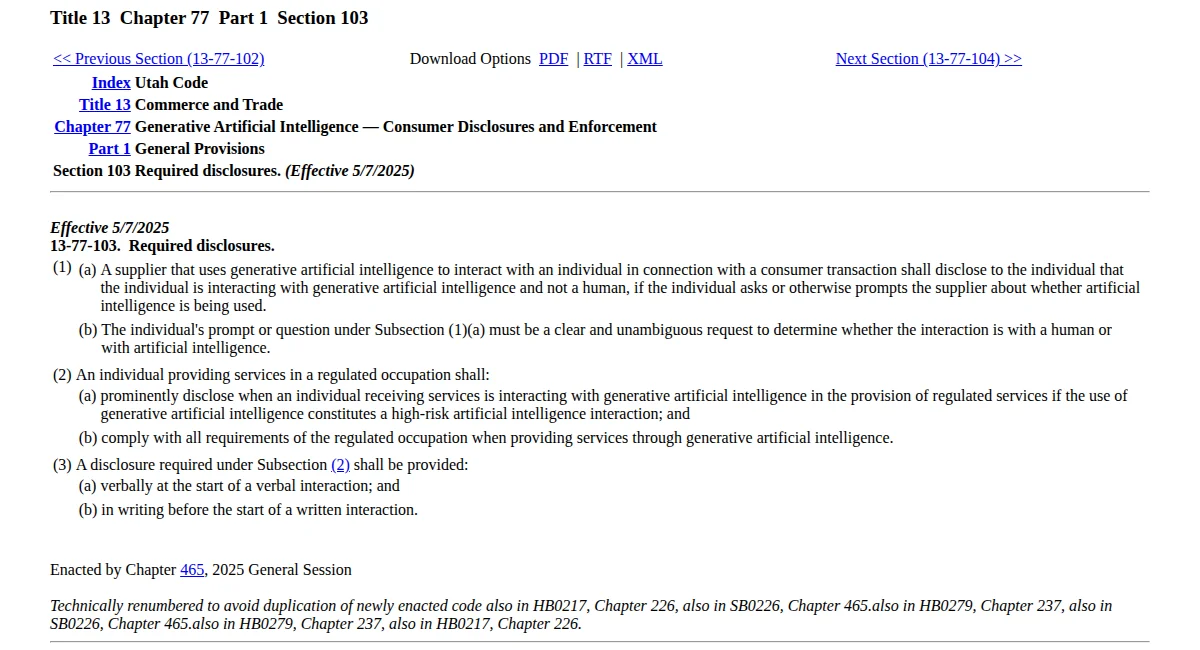
Screenshot: Utah Code 13-77-103, Utah State Legislature (le.utah.gov), captured October 20, 2026 from the page text.
What counts as a clear request
The original 2024 text required disclosure "if asked or prompted by the person". Since May 7, 2025, the request "must be a clear and unambiguous request to determine whether the interaction is with a human or with artificial intelligence."
Our reading of that standard, which no Utah court or Division ruling we found has tested:
- Clear requests: "Am I talking to a bot?", "Is this an AI or a real person?", "Are you a human agent?", "Is anyone actually reading this?"
- Probably not a request: "You sound like a robot", or a joke the user doesn't expect an answer to.
Don't build a classifier to tell the two apart. A bot that answers "I'm an AI assistant" to anything close to an identity question loses nothing, and one that says "I'm a human" once has a problem.
When you must disclose first
The up-front duty applies only to someone "providing services in a regulated occupation", meaning work regulated by Utah's Department of Commerce that needs a license or state certification. If your professional license comes through the Department of Commerce, assume this part applies to you.
It kicks in when generative AI use is a "high-risk artificial intelligence interaction". The statute defines that as an interaction that involves collecting sensitive personal information (health, financial or biometric data), or giving personalized recommendations, advice or information that could reasonably be relied on for significant personal decisions, including financial, legal, medical or mental health advice.
So a bot that only books appointment times is probably outside the high-risk definition; an intake bot that asks about symptoms, or a tax-prep assistant that gives filing advice, is inside it. The disclosure has to be "prominent": spoken at the start of a voice interaction, and in writing before a written one starts.
Enforcement
The Division of Consumer Protection administers and enforces Chapter 13-77, and the Attorney General acts as its counsel. A violation of the chapter "constitutes a violation of Subsection 13-11-4(1)", the deceptive-act provision of Utah's Consumer Sales Practices Act. If the Division wins in court, the court awards it attorney fees, court costs and investigative fees.
The chapter itself names only Division enforcement, but it also says it "does not displace any other remedy or right" under state or federal law. We haven't checked whether a consumer can bring a claim under the Consumer Sales Practices Act's own remedies for an AI disclosure violation, so we don't claim there is no private right of action.
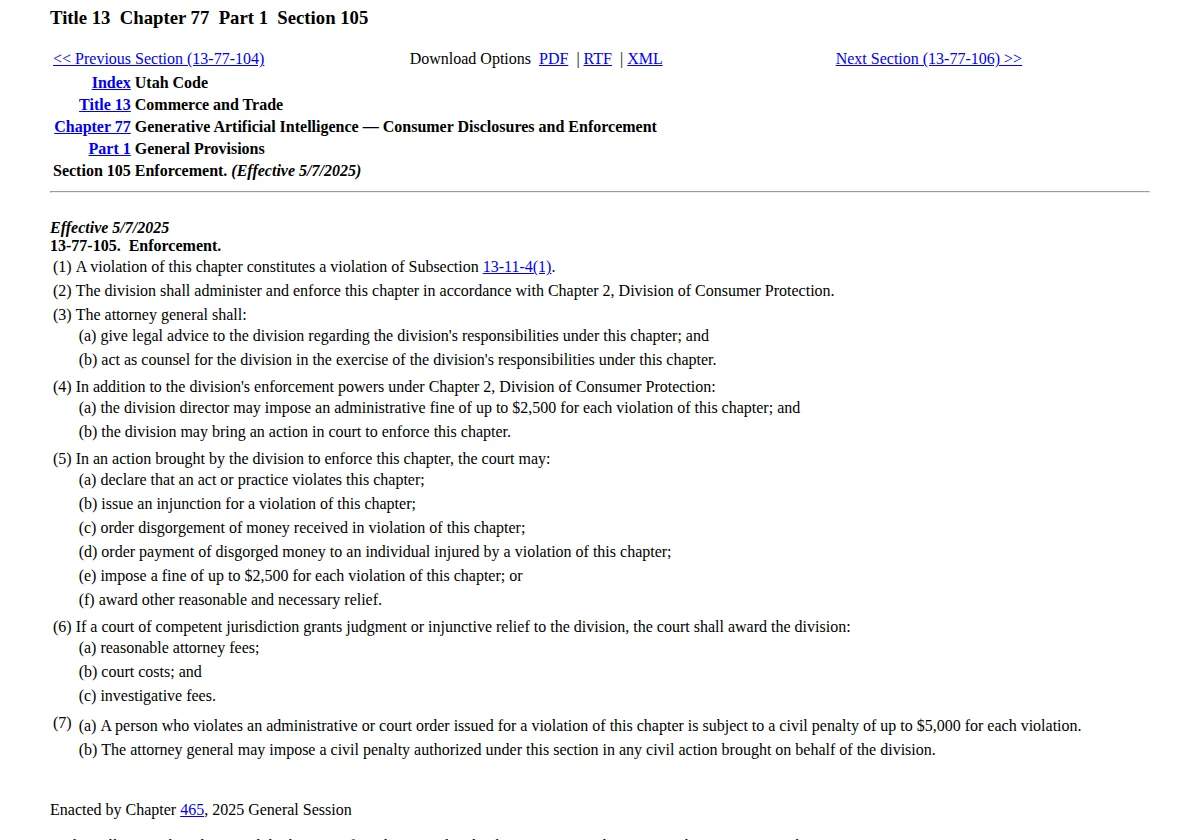
Screenshot: Utah Code 13-77-105, Utah State Legislature (le.utah.gov), captured October 20, 2026 from the page text.
What to update
Chat and AI assistants. Put the disclosure in the opening message and in the bot's persistent label (for example "AI assistant" next to its name), so you meet the safe harbor and don't depend on recognizing questions. Then add an instruction for identity questions anyway.
- Avoid: "I'm a knowledgeable support specialist here to help."
- Avoid: "I'm a member of the [Company] support team."
- Avoid: dodging the question with "Let's focus on your issue."
- Use: "I'm an AI assistant. I can help with [scope]. Would you like to continue, or speak with a person?"
Voice bots. Open the call with the disclosure. For licensed services handling high-risk matters, the spoken disclosure at the start is required, not optional.
Human agents. If a customer asks an agent who took over a chat "Was I just talking to a bot?", the agent answers honestly. Add this to support training and to your AI acceptable use policy.
Records. Keep dated screenshots of the opening message and bot label, the system instruction, and training records. They are your evidence for the safe harbor if the Division asks.

Image: Unsplash.
Sample disclosure language
None of these is statutory wording. Adapt them to your voice, keeping the AI statement plain.
Chat (opening message): "Hi, I'm [Company]'s AI assistant. I can answer most questions about [product/service area]. Type 'agent' at any time to reach a person."
Chat (when asked if it's a human): "No, I'm an AI assistant, not a person. Want me to connect you with someone on our team?"
Voice (start of call): "You're speaking with [Company]'s automated AI assistant. Say 'representative' at any time to reach a person."
Licensed service, written intake (before it starts): "This intake is handled by an AI assistant, not by [practitioner title]. Your answers will be reviewed by [practitioner title] before [next step]."
How Utah compares
| Framework | When disclosure is required | Who must disclose |
|---|---|---|
| Utah Code 13-77 | On a clear request; up front for high-risk regulated services | Suppliers using generative AI with consumers; regulated occupations |
| EU AI Act Article 50(1) | People must be informed they're interacting with an AI system, unless obvious | Providers of AI systems that interact with people |
| California SB 942 | Disclosures in AI-generated image, video and audio content | Covered providers of generative AI systems publicly accessible in California |
| Colorado SB 26-189 | Notice before covered automated decision-making technology materially influences a consequential decision | Deployers |
A company that discloses at the start of every AI chat to meet Article 50 already sits inside Utah's safe harbor, as long as the disclosure also stays visible during the conversation. If you serve both markets, one standard for everyone is simpler than sorting users by state. More detail: EU AI Act Article 50, California SB 942.
Checklist
- List every AI chat, voice or messaging feature that Utah consumers can reach.
- Add an opening AI disclosure and a persistent "AI assistant" label to each one.
- Test each with "Are you a human?" and "Am I talking to a bot?" and save the transcripts.
- If you're in a licensed occupation, list the AI interactions that touch health, financial or biometric data or give advice, and confirm the up-front disclosure runs before each.
- If you run a mental health chatbot, check HB 452's separate rules in Chapter 13-72a.
- Train human agents to answer identity questions honestly after a handoff.
- Re-test after any model, vendor or prompt change.
What we could not confirm: whether the Division has adopted rules on forms and methods of disclosure, which Section 13-77-104 allows (we didn't search the Utah Administrative Code); the text of the 2026 amendment to the definitions, beyond the current code we quote; and whether consumers can sue under the Consumer Sales Practices Act for these violations.
Correction (October 20, 2026): Earlier versions called the AI Policy Act "HB 452" and said it was signed on March 22, 2024. The act was SB 149, signed March 13, 2024; HB 452 (2025) is Utah's mental health chatbot law. The post also described a "sincerely asks" trigger (the statute says asked or prompted, and since 2025 a clear and unambiguous request), said no business ever has to disclose first (regulated occupations do in high-risk interactions), called Utah the first state with such a law and said there is no private right of action, neither of which we could source.
Related reading
For the EU proactive disclosure standard that often makes sense to adopt alongside Utah compliance, see EU AI Act Article 50 watermarking and deepfake disclosure. For California's content labeling rules, see California SB 942 AI transparency act compliance. Check AI law effective dates at AI regulation deadline calendar 2026. Build a broader governance program with the AI governance checklist 2026. For employee-facing AI policies, see ChatGPT usage policy for employees and AI acceptable use policy template small teams. If you manage Utah alongside California and the EU, see the multi-state AI compliance strategy 2026.