Image: Unsplash.
TL;DR DeepSeek's web and app chat service went down twice on the night of March 29-30, 2026. Its own status page shows a first incident from 9:35 p.m. to 11:23 p.m. China Standard Time, then a second one that opened 57 minutes later and was not resolved until 10:33 a.m. the next morning. DeepSeek has not said why. The often-repeated "355 million users" is its total user base, not a count of people affected. If your team leans on one AI chat tool, the useful lesson is a short outage runbook, and we give you one below.
This page was first published in April 2026 as a general AI governance guide. On October 9, 2026, we rewrote it from the primary record, DeepSeek's status page, because the earlier version contained figures we could not trace to any source. The section "What we changed on this page" lists what was removed.
What happened, from DeepSeek's status page
DeepSeek runs a public status page at status.deepseek.com. For the night of March 29, 2026, it holds two incident records. Both name a single affected component, the chat service (对话服务, "Chatservice"), which is the consumer web and app product.
| Time (China Standard Time, UTC+8) | Time (UTC) | Status page record |
|---|---|---|
| Sun, March 29, 9:35 p.m. | 13:35 | Incident 1 opens: "DeepSeek Web/APP Service Abnormal" |
| Sun, March 29, 11:23 p.m. | 15:23 | Incident 1 marked resolved (1h 47min) |
| Mon, March 30, 12:20 a.m. | 16:20 | Incident 2 opens, 57 minutes later: "DeepSeek Web/APP Service Performance Agnormal" (sic) |
| Mon, March 30, 1:24 a.m. | 17:24 | "A fix has been implemented and we are monitoring the results." |
| Later that night | Status goes back to "We are currently investigating this issue." | |
| Mon, March 30, 9:13 a.m. | 01:13 | A second fix is logged |
| Mon, March 30, 10:33 a.m. | 02:33 | Incident 2 marked resolved (10h 13min) |
Add the two records together and you get 12 hours of logged incident time. Measured from the first report to the final fix, the window was just under 13 hours. Techloy, which reported the timeline on March 30, put the same events at "over 13 hours" and called it "the longest disruption to its consumer service since it launched globally in January 2025."
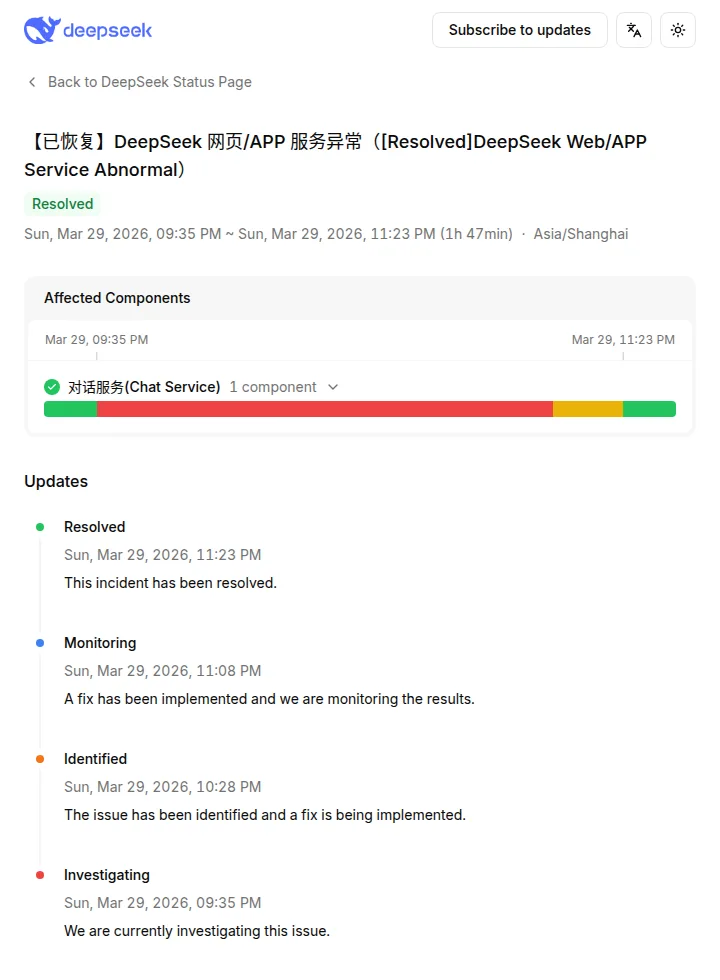
Screenshot: Incident record "DeepSeek Web/APP Service Abnormal", DeepSeek status page, times in Asia/Shanghai, captured October 9, 2026.
The first fix did not hold. In the second record, the status moves to monitoring after a fix and then back to investigating, before the final fix in the morning. That pattern, a fix that looks done and then is not, is the part most worth remembering if you are the person who tells your team "it's back."
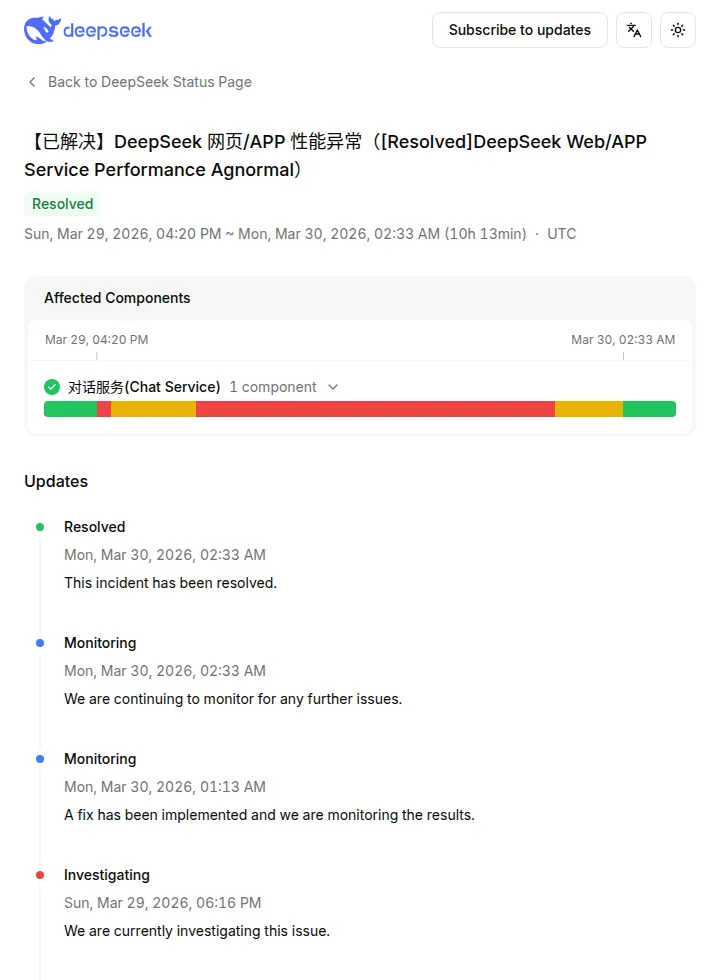
Screenshot: Incident record "DeepSeek Web/APP Service Performance Agnormal", DeepSeek status page, times in UTC, captured October 9, 2026.
What the record does not tell you
Several claims about this outage spread faster than the facts behind them. Here is what we could and could not confirm.
The cause. Unknown. Techloy wrote that "DeepSeek issued no public explanation for either incident," and Outlook Business reported that "the exact causes of the massive outage have not been revealed so far." We found no later post-mortem.
How many people were affected. Unknown. Techloy described DeepSeek as "the Chinese AI chatbot with 355 million users." That is a description of the whole user base. Our own earlier version of this page turned it into "disrupted 355 million users," which no source we could read supports.
How long it lasted. It depends on what you count. Outlook Business reported "over seven hours." Techloy reported "over 13 hours." The status page itself shows two incidents adding up to 12 hours, inside a window of just under 13. If you cite a duration, say which one you mean.
Whether the API went down. Unconfirmed. Both incident records list only the chat service. DeepSeek's status page today tracks its API as separate components (for example "DeepSeek V4 Pro API服务(API Service)"), but the March records name no API component and DeepSeek has said nothing either way. If your product calls DeepSeek through the API, do not assume you were spared; check your own error logs for that night.
Reliability before the outage. Outlook Business, citing Mint, reported that DeepSeek "has maintained that it has a near 99% operational record" since January 2025. That is DeepSeek's own claim, not an independent uptime figure.
Why a small team should care
Most small teams do not pick an AI chat tool through procurement. Someone starts using it, it works, and a few weeks later half the team drafts, translates or debugs with it every day. Nobody wrote down what happens when it is unavailable, because it never was.
The DeepSeek outage is a clean test of that gap, for three reasons:
- It ran into a Monday morning. The final fix came at 10:33 a.m. Monday, China time, so teams in China and nearby time zones started the work week without the tool. In Europe and the Americas the outage fell on Sunday, which is luck, not a plan.
- The first "resolved" was wrong. Anyone who told their team "it's fixed" at 11:23 p.m. China time was wrong within the hour.
- There was no explanation. Without a cause, you cannot judge whether it will happen again next week. The only thing you control is your own fallback.
None of this is unique to DeepSeek. Any hosted AI service can go down, and a status page is a record of the vendor's view, not a guarantee. The goal is not to drop a tool after one bad night. The goal is that one bad night costs you an inconvenience, not a missed deadline.

Image: Unsplash.
Copy-paste: AI vendor outage runbook
Paste this into your team wiki and fill in the brackets. It is written for a team without an on-call rotation or a dedicated IT person.
AI VENDOR OUTAGE RUNBOOK
Owner: [name]            Backup owner: [name]
Last tested: [date]

1. WHICH TOOLS ARE COVERED
   Tool: [e.g. DeepSeek chat]   Used for: [drafting, translation, code help]
   Status page: [URL]           Subscribed: [owner's email / Slack channel]

2. HOW WE FIND OUT
   - Owner is subscribed to the vendor status page.
   - Anyone who sees errors posts in [#ai-tools] with the time and the error text.
   - Owner checks the status page and confirms or rules out a vendor outage.

3. WHAT WE SWITCH TO
   Task                     Backup tool             Notes
   [Drafting]               [second chat tool]      [account already set up]
   [Code help]              [IDE assistant]         [no customer data]
   [Translation]            [second tool]           [check the data rules first]
   Tasks that simply wait:  [list]

4. RULES DURING THE OUTAGE
   - Use only backup tools already approved in our AI tool register.
   - Do not paste customer or personal data into a tool that is not approved for it.
   - Do not sign up for new tools in a hurry to fill the gap.

5. HOW WE DECLARE IT OVER
   - The vendor marks the incident resolved AND the owner runs one real task.
   - Wait before announcing "back": the first fix does not always hold.

6. AFTER
   - Owner writes three lines: what broke, what we switched to, what to change.
   - Update this runbook and the AI tool register.
Copy-paste: outage fields for your AI tool register
If you keep an AI tool register, add these columns. They take a few minutes per tool and make the runbook above work.
Tool | Owner | Status page URL | Owner subscribed (Y/N) |
Workflows that depend on it | Backup tool for each workflow |
Backup approved for the same data (Y/N) | Where our prompts/files live |
Can the work wait a day (Y/N) | Last outage we noticed | Notes
The column that matters most is "Where our prompts/files live." If your team's prompt library, reference documents and past conversations exist only inside one vendor's app, an outage blocks the work and the history at the same time. Keep the prompts you reuse in a shared document you control.
What to watch
- A post-mortem from DeepSeek. If one appears, we will add the cause here.
- Repeat incidents. DeepSeek's status page lists every incident with its affected components. The page has a "Subscribe to updates" option.
- API versus chat. If you build on the DeepSeek API, watch the API components on the status page, not only the chat service.
Our take
Based on the record above, this outage tells you less about DeepSeek than about how teams adopt AI tools. The status page is unusually clear: two incidents, one component, exact times. What is missing is everything a customer needs to plan, namely a cause, an affected-user count and an answer on the API. That is normal for a free consumer service, and it is why a small team should treat any consumer AI chat tool as something that can disappear for a working day without notice.
The fix is cheap: one named owner, a status-page subscription, a backup tool for each important workflow, and a rule against pasting sensitive data into whatever is open during the gap. We would rather a team spend half an hour on the runbook above than switch vendors after one bad night.
Community reaction
On r/DeepSeek, the first thread about it guessed at an update rather than a failure. In the thread "I think deepseek is being updated for V4, that is why its down now!!", one user wrote:
"Yeah it's down. I see. I was in the middle of script writing lmao. I thought it was just my network"
Another replied:
"deepseek is seriously so good, i rely on it more that GPT. I hope it gets fixed soon!"
Both comments describe exactly the dependency the runbook is for: work in progress inside one tool, and no plan for when it stops.
We did not embed a post. DeepSeek published no statement about the outage, and the Reddit thread's opening post is a guess about a model update rather than a report of the outage, so we quote the comments instead.
What we changed on this page
The April 2026 version of this page was titled "AI Governance Playbook for Small Teams: 2026 Guide" and was written without a source log. On October 9, 2026, we checked every figure in it. None could be traced to an openable source, so we removed all of them, including:
- "disrupted 355 million users for 12 hours" (355 million is the total user base; no source gives an affected-user count),
- a claim of faster AI deployments and fewer incidents "based on our analysis" of deployments that the page never identified,
- percentages attributed to Gartner, IDC, Forrester, Deloitte and NIST, given without a link or report name,
- example companies (a "fintech startup", a "healthtech duo" and others) that were not real cases.
We also fixed links that pointed to pages that do not exist.
How we checked this
We rebuilt this page from 4 sources, checked on October 9, 2026: DeepSeek's status page (both incident records, read through the page's own data feed and opened in a browser for the screenshots), Techloy's March 30 report by Damilare Odedina, Outlook Business's March 30 report, and one r/DeepSeek thread for the community quotes. Every time and number in the article matches a quote in our source log. The South China Morning Post and TechRepublic covered the outage but block automated readers, so we did not use them. Times are given in China Standard Time (UTC+8), as on DeepSeek's status page, with UTC alongside.
Last reviewed: October 9, 2026.
Related Reading
- AI Incident Response Plan Template for Small Teams
- GenAI Vendor Risk Assessment: A Framework (Treasury FS AI RMF + SOC 2)
- AI Vendor Contract Red Flags: Clauses That Create Liability
- DeepSeek GDPR Data Transfer Risk: What Teams Can Actually Use
- Anthropic Export Ban: What the Fable 5 Shutdown Means for Your AI Vendor Policy
- Vendor Risk Management: Uber's Hyperscaler Lessons