Image: Pexels, used under the Pexels License.
TL;DR On October 8, 2026, Danish culture minister Zenia Stampe introduced a bill that amends the Copyright Act so that sharing lifelike digital imitations of a person's appearance or voice becomes illegal. Satire, parody and criticism are exempt unless the fake is dangerous misinformation. The bill still needs parliamentary approval; the minister hopes it takes effect at the turn of the year. Teams that put real faces or voices into AI content should start keeping written consent now.
Denmark has been talking about giving people a right over their own face and voice since a cross-party deal in June 2025. On Thursday, October 8, 2026, the government put that deal into a bill. Culture minister Zenia Stampe introduced it, and the Ministry of Culture published a press release the same day under the headline that the minister wants to curb the sharing of digital imitations "from the turn of the year".
The bill is short on drama and long on consequences for anyone who makes marketing videos, training clips or voice content with AI. It does not ask whether a video is labeled. It asks whether the person shown agreed.
Event date: October 8, 2026 (bill introduced). First reports: October 8, 2026 (Euronews, Reuters, Telecompaper). We read the ministry's press release in Danish; we could not open the bill text itself (see "What we could not read").
What the bill does
The press release describes two protections, both added to the Danish Copyright Act (ophavsretsloven):
- A general protection against lifelike, digitally generated imitations of a person's personal characteristics. In the ministry's words, it becomes illegal to share, for example, lifelike reproductions of a person, "including their appearance and voice".
- An imitation protection for performing artists, covering lifelike digital imitations of their artistic performances shared without consent.
The bill protects "both ordinary people and artists", the ministry says. That is the part that matters for businesses: the right is not limited to famous people. An employee, a customer in a testimonial video or a voice actor are all covered in the same way.
Reuters, reporting from Copenhagen on October 8, summarized it as a bill "to ban the digital copying and sharing of lifelike representations of a person, including their appearance and voice".
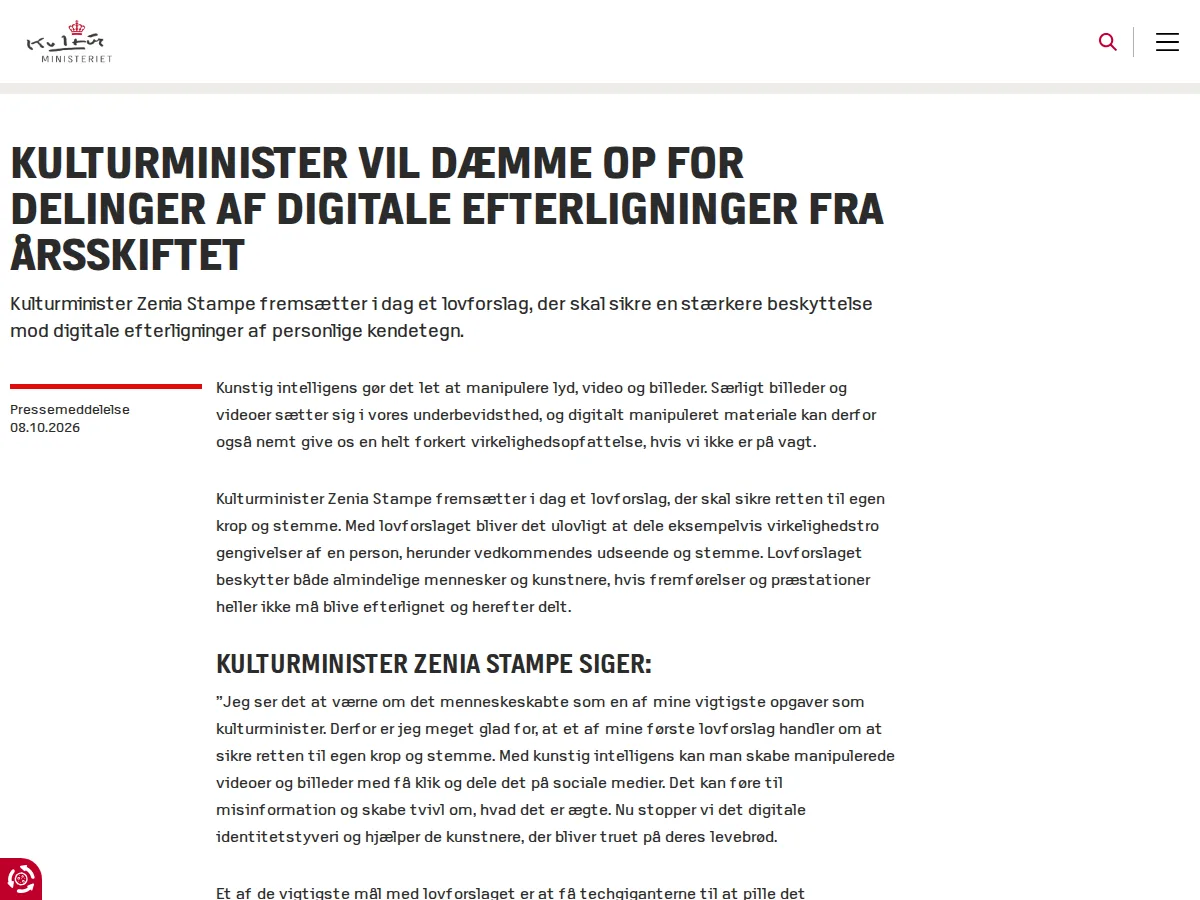
Screenshot: Press release, Kulturministeriet (Danish Ministry of Culture), October 8, 2026.
Two smaller changes ride along:
- Improvisations and other performances that are not artistic works in the copyright sense will also be protected under the Copyright Act.
- Payment disputes (for example over remuneration) must go to the Copyright License Tribunal (Ophavsretslicensnævnet) before the courts if one of the parties asks for it, so the same dispute cannot run in both places at once.
Where it came from
The bill carries out the political agreement of June 26, 2025. That agreement was signed by the then-government of Social Democrats, Venstre and Moderates (the SVM government) and six other parties: the Denmark Democrats, the Socialist People's Party, the Conservatives, the Red-Green Alliance, the Social Liberals and the Alternative. Euronews notes it was reached by then-culture minister Jakob Engel-Schmidt under the previous government. Stampe now carries it forward as one of her first bills.
The satire exception, and where it stops
The bill has an exception for caricature, parody, satire and criticism of power and society. Under it, the ministry says, you will "in some cases" be able to share lifelike digital imitations without consent when the content is satire or criticism.
The exception has a hard edge. It does not apply when the imitation is misinformation that can concretely cause serious danger to other people's rights or essential interests, or a concrete danger to life or property.
For a company, the practical reading is simple: the satire exception is built for commentators and comedians, not for ad campaigns. A product video that puts a real person's face on an AI avatar is not satire because it is funny.
Takedowns are the stated goal
The minister was clear about who the bill is aimed at. "One of the main goals of the bill is to get the tech giants to take down manipulated content quickly, so that it causes the least possible harm," she said in the statement (Euronews' English rendering). She also called it a way to stop "digital identity theft" and to help artists whose livelihoods are threatened.
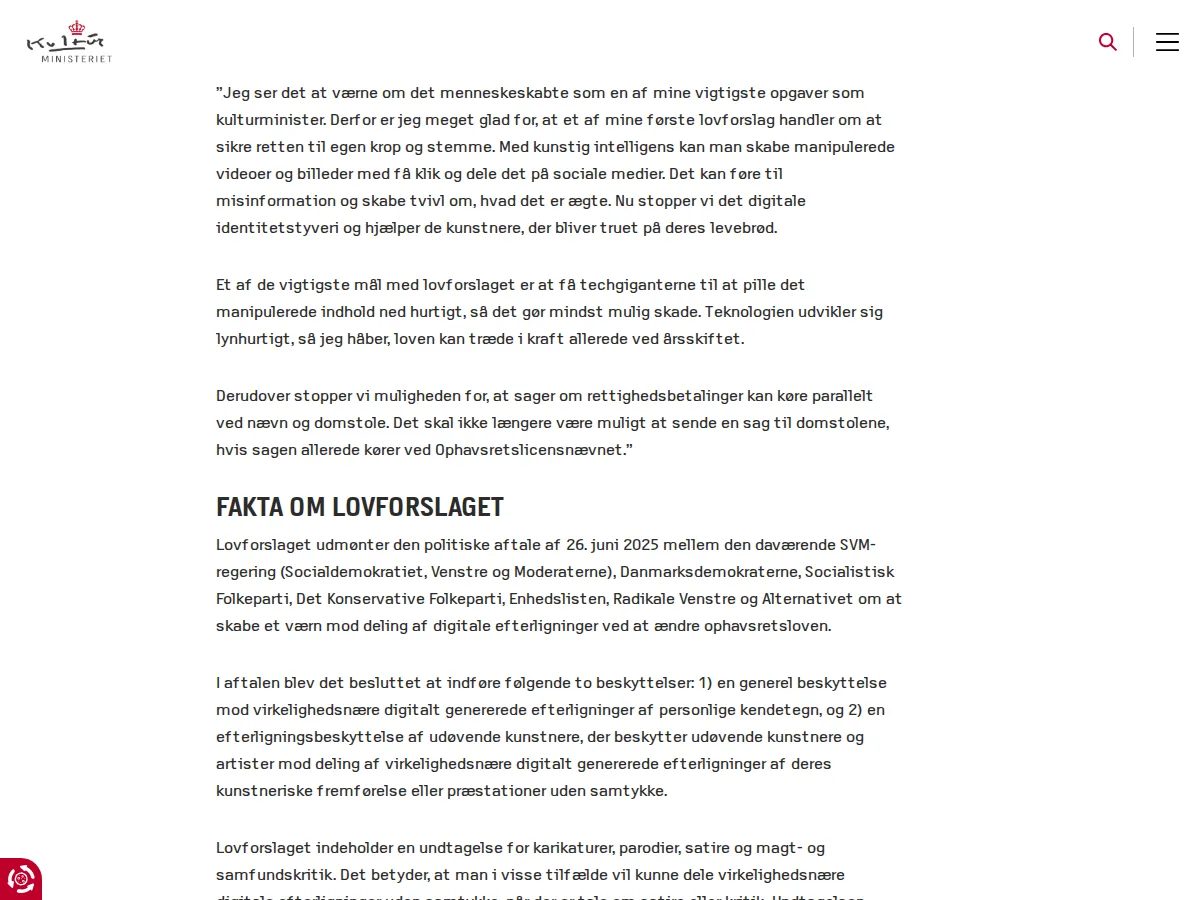
Screenshot: "Fakta om lovforslaget" section, press release, Kulturministeriet, October 8, 2026.
The press release does not say how fast a platform must act, what a takedown request must contain, or what the penalties are. Those details will be in the bill text and its explanatory notes.
What we could not read
- The bill itself. The Folketing's website (ft.dk) blocks automated access behind a bot check, including through a reader proxy. We could not confirm the bill number, the exact wording, penalties or any takedown deadline.
- Effective date. There is none yet. The minister said she hopes the law "can enter into force already at the turn of the year". Euronews reported that as the start of 2027. Reuters notes the proposal is still subject to parliamentary approval.
We will update this page when the bill text is readable.
How it sits next to the EU AI Act
The EU AI Act already has a deepfake rule. Article 50(4) says deployers of an AI system that generates or manipulates image, audio or video content constituting a deep fake "shall disclose that the content has been artificially generated or manipulated". For evidently artistic, creative, satirical or fictional work, that duty is limited to disclosing the content's existence in a way that does not spoil the work. The AI Act applies generally from August 2, 2026.
The two rules answer different questions:
| Question | EU AI Act, Article 50(4) | Danish bill (as described by the ministry) |
|---|---|---|
| What is required | Disclose that the content is AI-generated or manipulated | Do not share a lifelike imitation of a person without consent |
| Who it protects | Viewers, who should know what they see | The person whose face, voice or performance is imitated |
| Satire | Disclosure duty is limited for evident satire | Exception for satire, parody and criticism, except dangerous misinformation |
| Status | In force | Bill, needs parliamentary approval |
The ministry's release does not list labeling as an exception. So a label alone may not settle the Danish question: if the person did not agree, a clearly labeled deepfake of them could still be the problem.
Image: Pexels, used under the Pexels License.
Copy-paste: likeness consent record
If your team uses a real person's face, voice or performance in AI-generated content, keep a record like this for each person. It is useful under the Danish bill if it passes, under Article 50 for labeling, and under US likeness laws your content might also reach. Adjust it with your lawyer; it is a working record, not a legal opinion.
LIKENESS CONSENT RECORD (AI-generated or AI-altered content)

Person:                     [full name]
Role:                       [employee / contractor / customer / actor / other]
What is used:               [ ] face   [ ] voice   [ ] body/movement   [ ] performance
Source material:            [recording, photo set, voice sample; where it is stored]
AI tool used:               [tool name and version]
Purpose:                    [the specific video, ad, training clip or product]
Channels:                   [website / social / paid ads / internal only]
Countries where shown:      [include Denmark if any Danish audience]
Consent given on:           [date]  How: [signed form / e-signature / email]
Consent covers new uses?:   [ ] no, this purpose only   [ ] yes, list them
Withdrawal:                 Person can withdraw by writing to [contact].
                            On withdrawal we remove the content from [channels]
                            within [your internal deadline].
AI label shown?:            [ ] yes, wording: "[...]"   (EU AI Act Art. 50(4))
Satire/commentary claim?:   [ ] no   [ ] yes, reviewed by [name] on [date]
Record owner:               [name, team]
Copy-paste: takedown request for a deepfake of your staff
Until the bill passes and its text is public, write takedown requests that work under the platform's own rules and can be re-sent later. Keep them factual and complete.
Subject: Takedown request, unauthorized AI imitation of [person]

To: [platform trust and safety / legal contact]

1. Content:        [URL(s)], first seen on [date]
2. Person shown:   [name], [role at our company]
3. What is fake:   [face / voice / both]; the person did not take part
                   and did not consent.
4. Why it matters: [impersonation, fraud attempt, false statement attributed
                   to the person, harm to reputation]
5. Evidence:       [original recordings, statement from the person,
                   screenshots with timestamps]
6. Request:        Remove the content and any re-uploads, and preserve
                   account data in case of legal action.
7. Contact:        [name, email, phone]

We confirm the information above is accurate.
[Name, title, date]
What to watch next
- The bill text on ft.dk, with the explanatory notes on penalties and platform duties.
- Readings in the Folketing, and whether the turn-of-the-year target holds.
- How platforms respond, since quick takedowns are the minister's stated aim.
Our take
The Danish approach is narrower than it sounds and more useful than most deepfake rules. It does not try to police AI tools or demand labels; it gives the person in the picture a right to say no, and it does that through the Copyright Act. For businesses, the cost is mostly paperwork: written consent for every real face or voice you generate. That is cheap compared with pulling a campaign after launch.
The weak spots are the ones the press release leaves open. There is no takedown deadline or penalty in what we could read, and the satire exception will be argued over case by case. Until the text is public, treat the bill as a strong signal and build the consent record now, rather than waiting for a fixed date.
Community reaction
On r/europe, u/QuietGanache predicted: "Calling it now: watch this, as happened with strict libel laws, get abused by those wealthy enough to afford shark lawyers." u/xondk replied: "But if the law is in place, even normal people 'can' do something."
On r/Denmark, u/-S-P-E-C-T-R-E- doubted enforcement: "Med mindre man er villige til at gå rigtig hårdt tilværks imod Meta et al, så er dette helt dødfødt." (Our translation: "Unless they are willing to go really hard against Meta et al, this is dead on arrival.")
We did not embed a video or post: a YouTube search found only news-roundup channels, and we found no official ministry post about the bill.
How we checked this
We built this article from 5 sources, checked on October 9, 2026: the Danish Ministry of Culture press release (in Danish), the EU AI Act on EUR-Lex, and reports from Euronews, Reuters and Telecompaper. Every number and date in the article matches a quote in our source log. We could not read the bill text on ft.dk or EU Directive 2024/1385 on EUR-Lex, both blocked by bot checks, so claims that depend on them are left out.
Last reviewed: October 9, 2026.
Related Reading
- Germany's deepfake law: the digital violence bill and platform court orders
- EU AI Act Article 50: watermarking and deepfake disclosure
- EU AI Act nudification ban and watermarking from December 2026
- Washington's AI likeness law: compliance steps
- Tennessee ELVIS Act: AI voice and likeness compliance
- TAKE IT DOWN Act compliance
- AI acceptable use policy template for small teams