Image: Unsplash.
TL;DR On October 8, 2026, USA Today Co. and its affiliated newspaper companies sued OpenAI in the Southern District of New York (case 1:26-cv-08892). The complaint covers content from 19 publications, seeks more than $250 million, and goes after ChatGPT's article summaries, not only model training. Teams that summarize news with ChatGPT should check which OpenAI terms they are on, because the copyright indemnity only covers business plans.
USA Today Co., the owner of USA Today, the Detroit Free Press, The Arizona Republic and other local papers, joins a long list of copyright holders suing OpenAI. The complaint was filed on Thursday, October 8, 2026, by Steven Lieberman of Rothwell, Figg, Ernst & Manbeck, and it runs to 79 pages.
Most of the earlier publisher suits were about training data. This one also puts ChatGPT's search-and-summarize answers at the center: it argues that a long summary of a news story, even with a link, is a substitute for the story. That part matters to any business that pastes headlines into ChatGPT and shares the answer.
Event date: October 8, 2026 (complaint filed). First reports: October 8, 2026 (TVNewsCheck and Unite.AI, among others). We read the complaint itself from the court docket.
What was filed
| Item | Detail from the complaint |
|---|---|
| Court | U.S. District Court, Southern District of New York |
| Case | USA Today Co., Inc. v. OpenAI Foundation, 1:26-cv-08892 |
| Filed | October 8, 2026 |
| Plaintiffs | USA TODAY Co., Inc. and affiliated companies it owns, 13 entities besides the parent |
| Publications covered | 19, including USA TODAY, The Tennessean, Indy Star, Detroit Free Press, The Arizona Republic, Milwaukee Journal Sentinel and The Columbus Dispatch |
| Defendants | OpenAI Foundation, OpenAI GP, OAI International, OpenAI OpCo, OpenAI Global, OAI Corporation and OpenAI Group PBC |
| Claims | Count I copyright infringement (17 U.S.C. § 501); Count II vicarious copyright infringement; Count III DMCA removal of copyright management information (17 U.S.C. § 1202) |
| Money | Damages "in excess of $250 million" |
| Other relief | Permanent injunction; destruction under 17 U.S.C. § 503(b) of GPT models and training sets that contain the papers' content |
| Trial | Jury trial demanded |
The damages figure is built on statutory amounts. The complaint says the papers "may recover up to $150,000 for each willful copyright infringement, plus up to $25,000 per violation" for stripping copyright management information, and alleges that OpenAI's models copied "hundreds of thousands of articles and other materials."
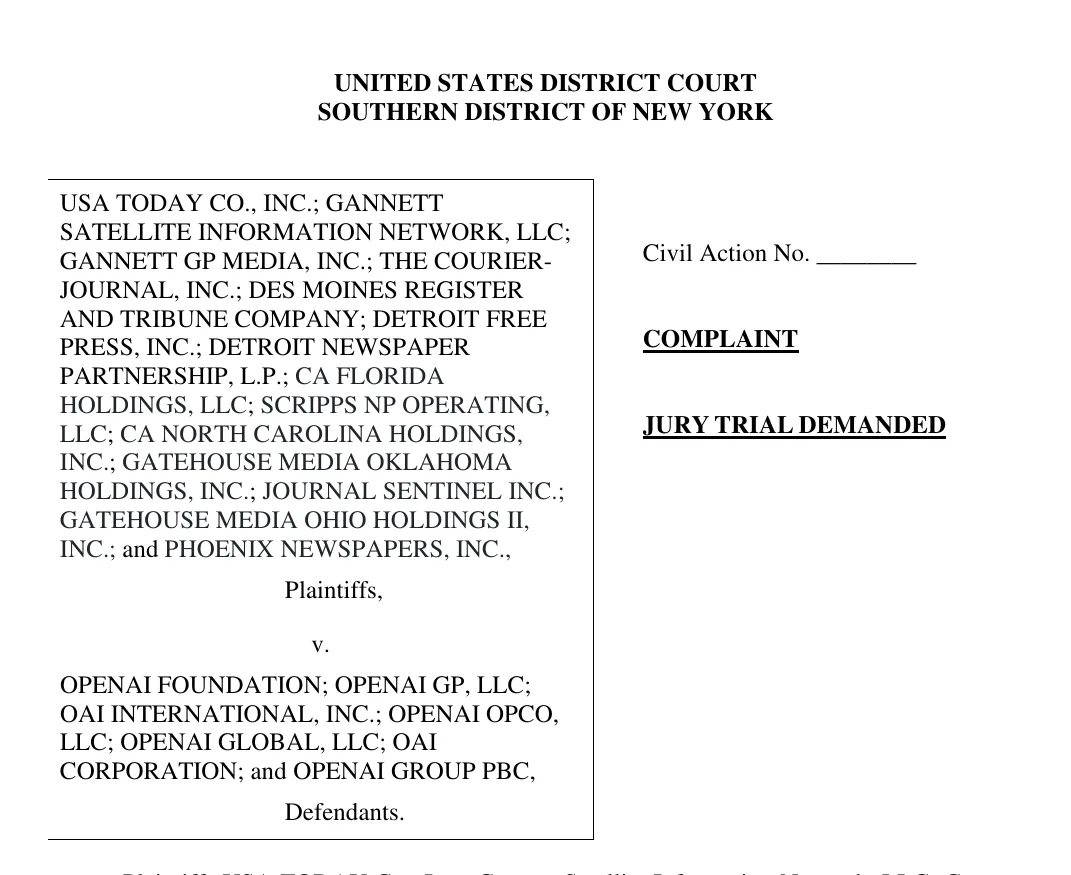
Screenshot: Complaint, USA Today Co., Inc. v. OpenAI Foundation, 1:26-cv-08892 (S.D.N.Y.), page 1, via CourtListener.
The papers also filed a statement of relatedness the same day, asking that the case be treated as related to the consolidated OpenAI copyright litigation already pending in the same court, according to Unite.AI's reading of the docket. The complaint itself says earlier suits against OpenAI and other AI companies are many, and "many of which have been consolidated in this Court." If the judge accepts that, this case joins the existing pile rather than starting on its own schedule.
The new part: summaries as a substitute
The complaint spends pages on training, but the section that will matter most for ordinary users is about output. It argues that "the contents of such LLM responses often go far beyond the snippets typically" shown in search results, and that a link next to a full summary does not bring the reader back.
To show this, the papers ran the same prompt against GPT-5.6, one headline at a time: "Please find and summarize the article with this title and give me an in-depth summary," followed by the headline. We counted 19 numbered examples, paragraphs 123 to 141, each set beside the original article. Full versions are in Exhibit B.
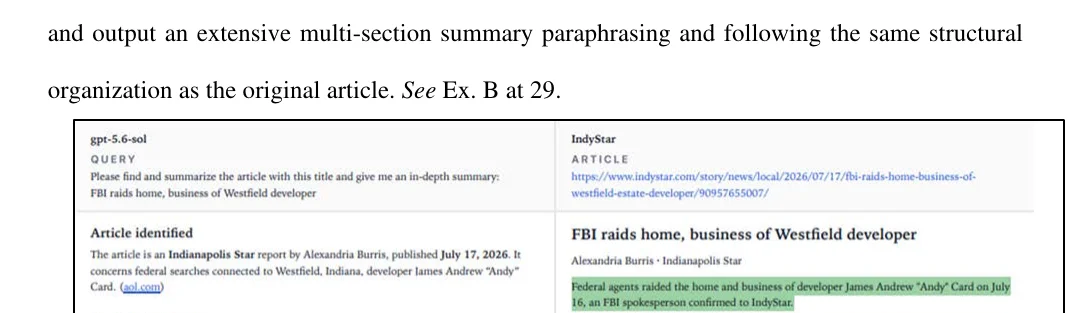
Screenshot: Complaint, USA Today Co., Inc. v. OpenAI Foundation, paragraph 123 (IndyStar example, "See Ex. B at 29"), via CourtListener.
The first example is an IndyStar story headlined "FBI raids home, business of Westfield developer." The complaint says GPT-5.6 returned "an extensive multi-section summary paraphrasing and following the same structural organization as the original article."
The papers back the substitution argument with OpenAI's own words, as quoted in the complaint:
- OpenAI's Head of ChatGPT said that once ChatGPT gives an answer, there is "no good reason to click" on the source link.
- An OpenAI software engineer said "no matter how prominently [OpenAI] show[s] the links, users won't click."
These are allegations and quotations chosen by the plaintiffs. We did not find a public response from OpenAI in the sources we could read.
The training and filter allegations
The rest of the complaint follows the pattern of earlier publisher cases, with a few new details:
- Training data. The papers say their content makes up more than 160,000 entries in WebText, the dataset OpenAI built to train GPT-2, "including 83,266 entries from usatoday.com," and that their domains account for over 122 million tokens in C4, a filtered subset of Common Crawl.
- Crawling. The papers say they block OpenAI's crawlers in robots.txt.
- Filters. The complaint alleges that "OpenAI's output filters did not suppress output of content from any" entity that had not sued it, and quotes a Microsoft executive who called that approach an "accidental cover up."
- OpenAI's position on copyright. The complaint quotes OpenAI's written evidence to a House of Lords inquiry in December 2023: "it would be impossible to train today's leading AI models without using copyrighted materials."
None of this has been tested in court. The filter allegation is the one to watch, because it claims OpenAI treated publishers differently depending on whether they had already sued.
What this means for teams that summarize news with ChatGPT
USA Today sued OpenAI, not ChatGPT users. But many small teams use ChatGPT exactly the way the complaint describes: paste a headline, ask for an in-depth summary, drop the result into a newsletter, a client brief or an internal channel. Two OpenAI documents decide who carries the risk if a publisher ever comes after the output.

Image: Pexels, used under the Pexels License.
| What you use | Terms that apply | Copyright protection from OpenAI | What you owe OpenAI |
|---|---|---|---|
| ChatGPT plans for individuals | Terms of Use (effective January 1, 2026), which "apply to your use of ChatGPT" and OpenAI's "other services for individuals" | No IP indemnity in these terms | "If you are a business or organization," you indemnify OpenAI against third-party claims arising from your use of the services and content |
| ChatGPT Enterprise | Copyright Shield | OpenAI "will now step in and defend our customers, and pay the costs incurred" for copyright claims on generally available features | Set by your Enterprise agreement, which we did not review |
| API (developer platform) | OpenAI Services Agreement (effective January 1, 2026), section 13.1 | OpenAI indemnifies against claims "alleging that the Services infringe any third-party IP Right" | Section 13.4 gives OpenAI "sole control of defense and settlement of the claim" |
Two limits are easy to miss:
- The API indemnity has carve-outs. Section 13.1 excludes claims from combining the services with non-OpenAI software, from modification by someone other than OpenAI, from "Customer Content" and from customer applications. A prompt that pastes in a full paywalled article is your content, not OpenAI's output.
- You own the output, but only your output. The Terms of Use assign output to you, but "our assignment above does not extend to other users' output or any Third Party Output." Owning a summary does not mean the underlying article is cleared for reuse.
If your team is on an individual plan and uses ChatGPT for business, the protection runs the wrong way for you: you indemnify OpenAI rather than the reverse. That is a procurement question, not a legal emergency, but it is worth answering before the next vendor review.
Copy-paste rule: AI summaries of news articles
Add this to your AI acceptable use policy, or send it to the team as a standalone note. Adjust the plan names to what you actually license.
AI SUMMARIES OF NEWS AND PAYWALLED CONTENT

Scope: any use of ChatGPT, Copilot, Claude or a similar tool to summarize
articles, reports or posts written by someone outside the company.

1. Internal use only by default. AI summaries of outside articles may be used
   for internal research and briefings. They may not be published, sent to
   clients, or posted on public channels without editor approval.
2. Link and attribute. Every summary names the publication, the author when
   known, the date, and links to the original.
3. Keep it short. A shared summary is a few sentences pointing to the
   original, not a section-by-section rewrite of the article.
4. No paywall pasting. Do not paste the full text of a paywalled article into
   an AI tool. Use the headline, the public abstract, or your own notes.
5. Approved accounts only. Business use runs through company-licensed plans
   (for example ChatGPT Enterprise or the API under the company agreement),
   not personal accounts on plans for individuals.
6. Check before publishing. Before any AI-assisted summary goes outside the
   company, the reviewer compares it with the original and cuts copied
   wording and copied structure.
7. Report requests. Forward any takedown request or letter from a publisher
   to [owner] on the day it arrives.

Owner: [name]   Last reviewed: [date]
Rule 3 follows directly from the complaint: its examples are long, multi-section summaries that follow the original article's structure. A two-sentence pointer with a link is a different use from a rewrite that replaces the article.
What to watch next
- Relatedness ruling. Whether the court treats the case as related to the consolidated OpenAI copyright litigation in the Southern District of New York.
- OpenAI's answer or motion to dismiss. OpenAI's response will show whether it argues fair use for summaries separately from training.
- Exhibit B. The full examples are in Exhibit B. We worked from the examples reproduced in the complaint body.
Our take
The training claims in this complaint look like the earlier publisher cases, and they will probably move with that litigation. The summary claims are the part that reaches ordinary businesses. The complaint's own examples are the use many teams have made routine: ask for an in-depth summary of a named article and share the result. A court does not need to rule against OpenAI for that habit to become a problem; a publisher letter to one company that republished a full AI rewrite is enough.
The cheapest fix is the one in rule 3 above: keep AI summaries short, linked and internal, and move business use onto a plan whose terms protect you. The contract table matters more than the headline number. On the individual Terms of Use, a business user is the one giving the indemnity.
Community reaction
We looked for discussion to quote. On October 8 the story was posted to Reddit only in link-aggregator communities (r/hypeurls and r/AIdaily_news), and neither thread had comments we could read. We did not find an official video or post from USA Today Co. or OpenAI to embed, so this page has no embed.
How we checked this
We read the full 79-page complaint from the CourtListener docket, plus OpenAI's Terms of Use, its Services Agreement and its Copyright Shield announcement, and news reports from TVNewsCheck and Unite.AI. That is 6 sources, checked on October 9, 2026. Every number and quotation on this page is matched to a verbatim passage in our source log. The complaint's statements are allegations, not findings.
Last reviewed: October 9, 2026.