Image: Pexels, used under the Pexels License.
If you're building a Colorado AI Act program, don't stop because of the FTC. Its claim that Colorado's law "may be preempted" lives in a proposed policy statement that still has no final version, and no court has adopted it. What actually decides when Colorado can enforce is a federal lawsuit xAI filed in April, where the Attorney General has agreed to hold off until a judge rules on an injunction motion that hasn't been filed yet.
What the FTC said on July 1
The FTC published a proposed policy statement on AI accuracy on July 1, 2026, after a 2-0 Commission vote under Chairman Andrew N. Ferguson. The core claim is a consumer-deception one: people reasonably expect an AI system to aim for accurate answers, so a company that quietly steers outputs toward objectives users didn't ask for may violate Section 5 of the FTC Act.
The Colorado part comes in the same opening summary. An AI company "might be tempted to alter or steer the output of its systems" for various reasons, including "attempted compliance with a state law, such as Colorado's recently revised Artificial Intelligence Act." The statement says that steering can be deceptive "even if the deceptive steering is done in an effort to comply with state laws," and it offers one way out: a company "may be able to avert potential deception" by making truthful, non-misleading representations about what its model is aiming for.
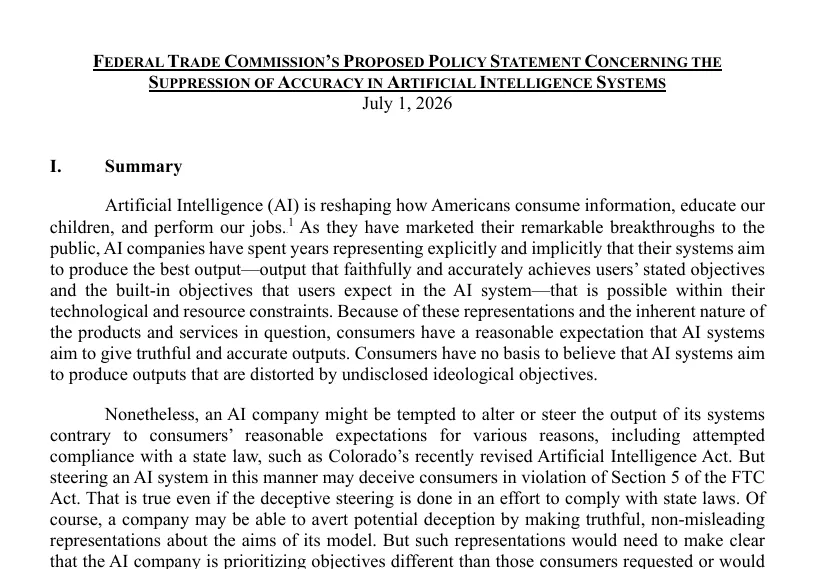
Screenshot: FTC proposed policy statement concerning the suppression of accuracy in AI systems, page 1, Federal Trade Commission.
The statement answers Executive Order 14365, which President Trump signed on December 11, 2025. Per the press release, that order "directed the FTC to issue a policy statement addressing the legal implications of state laws that require alteration of the 'truthful outputs of AI models.'"
The Federal Register notice (2026-13628) ran on July 7 and took comments until July 31. We re-ran the Federal Register search on October 20, 2026: the July notice is still the only FTC document on this policy, so the statement remains a proposal.
What exactly it says about Colorado
The statement's footnote cites SB 24-205, the 2024 Colorado AI Act, "repealed and reenacted, as amended" by SB 26-189 on May 14, 2026. It says the original version "imposed a broad duty on AI companies to avoid output that might lead to disparate impacts." The revised law dropped that duty, so the FTC points to a different provision, section 6-1-1707, under which a developer or deployer "may be held liable in an action alleging unlawful discrimination under state anti-discrimination laws."
Then comes the preemption sentence. The statement concedes that the FTC Act "does not expressly preempt state law" and argues instead that state law "is impliedly preempted to the extent it conflicts with a federal regulatory scheme." The press release goes further in tone, saying Colorado's law "appears to coerce companies into altering the output of their AI models."
That's the whole legal theory: implied conflict preemption, asserted in a policy statement. A policy statement doesn't bind a court, and this one isn't even final.
The lawsuit that actually controls Colorado enforcement
The July statement doesn't mention it, but Colorado's enforcement clock is already frozen by a court order. xAI sued Attorney General Philip J. Weiser on April 9, 2026 (X. AI LLC v. Weiser, No. 1:26-cv-01515, D. Colo.), and the United States moved to intervene as a plaintiff on April 24; the court granted that motion.
On April 27, Magistrate Judge Cyrus Y. Chung approved a stipulation. The Attorney General "shall not initiate enforcement, including but not limited to the initiation of an investigation," for violations of SB 24-205 "or any legislation replacing or amending SB24-205" that occur up to 14 days after the court rules on xAI's preliminary-injunction motion. xAI doesn't have to file that motion until 28 days after Colorado finalizes its rules.
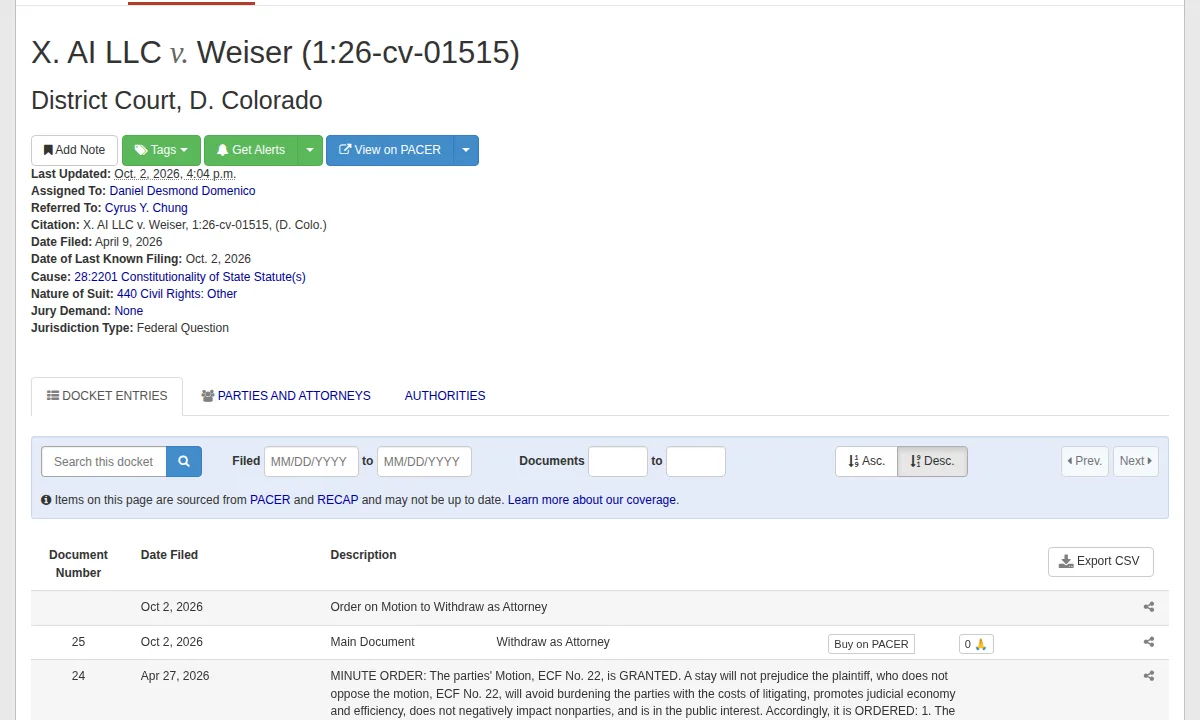
Screenshot: Docket, X. AI LLC v. Weiser, 1:26-cv-01515 (D. Colo.), via CourtListener, read October 20, 2026.
When we read the docket on October 20, 2026, the last filing was an October 2 order on an attorney's withdrawal. No preliminary-injunction motion was on it. So the order of events is: Colorado's rules become final, xAI has 28 days to move for an injunction, the court rules, and only 14 days after that ruling can the Attorney General start enforcing. Those rules aren't final yet: the Attorney General's office filed proposed rules on August 11, 2026 and takes written comments through the October 26 rulemaking hearing (coag.gov/ai, read October 20). Our Colorado AI Act compliance guide walks through what the law asks of you in the meantime.
The FTC's August statement points the other way on preemption
In August the FTC dropped disparate-impact claims altogether. On August 7, 2026, it adopted a policy statement saying it "will no longer pursue disparate-impact claims in any context" and will not bring discrimination claims under Section 5; it keeps disparate-treatment claims under the Equal Credit Opportunity Act. The vote was 2-0.
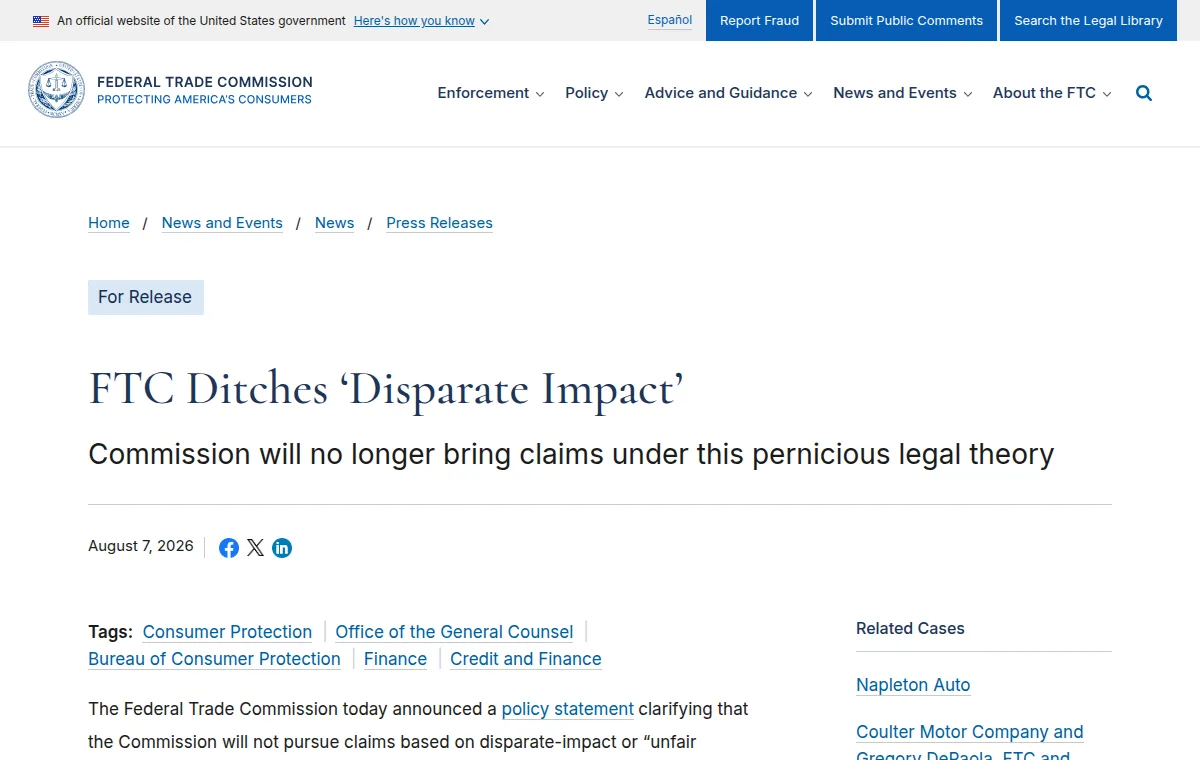
Screenshot: "FTC Ditches 'Disparate Impact'," press release, Federal Trade Commission, August 7, 2026.
Read the first footnote before you read anything into it for Colorado: "this Policy Statement does not preempt federal, state, or local laws." The FTC is narrowing what it will bring itself. It isn't telling states what they can enforce, and it leaves Colorado's state-law liability in section 6-1-1707 where it was. We covered what that statement means for hiring tools in FTC Drops Disparate-Impact Claims.
So the federal picture has two pieces that sit awkwardly together: a proposed statement that says Colorado's law is impliedly preempted where it conflicts, and a final statement that disclaims preemption of state law. Neither is a court ruling.
Who this applies to
Developers and deployers doing business in Colorado whose automated decision-making technology is "used to materially influence a consequential decision," the group SB 26-189 covers. If you're a vendor, there's a second audience: the July statement is aimed at you, because it describes undisclosed output steering as possible deception whatever the reason for it.
What to do now
- Keep preparing for SB 26-189. It applies to consequential decisions made on or after the January start date. Nothing the FTC has published, proposed or final, changes that, and the enforcement pause in the xAI case is tied to a ruling, not to a date you can plan around.
- Keep the records the law asks for. Deployers keep records for at least three years after a consequential decision. Document how you tested the tool and what you changed to reduce discriminatory outcomes, and why.
- If you're a vendor, write down what your model is optimizing for. The July statement's own escape hatch is truthful, non-misleading representations about a model's aims. If you adjust outputs to reduce discriminatory outcomes, say so in your documentation rather than leaving customers to assume a neutral system.
- Watch two dockets, not one. The FTC docket for a final statement (still nothing on October 20), and the xAI docket for the preliminary-injunction motion, which is the event that starts the real countdown.
We'd treat the FTC preemption claim as a signal of where federal agencies want this to go, not as a reason to change a compliance plan. If a final statement lands or the xAI court rules, we'll update this page.
What we could not confirm: when Colorado will adopt its final rules, which is what starts xAI's 28-day clock; the Attorney General's page gives no date after the hearing. We also found no court ruling applying the FTC's preemption theory to any state AI law as of October 20, 2026. The FTC's pages block scripts, so we read the press releases and both policy statements in a browser on October 20.
Correction (October 16, 2026): Earlier versions described Colorado's AI Act as SB 205 "in effect" with a reasonable-care duty for high-risk AI systems, and told readers not to stop complying with it. SB 24-205 never took effect: SB 26-189 repealed and reenacted it on May 14, 2026, before the FTC statement, and the FTC's own footnote cites both bills. The new law applies to decisions from January 1, 2027. We also removed a sentence saying the One Big Beautiful Bill Act passed in May 2026 with a ten-year state AI moratorium; we had no source for it (FTC press release, SB 26-189).
Update (October 19, 2026): The headline and earlier text asked readers to comment "by July 31." That deadline has passed. A Federal Register search on October 19, 2026 found only the July 7 notice, so the statement is still a proposal. We also removed a sentence saying industry groups and state governments "are all filing comments," which we had not checked against the docket.
Update (October 20, 2026): Added xAI's lawsuit against Colorado's Attorney General and the April 27, 2026 enforcement stipulation, which earlier versions left out even though it decides when Colorado can enforce. Added the FTC's August 7, 2026 disparate-impact policy statement and its footnote saying it does not preempt state law. Removed claims we couldn't source: that Texas TRAIGA and Illinois law would face the same preemption argument, and a summary of the legal test for implied preemption.
Related Reading
- Colorado AI Act compliance: what SB 26-189 requires in 2027
- FTC Drops Disparate-Impact Claims: What AI Hiring Tools Still Owe You
- FTC AI Accuracy Policy: 5 Questions for Your AI Vendor
- FTC AI Enforcement Actions 2026: What the Pattern Means for Small Teams
- US State AI Law Tracker: Every Law with Deadlines and Obligations
- Cleo AI FTC Refunds: $15.8M by PayPal, Dates and Who Gets Paid
Sources: FTC press release, July 1, 2026, FTC proposed policy statement (PDF), Federal Register 2026-13628, FTC press release, August 7, 2026, FTC disparate-impact policy statement (PDF), SB 26-189, X. AI LLC v. Weiser docket, April 27, 2026 minute order.