Image: Pexels, used under the Pexels License.
Updated October 10, 2026. We rebuilt this tracker from the Governor's own releases and his signing and veto letters. Earlier versions said Newsom vetoed SB 947 and SB 951 in mid-September; that was wrong, he signed both on September 30. The full list of corrections is at the end.
TL;DR: September 30, 2026 was Newsom's last day to act on this session's bills. On that day alone his office lists 13 AI-related signings, including SB 947 (no AI-only firing or discipline), SB 951 (AI layoff notice) and AB 1883 (no AI tracking of workers' emotions or neural data). Earlier in September he signed AI audit bills SB 813 and AB 1405, Adam's Law (SB 1119), the AI toy ban (SB 867), AI performer ad disclosures (SB 1050) and the customer service chatbot bill (AB 1609). He vetoed SB 903, AB 2575 and AB 2656. We could not confirm the status of SB 1015.
What Newsom signed and vetoed: the status table
Every row below comes from a release on gov.ca.gov, plus a law firm or news summary where we give a date or penalty. The official bill text site, leginfo.legislature.ca.gov, blocked our requests, so we have not read the chaptered text of any bill. Check it before you build a compliance plan on a single line of this table.
| Bill | What it covers (per the Governor's release or letter) | Outcome | Date |
|---|---|---|---|
| AB 1651 | State Bar of California: AI-generated content in bar exams | Signed | Aug 22 |
| SB 813 | Independent verification organizations that assess AI systems | Signed | Sept 9 |
| AB 1405 | State registry for AI auditors | Signed | Sept 9 |
| SB 1119 (Adam's Law) | Companion chatbots: children's safety | Signed | Sept 10 |
| SB 867 | Toys: companion chatbots | Signed | Sept 10 |
| SB 1050 | Disclosure of AI-generated performers in ads | Signed | Sept 16 release |
| AB 2504 | Community colleges: AI pilot program | Signed | Sept 18 |
| AB 686 | Election deepfake rule extended to Jan 1, 2031 | Signed | Sept 19 |
| AB 1609 | Customer service chatbots | Signed | Sept 28 release |
| SB 947 | Employment: automated decision systems | Signed | Sept 30 |
| SB 951 | Employment: technological displacement notice | Signed | Sept 30 |
| AB 1331 | Workplace surveillance (restrooms) | Signed | Sept 30 |
| AB 1883 | Workplace surveillance tools (neural data, emotional state) | Signed | Sept 30 |
| AB 1979 | Health care services: AI | Signed | Sept 30 |
| SB 503 | Health care services: AI | Signed | Sept 30 |
| SB 574 | Attorneys, arbitrators and judicial officers using AI | Signed | Sept 30 |
| SB 1000 | California AI Transparency Act | Signed | Sept 30 |
| AB 2713 | AI Transparency Act: system provenance data | Signed | Sept 30 |
| SB 1111 | Digital replicas | Signed | Sept 30 |
| SB 1159 | AI: transparency and governance | Signed | Sept 30 |
| AB 2392 | Public colleges: generative AI procurement standards and training | Signed | Sept 30 |
| SB 903 | Mental health professionals: AI | Vetoed | Sept 30 |
| AB 2575 | Health care services: AI | Vetoed | Sept 30 |
| AB 2656 | Public employees: notice of AI doing their work | Vetoed | Sept 30 |
| SB 1015 | Extortion of minors, including AI-generated images | Not confirmed |
AB 1864, which appears in the same September 30 release, is a gene synthesis safety bill, not an AI bill. We list it here only because earlier versions of this page counted it as one.
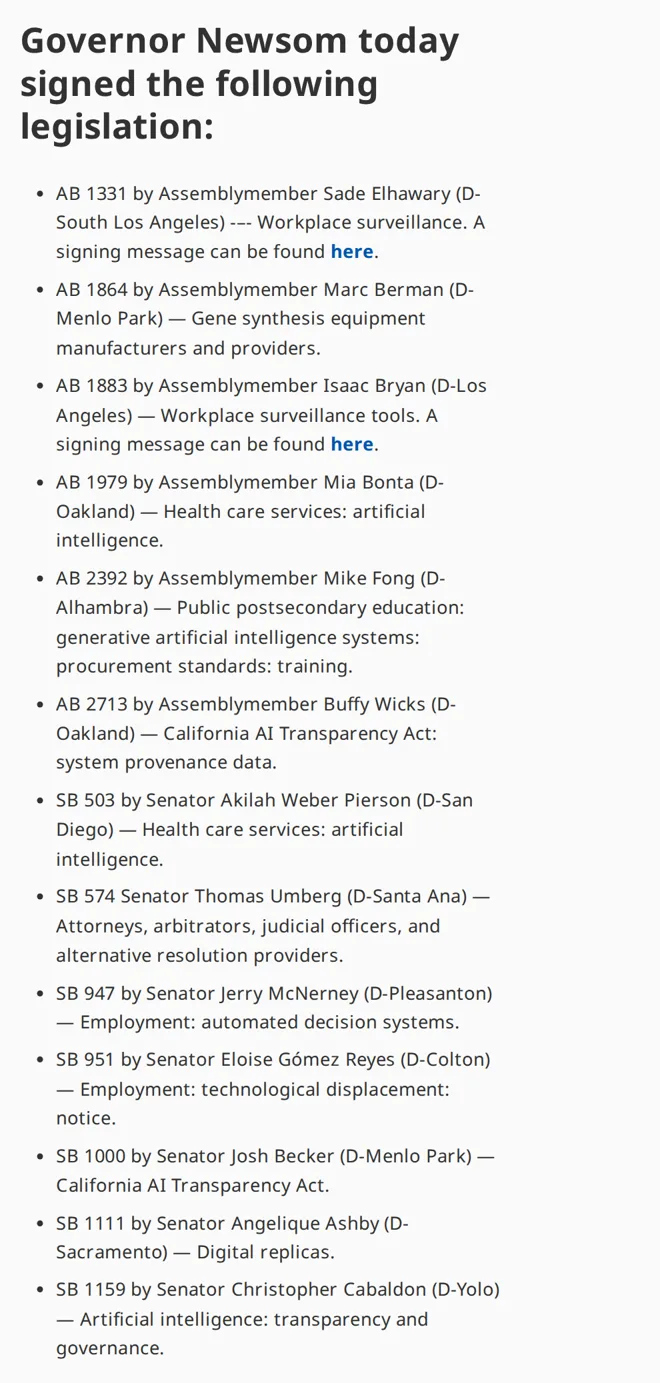
Screenshot: "Governor Newsom today signed the following legislation", Office of the Governor of California, September 30, 2026.
The workplace bills: what employers have to change
Four of the September 30 bills are about AI at work. The California Federation of Labor Unions named SB 947, SB 951, AB 1331 and AB 1883 in its statement on the signing. These are the ones most likely to need changes to HR systems.
SB 947, the No Robo Bosses Act. KQED reports Newsom vetoed a previous version last year and signed this narrower one. Covington's summary says it "requires human corroboration for ADS-based disciplinary or termination decisions" and "mandates post-use notice when an employer primarily relies on ADS for such a decision." It becomes operative on July 1, 2027, and violations carry a $500 civil penalty, enforceable through a civil action or by the Labor Commissioner.
SB 951, AI layoff notice. It amends Cal/WARN so that a mass layoff, relocation or termination "caused in whole or substantial part by AI or other automated technology" needs additional notice. Covington puts the operative date at January 1, 2027, with a civil penalty of up to $500 for each day of violation plus back pay and benefits for the notice period.
AB 1883, emotion and neural data. Covington says it "prohibits using these tools to infer or predict emotional states or collect neural data, subject to limited safety and federal-law exceptions," operative January 1, 2027, with a civil penalty of up to $500.
AB 1331, restrooms. The Governor's letter says it "restricts the use of surveillance tools in restrooms."
Newsom signed AB 1331 and AB 1883 with a letter that asks for follow-up work. He wrote that "Assembly Bill 1883 lacks key definitions, which may create confusion about which tools are covered," and that AB 1331 "may interfere with systems used by employees to access locked facilities." He asked the Legislature to refine both. So expect amendments in 2027, and do not read the current text as the last word.
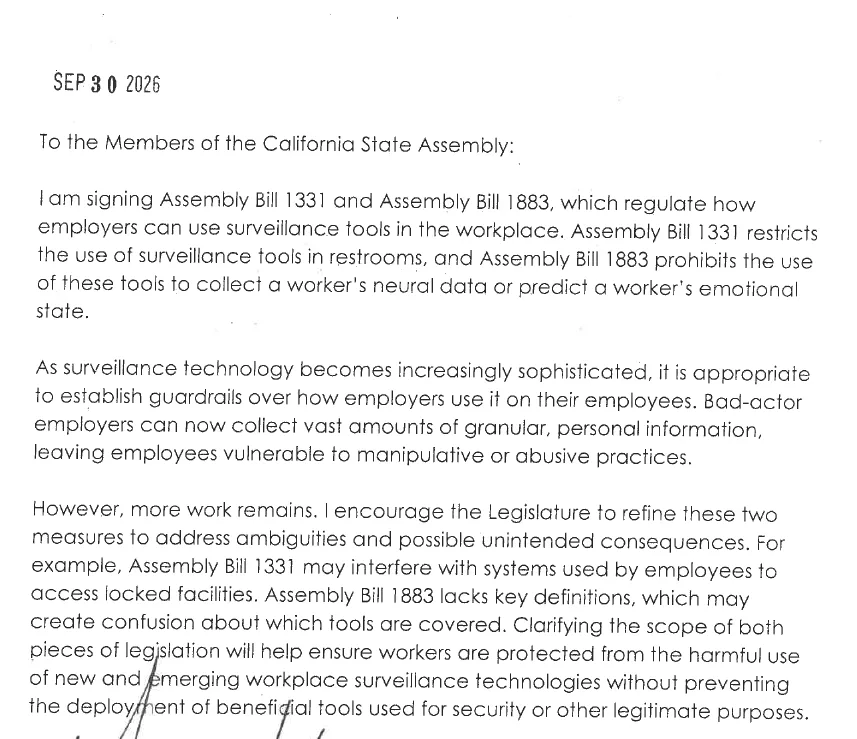
Screenshot: signing message for AB 1331 and AB 1883, Office of the Governor of California, September 30, 2026.
For the employer side in more detail, see our SB 947 and SB 951 worker protection guide and the September 30 signings tracker.
Health care, lawyers and transparency
The same release groups the rest of the September 30 bills by theme. It does not map each sentence to a bill number, so we quote the themes and list the bills the release names under the heading.
- Health care (AB 1979, SB 503). The release says the new laws ensure "doctors and licensed providers can use their own professional judgment when AI or other clinical decision tools are used," and require "developers of clinical decision tools to take reasonable steps to reduce known or predictable bias." KQED describes AB 1979 as a law "that bars health care entities from using AI to replace the clinical judgment of licensed professionals."
- Lawyers (SB 574). The release describes it as "prohibiting them from fully handing over core legal work, such as drafting briefs or providing legal judgment, to AI."
- Transparency (SB 1000, AB 2713, SB 1159). The release lists "prohibiting the deletion of a digital watermark and allowing access to metadata" and "strengthening the California AI Transparency Act." If you ship image, audio or video generation in California, read the chaptered text of SB 1000 and AB 2713 against your SB 942 compliance work.
- Deepfakes and likeness (SB 1111). The release says the laws update "civil and criminal laws to protect likeness rights and prevent false impersonation."
- Public colleges (AB 2392). Training and procurement standards for generative AI at public postsecondary institutions.
Chatbots, ads and AI audits signed earlier in September
SB 813 and AB 1405 (September 9). SB 813 "establishes a first-in-the-nation framework for independent verification organizations," and AB 1405 creates "a state registry for AI auditors." On September 18 the Governor issued an executive order that, in his office's words, "accelerates California's new law establishing first-in-the-nation independent oversight of AI companies" and "advances the creation of an 'AI kill switch.'" Our N-9-26 contract clause guide covers that order.
Adam's Law, SB 1119, and SB 867 (September 10). The release says Adam's Law requires "crisis protocols in the case of suicidal ideation, parental controls, and notifications should a child disable safety settings," and is the first to require "independent child safety audits and annual risk assessments." The September 30 release adds that California will "ban toys containing AI companion chatbots for five years." Our SB 1119 deadlines guide has the dates.
SB 1050 (September 16 release). It requires "explicit disclosure on any video or audio advertisement that uses AI-generated performers" and "prohibits the continued use of any advertisement found to be in violation." That reaches brands using AI ad tools, not only AI vendors.
AB 1609 (September 28 release). Large businesses must make "a good-faith effort to connect a customer to a human within 15 minutes after a request for human customer service is made," or schedule an appointment, and must disclose when the representative "is a chatbot and not a human." The release says "large businesses" and does not give a revenue threshold; earlier versions of this page gave one, and we have removed it.
AB 1651 (August 22). This is the State Bar bill. GovBuddy's summary says it covers AI-generated content "used in developing or administering state bar examinations," with the duties "operative on January 1, 2028." Earlier versions of this page said AB 1651 regulates lawyers' use of AI; that is SB 574.
The vetoes, in Newsom's own words
The September 30 legislative update lists three AI vetoes, each with a letter.
- SB 903 "would prohibit the use of companion chatbots in the provision of psychotherapy services." Newsom wrote that "this bill is overly broad" and that its definition of psychotherapy services would capture general-purpose AI systems.
- AB 2656 would have required public employers to give a union "at least 45 days' written notice before developing, purchasing, or requiring the use of any generative artificial intelligence" for work in the bargaining unit. He wrote that "this issue is best resolved through the collective bargaining process."
- AB 2575 would have let a worker providing direct patient care "override the output of a clinical decision support system," with anti-retaliation protection. His objection: it "puts the Labor Commissioner in the position of adjudicating the standard of care for patients."
He also vetoed SB 1130, a wearable recording device bill. The Next Web reports his letter said its definition of a wearable recording device was too broad.
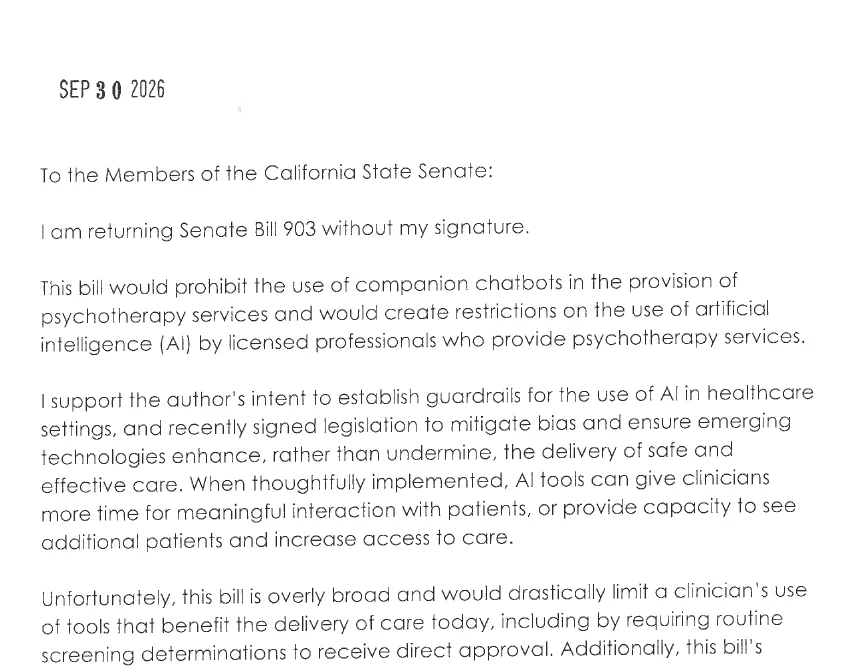
Screenshot: veto message for SB 903, Office of the Governor of California, September 30, 2026.
Our take
The vetoes are more useful than any prediction we made in September. In all three AI vetoes Newsom says he supports the goal and objects to the mechanism: a definition that sweeps in general-purpose AI (SB 903), an approval or notice step he calls redundant (AB 2656), or an enforcement design that puts a labor regulator in charge of medical judgment (AB 2575). The bills he signed set duties on employers, advertisers and chatbot operators where the line is easier to draw: a human corroborates a firing, an ad says the performer is synthetic, a customer can reach a person.
For a small team the practical order is simple. If you use any HR tool that scores or flags workers, find out by January 1, 2027 whether it infers emotion or collects neural data (AB 1883), and whether it can drive discipline without a documented human check before July 1, 2027 (SB 947). If you run a customer service chatbot at scale, plan the 15-minute human handoff now (AB 1609). And because Newsom himself said AB 1883 lacks key definitions, write your vendor questions around what the tool does, not around the bill's labels.
What to do this quarter
- Inventory HR and workforce analytics tools for emotion detection, sentiment scoring of workers, or any neural or biometric signal. Ask each vendor in writing whether a feature does either.
- For any discipline or termination workflow that uses automated scoring, write down who the human reviewer is and what other information they check. That is the record SB 947 will ask for.
- Add an AI-cause check to your layoff planning so Cal/WARN notices flag technology-driven cuts (SB 951).
- Audit marketing for AI-generated people in video or audio ads and add a disclosure step (SB 1050).
- For customer service bots, test how long it takes a customer who asks for a human to reach one (AB 1609).
- Pull the chaptered text from leginfo for each bill you rely on before you finalize policies.
How we checked this
We read 18 sources on October 10, 2026: nine releases from the Office of the Governor on gov.ca.gov, four signing and veto letters linked from them (scanned PDFs, read as images), and summaries from KQED, Covington's Inside Privacy, HR Dive, The Next Web and GovBuddy. leginfo.legislature.ca.gov blocked our requests, so no bill text was read directly; duties above are as described in the releases, letters and summaries. We found no release naming SB 1015, so we do not report an outcome for it. We looked for a Reddit thread and an official post about these signings to quote or embed and found none that matched (Reddit was rate-limiting our searches that day). Last reviewed: October 10, 2026.
Corrections in this update. The September 14 note said SB 947 and SB 951 were vetoed; both were signed on September 30. AB 1651 was described as a lawyer AI bill; it is the State Bar exam disclosure bill. We removed the unsourced "26 AI bills" count, a forecast of how many bills would become law, a $500 million AB 1609 revenue threshold, a description of SB 1119 as requiring pre-release safety testing, an older veto quote about a frontier AI bill that we did not re-check, and the blanket "most take effect January 1, 2027" claim. AB 1864 was listed as an AI bill; it is about gene synthesis.
Related Reading
- Newsom's Sept 30 AI Signings: Who Must Act
- California SB 947 / SB 951: no robo-bosses, worker AI protection
- California AB 1898 died in committee: what passed instead
- California SB 942: AI Transparency Act enforcement (Midjourney)
- California SB 942: AI Transparency Act August 2026 compliance guide
- AI regulation deadline calendar 2026
- AI securities class actions 2026: disclosure checklist
- FTC AI enforcement actions 2026
- California Adam's Law SB 1119: 3 Chatbot Compliance Deadlines Starting July 2027
- Newsom AI kill switch order N-9-26: 4 vendor contract clauses