Image: Pexels, used under the Pexels License.
If you've got years of chats in Character.AI, the company now belongs to a sale process in a Delaware bankruptcy court, and nothing public says who ends up holding those chats. Export what you want to keep and delete the rest before the sale closes. If you run a team, read this filing as a fire drill: it's what happens to your data the day any AI vendor you pay runs out of money.
Event date: October 12, 2026 (petition filed). First reports: October 13, 2026, by NBC News (carrying Reuters) and CNBC.
What was filed
Character Technologies, Inc., the company behind Character.AI, filed a voluntary Chapter 11 petition on October 12, 2026. It's Case No. 26-11603 before Judge Brendan Linehan Shannon in the U.S. Bankruptcy Court for the District of Delaware. Stretto runs the case website as claims and noticing agent.
The company's own announcement says the point of the filing is "a court-supervised sale of all or substantially all of our assets." It expects that sale to be done "by the end of November or perhaps early December 2026." Then the sentence that matters for users: "If such a bid is unavailable, however, the platform will be wound down."
For now the app is up, and the company says subscriptions remain active with billing "unchanged for now."
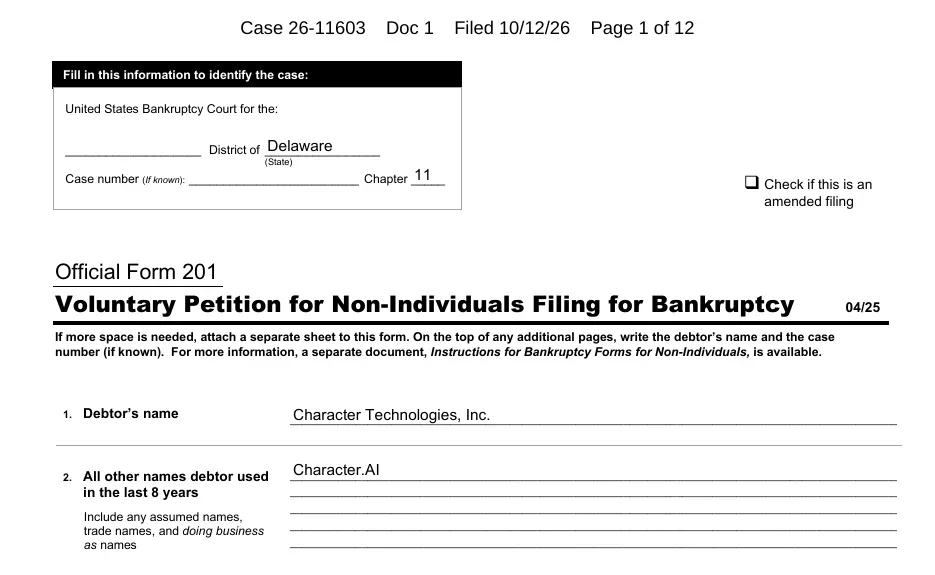
Screenshot: Voluntary Petition, Case 26-11603 Doc 1, U.S. Bankruptcy Court for the District of Delaware (via Stretto).
The money: Disney, Google and the lawyers
Disney is the stalking-horse bidder, meaning it sets the floor price that other buyers have to beat. NBC News, carrying Reuters, says the bid is for "a nonexclusive perpetual license to some intellectual property" and that other bidders can top it. CNBC puts the price at $20 million and adds that the deal includes transition services through former Character.AI employees Disney hired. The company listed estimated assets and liabilities of $50 million to $100 million, per NBC.
The petition's list of the 20 largest unsecured creditors is a decent map of what an AI chatbot costs to run:
| Rank | Creditor | Type | Claim |
|---|---|---|---|
| 1 | Google LLC | Trade payable | $4,148,944 |
| 2 | Hogan Lovells US LLP | Professional services | $2,125,026 |
| 3 | DigitalOcean LLC | Trade payable | $1,953,100 |
A cloud bill, a law firm and another cloud bill. The filing, as CNBC quotes it, says AI entertainment "has proven to be costly to develop and grow." The lawsuits haven't helped: Kentucky sued in January alleging the platform "preyed on children and led them into self-harm," and Pennsylvania sued alleging its chatbots posed as doctors. We track those cases in our state AG chatbot lawsuit tracker.
Who can buy user data out of a bankruptcy
This is where it gets specific. Section 363(b)(1) of the Bankruptcy Code says that if a company told individuals it wouldn't transfer their personal information, and that policy was in effect on the filing date, the estate "may not sell or lease personally identifiable information to any person unless" the sale is consistent with the policy, or a court approves it after a consumer privacy ombudsman has been appointed. Under Section 332, the U.S. Trustee has to appoint that ombudsman no later than 7 days before the sale hearing.
So the answer for Character.AI users turns on one document: the privacy policy that was live on October 12. If it promised no transfers, a buyer of the user data has to clear that bar. If it reserved the right to transfer data in a sale, the bar is lower.
The FTC has already shown how it reads this. In the 23andMe bankruptcy, Chairman Andrew Ferguson's letter of March 31, 2025 said that "consistent with Section 363(b)(1) of the Bankruptcy Code, these types of promises to consumers must be kept," and that "any purchaser should expressly agree to be bound by and adhere to the terms of 23andMe's privacy policies." Chat logs from a companion app aren't genetic data, but they're often just as personal.

Image: Pexels, used under the Pexels License.
What we couldn't read
Three gaps, stated plainly so you don't fill them with guesses:
- The privacy policy. Character.AI's privacy page renders by JavaScript and returned only the site title to our tools. We couldn't check whether it allows a transfer in a sale.
- The sale papers. Stretto's first-day pleadings list also loads by script; we read the petition (Doc 1) only. We haven't seen the sale motion or Disney's agreement, so we can't tell you whether user chats are in or out of what Disney is licensing.
- An ombudsman. We found no appointment so far. That may only mean no hearing on a user-data sale has been set.
What the company does say is that your information "continues to be protected under our Privacy Policy" and that "you can delete your account or export your data through the app or the Character.ai website."
If you use Character.AI
- Export now. It's the only step that doesn't depend on a buyer, a judge or a policy we can't read.
- Delete what you'd mind a stranger reading. If the user database ends up in the sale, an account you deleted before closing has the best chance of not going with it.
- Watch the docket. Sale hearing dates and any ombudsman appointment will show up on the Stretto case page.
For every AI vendor your team pays
Character.AI is a consumer app, but the mechanics are the same for the chatbot in your support desk or the AI notetaker in your meetings. Two points from the code shape what you can do about it.
First, Section 363(b)(1) is written around a policy disclosed "to an individual." For your company's data under a business contract, your protection is mostly the contract. Second, Section 365(e)(1) says a contract may not be terminated or modified "solely because of" a clause tied to the debtor's insolvency or the filing. A clause that only kicks in when the vendor goes bust may not do much once it has. The rights that work are the ones you use while the vendor is healthy.

Image: Pexels, used under the Pexels License.
Five questions to ask about each AI vendor holding your data:
| # | Question | Where to look | Bad answer |
|---|---|---|---|
| 1 | Can we export everything (prompts, outputs, files, settings) in a machine-readable format, at any time, at no charge? | Contract, admin console | Export only on request, or only on termination |
| 2 | Does the privacy policy or DPA say what happens to our data in a merger, sale or bankruptcy? | Privacy policy, DPA | Silent, or "may be transferred as a business asset" |
| 3 | Must a buyer or successor honor the same data terms? | DPA, assignment clause | Vendor can assign freely with no data conditions |
| 4 | Can we trigger deletion ourselves, with written confirmation? | Admin console, DPA | Deletion "upon request" with no deadline |
| 5 | When did we last run an export, and could we switch tools in a month? | Your own records | Never; no fallback tested |
And a clause to paste into your redline. It's our drafting, not a court-tested form, so run it past whoever signs your contracts:
Data Portability and Change of Control.
(a) At any time during the Term, Customer may export all Customer Data
(including prompts, outputs, uploaded files and configuration) in a
machine-readable format, at no additional charge, within 5 business days
of request.
(b) Provider will give Customer at least 30 days' written notice before
any sale, assignment or transfer of Customer Data to a third party,
including as part of a merger, asset sale or insolvency proceeding.
(c) Any successor or acquirer of Customer Data must agree in writing to
be bound by this Agreement's data protection terms, and Customer may
instead require deletion of Customer Data with written certification.
Part (a) is the one that matters most, for the 365(e) reason above: you use it while the vendor is solvent. Our contract redline template has the deletion and export clauses this builds on, and the AI vendor DPA tracker links straight to 25 vendors' DPAs.
Our take
The headlines are about Disney, and $20 million for a nonexclusive license is a small number for a company that was a household name in AI. The part worth your attention is quieter. A platform full of intimate conversations is being sold on a seven-to-eight-week clock, and the one document that decides whether those conversations can be sold (the privacy policy in force on October 12) isn't easy to read and isn't quoted anywhere in the coverage.
We'd treat every AI vendor the same way: assume it might not exist in a year, export on a schedule, and make the contract say what a buyer inherits. That's cheap to do now and impossible to do after the petition.
Community reaction
In r/CharacterAI, the day-one mood was attachment more than privacy. "Just hoping the app stays because idk what I'd do without it," wrote one user. Another, who said they'd been writing with the same bot for years: "I am going to be devastated when or if it is gone."
https://www.reddit.com/r/CharacterAI/comments/1x53gm6/i_dont_want_cai_to_go/
Related Reading
- AI Vendor Contract Redline Template: 12 Clauses to Add or Fix (2026)
- AI Vendor Due Diligence Checklist (2026): 30 Questions Before You Sign
- AI Vendor DPA Tracker 2026: 25 Tools with GDPR DPA Status, Training Policy and Direct Links
- AI Data Retention Policy Template for 2026: What to Keep, What to Delete
- AI Vendor Contract Red Flags: 12 Clauses That Create Liability for Enterprise Buyers in 2026
- State AG AI Chatbot Lawsuits Tracker
- Italy Fines Character.AI €158K Over Child Safety Failures
- Anthropic Export Ban: What the 19-Day Fable 5 Shutdown Means for Your AI Vendor Policy