Image: Pexels, used under the Pexels License.
If your team makes AI content about real people for an Indian audience, the Delhi High Court just drew the line for you: no generated quotes, voices, faces or "endorsements" of a public figure without their permission. And if you host other people's posts, a takedown list can now land on you with a clock measured in hours.
That's the working read of Justice Vikas Mahajan's interim order of October 8, 2026 in Kangana Ranaut v. Meta Platforms Inc and Ors, CS(COMM) 1100/2026. The coverage calls it a deepfake order, and it is one. But we read all 19 pages, and the list of links the court attached is mostly something more ordinary: posts that put fake quotes in the mouth of a sitting MP.
Event date: October 8, 2026 (order signed; Ranaut filed the suit the same day). First reported: October 12, 2026 at 04:55 UTC by LiveLaw, then The News Mill and NewsX the same morning.
What the court ordered
Paragraph 64 is the operative part. Until the next hearing:
- Everyone named, "including john does", is barred from using Ranaut's name, image, likeness, voice, speeches, signature or persona without her authorization.
- AI output is named outright: "AI-generated content, deepfakes, synthetic media, manipulated videos, manipulated audio recordings, fabricated speeches, false endorsements or impersonation content".
- Fake affiliation is out too: no account, page, channel or website that falsely suggests she endorses it.
- Meta has 72 hours from receiving the order to take down the links in Annexure-A and in a second list, Document K, then two weeks to file a compliance affidavit.
- MeitY and the Department of Telecommunications must tell internet and telecom providers to block the listed sites in the same 72 hours.
It's an ex parte interim injunction. Only the two government departments had a lawyer at the hearing; Meta and the account holders haven't answered yet. The case goes to the Joint Registrar on December 4, 2026 and back before the court on February 3, 2027.
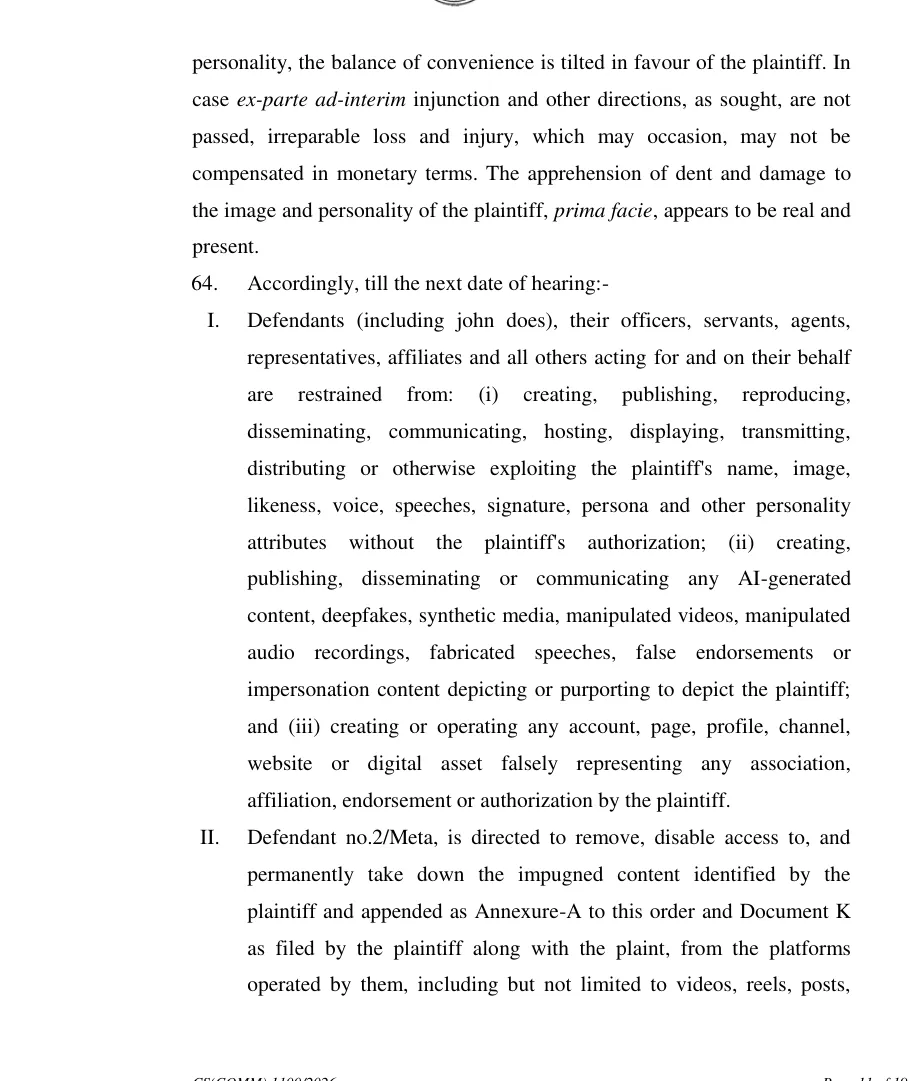
Screenshot: Order of October 8, 2026, CS(COMM) 1100/2026, Delhi High Court, page 11.
What's actually in the annexure
Annexure-A is the table at the back of the order: who posted, where it sits in the plaint, the URL, the platform and a category label. We counted every row.
| In Annexure-A | Count |
|---|---|
| Rows | 18 |
| Instagram rows | 17 |
| Facebook rows | 1 |
| Labelled "Fabricated Social Media Post and False Statement attributed to the Plaintiff" | 11 |
| Labelled AI-generated fake video | 3 |
| Instagram keyword search pages | 2 |
| Distinct URLs once repeats are removed | 13 |
The sexual deepfakes aren't in this table. They're in Document K, which was filed with the suit and isn't attached to the public order, so nobody outside the case can count them.
Three things in the table matter more than the headline:
Fake quotes carry the list. 11 of the 18 rows are posts attributing statements to Ranaut. The court handled them under Rule 3(1)(b)(v) of India's IT Rules, which covers information that's "patently false and untrue or misleading", and said such false quotes "cannot be permitted to remain available on social media platform". No deepfake detector needed; just a made-up sentence next to a real photo.
Two entries are search pages. Rows 17 and 18 are Instagram keyword searches ("kangana cow" and "rahul gandhi kangana ranaut"), labelled as searches showing a vast number of similar posts. That's a takedown target defined by a query, not by a post. If you run anything with search or tag pages, note it.
Satire got a pass, for now. The order records that a satirical meme Ranaut filed was left out, because her lawyer didn't press its removal "for the time being".
Two smaller details. Defendants 6 and 7 took their material down after receiving the advance copy of the suit and were dropped from the case, which is the cheapest exit available. And the order calls Meta defendant no. 2 in paragraph 64 while the annexure calls Meta defendant no. 1 and lists an account holder as no. 2. Somebody's clerk will hear about that.
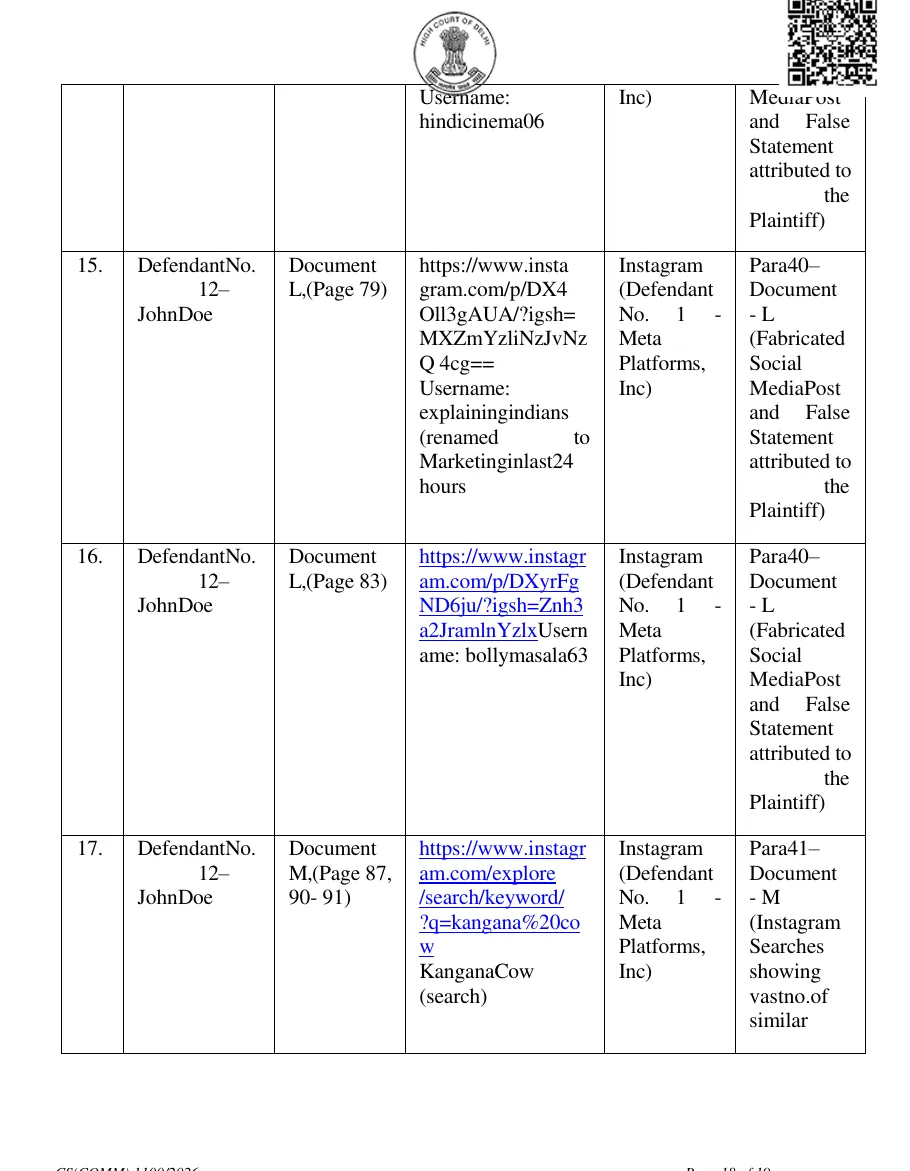
Screenshot: Annexure-A, order of October 8, 2026, Delhi High Court, page 18.
The paragraph platforms should read twice
Paragraph 67 lets Ranaut notify "additional infringing URLs, accounts, channels, or content" found after filing, and the defendants have to remove them "without requiring the plaintiff to institute fresh proceedings". She asked for this dynamic injunction because, per paragraph 54, the operators keep opening mirror accounts and cloned profiles after the originals are reported. In practice the list in Annexure-A is a starting point, not a ceiling.
Paragraph 66 is the escape hatch: a site that isn't "primarily an infringing website" but gets blocked anyway can go back to the court with an undertaking and ask for the injunction to be narrowed.
The 72 hours also looks generous next to India's own rules. Under the IT Rules amendments in force since February 20, 2026, intermediaries must act within three hours of a court order or government notice (it used to be 36), and within two hours for nudity, sexual content, impersonation or morphed images (it used to be 24). We'd plan around the short clock, not the long one.
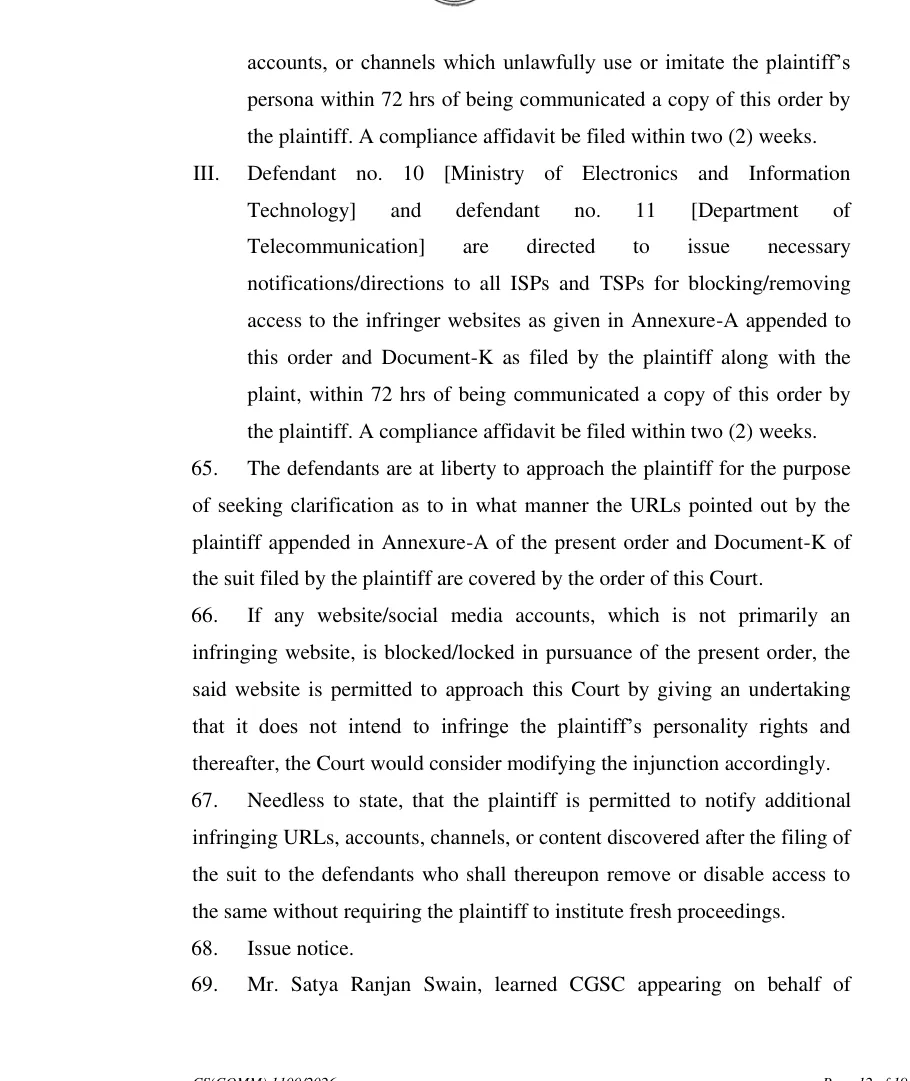
Screenshot: Order of October 8, 2026, Delhi High Court, page 12.
What we'd change this week
A small team meets this order one of two ways: you make content, or you host it.
If you make content (social, ads, newsletters):
- Kill the AI quote card. No quote attributed to a real person ships unless a reviewer has opened the source link. That habit alone covers 11 of the 18 rows here.
- No synthetic voice, face or endorsement of a public figure without written permission. The order names false endorsements and impersonation next to deepfakes, and the IT Rules list "impersonates another person" as its own category in Rule 3(1)(b)(vi).
- Make satire obvious. The meme survived. A parody that reads like a real statement is the one that ends up in an annexure.
If you host user content (a community, comments, an AI image tool):
- Name one person, plus a backup, who receives court orders and MeitY notices. A three-hour clock doesn't survive an unread shared inbox.
- Make takedown work on a list of URLs, including account pages and search pages, because this annexure has both.
- Log time received and time removed for each link. The order asks for compliance affidavits within two weeks, and you'll want the timestamps.
Image: Pexels, used under the Pexels License.
What people said
When Ranaut filed, Reddit mostly treated it as a chance to roast her. The top comment in r/BollyBlindsNGossip: "No need to protect it none of us want it." One reply pushed back: "Do you even understand what are personality rights ??"
https://www.reddit.com/r/BollyBlindsNGossip/comments/1x0o2d8/kangana_seek_her_pearsonlity_rights/
The jokes miss the point, and the point isn't about her. The same order, with the same template, is available to the next public figure who finds an AI clip of themselves.
Our take
This is narrower than "India bans deepfakes" and broader than "a celebrity got some posts removed". It protects one person, on an interim basis, before the other side has said a word. What it shows is the kit an Indian court will hand a public figure on day one: a ban that names AI output types, a 72-hour takedown, ISP blocking through two ministries, and a standing right to add new links without a new suit.
If your content workflow can produce a fake quote in under a minute, it can produce a defendant just as fast. We'd fix the quote-card habit first. It's the cheapest change, and it's the most common entry in this annexure.
How we checked this: we read the full signed order (19 pages, PDF via LiveLaw) on October 13, 2026, counted the Annexure-A rows by hand, and compared Rule 3(1)(b) with MeitY's consolidated IT Rules text. Document K and the 2026 Gazette notification weren't available to us; the three-hour and two-hour clocks come from Freshfields' summary. Last reviewed: October 13, 2026.
Related Reading
- Washington's AI likeness law: compliance steps
- Tennessee ELVIS Act: AI voice and likeness compliance
- Denmark's deepfake bill: consent for faces and voices
- Germany's deepfake law and platform court orders
- New York's synthetic performer ad disclosure law
- TAKE IT DOWN Act compliance
- EU AI Act Article 50: watermarking and deepfake disclosure