Image: Unsplash, used under the Unsplash License.
If your product puts news articles into a model's context (a research assistant, a news summarizer, a support bot that browses), here's the log the publishers now want from you, and we checked that it validates. The SPUR coalition just added The New York Times, The Economist, The Atlantic and more than 40 others, and its pitch is that every future AI licensing deal gets built on one reporting format. That format is open source, and a small team can emit it in an afternoon.
Event date: first reported at 23:01 UTC on October 12, 2026 by Press Gazette and A Media Operator, with AFP also named among the new members.
What changed
SPUR (Standards for Publisher Usage Rights) launched in February with The Guardian, the FT, the Telegraph, the BBC and Sky News, then added Mediahuis, the Associated Press and CMA Media as founding members. After its June expansion it counted 36 publishers and affiliate organisations. Now it's at 80 members from more than 20 countries. We counted Press Gazette's list of new names: 46 entries, from the NYT and AFP to Which?, Quanta Magazine and Blog Preston.
The members don't agree on tactics. Some are suing AI companies, some have signed deals, some both, some neither. The NYT, which sued OpenAI in December 2023 and later Perplexity, said it wants standards "not unilaterally set by tech platforms".
What they share is the Content Telemetry Standard, version 1.0, published in the repo on 2 September 2026 and announced on SPUR's site in October. SPUR says it's building tools so AI companies can adopt it easily, and it's set up a Licensing Advisory Board whose membership is by invitation.
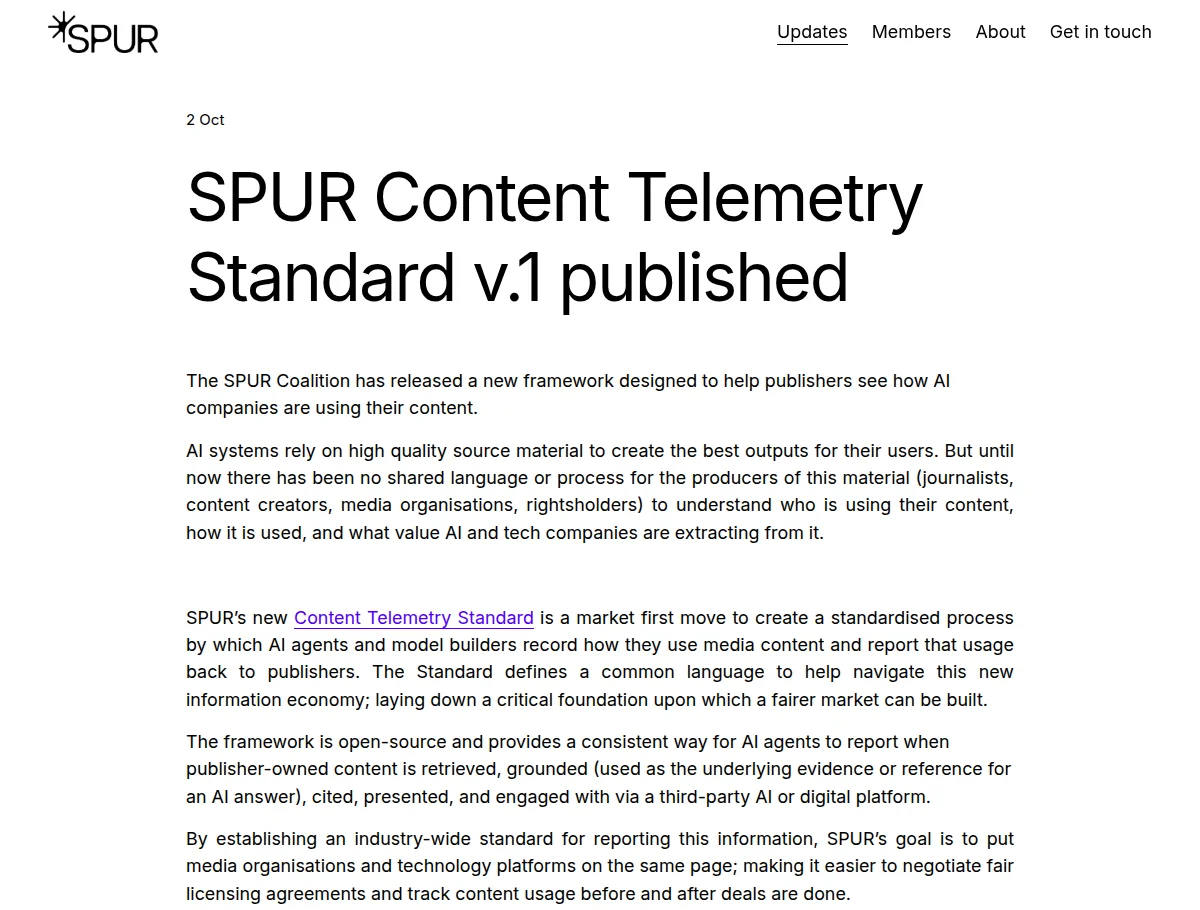
Screenshot: spurcoalition.org, "SPUR Content Telemetry Standard v.1 published", taken October 13, 2026.
The five events, in one session you can copy
The standard follows a piece of content through five stages: retrieved (fetched), grounded (loaded into the model's generation context), cited (referenced in the answer), presented (shown to the user as content or a link) and engaged (clicked, copied, shared). A session ties them together, and each turn declares a privacy level.
Here's the session we wrote for a small helpdesk bot that pulls one news article into a single answer. It's at the minimal privacy level, so no query text, topics or intent leave your system; only token counts and the content URLs do.
{
  "schema_version": "1.0",
  "session_id": "3f2b8c1e-5d4a-4e6b-9a7c-1b2d3e4f5a60",
  "agent_id": "helpdesk-rag-v1",
  "started_at": "2026-10-13T09:00:00Z",
  "ended_at": "2026-10-13T09:00:09Z",
  "events": [
    {"type": "turn_started", "timestamp": "2026-10-13T09:00:00Z", "turn_id": "1",
     "turn": {"privacy_level": "minimal", "query_tokens": 21}},
    {"type": "content_retrieved", "timestamp": "2026-10-13T09:00:01Z", "source_role": "agent",
     "content_url": "https://news.example.com/2026/10/eu-ai-act-guidance"},
    {"type": "content_grounded", "timestamp": "2026-10-13T09:00:02Z",
     "content_url": "https://news.example.com/2026/10/eu-ai-act-guidance",
     "data": {"scope": "turn", "cached": false, "chars_ingested": 6400}},
    {"id": "3f2b8c1e-5d4a-4e6b-9a7c-1b2d3e4f5a61", "type": "content_cited",
     "timestamp": "2026-10-13T09:00:05Z", "turn_id": "1", "output_id": "response:1",
     "content_url": "https://news.example.com/2026/10/eu-ai-act-guidance",
     "data": {"citation_type": "paraphrase", "position": "primary"}},
    {"id": "3f2b8c1e-5d4a-4e6b-9a7c-1b2d3e4f5a62", "type": "content_presented",
     "timestamp": "2026-10-13T09:00:05Z", "turn_id": "1", "output_id": "response:1",
     "citation_id": "3f2b8c1e-5d4a-4e6b-9a7c-1b2d3e4f5a61",
     "content_url": "https://news.example.com/2026/10/eu-ai-act-guidance",
     "data": {"presentation_kind": "source_reference", "presentation_type": "link"}},
    {"type": "turn_completed", "timestamp": "2026-10-13T09:00:05Z", "turn_id": "1",
     "turn": {"privacy_level": "minimal", "response_tokens": 240}},
    {"type": "content_engaged", "timestamp": "2026-10-13T09:00:09Z", "turn_id": "1",
     "presentation_id": "3f2b8c1e-5d4a-4e6b-9a7c-1b2d3e4f5a62",
     "content_url": "https://news.example.com/2026/10/eu-ai-act-guidance",
     "data": {"engagement_type": "link_click"}}
  ]
}
Why each part is there: content_grounded with data.scope and the two turn events are what the Grounding level requires. The content_cited event with an id, output_id and citation_type is what lifts you to the Citation level. The citation_id on the presented event and the presentation_id on the click link the chain, so a publisher can see that this article was used, credited, shown and clicked in one answer.
What we ran, and what tripped us
On October 13 we cloned the repo at tag v1.0 and ran its own conformance suite: 171 of 171 fixtures passed, and 15 of 15 worked examples in the spec validated. Our session above passed with zero schema errors and zero application-layer violations.
Then we broke it five ways, the way a rushed integration would:
| Mistake | Caught by JSON Schema? | Caught by the suite's application-layer check? |
|---|---|---|
Raw query text on a minimal turn |
No | Yes |
Citation without citation_type |
Yes | n/a |
Click without presentation_id |
Yes | n/a |
Retrieval without source_role |
No | Yes |
A hashed IP in data |
No | Yes |
Three of the five sail through a plain JSON Schema validator. If you only wire the schema into CI, you'll ship a privacy leak (query text at the lowest level) and a field the spec withdrew in v1 because a hashed IP address "is a pseudonym rather than an anonymous value". Run tests/validate.py's application-layer rules too, or copy them.
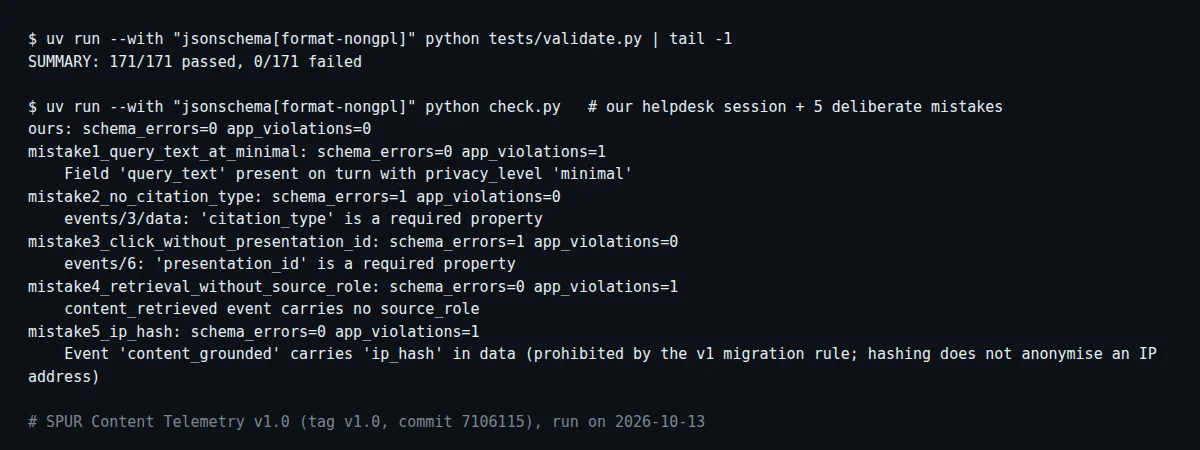
Screenshot: our validator run against SPUR Content Telemetry v1.0, October 13, 2026.
We also asked 12 member domains for the manifest the spec defines at /.well-known/content-telemetry.json. Nine returned 404 and three blocked us; none served one. Publishers aren't receiving this data in the open yet, so you've got time to do it properly.
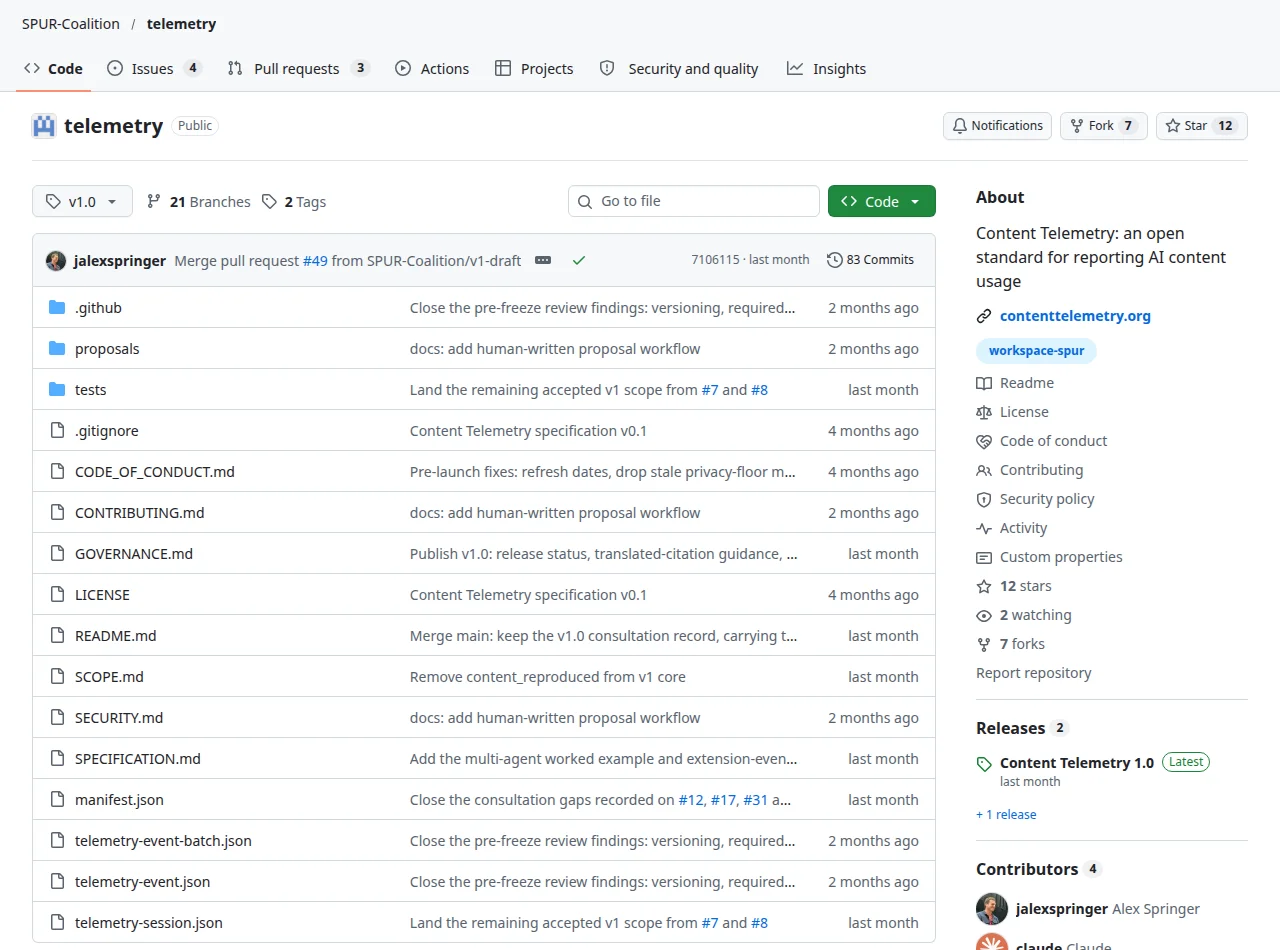
Screenshot: github.com/SPUR-Coalition/telemetry at tag v1.0, Apache 2.0, taken October 13, 2026.
The part publishers will push on
Grounding and citation are self-reported, and the README says so plainly: they're reported by the agent, "which is also the party that may owe compensation under a licence". During the public comment period (12 June to 24 July 2026, 29 specification threads), James Rosewell put the problem in GitHub issue #42: an emitter that grounds a thousand articles and reports one "appears fully conformant at Grounding level. I cannot find the sentence it breaches."
The maintainers answered with coverage declarations. You now state complete, sampled, aggregated or selected, and you can't call your reporting complete unless every qualifying occurrence is sent. Another commenter proposed the audit publishers will likely try: "Seed synthetic, uniquely fingerprinted passages into the licensed feed and check whether grounding and citation telemetry reports them back correctly" (issue #33). And the SPUR profile, the coalition's accreditation layer on top of the standard, requires event-level delivery and doesn't permit aggregation.
No Reddit or X thread about the expansion turned up by October 13, so there's nothing to embed; the GitHub issues are where the implementers are actually talking.

Image: Pexels, used under the Pexels License.
What we'd do this week
- Skip this entirely if your team only uses ChatGPT or Claude internally and never feeds publisher content to a model in your own product.
- If you ground answers in news content, emit the five events now, at
minimal, and keep them per event, not aggregated. That's what the SPUR profile asks for, and retrofitting event-level logs later is the expensive version. - Log what you actually ground, not what you retrieve. The gap between the two is the whole point of the format, and it's the number a publisher will audit with seeded passages.
- Pick your coverage mode on purpose. If you sample, write the rule down. Don't call it complete if it isn't.
- Put both validators in CI: the schema, and the suite's application-layer rules.
Our take
We'd adopt it now, at the lowest privacy level, for one reason: it's cheap today and it'll be a negotiating requirement the day you want a license from any of these 80 members. The standard isn't settled on the hard part, proving the logs are complete, and publishers know it. Small teams that log honestly from day one will have the easier conversation. If you're following the copyright fights that pushed publishers here, see our notes on the USA Today lawsuit over ChatGPT news summaries.
How we checked this: we cloned SPUR-Coalition/telemetry at tag v1.0 (commit 7106115), ran its two test scripts, validated our own session and five broken variants on October 13, 2026, and requested the manifest URL on 12 member domains. Member facts come from Press Gazette; SPUR hasn't posted the expansion on its own site yet. Last reviewed: October 13, 2026.