EN 18286:2026 is the first harmonised standard under the EU AI Act. Its reference went into the Official Journal on October 14, 2026, through Commission Implementing Decision (EU) 2026/2274. From that day, a provider of a high-risk AI system whose quality management system follows EN 18286 is presumed to meet Article 17 of the Act, and the first sentence of Article 11(1) on technical documentation if that documentation holds every Annex IV item. Using it is voluntary at any date; the Annex III rules it supports apply from December 2, 2027. The point most write-ups skip: you don't have to pay for it. NEN in the Netherlands shows the full text to anyone with a free account, and NEK in Norway posts the English PDF on its own site.
Event date: October 14, 2026 (reference published in the Official Journal; the decision is dated October 12). First report: CEN-CENELEC JTC 21, the committee that drafted the standard, the same day. The Commission's own notice followed on October 19.
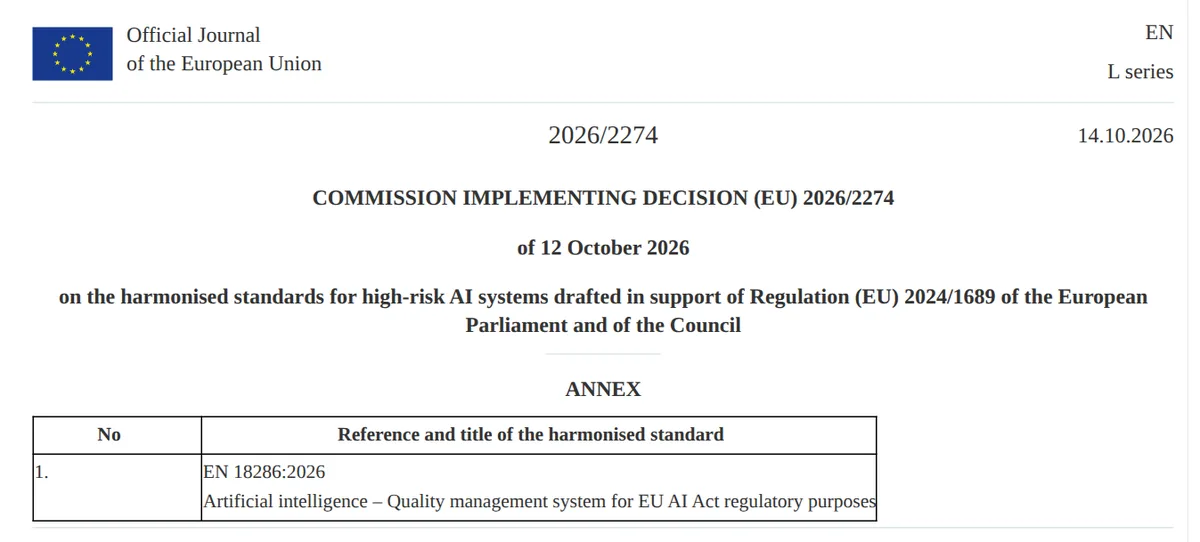
Screenshot: Commission Implementing Decision (EU) 2026/2274, header and Annex, EUR-Lex. Captured November 1, 2026.
What the October 14 decision changed
CEN and CENELEC published EN 18286 in July. Until the Commission cited it, it was a well-drafted document with no legal effect. JTC 21 puts it plainly: "A published European standard and a harmonised standard are not the same thing." The citation is what switches on Article 40 of the AI Act, under which conformity with a cited standard gives a presumption of conformity "to the extent that those standards cover those requirements." The decision says that presumption runs from the date the reference is published, so October 14 is the date that matters.
| Date | Step | Source |
|---|---|---|
| October 30, 2025 | prEN 18286 is the first AI Act standard to enter public enquiry | Commission standardisation page |
| July 12, 2026 | CEN approves EN 18286 | Standard, title page |
| July 31, 2026 | National editions published (SFS in Finland, BSI in the UK) | SFS, BSI shop pages |
| October 12, 2026 | Commission adopts Implementing Decision (EU) 2026/2274 | EUR-Lex |
| October 14, 2026 | Reference published in the Official Journal; presumption starts | EUR-Lex |
| October 19, 2026 | Commission notice: "the only AI QMS standard with a presumption of conformity" | digital-strategy.ec.europa.eu |
| January 2027 | Latest date for every national standards body to adopt it | Standard, European foreword |
| December 2, 2027 | Annex III high-risk requirements apply | AI Act Article 113 |
| August 2, 2028 | Annex I (product) high-risk requirements apply | AI Act Article 113 |
EN 18286 is the only standard on the list. The Commission asked CEN and CENELEC for standards in ten areas, from risk management to cybersecurity, and says "further harmonised standards" are "expected to follow." JTC 21 says the amended request runs until February 28, 2027 and that several core drafts are being revised after their public enquiries.
Who has to care, and who can skip it
Article 17 binds providers of high-risk AI systems. A five-person startup selling a CV-screening tool to EU employers is one: Annex III point 4(a) lists systems used "to analyse and filter job applications, and to evaluate candidates." Building the tool for your own hiring counts too. The standard's introduction gives the example in so many words: "An in-house developed AI system is put into service when it is used internally." And it says it is meant for providers "irrespective of size, nature or location."
If you buy a high-risk tool and use it as sold, you are a deployer, and the quality management system is the vendor's job. The standard's definition adds that a deployer "can be considered a provider of an AI system in certain circumstances," so check that before you skip this. Our EU AI Act guide for small teams covers the roles.
Two groups can skip it for now:
- GPAI model providers. The standard says that for its purposes a provider "shall be interpreted as a provider of high-risk AI systems and not general-purpose AI models." No harmonised standard covers Articles 53 or 55 yet; our GPAI Code of Practice explainer has what you rely on instead.
- Anyone hoping it removes an audit. For Annex III points 2 to 8 (employment, credit, education and the rest), Article 43(2) already prescribes internal control with no notified body. Orrick's October 27 note puts it the same way: those systems "must be self-assessed by providers, whether or not they rely on harmonised standards."
Among Annex III systems, biometrics under point 1 are the one place where harmonised standards change the conformity route, and EN 18286 doesn't change it yet. Article 43(1) sends those systems to a notified body where harmonised standards for the Section 2 requirements (Articles 8 to 15) don't exist or are applied only in part. EN 18286 is a quality management standard; the standards for risk management, data, logging, oversight and the rest aren't cited. Our reading, which matches Orrick's: point 1 providers still plan for a notified body.
What the presumption covers, clause by clause
The useful page of EN 18286 is Annex ZA, the table that says which AI Act provisions each clause supports. The Commission's notice only says the presumption covers "the Article 17 requirements covered by the standard." Here is what Annex ZA actually lists, from the text itself:
| AI Act provision | EN 18286 clauses (Annex ZA) | Condition or gap |
|---|---|---|
| Article 11(1), first sentence: technical documentation drawn up before release | 8.9.2 | Only if the documentation contains every element of Annex IV |
| Article 17(1), first sentence and points (a) to (m) | Clauses 4 to 10. Examples: data management (f) in 8.5; post-market monitoring (h) in 9.1 and 9.5; serious incidents (i) in 9.6.1 and 9.6.2.1 | Points (a) to (m) must each be documented |
| Article 17(1)(g): the risk management system | 8.2 | "Subject to use of a risk management system compliant with Article 9" |
| Article 17(2): proportionate to the provider's size | None | "Not covered" |
| Article 17(3): integration into a sectoral QMS | None | "Not covered" |
| Article 17(4): financial institutions | None | "Not covered" |
Source: EN 18286:2026, Annex ZA, Table ZA.1, NEK edition, read November 1, 2026.
The Article 17(2) row is the one a ten-person team should read twice. Article 17(2) says the system must be proportionate to the provider's size, "in particular, if the provider is an SME, including a start-up, or an SMC." The standard's introduction says its system "can take into account the size of the provider." But Annex ZA states that applying the standard "does not by itself ensure the proportionality" of what you put in place. So the presumption covers the full system. Every corner you cut because you are small is your own argument, made without the presumption behind it.
The guidance that would settle this hasn't shipped. Article 63, as amended, lets SMEs without partner or linked enterprises comply with "certain elements" of the quality management system "in a simplified manner," and tells the Commission to write guidelines on which ones. On November 1, the Commission's guidelines page still listed the SME guidelines among those "the AI Office keeps working on." That is the weakest part of the picture: the only standard written for Article 17 has no view on how small you can make it, and the official answer isn't out.
Two smaller catches. The 17(1)(g) row depends on an Article 9 risk management system, and the risk management standard isn't cited: the bibliography of EN 18286 lists EN 18228, "AI Risk Management," with a dash where the year should be, which is how standards mark a document not yet published. And Annex ZA warns that the presumption "stays valid only as long as" the reference stays on the Official Journal list.
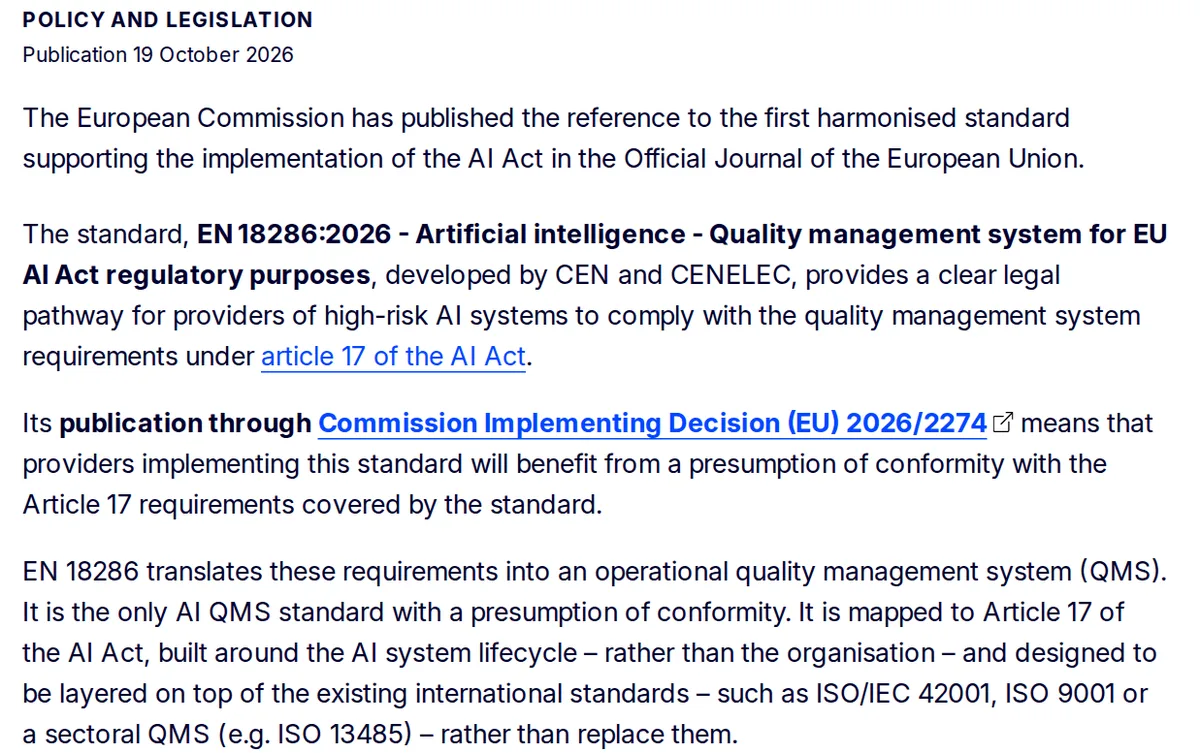
Screenshot: "First harmonised standard supporting the AI Act published in the Official Journal," European Commission, Shaping Europe's digital future, published October 19, 2026. Captured November 1, 2026.
Where to read it: free, or up to £322
The Official Journal publishes the reference, not the text. Orrick's note says national standards bodies sell the standard and that "prices vary from one organisation to the next." They do. We checked six national bodies on November 1, 2026:
| Seller | Edition | Price on November 1, 2026 | Catch |
|---|---|---|---|
| NEN (Netherlands) | NEN-EN 18286:2026, English | Free to read in NEN Connect with a free account; PDF EUR 102.00 before tax (EUR 111.18 with) | The free route is reading in NEN Connect; the download is the paid PDF |
| NEK (Norway) | NEK EN 18286:2026, English | Free PDF on nek.no | Every page carries a line citing "ECJ ruling C588/21" |
| EVS (Estonia) | EVS-EN 18286:2026, English | EUR 32.24 including tax | The single-user PDF needs Adobe Reader plus the FileOpen plugin; EVS says FileOpen doesn't run on Linux |
| SFS (Finland) | SFS-EN 18286:2026, English | EUR 95.76 to read online; EUR 106.40 to read, download and print; VAT on top | One named user |
| DIN Media (Germany) | DIN EN 18286, German | EUR 149.80 including VAT; English translation EUR 187.30 | |
| BSI (UK) | BS EN 18286:2026 | GBP 322; GBP 161 for BSI members |
Same text, from nothing to £322. The free copies have a legal backstory. In March 2024, in case C-588/21 P, the Court of Justice's Grand Chamber found "an overriding public interest" justifying disclosure of four harmonised standards that two non-profits had requested from the Commission. NEK's PDF heads every page with a line referring to that ruling. Orrick calls the paid-access model "controversial and legally contested" but doesn't mention that free copies of EN 18286 now exist. None of the ten pages we read for this piece does.
Our pick: read the NEN or NEK copy first. Buy a licensed copy only if an auditor or a customer wants one on file, and on anything but Linux the EUR 32.24 EVS PDF is the cheapest of the paid copies we found.
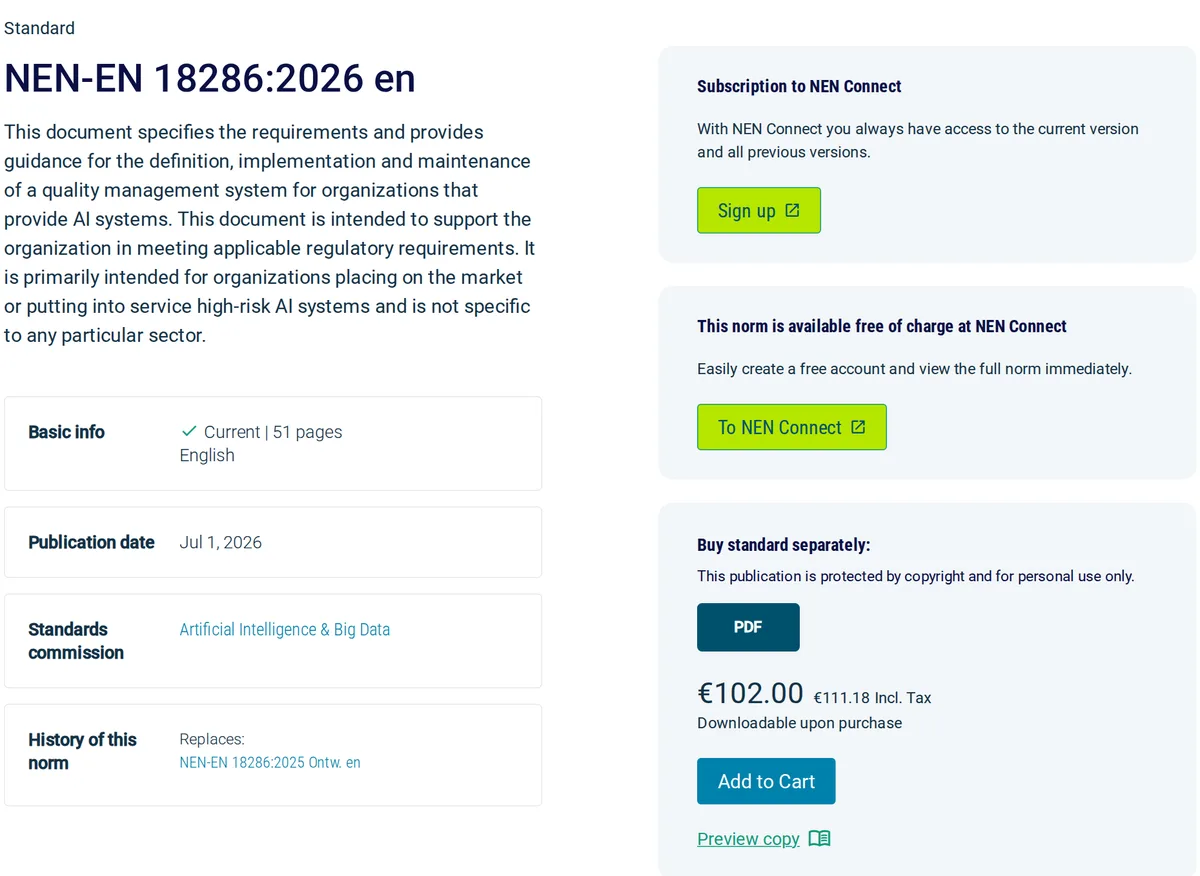
Screenshot: NEN-EN 18286:2026 product page, nen.nl. Captured November 1, 2026.
The memo it makes you write for Articles 9 to 15
While EN 18286 is the only cited standard, it creates paperwork for the requirements it doesn't cover. Clause 4.4.3.1 makes a provider select, for each essential requirement in Articles 9 to 15, one, or a combination, of four approaches: harmonised standards cited in the Official Journal, common specifications, other standards, or other technical specifications. For Articles 9, 10 and 12 to 15 there is nothing in the first two buckets today. When a provider uses the last two approaches, or a harmonised standard's annex records restrictions, clause 4.4.3.2 requires the technical documentation to list the requirements not covered in full and to give "a detailed description of how each and all applicable essential requirements are met." That is your position today. In practice it means a requirement-by-requirement memo, and it belongs in the Annex IV file our technical documentation templates set out.
Clause 9.3 is the other part small teams underrate. Its supply-chain controls cover "products, components, model training, test data and services" supplied from outside, with documented selection criteria proportionate to the risk and a monitoring plan with "criteria, frequency, and methods." Our reading: if your hiring screener runs on someone else's model through an API, or a contractor labels your training data, each of them needs a supplier file under 9.3.
What to do before December 2027
- Decide whether you provide an Annex III system, including one you built for internal use. If you only deploy a vendor's tool, ask the vendor for its EN 18286 position instead.
- Get the free text from NEN or NEK. Read clause 4 and Annex ZA first: pages 18 to 21 and 48 to 49 in the NEK copy.
- If you already run ISO 9001 or ISO/IEC 42001, work from the mapping in Annex B or Annex C. The Commission says EN 18286 is "designed to be layered on top" of those, not to replace them. Our ISO 42001 vs NIST AI RMF comparison covers what an ISO 42001 programme already gives you.
- Write the clause 4.4.3.2 memo for Articles 9, 10 and 12 to 15, and update it each time a new harmonised standard is cited.
- Open a supplier file under clause 9.3 for every external model, dataset and labelling contractor.
- Keep a separate note on what you scaled down because of your size and why. It sits outside the presumption. Revisit it when the Article 63 SME guidelines appear.
- Don't buy an EN 18286 certificate yet. Points 2 to 8 need no notified body under Article 43(2), and BSI, which sells the standard, said on October 14 that it is "actively working towards obtaining accreditation for EN 18286." If you want a credential for your team rather than your system, our AI governance certification comparison prices the options.
What we could not confirm
We don't know how long either free route stays open, or whether NEK's copy may be shared beyond reading it yourself. NEK's header refers to a "Request on CENELEC homegrown hENs via regulation 1049/2001"; we found no NEK statement explaining the arrangement. We haven't compared the NEK copy page by page with a purchased one. Its contents list and annex titles match the free sample of the Slovenian edition on iTeh. The Commission gives no date for the SME guidelines under Article 63, and JTC 21 gives no date for the next standard to be cited. The October roundup of AI regulation changes lists EN 18286 alongside the month's other EU items.
Related Reading
- EU AI Act Annex IV Technical Documentation Templates
- ISO 42001 vs NIST AI RMF: Which One a Small Team Needs
- EU AI Act Compliance for Small Teams: The Complete Guide
- EU AI Act GPAI Codes of Conduct: What Signing Gets You
- AI Governance Certification: AIGP vs ISO 42001 vs AAIA
- AI Regulation and Policy Changes, October 2026: What's Due
- NIST Solopreneur Cybersecurity Guide (CSWP 50): AI Checks