NIST's new cybersecurity guide for one-person businesses, CSWP 50, Small Business Cybersecurity: Non-Employer Firms, asks you to do five things about AI tools: list every AI product and AI feature you use, write down the laws and contracts that touch your AI use, read each tool's retention, training and access settings before you paste anything sensitive, review AI output before a client sees it, and find out how your vendors' AI reaches your data. That is section 1.9 of the final PDF, and it is new. Below are the five checks as a record you can keep, with the CSF 2.0 row and the spreadsheet tab NIST already provides for each.
Event date: November 2, 2026 (CSWP 50 final, superseding NIST IR 7621 Rev. 1). First report: NIST news release, November 2, 2026.
What NIST added on November 2
The guide replaces NIST IR 7621 Rev. 1, the 2016 "Small Business Information Security: The Fundamentals." It went through three comment periods: two drafts as IR 7621 Rev. 2 (March 18, 2024 and May 1, 2025) and one as CSWP 50, released April 14, 2026 with comments due May 14. The audience is narrow on purpose: firms whose only paid worker is the owner. NIST cites SBA figures of 34.8 million US small businesses, 81.9% of them with no employees, which its release rounds to "more than 28 million" solopreneurs.
We searched the text of the April 14 draft. It mentions artificial intelligence once, as an example of "new or emerging technologies" a business might adopt, and has no AI section. The final adds section 1.9, titled with Super Intelligence (SI), the federal executive branch's term for AI, plus one sentence in the phishing section: "Super Intelligence (SI) can now be used to craft increasingly convincing phishing attacks."
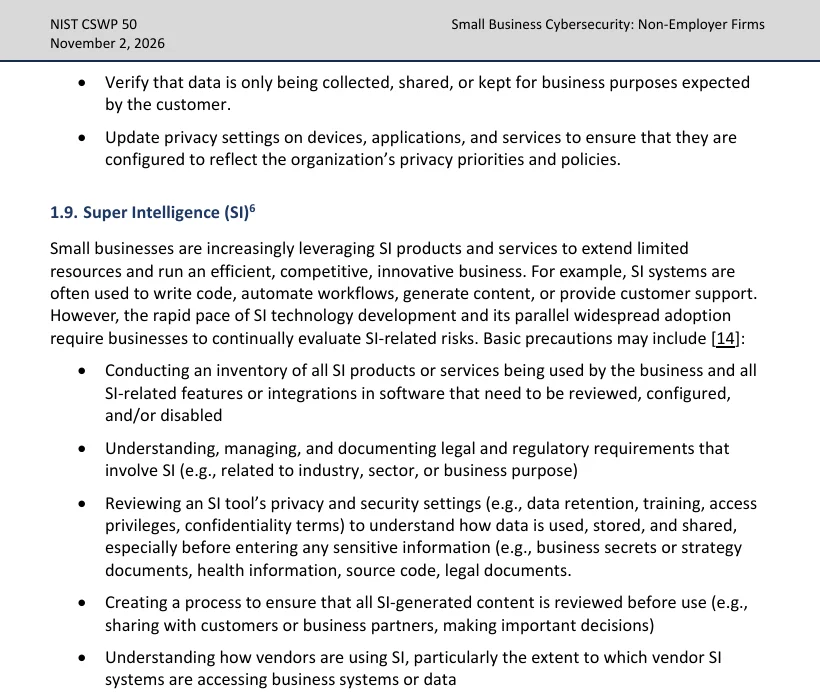
Screenshot: NIST CSWP 50, page 7, nvlpubs.nist.gov. Rendered November 3, 2026.
The "SI" is not a new technology. Footnote 6 explains it: the September 29, 2026 order Inaugurating the Era of Super Intelligence (EO 14434, 91 FR 63129) told executive agencies to swap "artificial intelligence" for "super intelligence." The section's own examples are tools you already pay for: SI "used to write code, automate workflows, generate content, or provide customer support." Its five precautions cite the NIST AI RMF 1.0 as their source.
"Because solopreneurs may not have cybersecurity expertise, we wanted to create a resource designed for them," Daniel Eliot, one of the authors, said in NIST's release.
The five AI checks, and where each one goes
Section 1.9 gives the precautions as bullets and stops there. The rest of the guide has the places to record them: a Govern table, an Identify table and an appendices workbook with fill-in tabs. The mapping below is ours, not NIST's. We matched each bullet to the CSWP 50 row that asks for the same kind of record.
| NIST's precaution (section 1.9) | CSWP 50 row that holds the record | Tab in the appendices workbook | What we'd write down |
|---|---|---|---|
| Inventory "all SI products or services" and "SI-related features or integrations in software that need to be reviewed, configured, and/or disabled" | ID.AM-01/02/04/05/06/07, inventory "including suppliers and third parties" | Appendix H, Assets and Risks (it already has example rows for "Digital Assistant" and "website chatbot") | One row per tool and per AI feature switched on inside another tool: name, account owner, data it can see, MFA on or off |
| Document "legal and regulatory requirements that involve SI" | GV.OC-03, legal, regulatory and contractual requirements | Appendix G, Requirements Table | Each client contract clause about AI use, plus any sector rule (NIST's own footnote names HIPAA and PCI DSS) |
| Review "data retention, training, access privileges, confidentiality terms" before entering business secrets, health information, source code or legal documents | GV.SC, risks from suppliers and third parties: "Periodically reassess privacy and security settings, practices, and agreements" | Appendix H, Data Sensitivity Classification column | Per tool: does it train on your inputs, how long it keeps them, who else on the account can read them, date you checked |
| Review "all SI-generated content" before sharing it with customers or using it for important decisions | No CSF row in the guide names this; the nearest is ID.IM, continuous improvement | None | Which outputs a person reads before they leave the business (proposals, code, client emails), and who that person is. In a solo firm, that's you |
| Understand "the extent to which vendor SI systems are accessing business systems or data" | GV.SC, and PR.AA-05, limit access "to only those who require access for a specified time" | Appendix H, Planned Risk Treatment column | Vendor name, what its AI feature can reach (mailbox, drive, CRM), date you reviewed the permission |
The workbook is the part worth downloading. Appendices D to J come as one .xlsx file with a tab each. Appendix H's columns already include data sensitivity classification, confidentiality, integrity and availability impact, planned risk treatment and "Multi-Factor Authentication Enabled?", so an AI tool fits the same row format as your email provider. If you'd rather keep AI tools in a separate list, our AI register template adds the fields EU AI Act and Colorado records ask for.
How NIST's consultant example handles an AI assistant
The guide ships three made-up businesses: an intellectual property attorney, a home-workshop e-commerce seller and a marketing and sales consultant. Only the consultant (Appendix F) uses AI, and the way NIST writes it up is the most useful AI material in the package.
Under GV.OC-03, the consultant "will have contractual obligations (including for Super Intelligence (SI)* use since the consultant uses an SI assistant) for each client." Under the inventory row, the consultant lists "SI tools" next to word processing and marketing software. That is the right instinct: for a freelancer, the client's contract is often the first document that says what you may paste into a chatbot, well before any AI law applies.
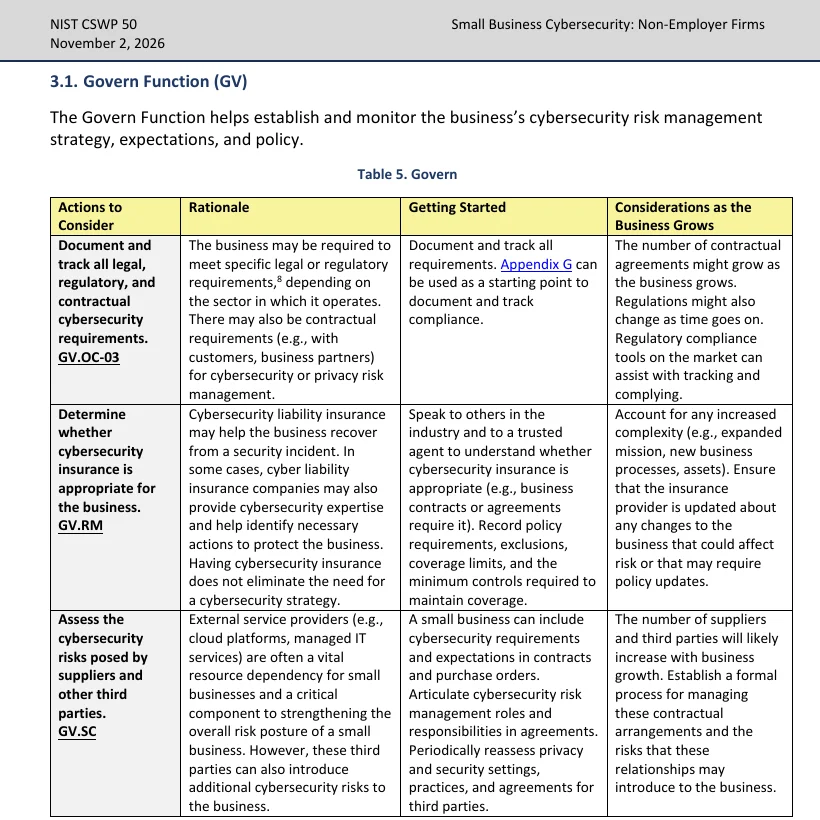
Screenshot: NIST CSWP 50, Table 5, page 11, nvlpubs.nist.gov. Rendered November 3, 2026.
To adapt it, open Appendix G. NIST's own note on that tab says it can track "requirements related to use of specific types of technologies," because some contracts "might put restrictions on how customer data is used with certain technologies." Put each client contract in the "Requirement Body" column and note whether it mentions AI, confidentiality or subcontractors, and whether your AI vendor counts as one. Then check the vendor's terms against it. Our privacy-first AI API comparison lists which providers train on inputs by default, and the vendor due diligence checklist has the pass/fail questions for the GV.SC row. If you hire your first employee, the guide's "as the business grows" column points to written policies; our AI acceptable use policy template is the short version.
What CSWP 50 leaves out
Five bullets is thin. We searched the final text: the word "agent" appears once, and it means an insurance agent. "API key," "prompt," "hallucination" and "deepfake" do not appear. So the guide has nothing on AI assistants that hold OAuth access to your mailbox or drive, nothing on a coding assistant that can read your keys, and nothing on cloned voices asking for a payment. Its phishing advice still covers the last case in general terms: verify requests for "new routing numbers, invoice changes, urgent payment requests" by "confirming with a trusted source before acting." We'd add a callback rule for any payment change, as in our write-up of the Fideuram deepfake CEO case.
Two limits come from NIST itself. The tables are "not intended to be a checklist or compliance criteria," and Eliot says the publication "is not comprehensive and won't address all the needs of every solopreneur." If you need a framework to show a client, the guide points to the AI RMF; our ISO 42001 vs NIST AI RMF comparison covers which one a small team can carry.
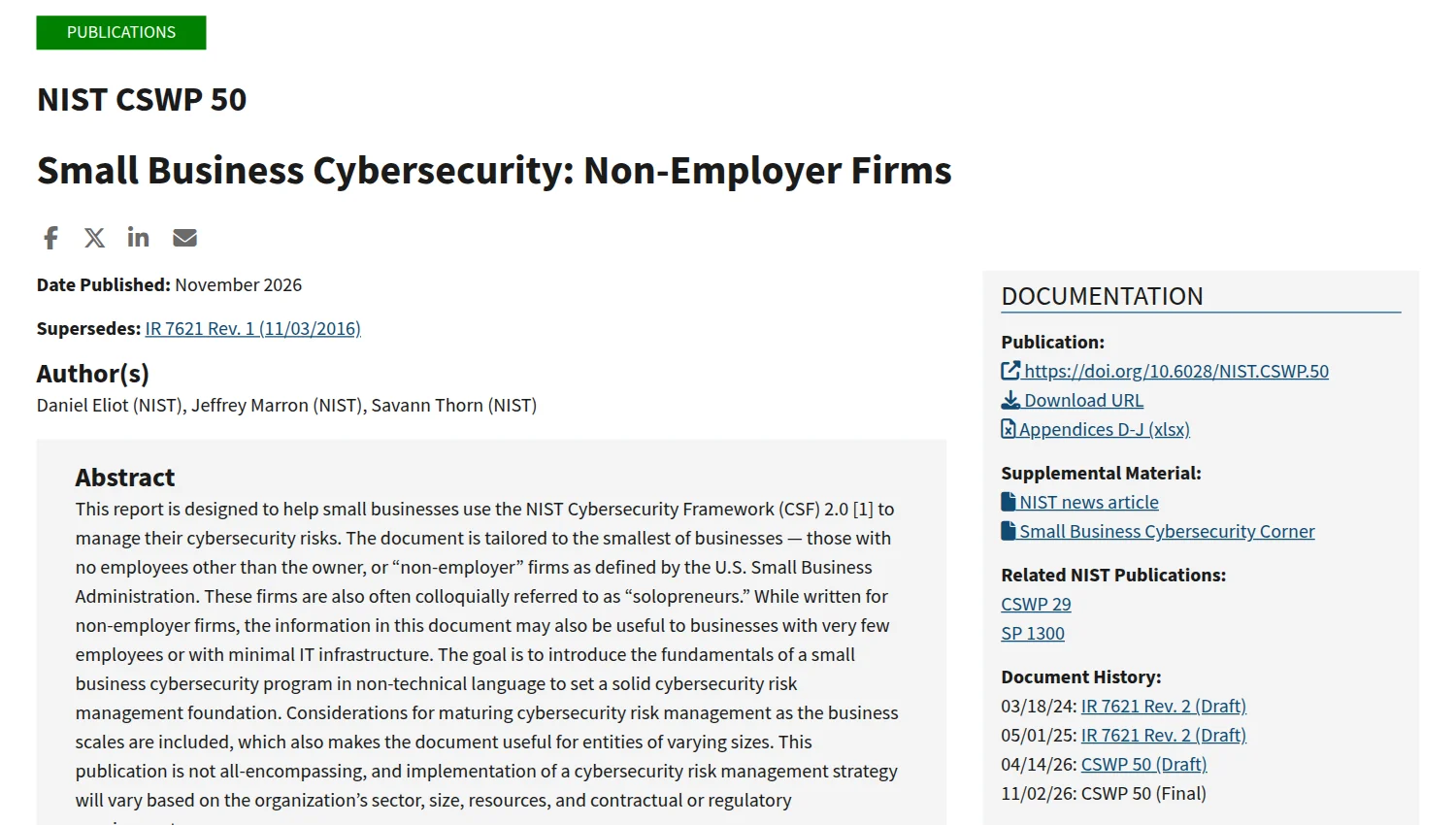
Screenshot: CSRC publication record for NIST CSWP 50, csrc.nist.gov. Captured November 3, 2026.
Our take: the AI section is the smallest part of a decent guide, and that's fine for a one-person firm, which needs a list and a habit more than a framework. Fill the two tabs once, put a date on each row, and look again when you add a tool or sign a client whose contract mentions AI. NIST is also collecting more example businesses at [email protected]; one with an AI-heavy workflow would fill the gap this version leaves.
What we could not confirm: neither CSRC record we read on November 3 (final or April draft) links the public comments, so we can't say who asked for section 1.9. The mapping table is our reading of the guide, not NIST's.