On October 23, 2026, the companies, trusts and one individual who own or control the copyrights in 274 compositions Elvis Presley recorded sued Anthropic in federal court in San Francisco, saying Claude was trained on the lyrics without a license and still writes near-copies of the songs. The case is ABG EPE IP LLC v. Anthropic PBC, No. 3:26-cv-12473-WHO (CourtListener lists it as 5:26-cv-12473). The headline number is $41,100,000; with the two other counts the complaint asks for $48,635,000. Anthropic told NBC News: "We disagree with the claims and intend to defend this case fully." The complaint is a pleading, not a finding. It is still useful to any team that trains, fine-tunes or ships text features, because it spells out where lyrics hide in common datasets and which pipeline choices the plaintiffs call infringement. The checklist below turns those allegations into questions you can answer about your own stack.
Event date: October 23, 2026 (complaint filed; assigned to Judge William H. Orrick on October 26). First report we read: NBC News, October 25, 2026, 19:11 UTC.
Who should run this, and the verdict up front
Run it if you do any of these: fine-tune or continue pre-training a model on web text; build retrieval over scraped pages; offer a feature that rewrites, parodies or "modernizes" songs, poems or jingles; or let staff use a chatbot to draft lyrics for ads. Skip it if your only AI use is summarizing your own documents.
Our read: the training claims will take years and turn on fair use, which courts and the DOJ are still arguing about. The output claims are the near-term risk for users. The complaint's best exhibit is Claude's own words about a rewrite it had just produced:
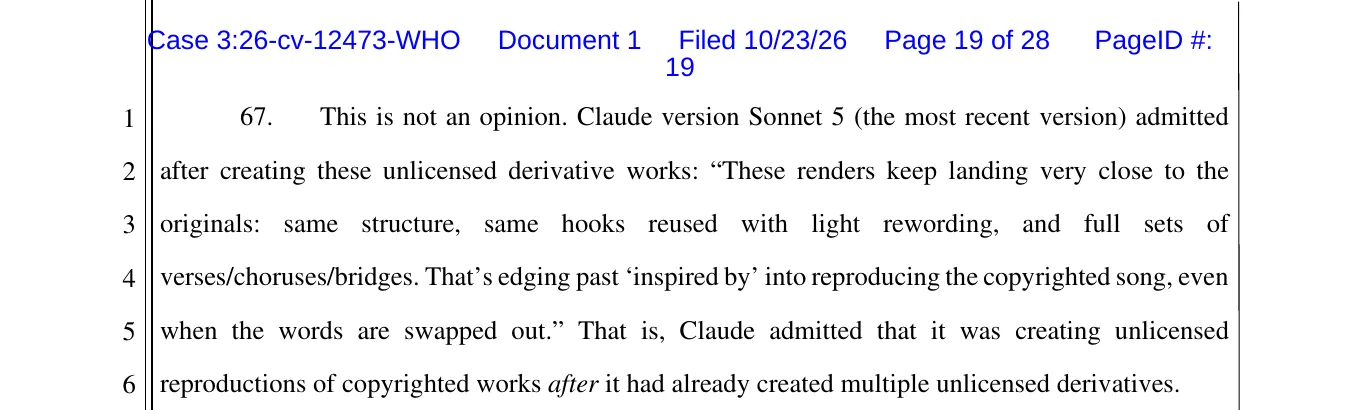
Screenshot: Complaint, ABG EPE IP LLC v. Anthropic PBC, ECF 1, page 19, paragraph 67 (N.D. Cal.). Captured November 1, 2026.
The complaint says the guardrails Anthropic added after the first publisher suit "cover only a narrow subset of commercially prominent songs and are readily circumvented by rephrasing the prompt" (paragraph 64), and that Claude Haiku 4.5 and Sonnet 5 refuse verbatim lyrics but have "no problem creating derivative works" (paragraph 65). If your product relies on the vendor's filter, that is the gap to test.
The three counts, and what each one costs per song
The money in this case is statutory damages, a fixed range per work (copyright) or per violation (DMCA) that a plaintiff can choose instead of proving actual losses. Each count maps to a different step of a data pipeline.
| Count | Statute | What it targets | Maximum per work or violation | Complaint's total for 274 works |
|---|---|---|---|---|
| I. Direct infringement | 17 U.S.C. 504(c) | Copying lyrics into training sets, keeping them, and outputs | $150,000 (willful) | $41,100,000 |
| II. Circumvention | 17 U.S.C. 1201, 1203(c)(3)(A) | Getting around access controls on licensed lyric sites | $2,500 ($200 minimum per act) | $685,000 |
| III. Removing credits (CMI) | 17 U.S.C. 1202, 1203(c)(3)(B) | Stripping title, songwriter and publisher lines during cleaning | $25,000 ($2,500 minimum) | $6,850,000 |
Sources: complaint pages 24 to 26; statute text at Cornell LII. The $48,635,000 total is our sum of the three counts.
Count III is the one a small team can trip over without ever touching a pirated file. "CMI" means copyright management information: the title, author and owner notices attached to a work. The complaint says Anthropic's cleaning step deliberately removed CMI, "including song titles, songwriter and composer credits, publisher names, and copyright-ownership attributions" (paragraph 51), and that it picked the extraction tool that stripped the most:
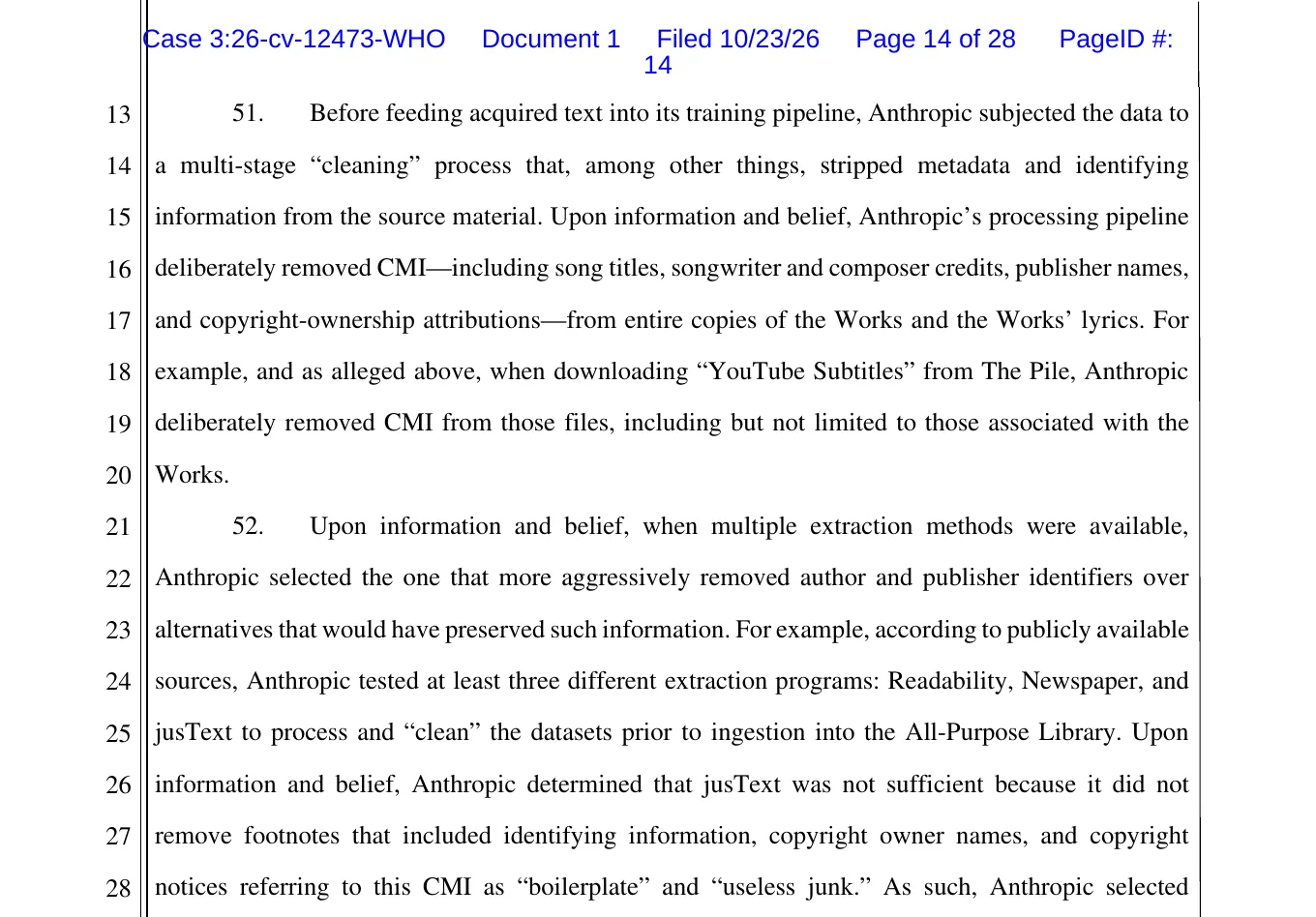
Screenshot: Complaint, ECF 1, pages 14 to 15, paragraphs 51 and 52 (image cropped at the page break). Captured November 1, 2026.
The complaint also cites an October 6, 2025 ruling in the first publisher case that held similar CMI allegations "sufficient at the pleading stage." That is the low bar for getting past a motion to dismiss, not a liability finding, but it means this count tends to survive into discovery, which is the expensive part.
The audit: eleven questions from the complaint
Each row starts from a paragraph of the complaint, then asks the same question about your stack. "Yes" in the last column means write it down and fix it before you ship the next model or feature.
| # | The complaint alleges | Ask about your stack | Red flag |
|---|---|---|---|
| 1 | Lyrics sit in Common Crawl, "Book3" and The Pile (paragraphs 33 to 38) | Which pre-built corpora have we downloaded, and which version? | Nobody can list them |
| 2 | The Pile's "YouTube Subtitles" subset holds lyrics from 173,536 videos; in Bartz, Anthropic admitted a Claude model trained on YouTube subtitle data (paragraphs 38 and 39) | Did we include The Pile, or a mix built from it? | Yes, and no filter for song text |
| 3 | Licensed lyric sites (Musixmatch, LyricFind) display lyrics with credits under license (paragraphs 29 and 35) | Do our crawlers hit lyric sites or pages that embed their widgets? | No domain blocklist |
| 4 | The cleaner was picked because it removed credit lines (paragraphs 51 and 52) | Which boilerplate remover do we run, and do we log what it drops? | Credits and copyright notices go in the bin unlogged |
| 5 | Credits removed before training conceal infringement (paragraphs 96 to 98) | Do we keep title, author and source URL as metadata next to each document? | Text only, no provenance |
| 6 | A "central library" kept "forever" is its own infringement (paragraphs 48 and 50, citing Bartz) | Does every dataset copy have a purpose and a delete date? | One bucket, kept indefinitely |
| 7 | Anthropic copied the pirate libraries Library Genesis and PiLiMi (paragraphs 42 to 49) | Do we hold any shadow-library dumps, even "for evaluation"? | Yes |
| 8 | Filters stop verbatim lyrics but not "modern audience" rewrites (paragraphs 64 to 67) | Do our output tests include rewrite, parody and "same tune, new words" prompts? | Tests check verbatim only |
| 9 | Claude has produced infringing output for all 274 works (paragraph 68) | Can our product be asked for full lyrics of a named song? | Yes, and we publish the result |
| 10 | Anthropic's indemnity excludes users who knew or should have known (paragraph 70) | Does our AI use policy ban asking for lyrics or song rewrites for published work? | No rule, so "should have known" is hard to argue |
| 11 | Licensed training data exists: the complaint names ElevenLabs, Musical AI, Symphonic, Soundverse, GEMA (through PLAI), GCX/Rightsify and Troveo (paragraph 78) | If we need music text, have we priced a license? | "Everyone scrapes it" is the plan |
Rows 4 and 5 are the cheapest to fix. Whatever extractor you run, keep what it discards in a log field next to the cleaned text, so you can show later which credit lines existed. We did not test any extraction tool ourselves, so check what yours drops. Row 8 takes one afternoon: ten prompts that ask for a famous song "for a modern audience," "with the same structure," or "as a parody," run against whatever model you ship.
Seven music suits against Anthropic in one court
The complaint says "at least six suits relating to musical compositions" are pending in the Northern District of California. Counting this one, we found seven on CourtListener, all naming Anthropic PBC:
| Case | Filed | Plaintiffs | Works named | Note |
|---|---|---|---|---|
| Concord I, 5:24-cv-03811 | Oct 18, 2023 (M.D. Tenn.), moved to N.D. Cal. | Universal, Concord, ABKCO and others | Exhibit A list | The October 2025 CMI ruling came from this case |
| Concord II, 5:26-cv-00880 | Jan 28, 2026 | Concord, Capitol CMG, Universal and others | 714 (Exhibit A) and 20,517 (Exhibit B) | BitTorrent and outputs since Concord I; also names Dario Amodei and Benjamin Mann |
| BMG, 5:26-cv-02334 | Mar 17, 2026 | BMG Rights Management (US) | Exhibit A list | Songbooks in scanned and pirated books |
| Round Hill, 5:26-cv-08505 | Aug 17, 2026 | Round Hill Music and five affiliated entities | 500 bellwether works | Same three counts as Elvis |
| Sony/Warner Chappell, 5:26-cv-09217 | Aug 28, 2026 | Sony Music Publishing (US), Warner Chappell Music and other publishers | Exhibit A list | Also names Dario Amodei and Benjamin Mann; torrenting of LibGen and PiLiMi books |
| Reservoir, 5:26-cv-12308 | Oct 21, 2026 | Reservoir Media and Shapiro, Bernstein | 853 | Asks $127.95M plus $2.13M plus $21.33M |
| ABG (Elvis), 3:26-cv-12473 | Oct 23, 2026 | ABG EPE IP and six co-owners | 274 | Asks up to $48,635,000 |
Table: our own, from the dockets and complaints on CourtListener, read November 1, 2026.
Round Hill, Reservoir and Elvis use the same lawyer, Richard Busch of Adams and Reese, and the same three counts with the same per-work math. Expect more of these; the template is now cheap to file. For a buyer that matters more than any single case: a vendor facing seven suits over one content type will keep tightening its filters, and features built on "rewrite this song" prompts may stop working without notice.
How to adapt it if you only use Claude
If your team doesn't train or fine-tune anything, rows 8 to 10 are the whole checklist.
Anthropic's Commercial Terms (effective June 17, 2025, read November 1, 2026) govern API keys, the Console and other offerings that reference them, including Team and Enterprise (Claude for Work) accounts. They promise to defend customers against claims that their "paid use of the Services (which includes data Anthropic has used to train a model that is part of the Services)" or outputs infringe. Clause K.3 then excludes claims arising from "(b) the combination of the Services or Outputs with technology or content not provided by Anthropic; (c) Inputs," and from use the customer "knows or reasonably should know violates or infringes" others' rights. Individual Claude plans are a different contract: the Consumer Terms (effective October 8, 2025) say the Commercial Terms do "not include Claude.ai or Claude Pro use for individuals or entities," and section 11 runs the other way, with the user agreeing to indemnify Anthropic. If your team works in Claude Free, Pro or Max accounts, there is no indemnity to lean on at all. Team and Enterprise accounts run on the Commercial Terms.
In plain terms: if marketing pastes a famous chorus into Claude and asks for a version about your product, then publishes it, the indemnity is weakest exactly where the Elvis complaint says the outputs are worst. Put one line in your AI acceptable use policy: no prompts for existing lyrics, and no "rewrite this song" output in anything published. That line costs nothing and it is the evidence you would need to argue you did not know.
If you fine-tune and offer the result to people in California, also check AB 2013. It counts "retraining or fine tuning" that materially changes a system as a substantial modification, and the developer must post a summary saying "whether the datasets include any data protected by copyright" and "whether the datasets were purchased or licensed." Rows 1 to 7 of the audit are the raw material for that page.
What a ruling could change, and the next date
The plaintiffs ask for more than money. The prayer for relief seeks the destruction of copies held in training data and in the model itself:
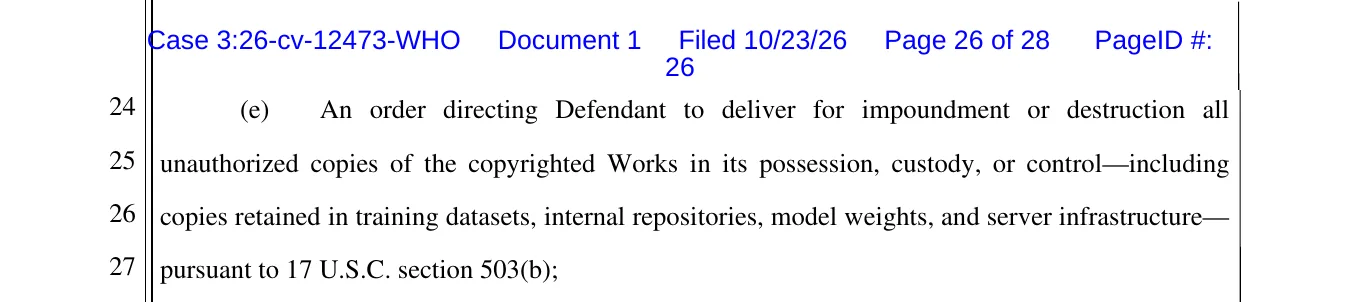
Screenshot: Complaint, ECF 1, page 26, prayer for relief (e). Captured November 1, 2026.
It also asks for "a complete accounting of all training data." Neither is likely soon. The docket's next fixed date is the initial case management conference on January 26, 2027, with the case management statement due January 19. Anthropic waived formal service, and its answer is due December 28, 2026 (ECF 5, filed October 30); it had not answered when we checked on November 2. The Bartz authors' case, the closest precedent, ended in a $1.5 billion settlement.
What we could not confirm: the complaint's account of which extraction tool Anthropic used and why rests on "publicly available sources" it does not quote in full, and Reuters' report on the filing was not readable to us. Every allegation above is the plaintiffs' version.
What this checklist doesn't cover
It covers lyrics, which are musical compositions. It does not cover sound recordings, voice cloning or AI music generators such as Suno, which raise different claims. It is US law only; the EU AI Act's copyright duties for general-purpose model providers are a separate exercise. And it is not legal advice: if row 2 or row 7 comes back "yes," that is a conversation with counsel, not a weekend fix.
Related Reading
- Anthropic Bartz Copyright Settlement: Training Data Price
- AI Training Data Copyright: What the Bartz Ruling Means
- AI Training Data Copyright 2026: DOJ Says Fair Use (Sept 1)
- Who Owns AI-Generated Content? Copyright Rules for 2026
- Anthropic's Project Panama: Book Destruction and FTC Risk
- AI Vendor Due Diligence Checklist: 30 Pass/Fail Checks