Source: Pexels stock photo, free to use under the Pexels license.
The draft FRIA template the AI Office published on November 16, 2026 is a 7-section questionnaire for the EU AI Act's fundamental rights impact assessment, which certain deployers of Annex III high-risk AI systems will fill in and send to their market surveillance authority under Article 27. It is a draft the Commission has not adopted, and deployers who will have to run a FRIA can apply to test it with the AI Office until December 4, 2026.
Most small teams can ignore the form, though. Article 27 reaches public bodies, private companies that provide a public service, and deployers of AI systems that score the creditworthiness of natural persons or price life or health insurance for them. We found no headcount threshold in Article 27 or in the draft's explanatory notice, so a 12-person consumer lender that scores applicants with an AI system is in and a 300-person software company screening CVs is out. Comments on the draft run to January 15, 2027, and the duty itself starts December 2, 2027.
Four dates in the Commission's notice, from the testing call to the 2027 duty
| Date | What happens | Who it's for | Source |
|---|---|---|---|
| November 16, 2026 | Draft explanatory notice and template published, with a public consultation and a call for testers | Everyone | Commission news page |
| December 4, 2026 | Expressions of interest to test the draft close | Deployers that will have to do a FRIA | Same page; the testing form says "open until 4 December 2026" |
| January 15, 2027 | Public feedback on the draft closes | Anyone: deployers, providers, experts, civil society | Same page; consultation form |
| December 2, 2027 | Article 27 applies to deployers of Annex III high-risk systems | Deployers in Article 27(1) | Same page, and the timetable set by the AI Omnibus, Regulation (EU) 2026/1744 |
The December 2027 date comes from the AI Omnibus, which moved the Annex III high-risk rules back from August 2026. Our explainer on what the Omnibus delayed and what still applies has the full timetable.
Who has to do a FRIA under Article 27(1)
Article 27(1) names three kinds of deployer, and the draft notice repeats them on pages 2 and 3. Check the type of organisation first, then the system.
| Your organisation and system | FRIA? | Basis |
|---|---|---|
| Public body (ministry, municipality, public agency) using any Annex III high-risk system except critical infrastructure | Yes | Article 27(1), "bodies governed by public law" |
| Private company providing a public service (private school, clinic, social care provider, housing provider) using any Annex III system except critical infrastructure | Yes, on the notice's reading | Article 27(1); notice page 3 reading of Recital 96 |
| Any deployer (lender or not) of a system that evaluates the creditworthiness of natural persons or sets their credit score | Yes, unless the system is only for detecting financial fraud | Article 27(1); Annex III point 5(b) |
| Any deployer (insurer or not) of a system for risk assessment and pricing in relation to natural persons in life or health insurance | Yes | Article 27(1); Annex III point 5(c) |
| Private employer using a CV screening or performance tool | No FRIA, unless the employer is itself a public-service provider; the Article 26 deployer duties still apply | Article 27(1) covers employment (point 4) systems only for public bodies and public-service providers |
| Anyone deploying an Annex III point 2 system (critical infrastructure) | No | Article 27(1) excludes point 2; notice page 3 |
Treat the table as a first filter. "Bodies governed by public law" and "private entities providing public services" are read through the AI Office's notice, so have counsel check any borderline case.
The second row is the one to read twice. Recital 96 calls public services "services important for individuals that are of public nature" and gives education, healthcare, social services, housing and the administration of justice as examples. The notice says those are examples only, "suggesting that private entities providing other services that are of public nature similar to the ones listed should conduct a FRIA."
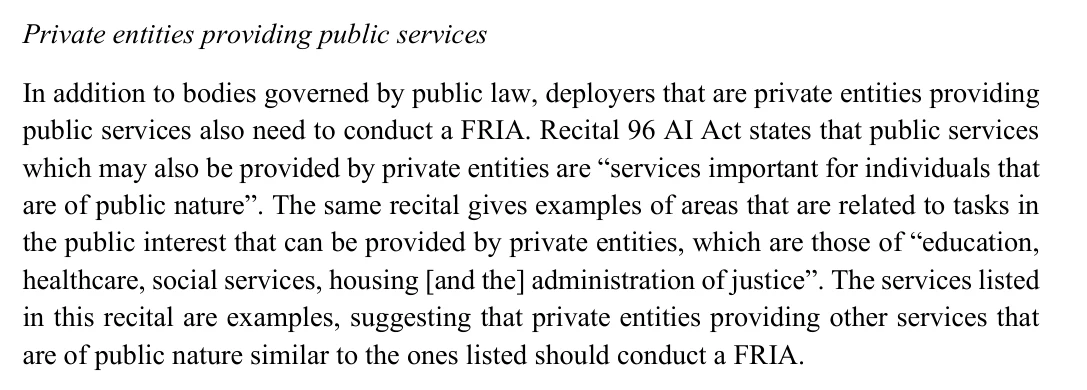
Source: Draft Explanatory Notice and template for the fundamental rights impact assessment under Article 27(5), page 3, AI Office, published November 16, 2026.
For public bodies, the notice admits the AI Act doesn't define "bodies governed by public law" and borrows from Court of Justice case law: State organs, regional and local authorities, entities set up under public law to perform public tasks, and EU institutions. If you aren't sure your system is high-risk in the first place, start with our Annex III category checklist.
What the 7 sections of the draft FRIA template ask, and where each answer comes from
The PDF runs to 13 pages: 4 pages of notice, then the template from page 6, then a summary page. We counted 9 numbered items (2.1 to 7.1) plus the tick-box lists. The last column is our reading of where a small deployer gets each answer. Four sections need a document only your provider holds.
| Section (Article 27(1) point) | What it asks | Where you get the answer |
|---|---|---|
| 1. General information | Type of deployer, the system's EU database number (Article 49(1)), 7 area-of-use boxes, first deployment or not, reliance on an earlier FRIA or on the provider's own assessment, update or not, stakeholders consulted | The provider, for the database number; your own records for the rest |
| 2. Context of use, points (a) and (b) | 2.1 intended purpose "as defined by the provider in the instructions for use" and how outputs are used; 2.2 period and frequency of use | The provider's instructions for use; your process owner |
| 3. Affected persons, point (c) | 11 boxes: children, older people, women, LGBTIQ+ persons, persons with disabilities, people in a vulnerable social or economic situation, minority racial or ethnic background, religious or belief groups, third country nationals, the general public, other | You |
| 4. Risks of harm, point (d) | 4.1 personal data, reusing your DPIA; 4.2 one block per risk, with 28 rights boxes (27 named rights plus "Other"), likelihood and severity each Low, Medium or High, mitigation, residual risk | Your DPIA for 4.1; the provider's Article 13 information for 4.2 |
| 5. Human oversight, point (e) | 5.1 oversight measures from the instructions for use, who carries them out and their power to override; 5.2 competence, training, authority and support | The provider's instructions for use; your training records |
| 6. If risks materialise, point (f) | 6.1 monitoring, suspension and reports to the provider under Article 26(5); 6.2 complaints, internal governance and redress | You |
| 7. Overall conclusion | 7.1 short synthesis of the risks in Section 4, submission date, signature | You |
Section 4.2 is where most of the effort goes. The draft defines Low as "unlikely under foreseeable conditions", Medium as "plausible under some conditions" and High as "highly probable or already observed in comparable deployments", and says mitigation measures are "not required for Low risk". The summary page after Section 7 is only for public authorities and those acting for them, which must publish a summary in the EU database under Article 49(3). A private deployer of a credit scoring or insurance pricing system sends the full FRIA to the regulator and skips that public summary.
Our high-risk documentation templates for Articles 9 to 15 show what the provider's side of that paperwork looks like, which tells you what to ask for.
A new model version can reopen your FRIA
The notice's timing section has one line every deployer buying a third-party system should read. A FRIA is done before first deployment, for every AI system, covering all its purposes, and it must be updated under Article 27(2) when a relevant factor changes, "for example, the processes concerned, the persons affected, or the version of the system or its underlying model."
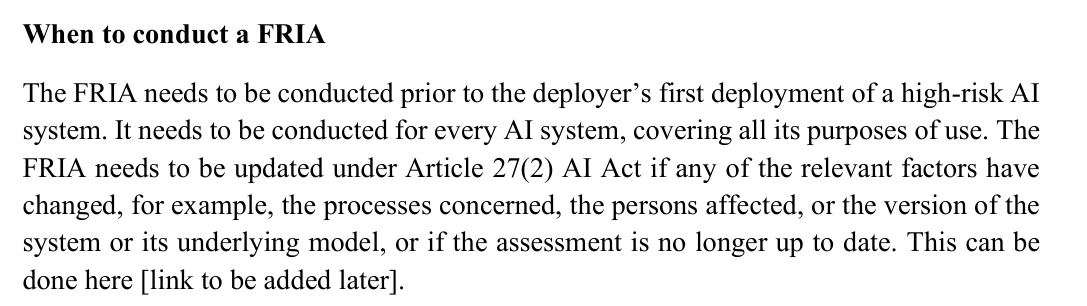
Source: Draft Explanatory Notice and template, page 4, AI Office.
Article 27(2) itself only says to update when an element "has changed or is no longer up to date". Naming the underlying model is the notice's own example, and it matters if your scoring or triage tool runs on a model the vendor swaps out. A lender can't update its FRIA for a model swap the scoring vendor never announced. The notice also says a provider "is not obliged to share its assessment with deployers", calling sharing "a good practice". So the provider's impact assessment that Article 27(2) lets you rely on in similar cases is something you have to ask for.
The DPIA reuse is real but partial. Article 27(4) and Section 4.1 let you cross-refer to your GDPR data protection impact assessment, then add the impact specific to this use. If your system also makes decisions without a person in the loop, our GDPR Article 22 guide covers the separate rules for that.
The draft isn't ready to file. It contains "[link to be added later]" three times: where to update the FRIA, which authority to ask for advice, and how to notify the market surveillance authority.
Our test fill: an invented 12-person lender
To see which answers a small deployer can write alone, we filled in the draft for an invented case: a consumer lender with 12 staff that licenses a credit scoring tool from a third-party provider and lets a loan officer approve or decline each application. Every answer below is ours, written for illustration. It is not a completed FRIA for any real company and it is not legal advice.
| Section | What we wrote | What we couldn't write without the provider |
|---|---|---|
| 1 | Type: credit/insurance deployer. Area: access to essential private and public services. First deployment: yes. Relying on the provider's assessment: yes, if shared | The EU database number of the system |
| 2 | 2.1 Scores every consumer loan application; the officer sees the score and decides. 2.2 Every working day, for the licence term | The intended purpose in the provider's own words |
| 3 | Persons in a vulnerable social or economic situation; third country nationals; Other: young adults with short credit histories | Nothing |
| 4.2, risk 1 | Applicants with short credit histories scored below what their repayments support. Right: equality and non-discrimination. Likelihood Medium, severity High | Accuracy figures by applicant group |
| 4.2, risk 2 | Declined applicants can't see why or contest it. Right: effective remedy. Likelihood Medium, severity Medium | Nothing |
| 5 | Officer reviews every decline and can override any score | The oversight measures the instructions for use specify |
| 6 | Monthly review of decline rates by group; stop using scores and tell the provider (Article 26(5)) if a group's rate jumps; complaints to one inbox, second review by a manager | Nothing |
| 7 | Two risks, both Medium after mitigation | Nothing |
The lender could write four of the eight rows alone. Each risk block needs its own rights, groups, ratings and mitigation, so the form grows with every risk you find. The provider-dependent cells are where a lender would stall, and each is something you can request now. French lenders also have the CNIL's May 2026 credit scoring recommendation to follow under the GDPR today, which our CNIL credit scoring post lines up against the AI Act dates.
Should you apply to test the FRIA template? The 16-question form
The testing form on EU Survey has 16 questions, is in English only, and the AI Office estimates five minutes. It asks your name and role, the organisation's type (body governed by public law, private entity providing public services, credit or insurance deployer, or other), Member State, size from Micro (0 to 9 employees) to Large (500 or more), the area of use, whether the system is live or planned, whether a DPIA exists, and a free-text description of the deployment and "what taking part would require." We read both forms without submitting either.
If you're picked, you fill in the draft for one of your own systems and the AI Office runs an introductory session, answers questions as you go and holds a closing session on the results. The Commission says taking part is voluntary and "without prejudice to obligations under the AI Act", and that it may select cases to balance areas of use, deployer types and sizes, and Member States.
Apply if you are in Article 27 scope and have a system live or planned: a deployer of a system that scores natural persons' creditworthiness or prices their life or health insurance, a public body, or (on the AI Office's reading) a private school or clinic. Answers from the AI Office on your own case are worth more than the five minutes. Skip it if the decision table above put you outside Article 27; the consultation form, open to anyone, is the better place for a provider or adviser, and it lets you answer only the sections you care about.
Our take: the hard part is the provider's paperwork
The weak spots are where the deployer depends on someone else. The model-version update line turns that into a recurring dependency.
So the useful work this quarter for a lender or insurer that uses such a system is contractual. Add a request like the one below to your next renewal or procurement.
Provider will give Customer, before first use and within 30 days of any change, the instructions for use, the EU database registration number, the Article 13 information on accuracy and known risks for the system, and written notice of any change to the system version or its underlying model.
That is sample wording to start the conversation, not legal advice; have counsel adapt it to your contract and to the final template.
Still open: the EUR-Lex text, national authorities, the final rating scale
- The consolidated Article 27 text on EUR-Lex, which we couldn't open on November 20. We read Article 27 on the AI Act Explorer and in the draft notice's own restatement of Article 27(1); the explorer marks paragraph 5 as amended.
- Which national authority will receive FRIA notifications in each Member State. The draft leaves that link blank.
- Whether the final template keeps the 7 sections, the 28 rights boxes or the Low, Medium and High scale. The consultation asks for comments on every section, including those rating definitions.
- How many testers the AI Office will accept.
Checked: the Commission news page, the 13-page draft PDF (read in full), both EU Survey forms, and Article 27, Article 49, Annex III and Recital 96 on the AI Act Explorer, on November 20, 2026.
What to do before the testing call closes
- Monday, November 23: list every AI system you use that scores, ranks or decides about people, and mark each against the decision table above. Our deployer evidence gaps checklist has a FRIA record you can start from.
- Tuesday, November 24: if any row says yes, email the provider for the instructions for use, the EU database number and its own impact assessment, and ask how it will tell you about a new model version.
- By Thursday, December 3: if you're in scope and have a system live or planned, submit the testing form, a day before it closes.
- By January 15, 2027: send comments through the consultation form on any section that didn't fit your case, Section 4.2 first.
Related reading
- EU AI Act compliance checklist for providers and deployers puts the FRIA among the 10 deployer items, so you can see what else falls due with it.
- Human-in-the-loop under Article 14 helps with Section 5, by testing what a vendor's oversight claims actually allow you to do.