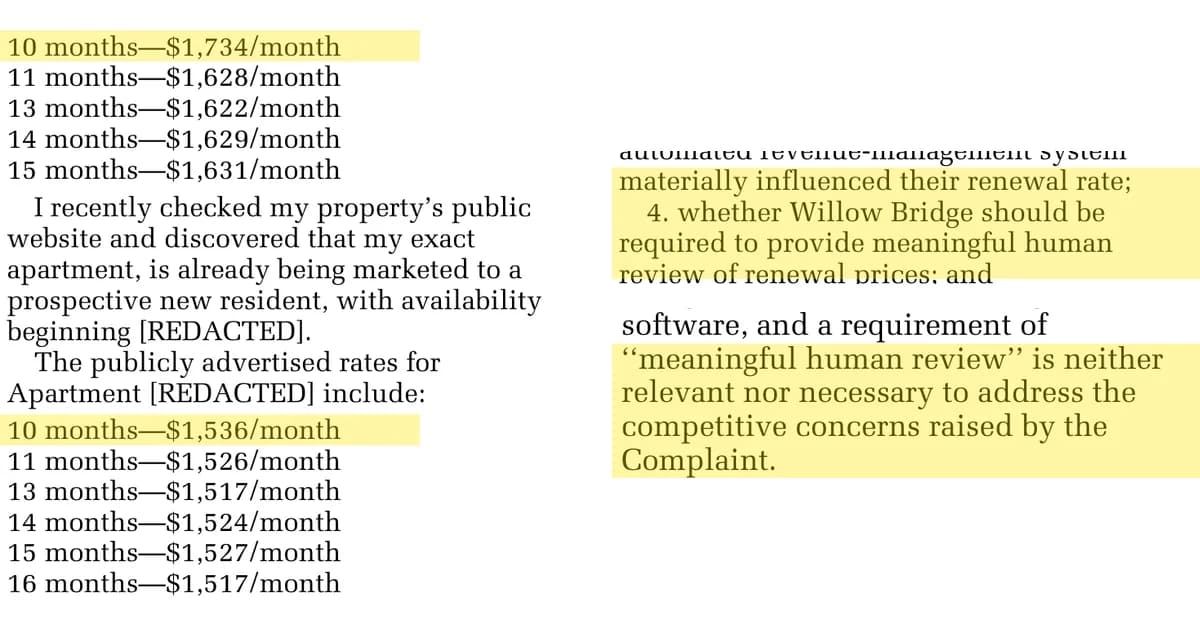
Source: Federal Register, 91 FR 70901 and 70903 (November 9, 2026), rendered and cropped by us on November 10, 2026. Highlighting is ours.
Say your property manager's pricing tool sends the renewal letters. One tenant opens the public listing for their own apartment, sees a lower number, and writes to the Justice Department. That happened at a Willow Bridge community in Dallas, and the Department answered on November 9, 2026, in a Federal Register notice.
Its answer to the tenant's request for "meaningful human review" of renewal prices fits in one clause: such a requirement "is neither relevant nor necessary to address the competitive concerns raised by the Complaint."
I read the response to public comments (91 FR 70898, FR Doc. 2026-22832, dated November 5), the two comments attached to it, and the proposed Final Judgment and Competitive Impact Statement (91 FR 43774, July 16) it answers. The case is United States v. RealPage, Inc., No. 1:24-cv-00710 (M.D.N.C.), and the settling landlord is Willow Bridge Property Company, LLC. My view: DOJ is right about what an antitrust decree is for, and that is exactly why the tenant's question has no home in it. The decree is a set of data rules. It does not say who looks at a price before it goes out.
What the Dallas tenant found
The first comment, identified in the notice only as "MC," was emailed on Monday, September 14, 2026, at 11:54 p.m. By my count that is the 60th day after the July 16 notice, which invited comment "within 60 days." MC writes that they are a current resident of a Willow Bridge-managed community in Dallas, Texas, and compares a written renewal offer with the public listing for their "exact apartment":
| Lease length | Renewal offer | Advertised to new renters | Gap (our arithmetic) |
|---|---|---|---|
| 10 months | $1,734 | $1,536 | $198 |
| 11 months | $1,628 | $1,526 | $102 |
| 13 months | $1,622 | $1,517 | $105 |
| 14 months | $1,629 | $1,524 | $105 |
| 15 months | $1,631 | $1,527 | $104 |
The 10-month gap is about 13% of the advertised rent. The other four are about 7%. MC adds that "a concession of 4 weeks free is being offered to all one bedroom floor plans that has been explicitly denied to me." The screenshots MC says they hold are redacted in the notice, so I could not check any of it against the listing.
MC is careful about what the numbers show: "I do not know whether my renewal rates or the currently advertised rates were generated, recommended, or influenced by RealPage, AIRM, YieldStar, or another revenue-management system. I am not asserting that this pricing discrepancy alone proves an antitrust violation." Then comes the ask: five numbered requests, among them that the decree address renewal pricing, that tenants be told when an automated system "materially influenced their renewal rate," and that Willow Bridge "provide meaningful human review of renewal prices."
What DOJ answered, request by request
DOJ received two comments and answers both. The second came from "JD," a renter in Chula Vista, California, on September 11. JD calls the decree's protections "material safeguards," and then asks whether they can be verified. On voucher-assisted units JD writes "I do not assert that this occurred in my tenancy." The table is my tracker of every answer in Section IV of the response, set against the decree paragraph DOJ cites.
| Who asked | Request | DOJ's answer (response page) | What the decree text says |
|---|---|---|---|
| MC | Cover renewal pricing; compare renewal and new-tenant prices at the same property | The decree's terms "do not make a distinction between renewal pricing and new-tenant pricing," so its limits "apply equally" (70901) | IV.A-C, V.A.1: the data limits are written for rent recommendations, with no renewal carve-out |
| MC | Tell tenants when an automated system shaped their rate | Use of such a system "standing alone, does not raise competitive concerns." "More is therefore not required." (70901) | I found no paragraph requiring notice to tenants; the notices in V.C go to the United States |
| MC | Meaningful human review of renewal prices | "neither relevant nor necessary" (70901) | The words "human," "override" and "review" do not appear in paragraphs I-XVI as I searched them |
| JD | Investigate JD's property; tell renters whether their property was covered | "not necessary"; footnote cites 15 U.S.C. 1313(c)(3) on confidentiality of investigative material (70901) | II.T: covers every multifamily property Willow Bridge services except student, affordable, age-restricted or senior, and military housing |
| JD | Independent technical verification of vendor products | Not required, but "certifications that the software complies" and a code inspection right (70901) | V.E (vendor certification); X.D (code and pseudocode of Willow Bridge's own product) |
| JD | A bigger audit sample than 12 | "sufficient"; no need to expand (70901-70902) | VII.A: see the next section |
| JD | A public annual compliance report | "not necessary"; would be "at odds with" the non-disclosure paragraph (70902) | XI bars public disclosure of materials obtained under the decree |
| JD | Spell out legacy-data controls | "already includes such a provision," VI.C (70902) | VI.C: see below |
| JD | Narrow the housing-type exclusions | "outside the scope of the Complaint," product market at Doc. 47 para. 183 (70902). DOJ's list in the reply names student, age-restricted and military housing | II.T excludes student, affordable, age-restricted or senior, and military housing |
| JD | Early termination only on a reasoned public determination | "already provides that a request for early termination would involve a public notice" (70902) | XIV: notice to the Court and Defendant that continuation "is no longer necessary or in the public interest" |
| JD | Question the 15-employee, 60-hour cooperation cap | Compulsory process is unaffected; the cap is "the product of a negotiated settlement" (70902) | VIII.A sets the cap; VIII.C keeps formal discovery |
| JD | Explain why there is no money for renters | Restitution "is not one of the remedies sought" in the Complaint (70902) | I found no payment to renters in the paragraphs I read |
Look at the second row's reasoning, because it is the clearest statement of DOJ's theory: "What matters is whether such a system or software is being trained on or otherwise uses Nonpublic Data shared by Willow Bridge's competitors and whether such a system or software, during operation, 'automates' pricing recommendations and/or decision-making for Willow Bridge and its competitors who are also using the system or software."
On the tenant's actual pattern, DOJ wrote that Willow Bridge pricing renewals differently from new leases "does not, in of itself, present a competitive concern, absent evidence that such a pricing strategy uses Nonpublic Data shared by Willow Bridge's competitors or aligns with the pricing strategy used by Willow Bridge's competitors in a local rental market."
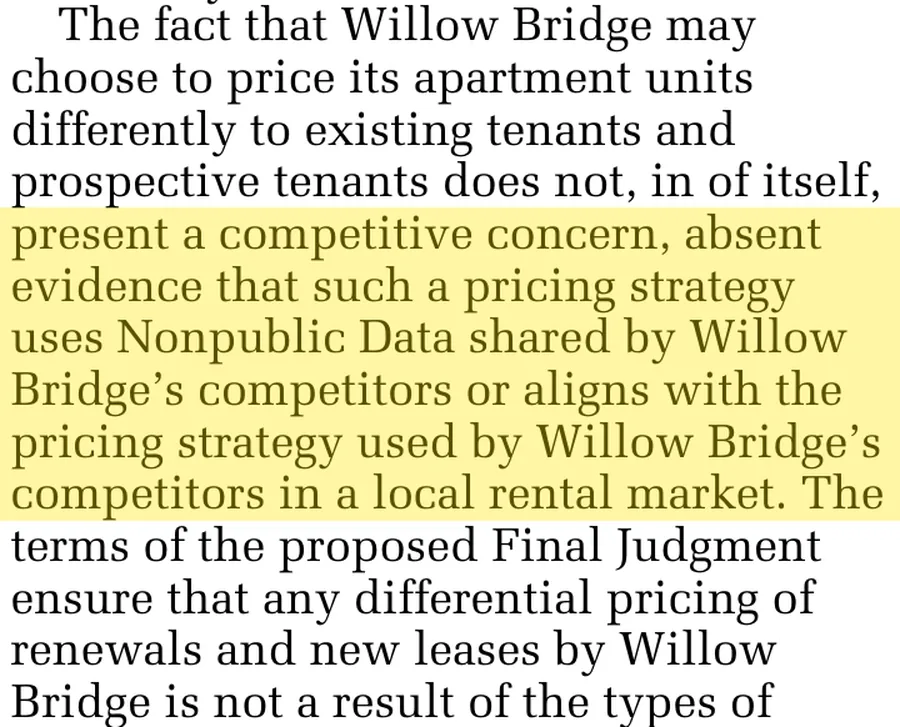
Source: Federal Register, 91 FR 70901 (November 9, 2026), rendered and cropped by us on November 10, 2026. Highlighting is ours.
The response does not repeat MC's dollar figures. It does not say they are wrong either. It says that, without evidence of shared data or aligned strategy, a gap between a renewal price and a listing price is not an antitrust matter.
Where DOJ's answer is stronger than the comment
JD's complaint about the audit reads "a minimum sample of 12 employees is difficult to reconcile with a company managing more than 240,000 units." The Competitive Impact Statement does say Willow Bridge "manages over 240,000 units in the United States" (page 43835). But paragraph VII.A does not cap the audit at 12 people. The annual audit must, "at a minimum, cover: (1) employees (including supervisors) engaged in or overseeing Willow Bridge's revenue management of multifamily rental properties in the United States and its territories; and (2) randomly selected, local, regional, or supervisory employees who manage property operations (at least 12 each year)." The 12 belongs to the second group. The first group has no number.
There is more that JD's comment does not mention. Paragraph VII.B.2 requires the employees who handle revenue management, and those overseeing property management across several properties, to attest under penalty of perjury that they complied with specific paragraphs, and VII.B.1 adds a General Counsel certification. Paragraph VII.D requires a report to the Antitrust Division listing, for each Willow Bridge property that uses a third-party product, the owner and the product used in the previous twelve months. It goes only to the Antitrust Division. JD worries the decree is "too dependent on self-reporting, vendor assurances, small samples, and nonpublic oversight." That is fair for the vendor side. For Willow Bridge's own staff the text leans on sworn attestations as well as sampling.
Where it is thinner than it reads
Three places where the response quotes the decree and leaves out the part the commenter was pointing at.
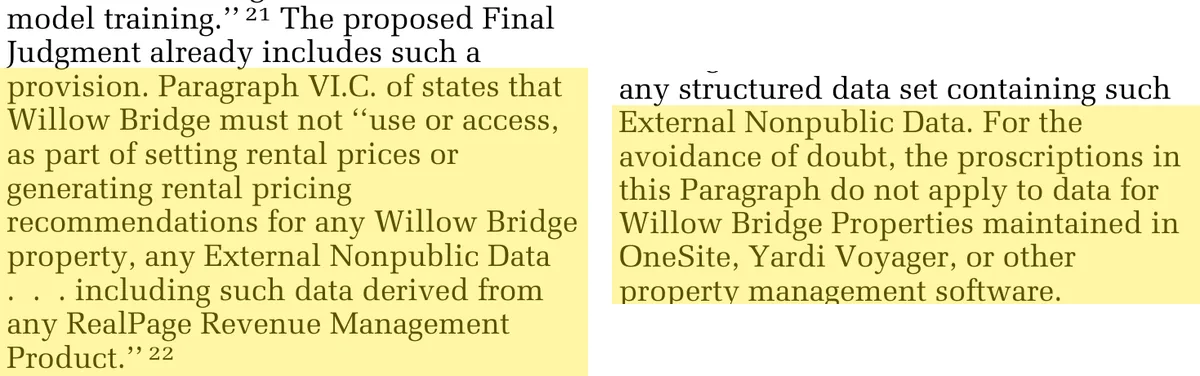
Source: Federal Register, 91 FR 70902 (November 9, 2026) and 91 FR 43831 (July 16, 2026), rendered and cropped by us on November 10, 2026. Highlighting is ours.
The OneSite and Yardi sentence. JD asked for legacy-data controls and flagged that the decree says its identification duties do not apply to data kept in "OneSite, Yardi Voyager, or other property management software." DOJ replied that the decree "already includes such a provision" and quoted the prohibition in VI.C. It did not quote the sentence that ends the same paragraph: "For the avoidance of doubt, the proscriptions in this Paragraph do not apply to data for Willow Bridge Properties maintained in OneSite, Yardi Voyager, or other property management software." That sentence speaks of Willow Bridge's own properties' data, so it may be harmless. The response never says so.
The word "public." DOJ says the decree "already provides that a request for early termination would involve a public notice to the Court (and to Willow Bridge)." Paragraph XIV says that after three years the decree "may be terminated upon notice by the United States to the Court and Defendant that the continuation of this Final Judgment is no longer necessary or in the public interest." So the text does carry a standard, "no longer necessary or in the public interest," and the notice goes to the Court and Willow Bridge. What I could not find in XIV is any step where the public, or a commenter like JD, is told or can respond. DOJ's "public notice" may mean a docket filing; the paragraph does not say.
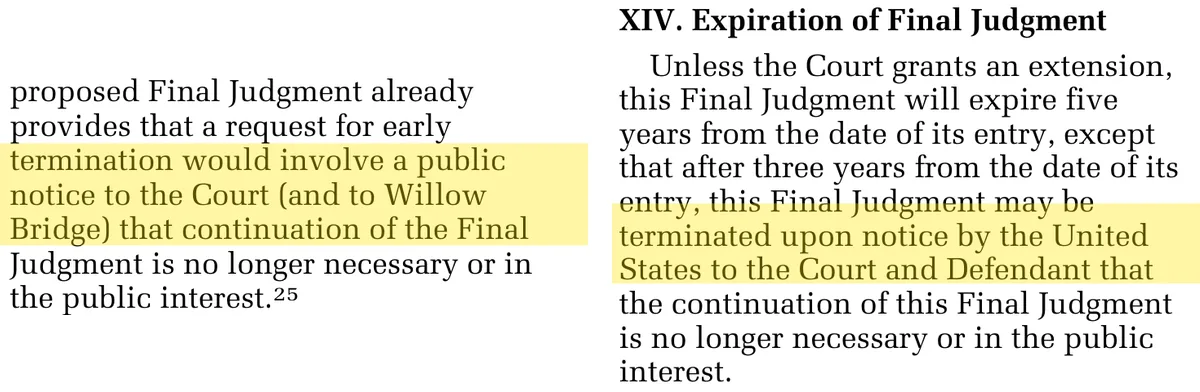
Source: Federal Register, 91 FR 70902 (November 9, 2026) and 91 FR 43834 (July 16, 2026), rendered and cropped by us on November 10, 2026. Highlighting is ours.
The vendor certification. DOJ says the decree "requires third-party revenue management providers to provide certifications." Paragraph V.E.1 adds that "after entry by the Court of the RealPage Final Judgment," Willow Bridge "may license or use a RealPage Revenue Management Product at any Defendant Property without the need to obtain certification." JD raised that exception. Section IV of the response does not answer it, and it does not mention JD's request for a monitor in the first two years or the section on voucher-assisted housing.
The decree's own text does draw a line for software that forces the price, but only for one kind of product. Paragraph V.A.2 applies to a "Third-Party Revenue Management Product" that "requires Willow Bridge to accept, or provides any financial rewards for Defendant to accept, any recommended rental prices." It also reaches a price floor, with one exception: a floor "that Willow Bridge or the Property Owner manually selects and is not based on Nonpublic Data other than Nonpublic Data of the Property Owner of the subject Willow Bridge Property." And paragraph V.D says that "Notwithstanding Paragraphs IV.A-C and V.A, Willow Bridge may license or use a Revenue Management Product that complies with the terms of the RealPage Final Judgment."
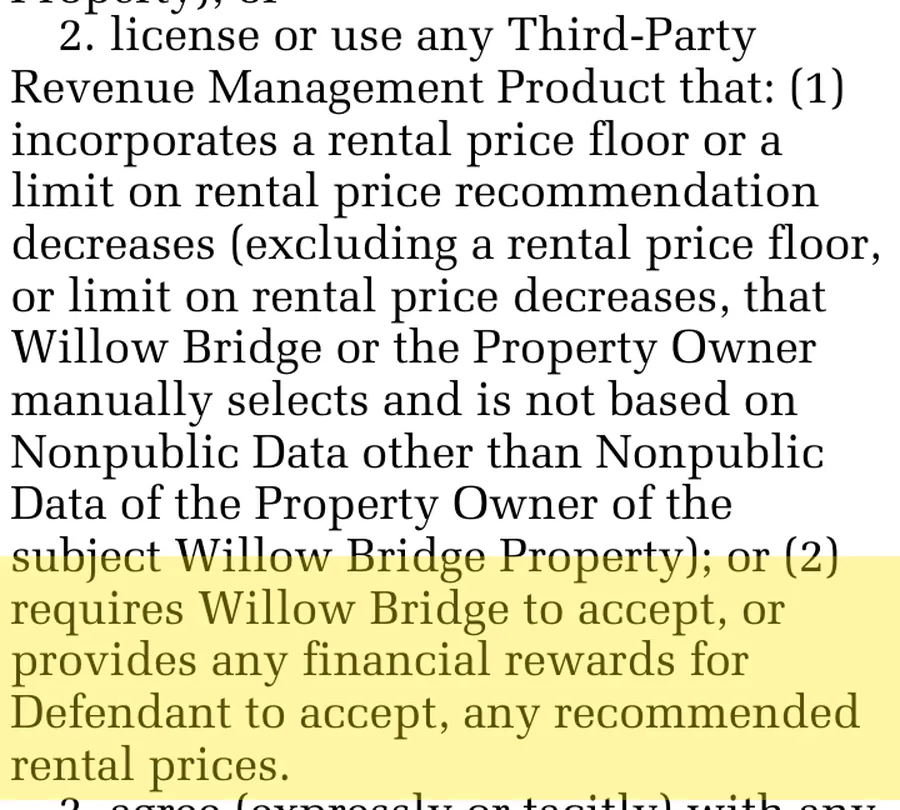
Source: Federal Register, 91 FR 43830 (July 16, 2026), rendered and cropped by us on November 10, 2026. Highlighting is ours.
That is the sharpest fact in the file for me. The Complaint, as DOJ quotes it at Doc. 47 para. 62, describes the daily choice: "the landlord's property manager chooses whether to accept the floor plan price recommendation, keep the previous day's rent, or override the recommendation." V.A.2(2) keeps a third-party tool from forcing or paying for acceptance of its price. I found nothing in paragraphs I through XVI that asks anyone to look at, explain or override a price; the words "human," "override" and "review" do not appear in them. On my reading of the text, a third-party tool that never forces the price and a manager who accepts every recommendation each morning are treated alike. The decree controls the data going in, not the person reading the number coming out.
The Competitive Impact Statement also puts renewals inside the alleged data pool: the information landlords gave RealPage included "how many leases have been renewed, on what terms, and at what price" (page 43834). So the tenant was not wrong to think renewals matter to this case. The remedy covers the inputs. It does not look at the output the tenant saw.
What a small team can take from it
The decree binds Willow Bridge and persons "in active concert or participation with Defendant who receive actual notice" (paragraph III). It is not a rule for your portfolio, and the third-party product limits in V.A start "180 days after entry of the Stipulation and Order." What the response gives you is how DOJ sorts risk, and that is usable.
- Ask your pricing vendor in writing whether its model is trained on, or its runtime recommendations use, other owners' nonpublic data, and whether your data feeds recommendations for competitors. Those are the two tests DOJ names.
- Check that your staff can reject a recommendation, and that no bonus or contract term pays for accepting it. For third-party products that is paragraph V.A.2(2) in plain terms.
- Keep a dated log of overrides. JD asked that Willow Bridge's internal audit look for "unusual override patterns." No decree requires you to keep one, but it is the record that answers a tenant like MC.
- Be ready to explain a renewal quote that sits above your listing price. DOJ will not treat it as an antitrust problem by itself. A tenant who has the screenshots will still ask you, and in New Jersey from July 1, 2027, the FAIR Act has its own ban on rent-setting software that uses competitors' nonpublic data.
If your tools price things other than rent, the same data-in questions run through the FTC's personalized pricing orders and the McDonald's pricing class action. The EU's human-oversight rule for high-risk AI is a separate question, covered in our Article 14 guide, and the decree does not borrow it. A contract clause on data and price acceptance is where this lands for a buyer: see the vendor contract red flags.
What comes next, and what I could not confirm
DOJ says it "will move this Court to enter the proposed Final Judgment after the comments and this response are published in a manner approved by the Court, as required by 15 U.S.C. 16(d)," the Tunney Act. I found no entry date or hearing date. The judge decides whether entry is in the public interest, and I did not read any filing after November 5.
The July 6 filing date is now confirmed three ways: the Competitive Impact Statement on the Justice Department's case page is stamped "Document 202 Filed 07/06/26," the case page lists the Willow Bridge documents as July 6, 2026, and the Federal Register notice of July 16 says the United States filed the proposed Final Judgment and a Stipulation and Order on that date. The docket on CourtListener, last updated with a filing of November 5, shows the RealPage Final Judgment signed on May 19, 2026 (Doc. 194), which V.E.1 depends on, and a Stipulation and Order signed on July 21, 2026 (Doc. 204), which is when the 180-day clock in V.A would start, about January 17, 2027. The docket entry for Doc. 204 does not name the defendant; I read it as Willow Bridge's because it follows Doc. 200 and Willow Bridge's July 16 notice, so treat that part as my inference. Through that docket's last filing I found no motion asking the Court to enter the Willow Bridge judgment, and CourtListener says its copy may not be up to date. The Justice Department's press release was not readable from my connection, and I could not see what MC's screenshots show. I also did not check whether the VI.C last sentence reaches competitor data stored in those systems; the text speaks of data "for Willow Bridge Properties," and DOJ did not explain it.