On October 28, 2026, the FTC ordered Delta, United, JetBlue, Lyft, Uber, DoorDash, Instacart, Target and Walmart to explain, in detail, how they use personal data to set prices and gig workers' pay. Your company didn't get one of these orders, but the 15-page order is the clearest list yet of what the FTC wants to know about a pricing tool: which inputs it uses, who sold it to you, how you tested it and the exact words you show customers. Its definition of "Pricing" includes coupons and discounts, so a personalized discount pop-up counts. The table below turns the order's 23 specifications into questions a small team can answer in an afternoon.
Event date: October 28, 2026 (FTC release published 15:01 EDT; Commission vote 2-0). First reports: AP, published on ABC News at 21:12 UTC the same day.
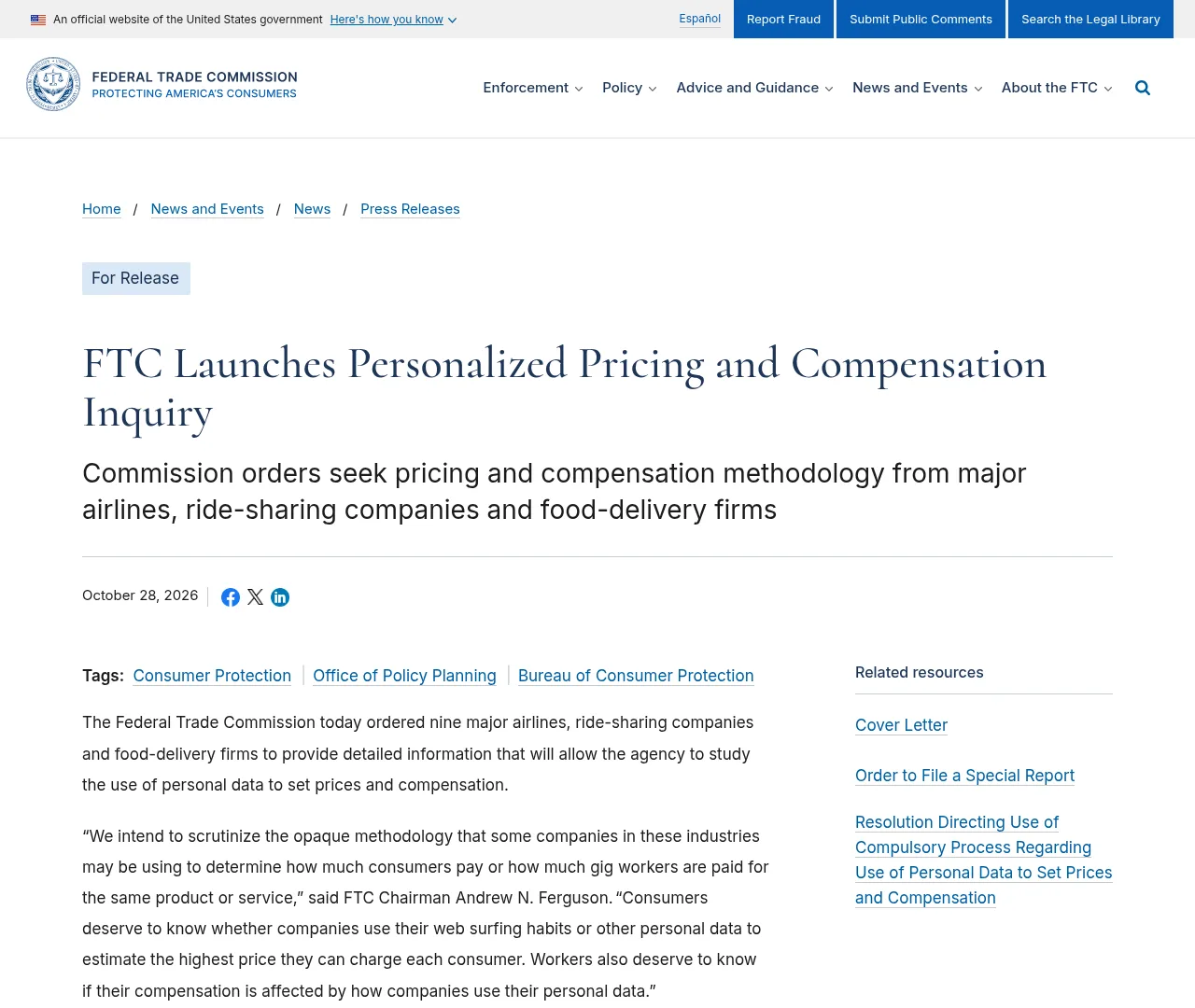
Screenshot: press release, Federal Trade Commission. Captured October 29, 2026.
Who should run this, and what it is not
Run it if your checkout, app or email system can show two customers different prices, coupons or offers based on what you know about them. That includes a discount pop-up aimed at visitors who look ready to buy, a loyalty tier that unlocks private prices, and an AI tool that sets offers from browsing history.
A 6(b) order is a study, not a case. The release says the Commission can "conduct wide-ranging studies that do not have a specific law enforcement purpose," and the recipients have 45 days from receipt to answer. Nothing in it applies to you directly. Two other things do, or soon may. In August the FTC proposed an enforcement policy statement; Chairman Andrew Ferguson said the agency "does not have the legal authority to ban personalized pricing in all circumstances, but businesses that fail to tell consumers how their personal data is being used to set a price may be in violation of the FTC Act." And New York has required a disclosure since November 10, 2025.
The FTC says this study replaces its 2024 one, which "examined only middlemen consultancies rather than the businesses that actually set prices." This time it is asking the sellers, and the questions are the ones it would ask anyone.
What the order counts as pricing, data and a method
The definitions in Attachment A are wider than the headlines.

Screenshot: FTC 6(b) order template, Attachment A, definition O (Matter No. P246202). Captured October 29, 2026.
- Pricing covers "posted prices, markups, coupons, discounts, special offers, promotions, purchasing opportunities, bonuses, and deals," online, in person or in an app.
- Personal Information runs from (a) a name to (x) anything "inferred or derived" from the list. It names "browsing history," "reactions to offered Pricing" and "willingness to pay."
- Methodology is "any formula, algorithm, code, model, statistical or machine-learning technique, or other set of rules," including segmenting customers into groups that get different prices. It "may be employed manually, using software, including SI, or by other means." A spreadsheet rule counts.
- Consumer includes "a business, a device, a user, a billing account, a household." B2B quotes are in.
The order uses "Super Intelligence (SI)," the federal executive branch's term for AI, and defines it as a system that can "make predictions, recommendations or decisions." The release speaks of "superintelligence algorithms." Both mean AI tools, and both sit alongside plain software and manual rules in the order.
One definition reaches your team's own chats. A "Document" includes material in "Collaborative Work Environments," which the order says includes "generative Super Intelligence platforms (e.g., ChatGPT, Copilot, Grok, or Claude)" and Slack. If your pricing logic was worked out in an AI chat, that chat is the kind of record the FTC asks recipients for.
The self-audit: twelve questions from the order
Each row maps one specification to a question for your team and the record worth keeping. We left out the gig-work specifications (11 to 16) unless you pay contractors by the job.
| Order spec | What the FTC asks the nine companies | Your question | Record to keep |
|---|---|---|---|
| 7 | Each Methodology using Personal Information to set Pricing | Which price, coupon or offer changes per customer, and on what data? | One line per tool: what it changes, for whom, since when |
| 7(c)(i) | Each "service or tool (including SI or software)" | Which app, plugin or model does it? | Vendor name, plan, date installed |
| 7(c)(ii) | Each Input, and whether it varies by customer | What fields go in? Location, device, past orders, browsing? | Input list, marked personal or not |
| 7(c)(iv) | How missing values are handled | What happens for a logged-out or new visitor? | Default rule, written down |
| 7(c)(v) | Overrides, including "restrictions imposed on Pricing by jurisdictions" | Do you switch it off anywhere, e.g. New York? | Geo rules and who can override |
| 9 | Sales and revenue where each Methodology was used | How much revenue goes through personalized prices? | A monthly share, even rough |
| 17 | How personal data divides customers into groups | Do segments get different prices or discounts? | Segment names and the rule for each |
| 18 | Where each tool, Input and data type came from; testing and validation | Did you or the vendor test it, and when? | Vendor docs and test dates |
| 19 | Whether you pass tools, Inputs or data to third parties | Does your pricing data feed anyone else's model? | Data-sharing terms |
| 20 | Analyses and A/B tests since January 1, 2021 | Which price tests have you run? | Test name, dates, goal, result |
| 21 | Whether each Methodology raises or lowers prices | Does it ever charge someone more than the list price? | The answer, with the data behind it |
| 22, 23(e) | Exact wording, location, URL and dates of every disclosure, plus screenshots incl. "mouseovers" and "pop-up windows" | What do you tell customers, where, since when? | Dated screenshots of each version |
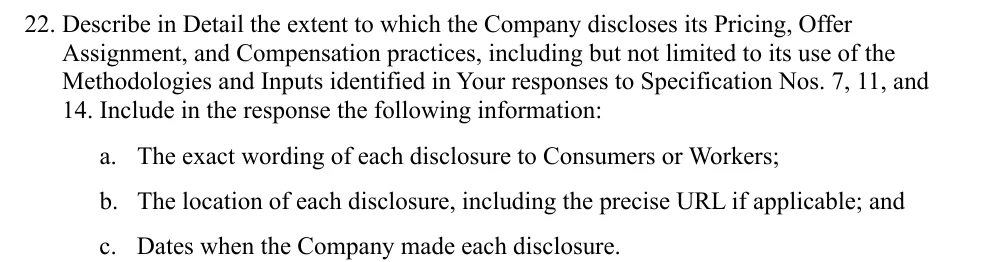
Screenshot: FTC 6(b) order template, specification 22. Captured October 29, 2026.
Two more specs are worth an hour. Specification 6 asks for "retention and destruction" policies for documents and data, and specification 3 asks how many staff work on "Super Intelligence; loyalty or discount programs." The order also tells recipients not to hand over records about individual customers. It wants the method, not your customer list.
How to adapt it for a small shop
If the honest answer to row 7 is "nothing changes per customer," write that down with the date and the tools you checked. Two airlines did the public version within hours. Delta told AP "there is no fare product Delta has ever used, is testing or plans to use that targets customers with individualized offers based on personal data." JetBlue said "all customers have access to the same fares."
If something does change per customer, the disclosure column matters most. The FTC's proposed statement says a disclosure should cover "the fact that the price is personalized, the basis of that personalization, and the type of data used," and that calling a price "specially selected" on its own "would likely be misleading." It also flags a personalized price that looks like a loyalty discount but is "in fact a higher price."
Coupons are where customers notice. On Hacker News in September, SaberTail described Safeway's app coupons: "Some of these get offered to everyone, but others are personalized based on whatever data they have on you." New York's attorney general made the same point in 2025, saying these schemes are most common in apps and loyalty programs "where consumers may receive an individualized discount offering a different, personalized price."
Then check the states you sell into:
| Rule | Status on October 29, 2026 | What it requires | Penalty |
|---|---|---|---|
| FTC proposed enforcement policy statement | Proposed August 19, 2026; not final | Clear disclosure that a price is personalized, why and on what data | FTC Act enforcement |
| New York Algorithmic Pricing Disclosure Act | In effect since November 10, 2025 | "THIS PRICE WAS SET BY AN ALGORITHM USING YOUR PERSONAL DATA" near the price | $1,000 per violation |
| New York One Fair Price Act (A.9349-B/S.8623-B) | Passed both houses June 4, 2026; no delivery to the Governor on the Assembly record | Bans surveillance pricing; allows loyalty programs, coupons and category discounts | AG civil cases for penalties and restitution |
| New Jersey Fair Price Protection Act | Signed July 23, 2026; main provisions from August 1, 2027 | No personal-data pricing on groceries and other necessities | Greater of actual damages or $50,000 per violation |
AP counted pricing bills in "at least 30 states" this year, citing the National Conference of State Legislatures. Our New Jersey FAIR Act post covers New Jersey's grocery law in more detail.
What this checklist doesn't cover
It doesn't cover answering a real 6(b) order; if you receive one, that is a job for counsel. It skips the gig-pay questions (specifications 11 to 16) and antitrust: shared pricing algorithms that use competitors' data are a separate risk, covered in our vendor pricing tool checklist.
What we could not confirm: the FTC published one order template with "[Company name]" left blank, so we can't say whether the nine orders differ. The comment deadline on the August statement is unclear. The FTC's September 3 release moved it to September 25, 2026, but AP reported on October 28 that the agency "has extended the comment period on that policy until Nov. 21." We found no FTC notice of a second extension. Reuters' exclusive on the orders was not readable from our location.
Related Reading
- Maryland Surveillance Pricing Law: Grocery Store Rules
- New Jersey FAIR Act: Algorithmic Rent Pricing Ban Guide
- McDonald's AI Pricing Antitrust Suit
- FTC AI Enforcement Actions 2026: Cases and What Gets Fined
- AI Regulation Deadline Calendar: 2026 and 2027 Dates
- FTC AI Accuracy Policy: 5 Questions for Your AI Vendor
- AI Data Privacy for Small Teams: GDPR and CCPA Checklist