Image: Pexels, used under the Pexels License.
TL;DR On October 7, 2026, the U.S. Treasury announced its first civil penalty under the Outbound Investment Security Program: $200,000 against Amidi, LLC, issued in July 2026. Amidi's Chinese fund invested about $92,478 in the embodied AI company Noematrix on April 19, 2025, and nobody notified Treasury. The penalty was for the missed notification, not a banned deal. Any U.S. company with a foreign fund or subsidiary that invests in Chinese AI needs a pre-close screen and a 30-day filing owner.
The outbound investment rules have been in force since January 2, 2025, and until this week nobody outside Treasury had seen them enforced. On Wednesday, October 7, 2026, Treasury published the first case. It is small, specific and easy to repeat: a U.S. parent, a fund it controls in China, a five-figure check into an AI robotics startup, and no filing.
Event date: October 7, 2026 (Treasury press release; the penalty itself was issued in July 2026). First reports: October 7 and 8, 2026 (South China Morning Post, Kharon, Steptoe). We read the Treasury release, Treasury's enforcement page, the rule text in 31 CFR part 850 and Treasury's enforcement guidance.
What Treasury announced
Treasury's press release, dated October 7, 2026, says that in July 2026 the department "issued its first civil penalty under the Outbound Investment Security Program (OISP)." The target was Amidi, LLC. Treasury penalized Amidi $200,000 "for failing to submit a required notification of an investment by its controlled foreign entity into a Chinese embodied artificial intelligence company."
The facts Treasury gave are short:
- The investor: Amidi's subsidiary, a Chinese fund. Treasury says Amidi "is also the parent entity of the organization that does business as Plug and Play Tech Center."
- The deal: on April 19, 2025, that fund invested approximately $92,478 in Shanghai Qiongche Intelligent Technology Company Limited, known as Noematrix.
- The target: Noematrix "is a private Chinese company that develops artificial intelligence, robotics, and embodied intelligence."
- The violation: no notification was filed. Treasury's enforcement page says the investment was made "without submitting a notification to Treasury as required under the Outbound Investment Security Program."
- How Treasury found it: "as part of its regular and ongoing compliance and market monitoring efforts." Amidi did not self-report, as far as the release says.
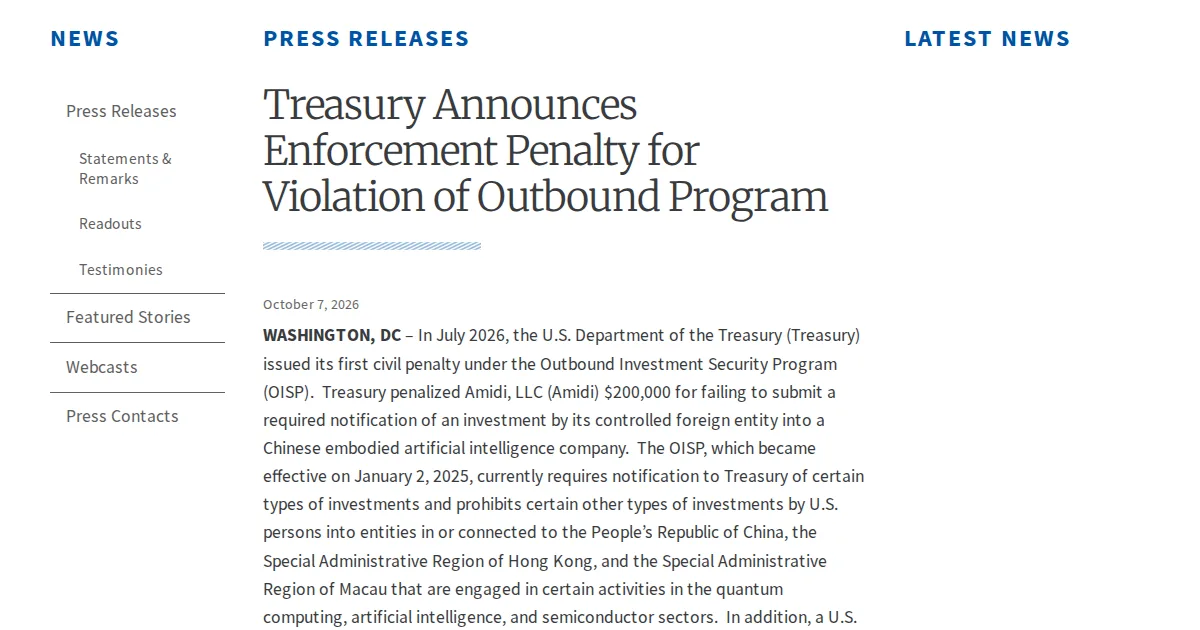
Screenshot: Press release, U.S. Department of the Treasury, October 7, 2026.
Treasury Secretary Scott Bessent framed it as part of "safeguarding U.S. national security through robust investment security measures that preserve America's technological leadership." Christopher Pilkerton, Assistant Secretary of the Treasury for Investment Security, added: "We will continue to ensure that investors comply with the requirements established under the program."
What the penalty was for, and what it was not
This is a paperwork case, and that is the point. The South China Morning Post noted that "the announcement did not describe the investment as prohibited or allege wrongdoing by Noematrix." Treasury's own words describe a failure to notify, nothing more.
The size gap is what lawyers picked up on first. Steptoe's international compliance blog, posted October 8, 2026, put it plainly: "the $200,000 penalty exceeded twice the amount invested," and "notification failures involving relatively small investments can result in significant enforcement exposure." Darshak Dholakia, who heads the law firm Winston Taylor's international trade practice, told Kharon: "Making the first enforcement action about a failure to notify shows how seriously they take those notification obligations."
Two things Treasury left out matter for anyone trying to read the case:
- Which AI test applied. Steptoe notes "the announcement does not specify which AI notification criterion applied or explain how Treasury calculated the penalty." The rule has several AI triggers (listed below), and one of them covers AI intended for "the control of robotic systems." Treasury did not say that was the one.
- Why $200,000. The release points to the aggravating and mitigating factors in Treasury's enforcement guidance, but does not say which ones Treasury weighed.
Kharon's October 8 brief adds its own finding: it describes Amidi as "a California company that funded a Chinese artificial intelligence firm that Kharon found has ties to the country's military-industrial complex." That is Kharon's claim from its own research, not Treasury's. The SCMP also reported that Noematrix's financing announcements "have named Plug and Play China among its investors, alongside Prosperity7 Ventures, a fund under Aramco Ventures."
The rules Amidi missed
The Outbound Investment Security Program lives in 31 CFR part 850. Treasury's guidance, dated January 17, 2025, says it rests on IEEPA and Executive Order 14105. It covers U.S. investments into entities in or connected to China, "the Special Administrative Region of Hong Kong, and the Special Administrative Region of Macau that are engaged in certain activities in the quantum computing, artificial intelligence, and semiconductor sectors."
The guidance sums up the two main duties as to "timely notify" Treasury of a notifiable transaction, and not to undertake a prohibited one. The Amidi case turns on a third duty that is easy to miss.
The controlled foreign entity rule
Under § 850.206, a controlled foreign entity is "any entity incorporated in, or otherwise organized under the laws of, a country other than the United States of which a U.S. person is a parent." Under § 850.402, the U.S. parent must notify Treasury of "any transaction by a controlled foreign entity of that U.S. person that would be a notifiable transaction if engaged in by a U.S. person." It also has to "take all reasonable steps to prohibit and prevent" the foreign entity's prohibited deals, as Treasury's release puts it.
In plain terms: the fund was in China, the check was written in China, and the U.S. parent still owned the filing.
The 30-day clock
Section 850.404(c) says a notification under § 850.401 or § 850.402 is due "no later than 30 calendar days following the completion date of a notifiable transaction." If the U.S. person only learns the facts that make a deal covered after it closes, § 850.403 gives it 30 calendar days from learning them.
The AI triggers
Section 850.217 makes an AI deal notifiable when the Chinese company develops an AI system that is:
- designed for military, government intelligence or mass-surveillance end use;
- intended for cybersecurity applications, digital forensics tools, penetration testing tools, or "the control of robotic systems"; or
- trained using more than 10^23 computational operations.
Section 850.224 moves AI deals into the prohibited column when the system is designed exclusively for, or intended for, military or intelligence and mass-surveillance use, or is trained on more than 10^25 operations (10^24 if it uses mainly biological sequence data). Investments "in any publicly traded security" are excepted under § 850.501.
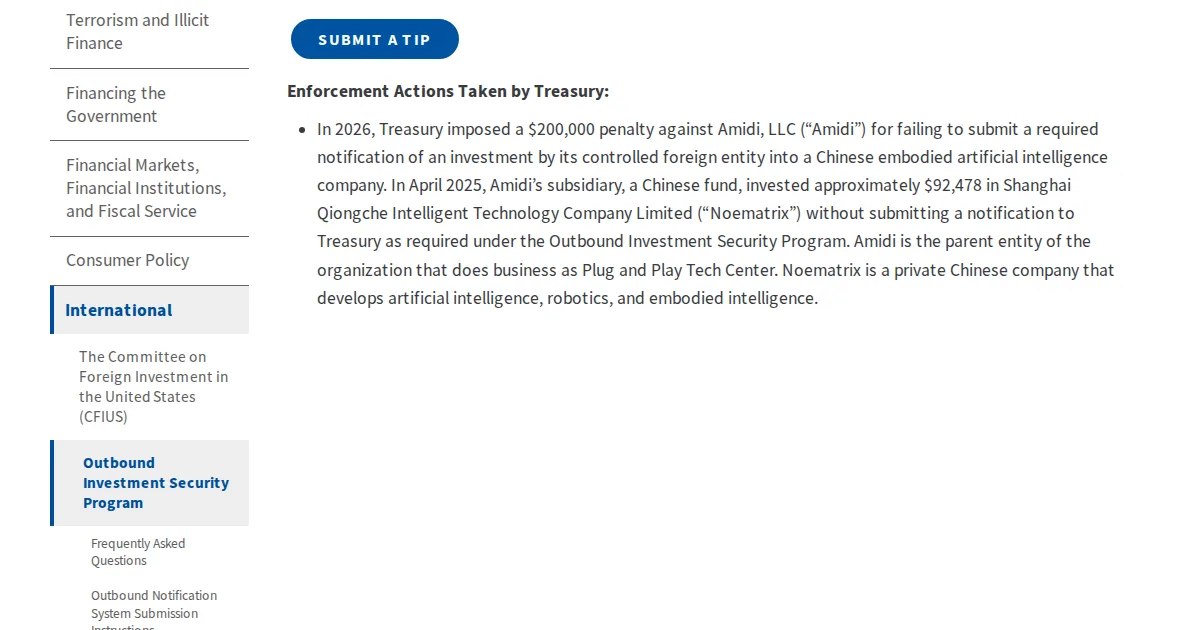
Screenshot: Enforcement page, Outbound Investment Security Program, U.S. Department of the Treasury.
Penalties, and how Treasury weighs them
Section 850.701 caps the civil penalty at the greater of "$250,000, as such amount is adjusted" for inflation, or "an amount that is twice the amount of the transaction that is the basis of the violation." Treasury's inflation notice (FR Doc. 2025-01633) set the adjusted figure at $377,700. Amidi's $200,000 sits below that cap. Willful violations can lead, on conviction, to fines of up to $1,000,000 and, for a person, up to 20 years in prison. Under § 850.703 Treasury can also force the unwinding of a prohibited deal.
The enforcement guidance lists factors Treasury "may consider aggravating or mitigating," and says the list is non-exhaustive. The headings are:
| Factor in Treasury's guidance | What it asks, in short |
|---|---|
| Accountability and Future Compliance | What the action does for compliance going forward |
| Harm | The harm the conduct caused |
| Negligence, Awareness, and Intent | Whether the conduct was careless, known or deliberate |
| Persistence and Timing | How long passed before Treasury became aware |
| Response and Remediation | Whether the company self-disclosed and cooperated |
| Sophistication and Record of Compliance | How experienced the company is and its past record |
The timing factor asks about "the length of time that elapsed after the Subject Person became aware, or had reason to become aware, of the conduct or omission." Under § 850.704, when Treasury judges whether a self-disclosure was timely, it "will consider whether it has learned of the conduct prior to the voluntary self-disclosure." In the Amidi case, Treasury found the deal itself.
Who should read this as a warning
The case is not only about venture funds. Any U.S. company with a foreign subsidiary, fund or corporate venture arm that writes checks into Chinese tech companies has the same exposure, and Treasury's release reminds readers that more is coming. "On December 18, 2025, Congress passed the Comprehensive Outbound Investment National Security Act of 2025 (COINS), which will expand OISP jurisdiction to include investments in additional countries and technology sectors."
Steptoe's advice to investors matches what the case shows: "review whether their diligence and reporting procedures adequately identify potentially covered transactions, including investments by controlled foreign entities, and assign responsibility for required filings."

Image: Pexels, used under the Pexels License.
Copy-paste: pre-close outbound investment screen
Use this before any company in your group, U.S. or foreign, signs an investment in a company in China, Hong Kong or Macau. It is a screen to decide whether to call counsel, not legal advice. Each question points to the rule section we quoted above.
OUTBOUND INVESTMENT PRE-CLOSE SCREEN (31 CFR part 850)

Deal name: ______________________   Expected close date: ___________
Investing entity: ______________________
Screen completed by: ____________   Date: ___________

A. WHO IS INVESTING
[ ] Is the investor a U.S. person, or a foreign entity whose parent
    is a U.S. person (controlled foreign entity, 850.206)?
    If either: the U.S. parent owns the filing (850.401 / 850.402).

B. WHERE IS THE TARGET
[ ] Is the target in or connected to China, Hong Kong or Macau?

C. WHAT DOES THE TARGET BUILD (AI questions, 850.217 / 850.224)
[ ] AI designed for military, intelligence or mass-surveillance use?
[ ] AI intended for cybersecurity, digital forensics,
    penetration testing, or control of robotic systems?
[ ] AI trained on more than 10^23 operations?
[ ] AI trained on more than 10^25 operations (10^24 if mainly
    biological sequence data)?  -> possible PROHIBITED deal, stop.
[ ] Semiconductor or quantum work?  -> send to counsel.

D. EXCEPTIONS
[ ] Is this only a publicly traded security (850.501)?

E. IF ANY BOX IN C IS TICKED AND D IS NOT
[ ] Counsel review requested on: ___________
[ ] Filing owner named (person, not team): ______________________
[ ] Notification due: 30 calendar days after close (850.404(c))
    Due date: ___________   Filed on: ___________
[ ] Facts learned after close? Notify within 30 calendar days
    of learning them (850.403). Date learned: ___________

F. MISSED A FILING?
[ ] Counsel consulted on voluntary self-disclosure (850.704):
    Treasury considers whether it already knew of the conduct.
Keep the completed screen with the deal file. If an old deal by a foreign subsidiary fails section C and nobody filed, that is a question for counsel this week, not at the next audit.
What to watch next
- More cases on Treasury's enforcement page. The page lists the Amidi action under "Enforcement Actions Taken by Treasury." It is the only entry today.
- COINS rules. The release says COINS will widen the program to more countries and technology sectors. We have not read implementing rules and do not describe them here.
- Whether Treasury explains the amount. The release does not say how the $200,000 was set.
Our take
The lesson from the first case is that the trigger was small and the filing was the whole offense. A $92,478 investment by a fund in China turned into a $200,000 penalty because the U.S. parent did not file. Treasury did not call the deal banned and did not accuse Noematrix of anything.
For small teams, the practical risk sits in structure, not size. If your company has any foreign entity that can write checks, a missed filing for that entity is the U.S. parent's missed filing. The rule gives you 30 days after close and the guidance rewards self-disclosure, so the cheapest control is a short screen at signing and a named person who owns the notification. Treasury found this deal through its own monitoring, which tells you how much weight to put on "nobody will notice."
Community reaction
We found no Reddit thread about the Amidi penalty as of October 9, 2026, after searching site-wide and in r/China, r/venturecapital, r/law, r/geopolitics, r/Economics and r/startups. We are not quoting a community reaction rather than borrowing one from an unrelated story.
We did not embed a video or post: Treasury published no video or webcast for this announcement, and a YouTube search found only a news-roundup channel and law-firm webinars that predate the penalty.
How we checked this
We built this article from 7 sources, checked on October 9, 2026: the Treasury press release, Treasury's OISP enforcement page, Treasury's January 17, 2025 enforcement guidance, the January 2025 Federal Register inflation notice, the rule text in 31 CFR part 850, and reports from the South China Morning Post, Steptoe and Kharon. Every number and date in the article matches a quote in our source log. The Wall Street Journal report is paywalled and was not used. eCFR blocks scripts, so we matched the rule quotes by hand against the eCFR copy of part 850 we downloaded the same day.
Last reviewed: October 9, 2026.
Related Reading
- China AI export controls: Qwen, Doubao and GLM enterprise access
- Moonshot AI, the Fable IP claims and Treasury's sanctions threat
- Trump-Xi AI summit: the chip loophole and distillation
- DeepSeek and Chinese AI models under GDPR
- Anthropic export ban and vendor dependency
- AI vendor due diligence checklist
- FTC AI enforcement actions