Image: Pexels, used under the Pexels License.
Your pilot worked. The AI agent drafts most of the first-line support replies now, and someone has already done the math on two salaries. Before that spreadsheet turns into a layoff, write a one-page transition plan. We'd write it even if you're sure the answer is a cut: it's the document that shows you looked at retraining first, it's where you find the public money that can pay for most of that retraining, and it's the record you'll want if an exit is ever challenged.
The plan below runs in six steps. Steps 1 to 3 decide who stays and how they get trained. Steps 4 and 5 are the legal checks for anyone who leaves. Step 6 is what you hand the people who go. The copy-paste version is at the end.
When to use this plan
- Before an AI tool changes what a role does, not after the first resignation or the first notice.
- At any headcount. The federal notice law usually starts at 100 employees, but New York's version starts at 50, California's at 75, and the age-discrimination rules on severance releases start at 20. A ten-person team still needs Steps 1 to 3 and Step 6.
- Not for a performance firing, or a change your union contract already covers. Those have their own process.
Step 1: Map the tasks, not the people
List every role the tool touches and split the work into what the tool now does, what stays human, and what the tool creates. The third column is the one teams skip, and it's usually where the redeployment is.
| Role | Tasks the AI tool now does | Tasks that stay human | New tasks the tool creates | Share of the week freed (estimate) |
|---|---|---|---|---|
| Example: support rep | First-draft replies, ticket tagging | Refunds above a limit, upset customers, edge cases | Reviewing drafts, flagging bad answers, updating the help center | About half |
That third column isn't theory. In a July thread on r/managers about staff anxiety over AI, one manager, u/scronline, described rolling out a lot of automation and finding that "instead of laying off staff, its those same staff that are now babysitting and maintaining those systems."
Our rule of thumb: if the freed share is under half the week, you're redesigning a job, not removing one.
Step 2: Decide retrain, redeploy or exit, role by role
| Decision | Pick it when | What you owe the person |
|---|---|---|
| Retrain in place | The role keeps its human tasks and picks up the review work | Training on paid hours, a start date, a named person to learn from |
| Redeploy | Another team has open work the person can learn in weeks, not months | A written offer with the new title and pay |
| Exit | Nothing is left in the role and there's no open seat | Steps 4, 5 and 6 |
Then tell people, and be specific. The best advice in that r/managers thread came from u/ALundsten: "Reassurance without a visible boundary probably won't land." And: "On jobs, I would separate what you know from what you don't." Put the date you'll decide each role in the plan, and keep it.

Image: Pexels, used under the Pexels License.
Step 3: Price the retraining, then ask for public money
Ask before you budget anything yourself, because this money is built for exactly this. Under the federal Workforce Innovation and Opportunity Act (WIOA), local workforce boards can pay for incumbent worker training: training that helps your current staff keep their jobs or "avert the need to lay off employees," given with your commitment to keep the people you train (20 CFR 680.790). A worker usually needs six months with you, though a training cohort can include newer hires (680.780). A local area can set aside up to a fifth of its adult and dislocated worker money for it (680.800).
You pay part of the cost. The minimum depends on your size:
| Program | Who it covers | Your minimum share or the board's payment | Rule |
|---|---|---|---|
| Incumbent worker training, 50 or fewer employees | Current staff, generally 6+ months with you | At least 10% of the cost | 29 U.S.C. 3174(d)(4)(D) |
| Incumbent worker training, 51 to 100 employees | Same | At least 25% of the cost | Same |
| Incumbent worker training, more than 100 employees | Same | At least 50% of the cost | Same |
| On-the-job training for an employed worker | Someone moving into a job tied to new technology who isn't earning a self-sufficient wage | Board reimburses up to 50% of the wage rate, up to 75% in some cases, with employer size weighed | 20 CFR 680.710, 680.720, 680.730 |
The detail that makes this cheap: the wages you pay while someone is in training count toward your share, in cash or in kind. The board sets the actual share within those floors and weighs how many people you train, their pay after training and what training you already offer (680.810).
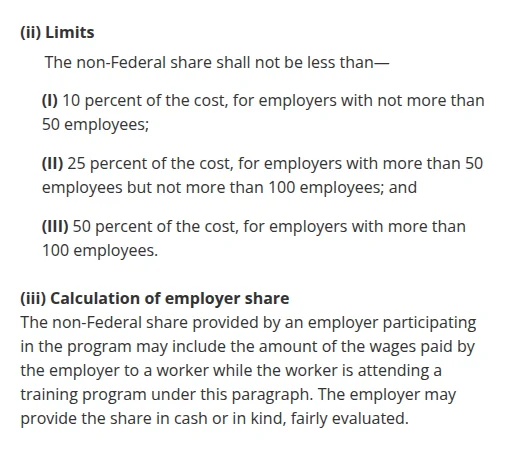
Screenshot: 29 U.S.C. 3174(d)(4)(D), Cornell Legal Information Institute, checked October 21, 2026.
Who to call. Your state's Dislocated Worker Unit, or the local American Job Center. The Labor Department's Rapid Response page pitches its employer services as a way to "avoid future layoffs, access incumbent worker training programs and skilled job seekers." Rapid Response must show up when a WARN notice is filed, whatever the headcount, or at a mass layoff your state defines at no more than 50 workers (20 CFR 682.305). Below that, call anyway: layoff aversion work includes helping employers manage a reduction in force (682.320).
What to put in the training. In August 2025 the department encouraged state and local boards to use WIOA money for AI literacy, and in February it published an AI Literacy Framework with five content areas and seven delivery principles. The Congressional Research Service summary puts it plainly: understand how AI works, use it responsibly, learn it inside your own occupation, and build the human skills around it (judgment, communication, problem-solving). A training request that pairs "using the new tool well" with the review and exception work from your Step 1 map fits what the department has been asking boards to fund. That's our reading, not a promise of approval.
Step 4: For roles that still go, run the notice check
Fill this in even when the answer is "none applies", and write down the headcount you used.
| Law | Who's covered | What triggers it | Notice | AI-specific part |
|---|---|---|---|---|
| Federal WARN | 100 or more full-time employees (DOL employer guide) | Plant closing with 50+ job losses at one site, or a mass layoff of 50-499 (if 33% of the site) or 500+, in any 30 days (20 CFR 639.3) | 60 days | None |
| New York WARN | 50 or more full-time employees in New York | Closing affecting 25+; layoff of 25+ full-time (if 33% of the site) or 250+ (NY DOL) | 90 days | Filing form asks whether the job losses relate to "technological innovation or automation", then which technology (since March 2025, per a law firm summary) |
| California Cal-WARN | A site that employed 75 or more in the past 12 months | Layoff of 50+ in any 30 days (SB 951 text) | 60 days | From January 1, 2027: if AI is the whole or a substantial cause, the notice opens with "This notice is for a technology displacement" and lists the job functions automated and the type of technology |
A few things the table can't hold:
- Federal WARN has no pay-in-lieu option. The employer guide says plainly that "Neither the Act nor the regulations recognize the concept of pay in lieu of notice." Missing it costs back pay and benefits for up to the notice period, plus a civil penalty of up to $500 a day for not notifying local government.
- New York points you to Shared Work first. Its WARN page suggests the program, which pays partial unemployment benefits while staff work reduced hours, before you file. The governor's FutureWorks Commission on AI and jobs is due to send recommendations by the end of December, so expect more here.
- California's notices go public. SB 951 (Chapter 860, signed September 30) has the Employment Development Department post a summary of technology displacement notices and a quarterly statewide tally. Our SB 947 and SB 951 guide has the full text and the related rule on AI in firing decisions.
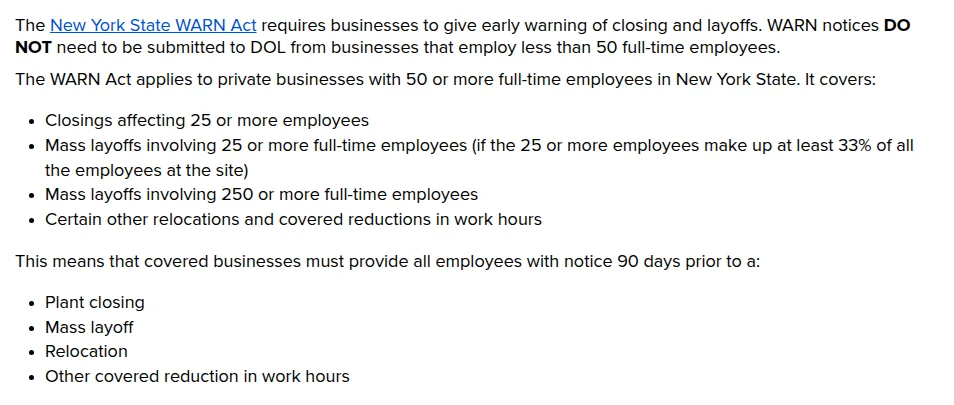
Screenshot: "How WARN works", New York State Department of Labor, checked October 21, 2026.
Step 5: If anyone signs a release, follow the over-40 rules
If you have 20 or more employees, the federal age-discrimination law covers you (29 U.S.C. 630) and protects anyone 40 or older. When you offer severance in exchange for a release of claims, the release from an older worker only holds up if it meets the waiver rules in 29 CFR 1625.22:
| Situation | Time to consider | Time to revoke after signing | Also required |
|---|---|---|---|
| One person leaving | At least 21 days | At least 7 days | Written advice to consult an attorney |
| A group or class of employees offered an exit program | At least 45 days | At least 7 days | A written list of the job titles and ages of everyone selected, and the ages of those in the same unit who weren't |
If two or more people leave in the same AI reorganization, ask counsel whether that's a group program before you hand out the paperwork. The age list is the part teams forget, and it's the part that sinks the release.
Step 6: Point the people who leave at retraining money
Everyone you let go can walk into an American Job Center for dislocated worker services. In some places there's extra money right now. On October 19 the department awarded $95.5 million in Rapid Reskill grants to 20 projects in 17 states, aimed at getting laid-off workers into paid work within six months of enrolling. The June notice (TEGL 15-25) had announced about $50 million, so the final pot nearly doubled. The research service's summary adds that participants' layoffs don't have to be AI-related.
| Recipient state | Grantees |
|---|---|
| AK, CA, CT, FL, KY, LA, ME, MI, NC, NE, NH, OH, OK, RI, WA | One each |
| NY | Three (state Department of Labor, Per Scholas, Pursuit) |
| TX | Two |
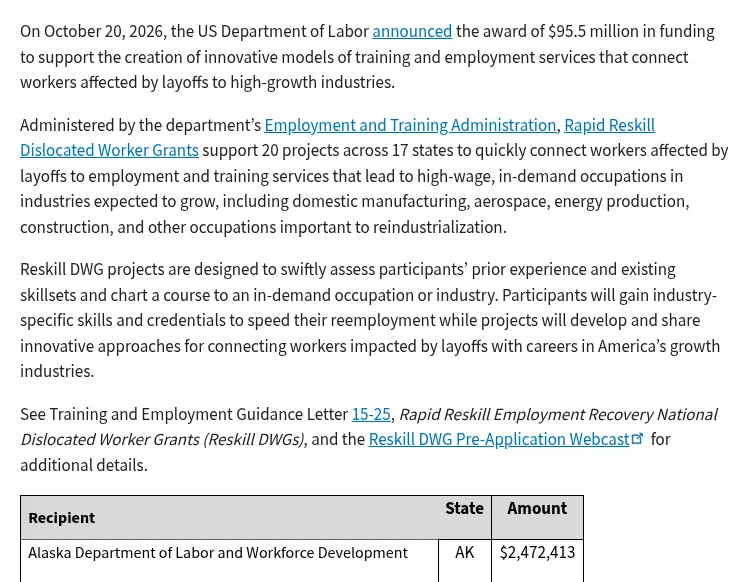
Screenshot: Reskill DWGs, U.S. Department of Labor, Employment and Training Administration, checked October 21, 2026.
Be honest with people about fit. These grants lean toward manufacturing, aerospace, energy and construction. For a former support rep or copywriter, the regular dislocated worker training at the job center is the likelier route, and that's fine: put the job center's address in the exit letter rather than a vague "we'll support your transition."
What to keep on file: the plan
Copy this into a doc, fill one per rollout, and keep it with the tool's approval record (our AI workforce policy template is the policy that sits above it).
AI WORKFORCE TRANSITION PLAN
Tool and go-live date:
Plan owner (name):
Written on:                Next review:

1. TASK MAP (one row per role)
Role | Tasks the tool does | Tasks that stay | New tasks | Share of week freed

2. DECISION PER ROLE
Role | Retrain / Redeploy / Exit | Reason | Person told on (date)

3. TRAINING AND FUNDING
Course or program | Paid hours | Cost | Board or job center asked (date) | Answer | Our share

4. NOTICE CHECK (fill even if none applies)
Headcount used: total __  full-time __  by state __  (date counted)
Federal WARN applies?  Y / N   Why:
New York WARN applies? Y / N   Automation checkbox answer:
Cal-WARN applies?      Y / N   Technology displacement fields (from Jan 1, 2027):
Other states checked:

5. EXITS
Role | Last day | Release given (date) | Consider period ends | Revocation ends | Age list attached Y / N
Job center referral given (date):

6. SIGN-OFF
Approved by:                Date:
What this plan doesn't cover
- Who gets picked inside a role. Selection by an algorithm or a score has its own discrimination risk; see our EEOC AI guidance checklist.
- Other states' notice laws. We checked federal WARN, New York and California only. Check your own state before Step 4 says "none applies."
- Union contracts and anything outside the US.
What we could not confirm: New York's automation checkbox comes from a law firm summary, because the state DOL's WARN page doesn't describe the form. The department's grant page dates the Reskill awards October 20, a day after the news release; we use the release date. Whether your local board has incumbent worker money left this program year is up to its own policy, so ask before you budget on it.