Image: Pexels, used under the Pexels License.
On September 1, 2026, the Justice Department filed a Statement of Interest in the consolidated OpenAI copyright cases in the Southern District of New York, In re OpenAI, Inc. Copyright Infringement Litigation. Its position is plain: copying written works to train a large language model is fair use, and the court should reject any argument that it violates copyright law.
Our read: this helps your vendor's defense and changes little in your contract. The brief argues one question, training, to one judge. Outputs, how the content was collected and non-US law are where they were.
Correction, October 15, 2026: an earlier version quoted the brief as saying training "generally qualifies as fair use" (those words aren't in it), called it the first time the government took a side (we couldn't confirm that), said the brief does not address outputs (it says outputs raise distinct questions and can be judged case by case), described the DOJ as negotiating an equity stake (reports say the administration and OpenAI discussed a 5% stake), gave a count of newspaper publishers suing that we couldn't confirm, and said a secondary liability claim against Microsoft for infrastructure support remains active (on August 6 the court refused to let the Times add new contributory theories against Microsoft, and the theory it had pleaded is the one the Supreme Court rejected in Cox).
What the brief argues
The filing runs 20 pages and rests on 28 U.S.C. § 517, which lets the Justice Department "attend to the interests of the United States" in any federal suit without the court's leave. Its arguments, in order:
- National interest. The government says rules that make it harder to build AI in the US "threaten national security and give a competitive advantage to foreign adversaries."
- Training is "exceedingly transformative." That is the heading of its first-factor argument. Training, it says, "does not make any copied works accessible to the public."
- Licensing fees would distort the market. It argues that only the largest technology companies could afford them and that they "would disproportionately benefit legacy media outlets."
The brief is careful about scope. It describes three stages, collection, training and output, and says "each stage may present distinct questions of copyright law." It then argues only the training stage.
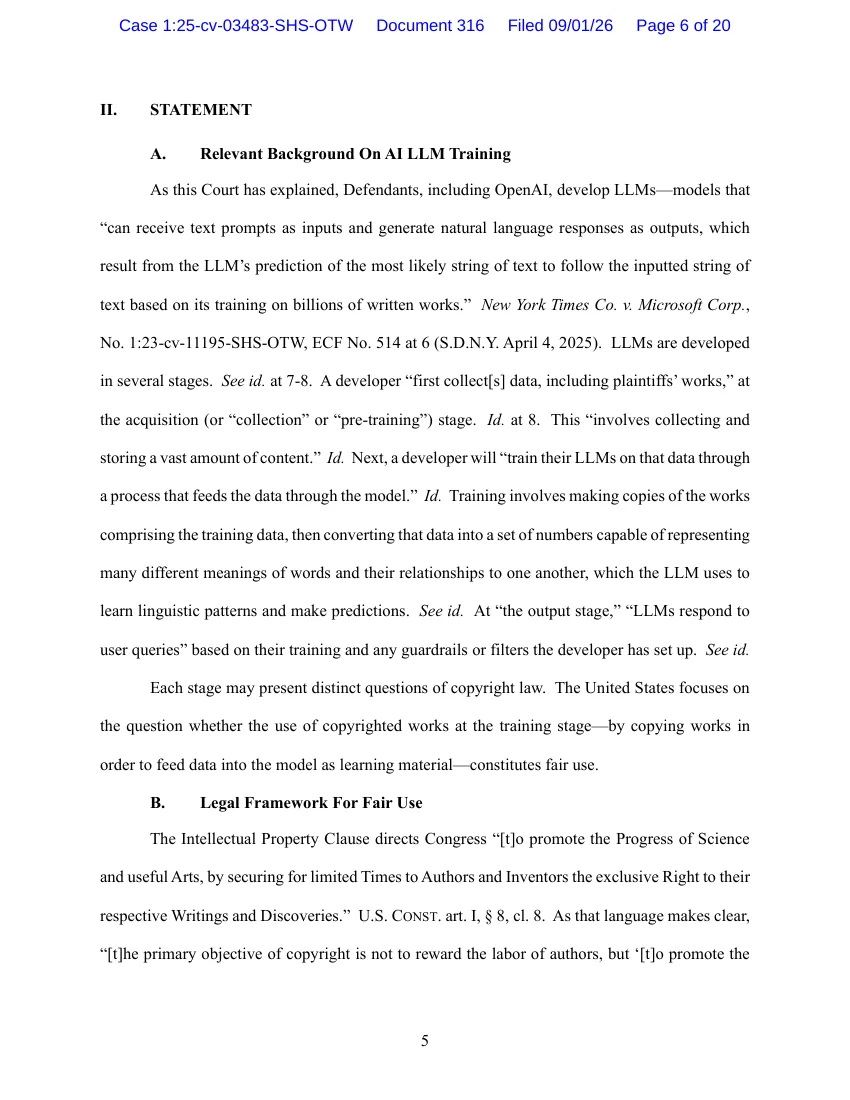 Screenshot: Statement of Interest of the United States, ECF No. 316, S.D.N.Y.
On outputs it says little. A footnote argues that a "tiny sliver of anomalous reconstructive outputs" should not support a remedy that threatens training, and the fair use section adds that "particular outputs can be assessed case-by-case." That leaves output claims open.
Associate Attorney General Stanley Woodward called the brief historic on X, the New York Daily News reported. Above the Law pointed out that the administration and OpenAI have reportedly discussed a 5% government stake in the company, which the brief doesn't mention, and NOTUS described the filing as a break from the department's past support for copyright owners.
What happened the same week
Three days later, on September 4, the Seattle Times and Newsday sued OpenAI and Microsoft in the same court. Their complaint says the companies scraped their sites with bots, "bypassing Plaintiffs' paywalls," and that the models can reproduce their articles. It pleads copyright, DMCA and trademark dilution claims and asks for the impoundment or destruction of "all LLMs and training datasets incorporating Plaintiffs' works."
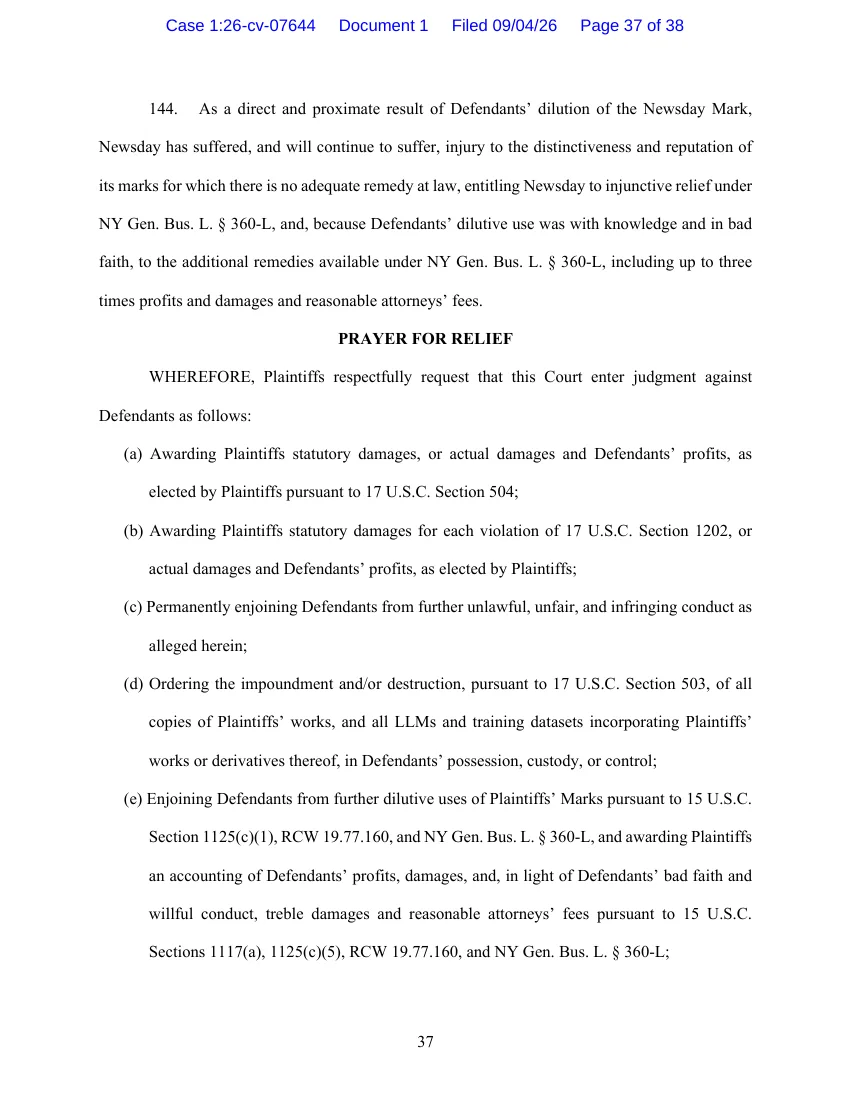 Screenshot: Seattle Times Co. v. OpenAI, complaint, S.D.N.Y. Case 1:26-cv-07644.
The same Friday, both sides in the main case were due to file summary judgment motions before Judge Sidney Stein, so the brief arrived just ahead of them.
Readers on r/COPYRIGHT went straight to the gap the brief leaves. u/building-wigwams-22 put it this way: "Was the content acquired legally? Then you can train your AI on it. Was it acquired some other way? Then current law covers this and the AI aspect is not relevant." That is the Seattle Times theory in one line, and it is why "training is fair use" doesn't end the case.
Where the New York Times case stands
The Supreme Court's decision in Cox Communications v. Sony Music Entertainment held that "material contribution" is not a valid theory of contributory copyright liability. The Times, the Daily News and CIR then agreed to drop their contributory claims that rested on that theory and on end users' infringement.
On August 6, 2026, Judge Stein dismissed those claims against OpenAI and Microsoft with prejudice, dismissed the Times' and Daily News' trademark dilution claims, and denied their request to add new "inducement" and "services tailored to infringement" theories against Microsoft. Allowing the switch, he wrote, would require reopening discovery.
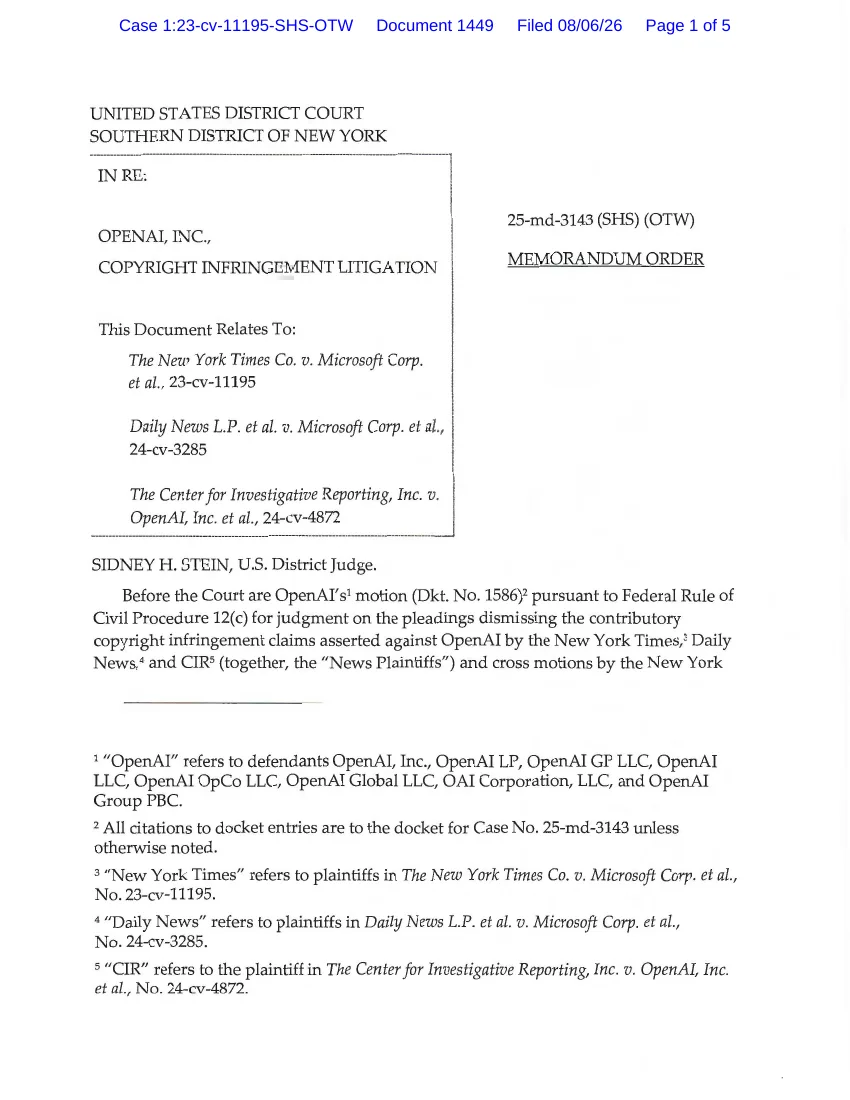 Screenshot: Memorandum Order, ECF No. 1449, S.D.N.Y., August 6, 2026.
The Times and Daily News had pleaded that Microsoft "materially contributed" to OpenAI's infringement, which is the theory Cox rejected, and they now can't swap in a new one. Fair use itself was not decided in this order; it comes with summary judgment.
Four clauses to check with your vendor
1. Does the indemnity cover claims about training data, or only outputs? Ask in writing whether the vendor will defend a claim that the data used to build the model infringed someone's copyright, not only claims about what the model produced for you. The brief makes that defense stronger; it doesn't put the cost on the vendor.
2. Does it cover output reproduction, and on what conditions? Output claims are the part the brief leaves to case-by-case review. Check the conditions: Microsoft's Customer Copyright Commitment, for example, says its "required mitigations must be enabled," including protected material detection in Azure OpenAI. Know which settings you must keep on.
3. Which law governs, and where are your users? The brief is about US fair use. In the EU, the text and data mining exception in Article 4 of the 2019 Copyright Directive applies only where rightholders have not "expressly reserved" their works, for example by machine-readable means. If you serve EU users or your contract names non-US law, the September 1 brief does not help you.
4. What happens if the fair use defense loses? The Seattle Times and Newsday ask for destruction of models trained on their work. Ask what the vendor owes you if a court orders a model withdrawn or retrained: notice, a replacement model, a price cut or a right to terminate.
Our take
The brief is the strongest signal yet that Washington wants AI training treated as fair use, and your vendor's lawyers will cite it. It is not a ruling, and it argues the one question that matters least to a buyer. The claims that can reach you, about outputs and about how content was collected, are moving forward in the same courtroom. Spend an hour on the four clauses above at your next renewal. The AI output copyright risk guide covers the output side, and the Bartz settlement analysis shows what a pirated-data claim cost one vendor.
Related Reading
- Superintelligence ban bills and OpenAI board shift: 4 enterprise governance questions
- AI output copyright risk: commercial use guide 2026
- AI vendor contract red flags: what to catch before signing
- Agentic AI vendor contract clauses: what to add in 2026
- Anthropic Bartz copyright settlement: training data analysis
- Generative AI copyright ownership: who owns the output?
- AI training data copyright: what the Bartz ruling means
- AI governance for legal teams and general counsel
- FTC AI enforcement actions 2026
- California 2026 AI bills: Newsom September deadline tracker