Marketing copy, product documentation, code, images and books now come out of generative AI tools every day, and the ownership question has a settled answer in the US: on March 2, 2026 the Supreme Court declined to hear Thaler v. Perlmutter, leaving in place the rule that copyright needs a human author.
The short version: under both US and EU copyright law, content generated by AI without meaningful human creative input is in the public domain. Anyone can copy it, sell it, or use it without permission. But the line between "AI-generated" and "human-authored with AI assistance" is real and navigable. This guide explains where that line sits, what the major cases say, what your vendor contracts cover, and how to document the human contribution that makes protection possible.
The baseline ruling: what the US Copyright Office decided
The US Copyright Office set out its position in registration guidance published March 16, 2023 (88 FR 16190), after applications for AI-produced works, and expanded it in its January 2025 report on copyrightability.
Copyright in the United States requires human authorship. The Copyright Act's protection extends to "original works of authorship," and "authorship" has been interpreted by courts for over a century to require human creativity. The Copyright Office applied this principle directly to AI-generated content.
In the 2023 guidance and later decisions, the Copyright Office held that content generated by AI without human creative input cannot be registered. Its January 2025 report goes further on prompts: "Based on the functioning of current generally available technology, prompts do not alone provide sufficient control." When a user types a prompt and the system produces the content, the expressive choices were made by the machine, so there is no human author in the legal sense.
The Office acknowledged that AI-assisted works are different. When a human makes genuine creative choices in selecting, arranging or editing, the human-authored and human-selected portions may qualify for protection. The AI-generated portions remain unprotectable, and the human must be able to identify what they contributed.
The Thaler v. Perlmutter decision
Thaler v. Perlmutter is the case that tested the human authorship requirement. Stephen Thaler built a system he called the "Creativity Machine," which made a picture he titled "A Recent Entrance to Paradise." He applied to register it listing the Creativity Machine as the sole author and himself as the owner. The Copyright Office refused, the District Court for the District of Columbia upheld the refusal in August 2023, and the D.C. Circuit affirmed on March 18, 2025.
The appeals court held that "the Copyright Act of 1976 requires all eligible work to be authored in the first instance by a human being," and did not reach Thaler's argument that he was the author by making and using the machine, "because that argument was waived before the agency." The Supreme Court denied Thaler's petition for certiorari (No. 25-449) on March 2, 2026.
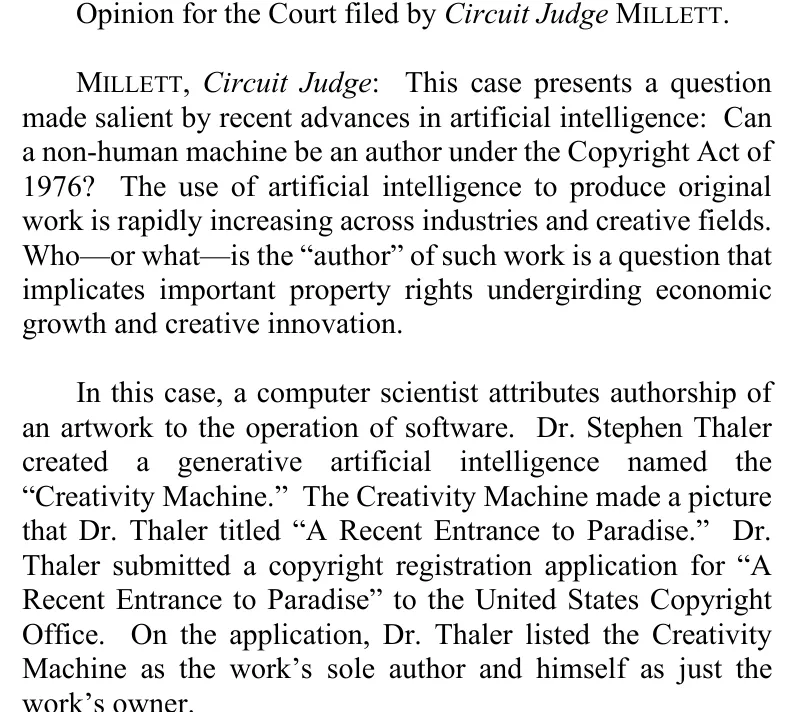
Screenshot: Thaler v. Perlmutter, No. 23-5233 (D.C. Cir. March 18, 2025), opinion page 2.
The practical implication for businesses is clear: if you generate an image, a piece of text, or code using an AI tool and you do not make substantial creative choices in the process, you have no copyright in the output. Your competitors can copy it freely.

What you CAN protect
The harder and more practically important question is what qualifies for protection when humans and AI tools work together.
Prompting alone is not enough. The Copyright Office's January 2025 report says that "prompts do not alone provide sufficient control" over the output, however detailed the prompt. A prompt specifying "a melancholy winter landscape with a solitary farmhouse and a woman in a red coat at dusk" still leaves the expressive execution to the machine. What the report does protect is human expression that remains perceptible in the output (for example, your own drawing or text used as input) and the creative selection, arrangement and modification of outputs, covered below.
Selection among multiple outputs is potentially protectable. If you generate 50 AI images and select one because of particular compositional choices it makes, the selection and arrangement may reflect human authorship in the same way that a photographer selects from many shots. Document what you chose and why.
Arrangement and compilation is a well-established copyright category. A collection of AI-generated and human-authored elements arranged with human creative judgment can create a protectable compilation, even if the individual AI-generated pieces are not independently protectable.
Substantial human editing creates protectable expression. If you take AI-generated text and substantially rewrite it, your rewriting is protectable even if the underlying AI output is not. The practical challenge is that you must be able to separate your contribution from the AI's.
Works where AI assistance is incidental to substantial human authorship retain full protection. A human author who writes 90% of an article and uses AI to suggest a few sentence revisions has a fully protectable work.
What you CANNOT rely on
Several common assumptions about AI copyright are wrong.
You cannot assume that AI-assisted content is automatically protectable just because you were involved in creating it. Minimal involvement, such as typing a brief prompt and accepting the output unchanged, does not create copyright protection. The human contribution must be genuinely creative, not merely mechanical.
You cannot rely on your AI vendor's terms of service to create copyright protection. OpenAI's terms assign output ownership to users. Anthropic and Google do the same. But a contractual assignment of rights only functions if the rights exist. If there is no copyright in AI-generated output under law, there is nothing for the vendor to assign. The vendor's terms govern the contractual relationship between you and the vendor; they do not create intellectual property rights under copyright law.
You cannot use registration as a substitute for actual protectable authorship. The Copyright Office will reject applications for purely AI-generated content. Attempting to register by concealing AI involvement would be fraudulent and could invalidate any registration obtained.
The EU position
The EU has not enacted specific AI copyright legislation, but its approach is broadly consistent with the US human authorship requirement, with some differences in how human contribution is assessed.
Under EU copyright law, works are protected if they reflect the author's own intellectual creation. This formulation, established by the Court of Justice of the EU in cases like Infopaq and Painer, requires that the work involves free and creative choices by the human author. AI-generated content without human creative choices fails this test.
The EU AI Act, which is in phased application as of 2026, requires providers of general-purpose AI models to make publicly available a summary of training data that may be subject to copyright. This requirement addresses the input side (what was used to train the model) rather than the output side (who owns what the model produces). These are separate legal questions.
The EU approach treats AI as a tool. The human operating the tool may claim copyright if they made free and creative choices in using it, and the Court of Justice has not yet ruled on an AI-generated work.
IP clauses in AI vendor contracts
Understanding what your AI vendor's terms say about output ownership is important for commercial work, even given the limitations discussed above.
OpenAI's terms say that, as between you and OpenAI and "to the extent permitted by applicable law," you "own the Output," and OpenAI assigns "all our right, title, and interest, if any, in and to Output."
Anthropic's consumer terms say "we assign to you all of our right, title, and interest" in Outputs, "if any," subject to compliance with the terms.
Google's Gemini API terms say "Google won't claim ownership over that content" and reserve the right to generate the same or similar content for others.
One area where vendor terms matter regardless of copyright questions: indemnification for third-party IP claims. Some vendors (including OpenAI with its Copyright Shield program for certain enterprise customers) offer indemnification if a third party claims their copyrighted training data appears in outputs. Others do not. If you are producing commercial content at scale, review the indemnification terms carefully.
Work-for-hire implications
Work-for-hire doctrine affects who holds whatever rights exist in AI-assisted content.
For employees, content created within the scope of employment is owned by the employer as a work made for hire. This applies to protectable AI-assisted content the same way it applies to traditional employee-created content. If your employee uses AI tools to create marketing materials that involve sufficient human authorship, your company owns the copyright.
For contractors, the default rule is different. Copyright vests in the contractor unless the work falls within one of the statutory categories of works that can be made for hire by contract and there is a written agreement. Most marketing copy falls outside those categories, so a work-for-hire clause does not move ownership; you need a signed written assignment of copyright. Review contractor agreements to confirm that AI-assisted output is covered by the assignment.
For KDP authors and content creators: if you self-publish or create content for commercial licensing, your ability to license and enforce rights depends on whether you can document human authorship. Amazon's KDP platform now requires disclosure of AI-generated content, but separate from disclosure, your ability to enforce rights against infringers depends on copyright protection. Plan your human contribution before you generate.
Practical documentation framework
If you produce AI-assisted content for commercial purposes, build documentation habits from the start.
Keep a record of your prompts, including iterations and the creative intent behind them. Note what alternatives the AI generated and which you chose and why. Track substantial edits you made to AI outputs. For image work, note post-processing choices. This does not require elaborate systems: a simple log file or a folder with versioned outputs and brief notes is often sufficient.
When registering copyright in AI-assisted works, identify the human-authored elements and disclaim AI-generated material that is more than de minimis, as the Copyright Office's March 2023 registration guidance requires.
For high-value commercial content, consult IP counsel before assuming protectability. The law is developing and the specific facts of how the work was created matter to the analysis.
Correction (October 28, 2026): Earlier versions said Thaler's image was made by his "DABUS" system (it was the "Creativity Machine"), described the August 2023 District Court ruling as the last word (the D.C. Circuit affirmed on March 18, 2025 and the Supreme Court denied review on March 2, 2026), dated the Copyright Office guidance February 2023 and "2024" (it was published March 16, 2023), said the Office had indicated that extensive prompting can be evidence of authorship (its January 2025 report says prompts alone do not provide sufficient control), and said a written work-for-hire agreement transfers ownership of contractor work outside the statutory categories (a written assignment is needed).
Related Reading
- DOJ AI training fair use brief 2026: 4 contract clauses to review
- Amazon KDP AI-generated books: surge data and the rules
- EU AI Act GPAI provider self-test 2026
- California AB 2013 AI training data transparency 2026
- Anthropic vs OpenAI GDPR compliance 2026
- AI vendor evaluation checklist
- AI governance guide for small teams
- Tennessee ELVIS Act AI voice likeness compliance 2026
- Seedance 2.5 enterprise risk checklist: before your team uses ByteDance AI video
- SB 942 Enforcement: Midjourney Has No Watermark, Fines Begin
- Minnesota Nudify App Ban Is Live After xAI Loses First Round
- Elvis Presley Anthropic Lawsuit: A Lyrics Data Checklist
- Like Company v Google (C-250/25): When RAG Chatbots Infringe