Image: Pexels, used under the Pexels License.
This is for small law firms and for any team that drafts with AI and then files, publishes or sends the result. On October 22, 2026 the US Court of Appeals for the Fifth Circuit took a case away from a federal district judge whose orders contained AI-generated errors. Our verdict: the AI tool caused the first mistake, but the court's reasons for reassigning the case lean on how the mistake was handled afterwards, and that part is a process any five-person team can fix this week.
Event date: October 22, 2026, opinion filed in Jackson Federation of Teachers v. Fitch, No. 25-60496. First reports: October 22, 2026, by Bloomberg Law and Law.com; Reuters followed that evening.
What the Fifth Circuit did
The panel vacated a preliminary injunction that Judge Henry Wingate of the Southern District of Mississippi had entered against House Bill 1193, Mississippi's April 2025 law on diversity, equity and inclusion programs in public schools and colleges. Then it went further. It directed the chief judge of that district "to assign this case to a different district judge for all further proceedings."
Judge Jerry Smith wrote the opinion, joined by Judge Kurt Engelhardt. Judge Catharina Haynes concurred only in the last paragraph, the one that vacates, remands and reassigns. The court called reassignment an "extraordinary" and "rarely invoked" power. It imposed no sanction, and reassignment isn't judicial discipline: the order moves this one case to another judge and says nothing about Wingate's other cases.
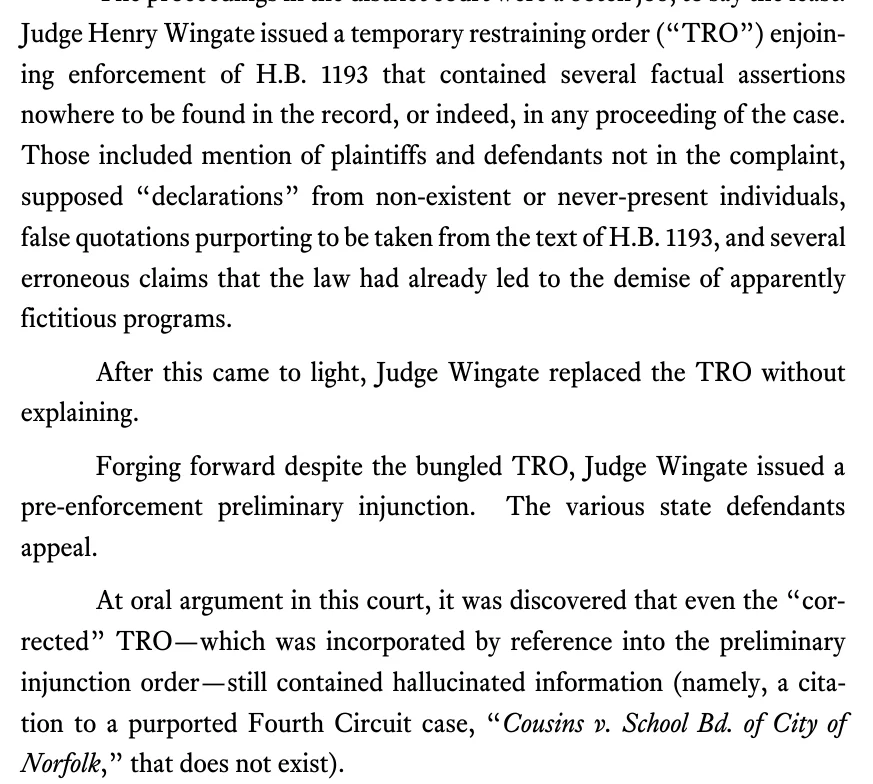
Screenshot: Jackson Federation of Teachers v. Fitch, No. 25-60496 (5th Cir. Oct. 22, 2026), page 3. Captured October 26, 2026.
The opinion's account, in order:
| Date | What happened, per the opinion |
|---|---|
| July 20, 2025 | Wingate issues a temporary restraining order. It names eleven plaintiffs who were never party to the case, two defendants who weren't sued, and declarations from four people who aren't in the record, and misquotes the statute. |
| July 22, 2025 | The defendants file a motion pointing out the errors. The same day the court swaps in a "seemingly corrected" order, backdated to July 20, and later refuses to put the original back on the docket, calling the errors "clerical." |
| August 18, 2025 | Wingate grants the preliminary injunction, incorporating the corrected order by reference. |
| September 16, 2025 | The state officials appeal. |
| October 2025 | After Senator Chuck Grassley's letter of October 6, Wingate admits a law clerk used AI on an earlier draft that was docketed by mistake. |
| At oral argument | The panel finds the corrected order still cites "Cousins v. School Bd. of City of Norfolk," a Fourth Circuit case that does not exist. |
| October 22, 2026 | Injunction vacated; case reassigned. |
The rest of the 28 pages is about the law itself: the panel found the injunction legally wrong under Moody v. NetChoice and wrote detailed instructions for the next judge. The constitutionality of H.B. 1193 is still undecided.
Where the review failed
Wingate's explanation, in his letter to Grassley, was that a clerk used Perplexity "strictly as a foundational drafting assistant" and an unfinished draft went onto the docket (Broadband Breakfast, Bloomberg Law). He said the clerk didn't put confidential or non-public case information into the tool. That is one failure. The opinion describes three more, and they are the ones a small firm should study.
The fix wasn't checked. Defendants flagged the errors, the order was replaced the same day, and the replacement still carried a fake citation that nobody caught until an appellate judge looked. We checked it ourselves on CourtListener in under two minutes: 503 F.2d 422 resolves to United States v. Betty Jean Anderson, and a case-name search for Cousins and Norfolk returns nothing like it. The pin cite, 426-27, lands in Avis Rent A Car System v. United States, which the opinion also notes.
The record was rewritten. The replacement was backdated, and the original came off the public docket. The court only had it because the defendants had attached a copy to a motion, which it called lucky.
"Clerical" was claimed, not shown. "It is not clear to this court how so many mistaken facts could not at least marginally 'affect' 'core legal reasoning,'" the panel wrote. Because the corrected order never explained why the ruling still stood without the invented facts, the court concluded the judge would have "substantial difficulty" setting his views aside on remand.
In one passage Haynes did not join, the majority said the district court, "or perhaps, being charitable, its AI agent," ignored and manipulated governing law. The Volokh Conspiracy used that line as its headline.
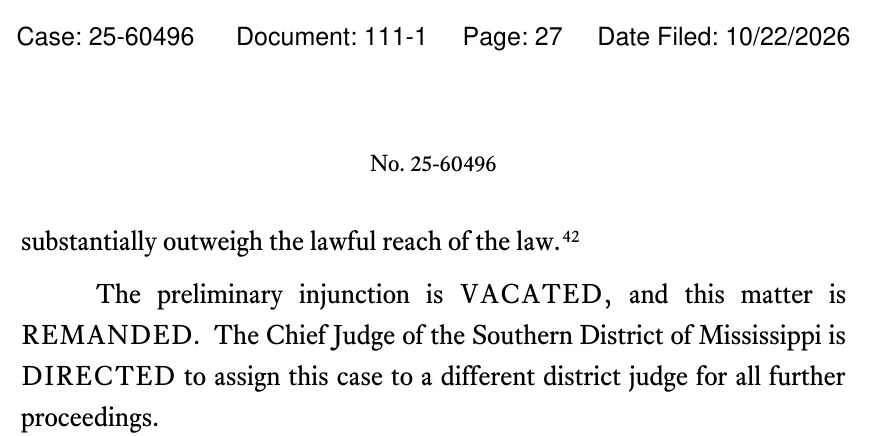
Screenshot: Jackson Federation of Teachers v. Fitch, No. 25-60496 (5th Cir. Oct. 22, 2026), page 27. Captured October 26, 2026.
The checklist: AI draft review before anything leaves the firm
Wingate's own fix, per the Senate Judiciary Committee, was a second independent review of all draft opinions, orders and memos, with every cited case printed and attached to the final draft. That's a good start. Here is the version we'd run in a small firm or team, one line per failure in this case:
- Label AI-assisted drafts when they're created. A tag in the file name or header ("AI-assisted, unverified") tells the reviewer what kind of check it needs. Wingate says an unfinished draft was docketed by mistake; a visible label is the cheapest guard against that.
- Keep drafts out of the filing path. Nothing gets filed, sent or published from a drafts folder. A final version needs a named sign-off, so an unfinished draft can't be the one that goes out.
- A second person opens every cited source. Not the person who drafted it. For each case, statute or study: open it, confirm it exists, confirm the page, confirm it says what the draft says. Attach the copy, as Wingate now does.
- Check names, parties and quotes, not only case cites. Most of the TRO's errors were people and organizations who weren't in the case and phrases the statute never used. Search every quoted phrase in the source text.
- Re-run the whole check on every correction. A fix written under pressure gets the same review as the first draft, top to bottom. The July 22 replacement "did not correct all of the errors," the court said: the fake Cousins citation was still in it.
- Keep the version you replaced, and date the new one honestly. Mark the old one superseded and add a short note on what changed and why. Never backdate a replacement.
- Show the conclusion holds before calling an error minor. If you say a mistake was "clerical," write down why the result still stands without it. If you can't, it wasn't clerical.
- Keep client data out of public AI tools. Wingate said no non-public case information went into Perplexity. Your policy should let you say the same.
- Log who checked what. Reviewer, date, sources opened. When a client, court or regulator asks, the log is your answer.
Image: Pexels, used under the Pexels License.
How to adapt it
Small law firm (two to ten lawyers). The second reviewer can be another lawyer or a paralegal; what matters is that it isn't the drafter. Item 3 is the step every sanction in our AI hallucination sanctions tracker traces back to, and that post has a copy-paste verification policy you can merge with this list.
Solo practitioner. You can't hand it to a second person, so put time between drafting and checking: verify the next morning, from the sources, not from the draft. Print or save every cited authority into the matter file.
Teams outside law. Swap "court" for regulator, client or auditor. A compliance memo, a grant application or a client report with an invented statistic fails the same way, and nobody will catch it on appeal. Put items 1 to 9 into your AI acceptable use policy, and treat a published AI error as an incident under your AI incident response plan: items 6 and 7 are the correction half of that plan.
What people said
On r/law, the most practical reply came from a user called nonlawyer. "Judge's quite often have their clerks write the first draft of decisions. So this is more like a junior lawyer drafting something and the partner failing to check it properly. Still inexcusable, of course," wrote u/nonlawyer. The top-voted reply was blunter: "Some law clerks have probably received their walking papers," wrote u/PsychLegalMind. Nothing in the record says what happened to the clerk.
https://www.reddit.com/r/law/comments/1xd9hxq/mississpi_5th_circuit_reassigns_case_after_judge/19rjm7if6764k/
What this doesn't cover
The ruling doesn't discipline anyone; complaints against judges go through a separate misconduct process, and we found no public record of one here. It doesn't decide whether H.B. 1193 is constitutional. And it doesn't create an AI rule for courts. The Administrative Office's advisory AI Task Force issued interim guidance on July 31, 2025 that, according to the AO's letter to Grassley, allows "the use of and experimentation with AI tools" and suggests users consider "whether the use of AI should be disclosed." Those suggestions are non-binding.
We could not open Wingate's letter itself: Senator Grassley's download link gave our fetch a redirect page, not the PDF, on October 26. His description of the Perplexity use and his new review rules are as reported by the Senate Judiciary Committee, Bloomberg Law and Broadband Breakfast. The opinion doesn't name the AI tool or say how the corrected order was prepared.
Related Reading
- AI Hallucination Sanctions Tracker 2026: Fines by Case
- AI governance for legal teams: privilege and confidentiality
- AI Acceptable Use Policy Template: Free Copy for Small Teams
- AI Incident Response Plan Template for Small Teams (2026)
- Shadow AI Policy for Small Teams: Detection and Governance
- Starbuck v. Google: AI Defamation Claim Survives Dismissal