Image: Pexels.
Nobody has to do anything by a deadline yet. Texas filed a petition, not a rule, and no court has ruled. If you run a chatbot that minors can reach, the useful reading is the list of things Texas says are deceptive, because the law it uses applies to companies of any size.
Event date: October 23, 2026, filed in Collin County district court. First report we found: Bloomberg Law, October 23, 18:26 UTC, followed by The Texas Tribune, Courthouse News and Politico the same day.
What happened
Attorney General Ken Paxton sued six OpenAI entities and Sam Altman in a 67-page petition. Altman is named personally as the CEO who "personally directed the design, development, safety policies, and deployment of ChatGPT as used in Texas." Texas seeks "monetary relief over $1,000,000," asks for a jury, and brings the case "exclusively under Texas law."
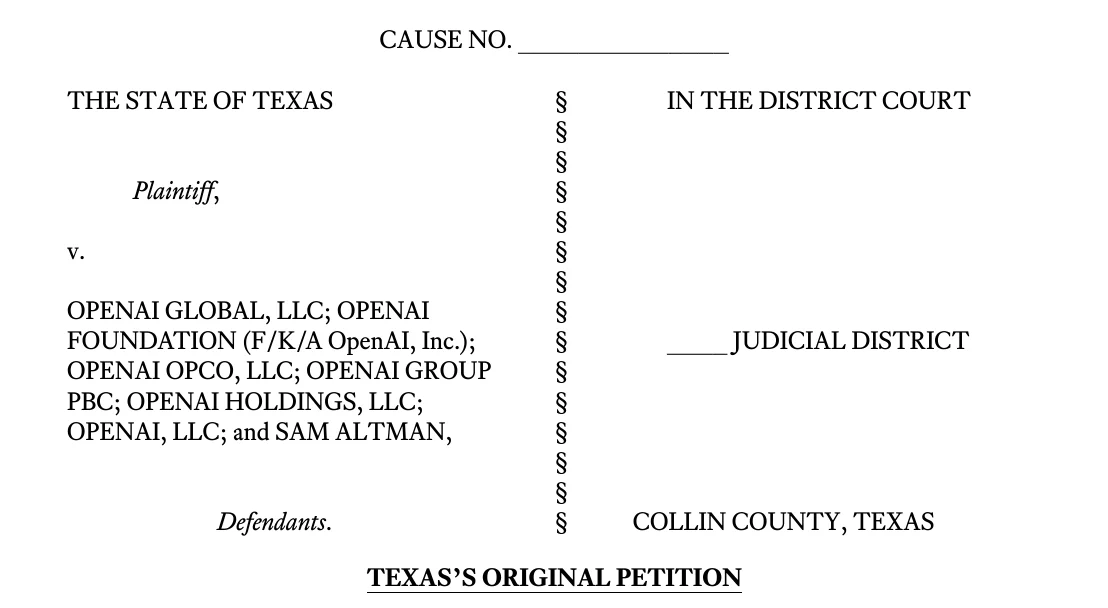
Screenshot: Texas's Original Petition, State of Texas v. OpenAI et al., Collin County, October 23, 2026, posted by the Texas Attorney General. Captured October 24, 2026.
There are two counts. Count I is the Deceptive Trade Practices Act: failing to warn, no real age check, harmful content, compulsive-use features, thin safety testing, and a product that "falsely represents itself as having human emotions." Count II is the SCOPE Act, the Texas law on minors and digital services in force since September 1, 2024. The petition cites four of its sections: 509.051 (register a user's age), 509.052 (limits on a known minor's data and ads), 509.054 (parental tools) and 509.101 (verify the parent). In Texas's words, OpenAI does "not request, nor verify, any information related to a purported" parent's identity. Each SCOPE violation is pled as a per se DTPA violation, worth up to $10,000.
The age allegations are specific: the free version of ChatGPT "has no gatekeeping or age" check at all, that the paid version "nominally asks users to provide their age" without verifying it, and that parent alerts work only if an account is linked. It quotes Common Sense Media's October review of ChatGPT for Teens, launched in August 2026.
What Texas is asking the court to order
The prayer asks the court to stop OpenAI from offering ChatGPT to minors in Texas (item f). Item j would bar any new AI model release to Texas users until an "independent third-party evaluator, approved by the Court," has reviewed its "safety guardrails and approved its release."
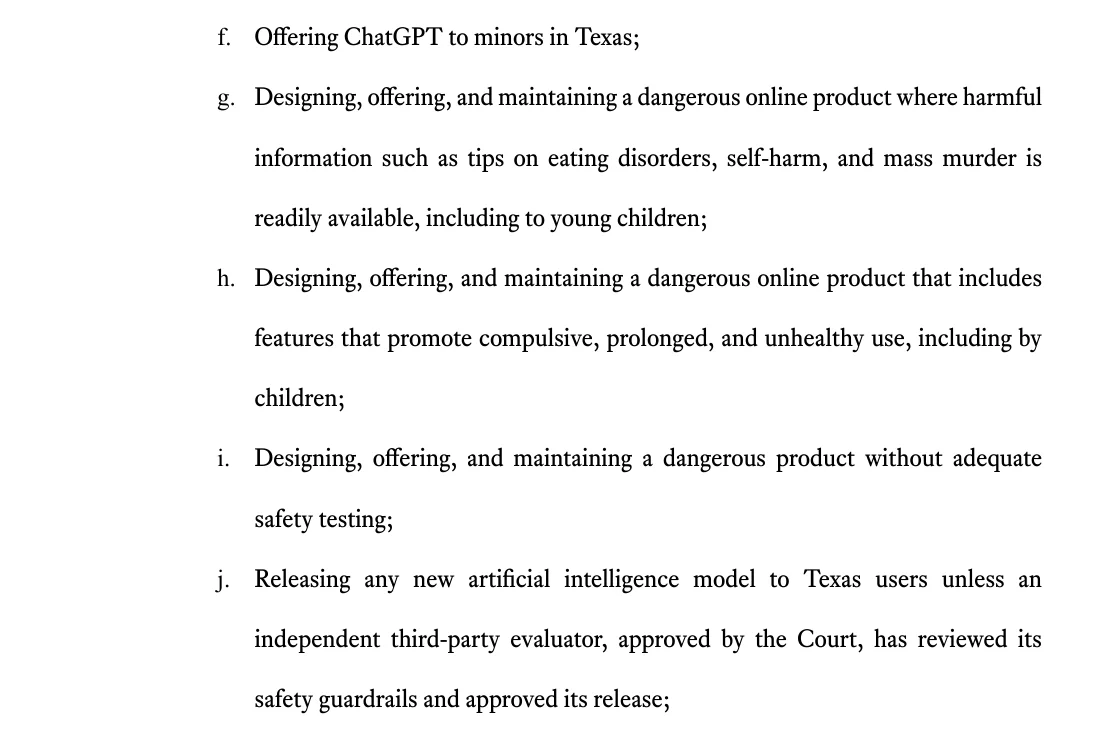
Screenshot: Texas's Original Petition, prayer, paragraph 208, page 64. Captured October 24, 2026.
Other items would bar a product that promotes "compulsive, prolonged, and unhealthy use" and one "capable of ignoring human direction." Texas also wants $10,000 for each violation, plus disgorgement and fees.
Our take: item j is the one to watch. A court-approved evaluator signing off before every model release in one state would be a licensing regime built out of a consumer protection case. Florida's injunction motion of September 28 asked for something close, no new models "without independent third-party guardrails and approval," so this is now a pattern, not a one-off. We'd be surprised to see either granted as written, but it tells you where state enforcers would like to go.
Video: KVUE, "AG Paxton sues OpenAI and its CEO for allegedly deceiving and harming Texans," October 23, 2026.
Who the SCOPE Act actually covers
This part decides whether the second count could ever reach you. Under section 509.002, the chapter applies only to a digital service that does all three of these: it lets users "socially interact with other users," lets them create "a public or semi-public profile," and lets them post content "that can be viewed by other users." It also exempts "a small business as defined by the United States Small Business Administration on September 1, 2024."
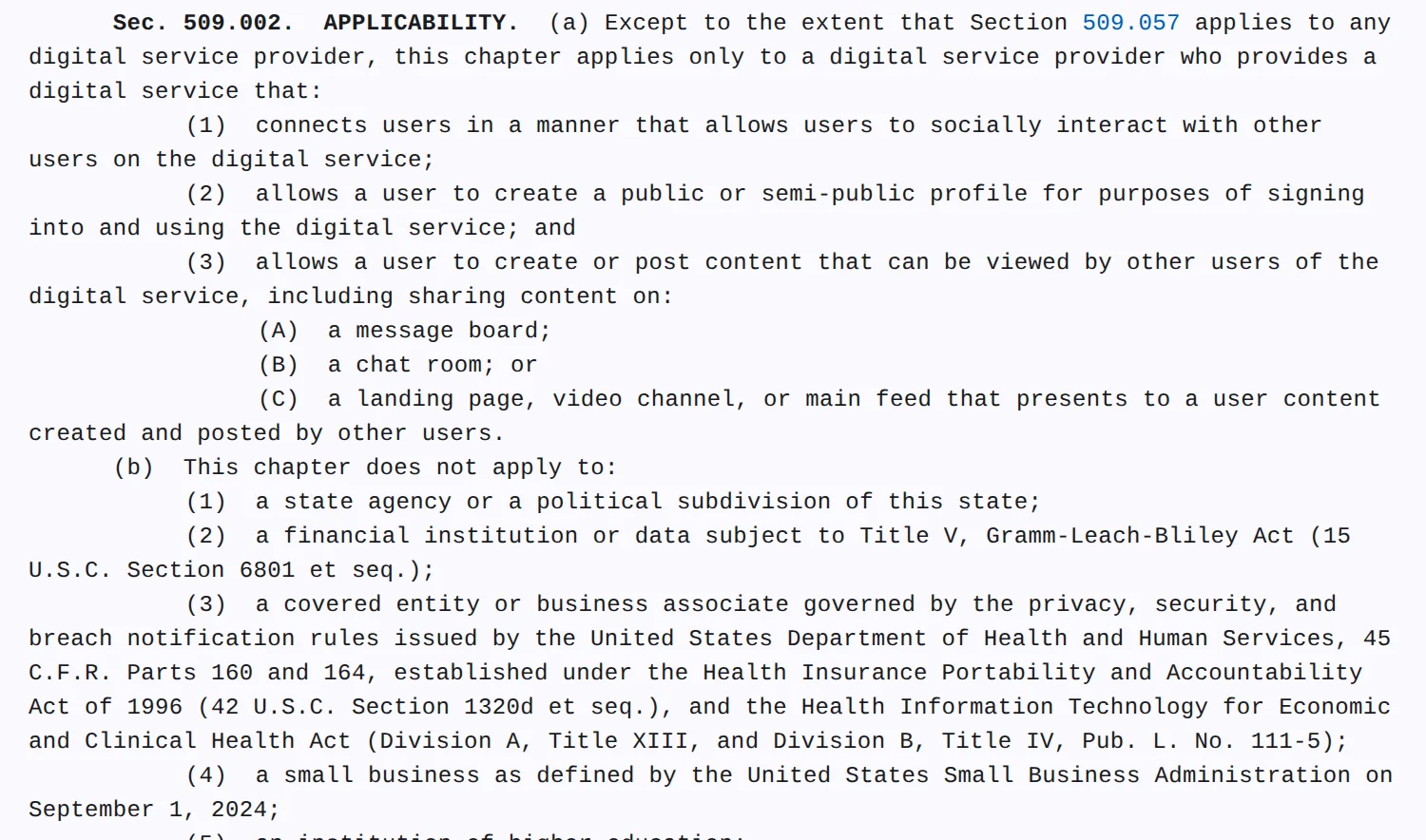
Screenshot: Tex. Bus. & Com. Code section 509.002, statutes.capitol.texas.gov. Captured October 24, 2026.
The petition calls OpenAI a "digital service provider" but, as far as we could find, never cites 509.002 or explains how ChatGPT meets the social-interaction test. Expect OpenAI to fight there. For a small team, the point is simpler: a one-to-one support bot or a B2B assistant with no profiles or user feeds likely sits outside the SCOPE Act, and a company under the SBA size standard is exempt anyway. There is no private right of action; only the attorney general enforces it.
The law isn't fully in force either. In CCIA v. Paxton, decided July 24, 2026, the Fifth Circuit held the SCOPE Act's monitoring and filtering duty preempted by Section 230 for the trade group plaintiffs, and threw out other parts of the injunction for lack of standing. The district court had never blocked age registration. In our reading, none of the four sections Texas sues on is among the parts still blocked, but that's our reading of a long opinion, not a court's statement about this case.
What to do now
The DTPA count is the one that travels. It needs no AI statute, no social features and no minimum size. Per The Texas Tribune, Paxton has sued or settled with Meta, TikTok, Snapchat and Roblox under the state's consumer protection laws.
- List your safety claims. Pull every "safe," "accurate," "for kids" or "age-appropriate" line from your site, app listing and sales decks. Each one needs to match what the product does.
- Say what your age gate does. If you ask for age and don't check it, don't describe it as verification. That gap is the core of the age allegations here.
- Check whether your bot claims feelings. Texas lists a product that "falsely represents itself as having human emotions" as deceptive. A persona that says it cares about the user is the plain case.
- Run the SCOPE test once. If you have profiles, user posts and user-to-user interaction, and you're over the SBA size line, the SCOPE Act's duties apply to you now, including the four sections in this suit.
What people said
On Hacker News, anigbrowl wrote: "I think this is a meaningless election-season gesture rather than a meaningful signal about litigation or policy preferences." Under a Texas Scorecard video, @jimroland7542 saw it the other way: "Ken Paxton looking out for our children and our Texas Treasury at the same time." Both readings have support. The Tribune points out that Paxton is the GOP nominee for U.S. Senate and that Elon Musk, who has a "fraught history" with OpenAI, is the largest single donor behind that campaign. And in Politico's words, the suit "echoes" those filed by attorneys general in eight states the week before.
OpenAI told the Tribune that governments have a role in setting "robust safety standards for AI" and that it wants AI policies "that apply to the entire AI industry," not one company. It didn't address the specific claims.
What we could not confirm
The posted petition has no cause number or court assignment, so we couldn't check the docket or whether OpenAI has been served. We read Bloomberg Law's headline and timestamp only. We didn't verify the incidents the petition cites; Courthouse News counts at least eight. Whether any court will treat ChatGPT as a service where users socially interact is an open question the petition doesn't argue. For how this fits with Florida's earlier suit and the eight state suits filed the week before, see our state AG lawsuits tracker.