Image: Unsplash, used under the Unsplash License.
The US has sanctioned a Chinese startup accelerator over stolen AI secrets. On Monday, October 19, 2026, the State Department designated five Chinese entities under the Protecting American Intellectual Property Act (PAIPA): MiraclePlus, the venture firm Bloomberg's headline called "China's Y Combinator", three of its funds and holding companies, and Shanghai Zhisuan Technology, the startup set up by former Google engineer Linwei Ding. The State fact sheet went up that day, and the South China Morning Post had it the same evening, with Bloomberg and AP following on October 20. Few small teams do business with a Beijing venture fund. The ones that do, and the ones whose sanctions screening only checks the main list, have work to do this week.
What happened
PAIPA was signed in January 2023 and mandates sanctions on foreign persons who have engaged in, or benefited from, significant theft of US trade secrets, and on people tied to them. Here the State Department used it on an AI case.
According to the fact sheet, Ding founded Zhisuan in 2023 and pitched it as a platform to speed up machine learning workloads, including training "super intelligence" models. He applied to MiraclePlus's incubation program on Zhisuan's behalf, "touting his experience with and knowledge of Google's technology and internal systems." MiraclePlus, which runs two startup camps a year, gave Zhisuan seed capital in exchange for an ownership stake. State found that Zhisuan benefited from trade secret theft dating from January 5, 2023 onward, and that MiraclePlus provided "significant financial, material, or technological support."
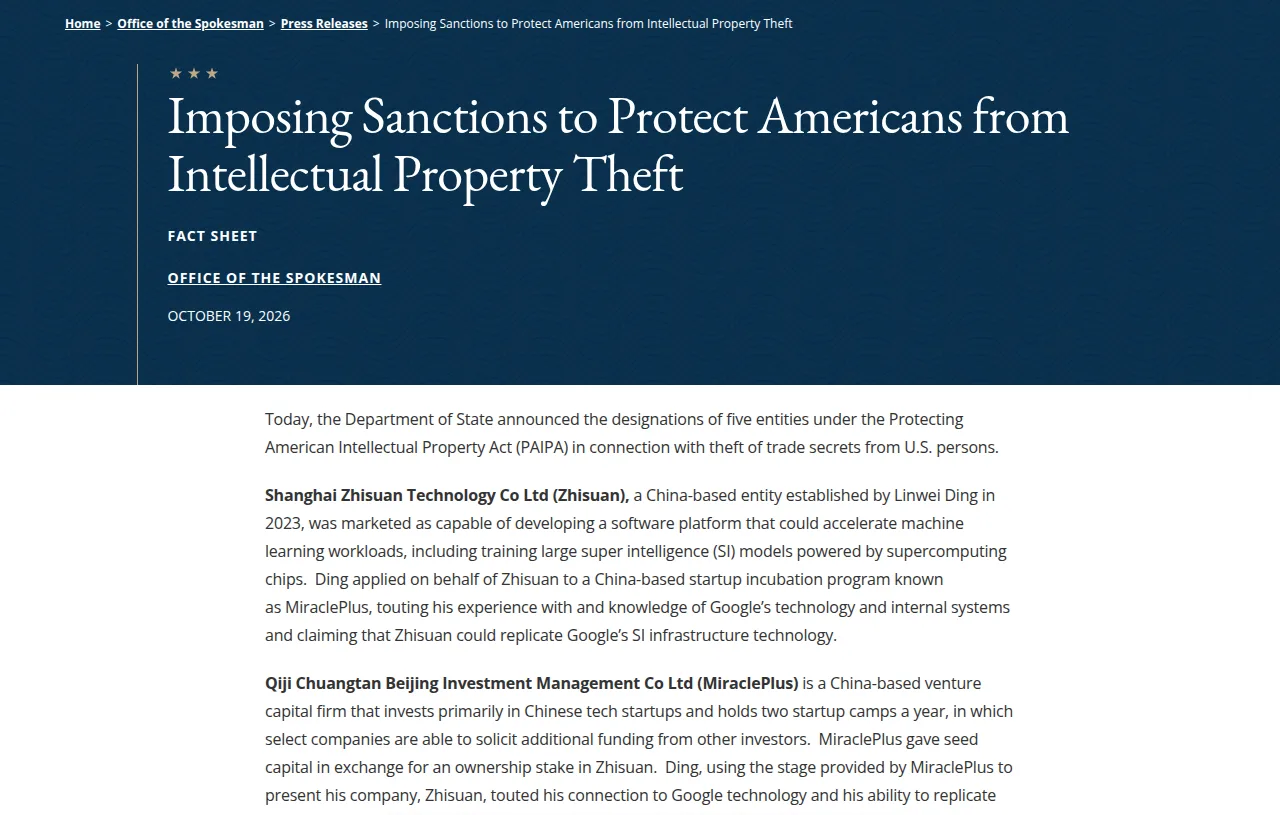
Screenshot: US Department of State fact sheet, October 19, 2026.
Ding's criminal case is the background. A federal jury in San Francisco convicted him in January of economic espionage and theft of trade secrets; a judge later dismissed the espionage counts and sentenced him to 12 months, and the Justice Department is appealing, AP reported. He allegedly moved more than 2,000 pages of trade secrets to a personal cloud account and downloaded files less than two weeks before resigning in December 2023, Bloomberg reported.
MiraclePlus was set up by Lu Qi, a former Microsoft AI scientist, and took over what had been Y Combinator's China program, Bloomberg reported. It has backed startups including the AI inference platform SiliconFlow and the robotics maker AgiBot. MiraclePlus didn't immediately respond to Bloomberg. On Tuesday, China's commerce ministry expressed "firm opposition" and said Beijing would take "necessary measures," without saying what they'd be.
Who's on the list
| Entity | What it is | Wind-down allowed? |
|---|---|---|
| Qiji Chuangtan Beijing Investment Management Co Ltd (MiraclePlus) | The venture firm | Yes |
| Beijing Qiji Chuangtan Phase I Venture Capital Center LP (a.k.a. MIRACLE PLUS RMB FUND I) | Fund managed by MiraclePlus, set up 2020 | Yes |
| Beijing Qiji Chuangtan Phase II Venture Capital Center LP | Fund managed by MiraclePlus, set up 2022 | Yes |
| Beijing Qiji Chuangtan Zhiyuan Enterprise Management Center LP | Wholly owned by the Phase I fund | Yes |
| Shanghai Zhisuan Technology Co Ltd | Ding's startup, Xuhui District, Shanghai | No |
What the sanctions do
The same five measures from PAIPA Section 2(b)(1) apply to all five entities, according to OFAC's October 19 notice:
- Blocking. Their property is blocked and "all transactions with this entity are prohibited, except for the importation of goods."
- Loans. US financial institutions can't lend them more than $10,000,000 in any 12-month period.
- Foreign exchange. FX deals under US jurisdiction in which they have an interest are banned.
- Bank transfers. Payments through any financial institution under US jurisdiction that involve them are banned.
- Investment. No US person may invest in or buy significant amounts of their equity or debt.
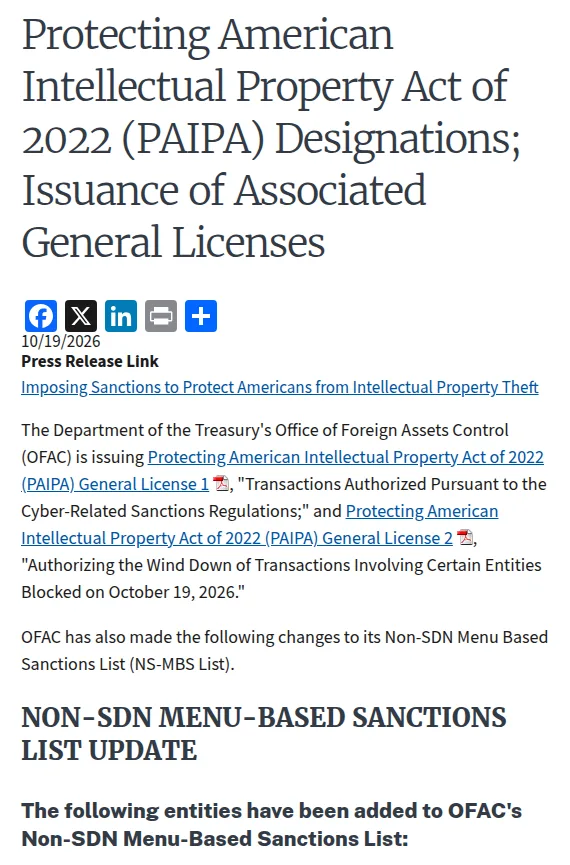
Screenshot: OFAC recent actions, PAIPA designations, October 19, 2026.
Here's the detail that matters for screening. OFAC didn't add these names to the Specially Designated Nationals (SDN) List. It added them to the Non-SDN Menu-Based Sanctions List (NS-MBS List), which OFAC publishes with its other non-SDN lists in the Consolidated Sanctions List. A screening setup that checks only the SDN List won't flag MiraclePlus.
OFAC also issued two general licenses. General License 2 lets existing dealings with the four MiraclePlus entities, and with any company they own 50% or more of, be wound down until 12:01 a.m. Eastern on January 19, 2027, as long as any payment to them goes into a blocked account in the US. Zhisuan isn't on that list, so there's no wind-down period for it. General License 1 allows whatever the Cyber-Related Sanctions Regulations already allow (31 CFR part 578).
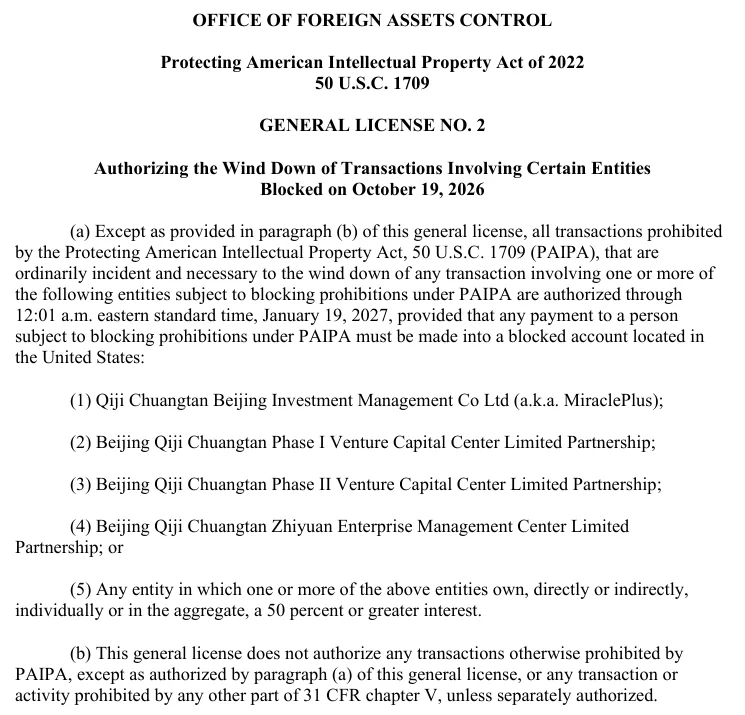
Screenshot: OFAC PAIPA General License No. 2, paragraphs (a) and (b), signed by OFAC Director Bradley T. Smith.
What to check this week
- Your screening list. Ask your payments provider or screening vendor whether it checks OFAC's consolidated non-SDN lists, including NS-MBS, or only the SDN List. If only SDN, add the consolidated list or run these five names by hand.
- Your cap table and investors. If a MiraclePlus fund invested in your company, or you're a US investor in one of its funds, talk to sanctions counsel now. New investment in their equity or debt is the measure aimed squarely at US persons.
- Your vendors and customers. Search contracts, AP and AR for the five legal names above and the "Miracle Plus RMB Fund" alias. Anything with MiraclePlus entities goes on a wind-down plan with payments into a blocked account. Zhisuan has no wind-down license, so stop and call counsel.
- Portfolio companies. SiliconFlow and AgiBot aren't designated. A MiraclePlus-backed startup is only pulled in through GL2's ownership line if the group owns half or more of it, and we couldn't find ownership figures. Don't treat "went through a MiraclePlus camp" as a match, but do ask.
- Your own offboarding. The criminal case centered on files allegedly copied to a personal cloud account by a departing engineer. Our AI offboarding checklist covers the controls that catch that.
Our take: if you've never dealt with these five names, the lesson worth keeping is which list they're on. PAIPA has just turned an AI trade secret case into sanctions on the investor that funded the startup, a venture firm with a well-known portfolio. If your vendor review for Chinese AI models stops at "is the company on the SDN List," it's already out of date. Pair it with the checks in our Moonshot AI sanctions piece and China AI export controls guide.
What we don't know yet
- Which portfolio companies, if any, cross that ownership line. OFAC hasn't published a list and MiraclePlus hasn't commented.
- What China's "necessary measures" will be. The commerce ministry gave no details.
- Whether more PAIPA cases follow. The fact sheet doesn't say, and the Justice Department's appeal on the espionage counts is still pending.
- Whether your case is covered. If GL1 or GL2 doesn't fit what you're doing, talk to sanctions counsel before you move money; this post isn't legal advice.
Related Reading
- China's Moonshot AI Accused of IP Theft, Sanctions Threat
- First Outbound Investment Fine: Treasury Hits Amidi $200K
- Apple vs OpenAI Trade Secret Lawsuit: AI Offboarding Gaps
- China AI Export Controls: Qwen and Doubao Access at Risk
- Who Enforces When Your AI Vendor Fails? DOJ vs States
- AI Vendor Due Diligence Checklist: Questions Before You Sign