Image: Mikhail Nilov, Pexels, used under the Pexels License.
This is for the online shop, the subscription app and the local service business that put a chatbot or a phone menu between New York customers and a person. New York City's consumer agency has proposed a rule that makes a support bot with no exit a presumed deceptive practice. It isn't law yet. But the drafting is specific enough to build against today, and the comment window is the one moment a small team can tell the city what the logging duty costs.
What New York City proposed, and when
On Tuesday, October 20, 2026, the Department of Consumer and Worker Protection (DCWP) and Commissioner Samuel A.A. Levine published the proposed rule in the City Record, and Semafor and local outlets reported it the same day. Mayor Zohran Mamdani's line was that doom loops are "stealing your time, money, and patience"; Levine, who used to run the FTC's consumer protection bureau, added "We are not waiting for Washington to come to the rescue of working people." The rule text adds a new subchapter U (6 RCNY §§ 5-310 to 5-313), a penalty schedule (§ 6-91) and a general clause (§ 5-02) saying that a technology did it is never a defense. It covers AI chatbots and plain phone voice-response menus alike: anything where "all or substantially all" of the conversation comes from the machine. If adopted, the city says it would be the first municipality able to enforce this kind of protection.
The agency isn't starting from zero on chatbots. Five days earlier it sued CarGurus in state court, saying the car site's "Great Deal" ratings hid mandatory fees and its AI chatbot generated lists of supposed "deals" on top. That case runs under the existing Consumer Protection Law, which DCWP says already reaches what a chatbot says, so you don't need to wait for this rule to be adopted to be in scope.
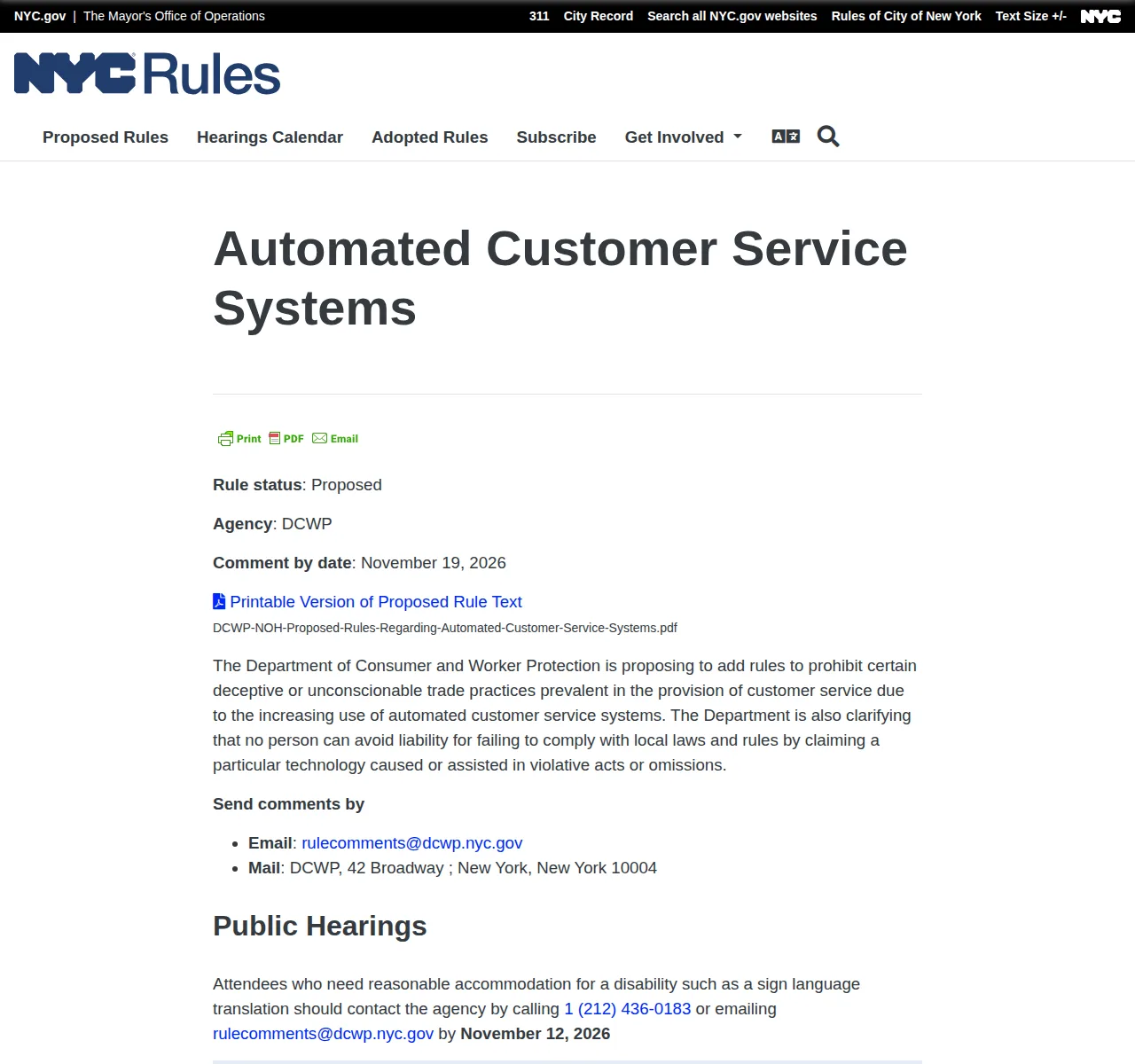
Screenshot: NYC Rules, "Automated Customer Service Systems" rule page.
The checklist
Copy this into your support runbook. Each line maps to a section of the proposed rule, so you can show your work if DCWP asks.
| # | Check | Rule section | Done when |
|---|---|---|---|
| 1 | Every channel labelled "customer service" or "contact us" is actually staffed for service | § 5-311(a)-(b) | No inbox, number or chat widget sits under a "contact us" label without someone answering it |
| 2 | The bot says it's a bot in its first message | § 5-312(a) | Opening line names it as automated, not a person, in the language the customer is using |
| 3 | A single-step route to a human is offered and named | § 5-312(c)(1) | The bot tells people the exact step ("Say or type 'agent'", "Press 0") |
| 4 | The step works at any point in the conversation | § 5-310 | Typing "agent" mid-flow transfers or queues; no extra questions, no "tell us why" |
| 5 | People in the queue see an estimated wait time | § 5-312(c)(1) | The bot shows the estimate after the transfer starts |
| 6 | Out of hours, the bot gives a real alternative | § 5-312(c)(2) | Human hours, a phone number with hours, live chat with hours, or a callback, form, text or email with a stated reply time |
| 7 | The bot doesn't loop | § 5-312(b) | You've tested the top ten intents and none sends people back to the same menu or answers off-topic |
| 8 | Vendor paperwork is on file | § 5-313(a)(1) | Contract or license for the bot, setup documents, and which model ran in which period |
| 9 | Every bot conversation is logged with four fields | § 5-313(a)(2) | Duration, transfer offered, transfer used, outcome (human, queue or alternative) |
| 10 | An annual summary is produced | § 5-313(a)(3) | Totals, transfers, conversations resolved without a transfer, repeat contacts within 72 hours, average duration |
| 11 | The disclosure wording itself is archived | § 5-313(a)(4) | You can show the exact opening text and format used on any past date |
| 12 | Records are kept three years, machine-readable | § 5-313(a)-(b) | Export to CSV or JSON works and the retention setting is three years or longer |
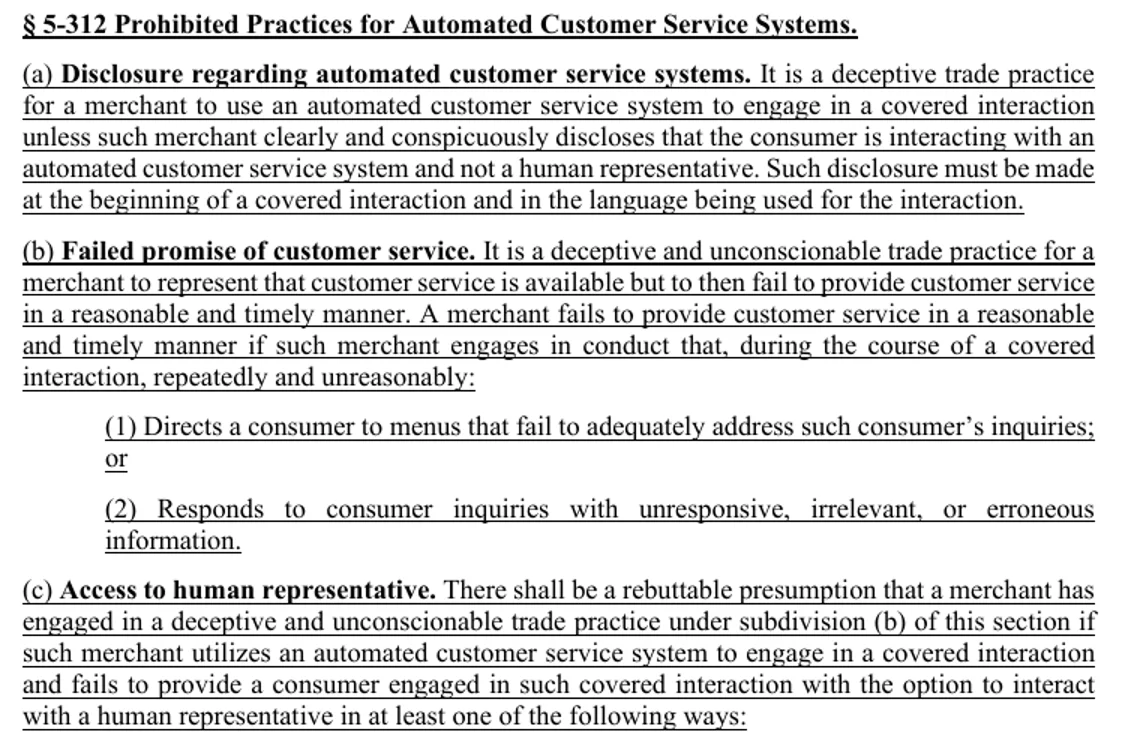
Screenshot: proposed 6 RCNY § 5-312(a)-(c), DCWP notice of proposed rules, page 7.
How to fill it in
Lines 2 to 5 are bot settings, not paperwork. The rule's "single-step transfer mechanism" is a button, voice command or menu choice that hands off to a person, or puts them in line, with nothing in between. A routing menu that only picks the right team is allowed; a "before I connect you, can you describe your issue?" step is not. Leaving it out has a built-in consequence: a bot with no human option is presumed to be the deceptive "failed promise of customer service" in § 5-312(b). You can rebut that presumption, but you'd be arguing uphill.
Line 6 is where small teams win. You don't need a night shift. The rule lists seven alternatives, and an email address with a stated reply time is one of them. "Our team answers within one business day at help@..." shown when the queue is closed is the cheap way through.
Lines 9 and 10 are the expensive part. A transcript archive isn't the same thing as a log with "was the transfer offered" and "was it used" as fields, plus a count of people who came back within three days. Ask your vendor now whether its export has those fields. If it doesn't, that's a change request with a lead time, and a real point for your comment letter. The exact format is left to the commissioner, so what you build now may need reshaping later.
The fines are per provision, and they stack. Each subsection charged is a separate violation, and there's no cure period. The proposed schedule in § 6-91 is the same for all four provisions it lists:
| Provision | What it punishes |
|---|---|
| § 5-311(a) | Calling a channel "customer service" when nobody provides service there |
| § 5-312(a) | No bot disclosure, or an inadequate one |
| § 5-312(b) | Promised customer service not provided |
| § 5-313 | Records not kept or not produced |
Each starts at $525 for a first violation, $1,050 for a second and $3,500 for a third or later; "second" means the same provision again within two years. A knowing violation of the Consumer Protection Law or its rules carries the top figure from the start (Admin. Code § 20-703(d)), and violators also owe restitution to customers.
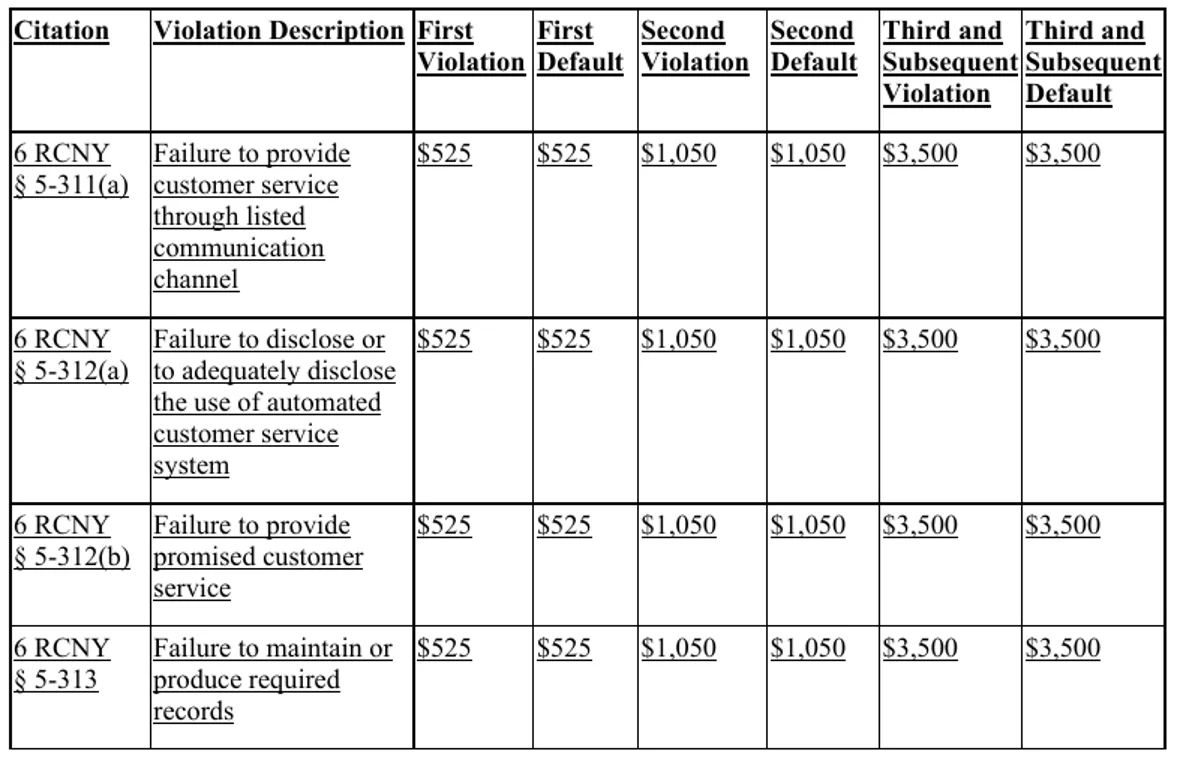
Screenshot: proposed 6 RCNY § 6-91 penalty schedule, DCWP notice of proposed rules, page 10.
To comment: email [email protected] or post on the NYC Rules page by the deadline in the verdict. The hearing runs by phone and video at 11:00 AM that same day, and speakers get three minutes. If you need an accommodation, ask by November 12. Both public comments posted on the first day backed the rule: "I strongly support this proposal to create common-sense restrictions on AI slop!" wrote one; another, Lauren, added "I want the option of talking to a human being." If you're a small business with a real cost problem, the record has room for your view. (We looked for a wider discussion to embed here and found none: the one r/nyc thread on the rule had a single comment, from Bloomberg Law's own account.)
Our take: we'd ship lines 1 to 7 this month whether or not the rule passes. They're cheap, and they line up with the chatbot disclosure laws the city itself points to in California, Maine, New Jersey and Utah (see our Utah AI Policy Act guide). Lines 9 to 12 we'd scope with the vendor and raise in a comment, because a three-year interaction log is a data retention decision, not just a support setting.
What it doesn't cover
- It's a proposal. There's no adoption date or effective date yet; DCWP will review comments once the comment period closes. We'll update this page when the final rule is published.
- Business-to-business support. The rule sits under the city's Consumer Protection Law, which covers sales of consumer goods and services. Our read is that a pure B2B tool is outside it, but the text doesn't say so in terms.
- Out-of-town sellers. The press release says DCWP would have citywide enforcement over businesses using these systems. We could not confirm from the rule how DCWP will treat an online seller based outside New York that serves city residents.
- What counts as "unreasonably long." The rule doesn't put a number on queue length or on how many failed answers is "repeatedly." Expect that to come from enforcement, or from comments.
- AI accuracy rules. Beyond "unresponsive, irrelevant, or erroneous information", the rule sets no accuracy standard for what the bot says. Other city proposals on AI are in our NYC Council AI bills tracker.
Related Reading
- NYC Council AI Bills Tracker, Oct 2026
- Utah AI Policy Act Compliance: Chatbot Disclosure Rules
- California Adam's Law SB 1119: Chatbot Compliance Deadlines
- Colorado Chatbot Safety Act (HB 26-1263) Compliance Guide
- State AG AI Chatbot Lawsuits Tracker
- FTC AI Enforcement Actions 2026: Cases and What Gets Fined
- AI Vendor Contract Redline Template: Clauses to Add or Fix