Democrats won control of both chambers of Congress on November 3, according to an NPR tally of Associated Press race calls and CBS News projections. Their majorities start at noon on January 3, 2027, when the 20th Amendment ends the current terms. For AI law that changes less than the election night coverage suggests. President Trump keeps his veto. Senate rules still require 60 votes to end debate. Every federal AI bill that hasn't passed by January 3 has to be introduced again. And the state deadlines a small team actually faces, in Colorado and New York, fall on January 1, 2027, two days before the new Congress is sworn in.
This page tracks the federal side: each AI bill's status, who holds the committees that decide which bills move, and what the White House can keep doing without Congress. Results are as reported on November 4; we add final seat totals when they are certified.

Image: Pexels.
Federal AI bills on November 4, 2026
Two bills in the table are already law. The rest sit in committee or on the Senate calendar. Status below is the latest action in the Library of Congress record for each bill, read on November 4. Cosponsor counts are by party, which is the best early hint of which bills get reintroduced in 2027.
| Bill | What it does | Sponsor | Status on November 4 | Cosponsors |
|---|---|---|---|---|
| TAKE IT DOWN Act, S. 146 | Platforms must remove nonconsensual intimate images, including AI-made "digital forgeries", on request | Sen. Cruz (R-TX) | Law: Public Law 119-12, approved May 19, 2025. Removal process required by May 19, 2026 | Not relevant now |
| One Big Beautiful Bill Act, H.R. 1 | Budget law. The House-passed text barred state enforcement of AI laws for 10 years | Rep. Arrington (R-TX) | Law: Public Law 119-21, July 4, 2025. Senate struck the AI section 99 to 1 on July 1, 2025 | Not relevant now |
| American Artificial Intelligence Leadership and Uniformity Act, H.R. 5388 | 5-year moratorium on enforcing state AI laws | Rep. Baumgartner (R-WA) | Referred to 12 House committees; last action December 19, 2025 | None |
| FRONTIER Act, H.R. 9925 | Federal oversight of frontier AI developers; sponsors call it a uniform national standard | Rep. Obernolte (R-CA), Rep. Trahan (D-MA) | Referred to Energy and Commerce and to Science, July 23, 2026 | 11 (6 D, 5 R) |
| GUARD Act, S. 3062 | Age verification and disclosures for AI chatbots | Sen. Hawley (R-MO) | Reported by Judiciary May 11, 2026; on the Senate calendar (No. 406) | 20 (14 D, 6 R) |
| NO FAKES Act, S. 1367 / H.R. 2794 | Rights in a person's voice and visual likeness | Sen. Coons (D-DE); Rep. Salazar (R-FL) | Referred to Judiciary in both chambers, April 9, 2025 | Senate: 13 (7 R, 6 D) |
| AI Kill Switch Act, H.R. 9917 | Certain entities must keep a way to shut down certain technology | Rep. Lieu (D-CA) | Homeland Security subcommittee, July 24, 2026 | 13 (11 D, 2 R) |
| SANDBOX Act, S. 2750 | Federal regulatory sandbox for AI run by the White House science office | Sen. Cruz (R-TX) | Referred to Commerce, September 10, 2025 | None |
| AI LEAD Act, S. 2937 | Legal standards for advanced AI products | Sen. Durbin (D-IL) | Referred to Judiciary, September 29, 2025 | 4 |
No federal statute overrides state AI laws today. In July 2025 the Senate voted 99 to 1 to strike the AI moratorium section from H.R. 1. The Great American AI Act that Obernolte and Trahan circulated on June 4, 2026 was a discussion draft "before the bill is formally introduced"; the FRONTIER Act is the bill that came out of it, and our Great American AI Act explainer covers the draft.
Our read: bills with cosponsors from both parties (GUARD, FRONTIER, NO FAKES, the AI Kill Switch Act and the AI LEAD Act) are the ones most likely to come back in 2027 in some form. A broad moratorium with no cosponsors, like H.R. 5388, has the weakest path under a Democratic House that decides which bills reach the floor.
The vote math for an AI bill in 2027
A bill has to clear four gates, and the election changed who controls only the first two.
| Gate | Rule | Who controls it from January 3 |
|---|---|---|
| House floor | "In the House, majority party leaders generally decide which bills will receive floor consideration" (CRS) | Democratic majority |
| Senate floor | Ending debate takes "three-fifths of the Senators duly chosen and sworn", 60 with no more than one vacancy | Democratic majority sets the agenda; 60 votes still needed |
| President | 10 days, excluding Sundays, to sign or veto | President Trump |
| Veto override | Two-thirds of each chamber, voting separately | Neither party alone |
Democrats held 47 Senate seats before the election, counting two independents who caucus with them, and NPR counts seven seats that flipped from Republican control: North Carolina, South Carolina, Ohio, Texas, Kansas, Iowa and Maine. Our read: even with those seven added, Democrats stay short of 60 and far short of 67. We will add the final seat count when it is certified.
"I'll become Mr. Veto," the president said of a Democratic Congress, adding, "and then at some point we'll probably make deals," according to NPR. NPR's summary of the practical effect: legislation "will almost certainly need his support to become law."
Our read: in 2027 an AI bill needs Republican votes in the Senate and a signature from the White House. That favors narrow bills both parties already cosponsor, such as chatbot rules for minors or likeness rights, over a federal standard that overrides state laws. A preemption bill would likely need to give Democrats something they want in return.
The lame-duck window, November 4 to January 3
Until noon on January 3, Republicans keep their majorities; in CBS News' words, Senate control "is poised to switch hands in the new year." Two pieces of must-pass legislation are open during that window.
The first is government funding. The current stopgap, the Continuing Appropriations and Extensions Act, 2027 (Public Law 119-103), funds the government until December 11, 2026, unless full-year bills pass first. The House cleared it 370 to 48 on September 1.
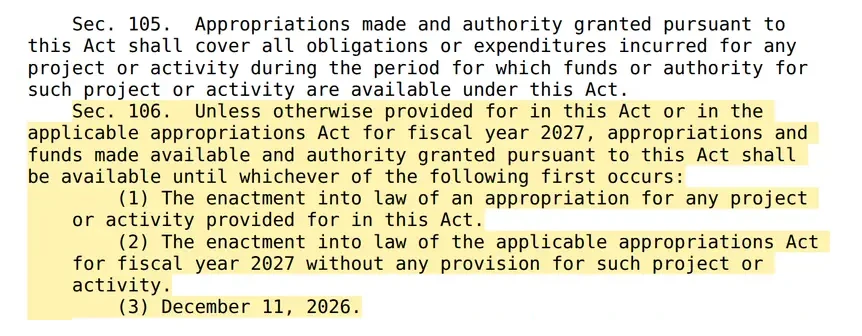
Screenshot: enrolled text of H.R. 6500, Sec. 106, govinfo.gov. Captured November 4, 2026.
The second is the defense bill. The House passed the NDAA for fiscal year 2027 (H.R. 8800) 216 to 212 on July 22, 2026, and the Senate received it on September 14. We searched the House-passed text: "artificial intelligence" appears 184 times, but no provision imposes a moratorium on state AI laws or preempts them; the word "preemption" appears only in unrelated sections, such as a change to the Cybersecurity Information Sharing Act. Any state AI law language would have to be added in the Senate or in conference.
Our read: a moratorium rider on the December funding bill or the NDAA is the one federal scenario that could change a state deadline before January. It would still need 60 Senate votes, and when the Senate voted on a moratorium in July 2025, 99 senators voted to strike it. We will update this page if such language appears in any bill text.
What the White House can do without Congress
The election doesn't touch executive orders. They "do not, by default, expire when the issuing President leaves office," the Congressional Research Service notes, and they stay in force until revoked.
| Action | What it does | Status on November 4 |
|---|---|---|
| Executive Order 14365, December 11, 2025 | AI Litigation Task Force at the Justice Department to challenge state AI laws; Commerce list of "onerous" state laws due in 90 days | The order gave the Attorney General 30 days to set up the Task Force. No Commerce evaluation in the Federal Register as of November 4 |
| EO 14365, Sec. 8 | Legislative recommendation for a federal standard | Must not propose preempting state child safety, data center infrastructure or state procurement laws |
| Executive Order 14434, September 29, 2026 | Tells executive departments and agencies to say "Super Intelligence" in their documents | Applies to federal agencies; no duty or penalty for companies |
| FTC AI accuracy policy statement | Proposed July 2026; says a state law is "impliedly preempted to the extent it conflicts" with the FTC Act | Comment period closed July 31, 2026 |
| NIST AI RMF | Voluntary risk framework | "Being revised as part of the White House AI Action Plan" |
A Democratic Congress has two ways to push back. It can repeal an order by statute, but CRS points out that "if the President disagrees, then Congress would presumably need sufficient votes to overcome a veto." Or it can refuse funding: "Congress may inhibit the implementation of an executive order by preventing funds from being used to put the order into practice."
Our read: the funding route is the realistic one, and it runs through the 12 annual appropriations bills NPR notes still need bipartisan agreement. Watch the Justice Department's appropriation for a limit on money for the AI Litigation Task Force. None of the executive actions above removes a state obligation on its own; that takes a statute or a court ruling.
Committees to watch, and who chairs them
"The committee chair has the primary agenda-setting authority for each committee," CRS writes. The new majority picks the chairs in January. We found no announcement of 2027 chairs as of November 4; NPR reported one expectation, that Rep. Robert Garcia (D-CA) would chair House Oversight.
| Committee | AI bills referred there | Chair in the 119th Congress | Chair from January 2027 |
|---|---|---|---|
| Senate Commerce, Science, and Transportation | SANDBOX Act | Ted Cruz (R-TX) | Not announced |
| Senate Judiciary | GUARD Act, NO FAKES Act, AI LEAD Act | Chuck Grassley (R-IA) | Not announced |
| House Energy and Commerce | FRONTIER Act, H.R. 5388 | Brett Guthrie (R-KY) | Not announced |
| House Science, Space, and Technology | FRONTIER Act | Brian Babin (R-TX) | Not announced |
| House Homeland Security | AI Kill Switch Act | Andrew Garbarino (R-NY) | Not announced |
| House Appropriations | Fiscal 2027 funding, any rider | Tom Cole (R-OK) | Not announced |
| Senate Appropriations | Fiscal 2027 funding, any rider | Susan Collins (R-ME), who lost her seat per CBS News | Not announced |
Two current Senate chairs won't return: Collins lost on November 3, and Sen. Bill Cassidy, who chairs the health committee, lost his Republican primary, according to CBS News. We check the party announcements weekly and will fill in the last column with a source when each chair is named.
Hearings and letters from these committees create no legal duty for a company that isn't their target. Our read: a marked-up bill is the signal that something might pass.
What doesn't change for small teams
The state AI laws with 2027 dates were passed by state legislatures and don't need anything from Congress. Unless a federal statute overrides them, or a court blocks them, they apply on schedule.
| Law | Date | What it covers |
|---|---|---|
| Colorado SB 26-189 | January 1, 2027 | Automated decision-making technology in consequential decisions (education, jobs, housing, lending, insurance and others) |
| New York RAISE Act (A.9449) | January 1, 2027 | Large frontier AI developers |
| New York S.9051B / A.10379, Chapter 368 | January 1, 2027 | AI chatbots and minors |
| TAKE IT DOWN Act | In force since May 19, 2026 | Federal removal duty for intimate images, including AI-generated ones |
Every January 1 date above lands two days before the new members take their seats. The full list with sources is on our AI regulation deadline calendar, and the question of which state laws a federal standard could override is covered in our federal AI preemption guide.
Image: Pexels.
How we keep this tracker current
We read each bill's status from the Library of Congress record on GovInfo, not from press releases, and we date every check. Three changes would move a row here: a committee markup, any AI language in the December funding bill or the NDAA, and the January reintroduction of a bill under a new number in the 120th Congress. Seat totals and committee chairs go in when they are certified or announced, with a source for each.
If you read about a federal AI law that "takes effect" in 2027, check it against the table above. As of November 4, 2026, Congress has passed no AI law that overrides a state statute.
Related Reading
- AI Regulation Deadline Calendar: 2026 and 2027 Dates
- Federal AI Preemption: Which State AI Laws Still Apply
- Super Intelligence Executive Order: What It Means for You
- FTC Says Colorado's AI Bias Law May Be Preempted
- Colorado AI Act Compliance: What SB 26-189 Requires in 2027
- New York AI Chatbot Law: What S.9051B Bans From 2027