Image: Unsplash.
TL;DR: On October 7, 2026, the Pennsylvania House passed Senate Bill 806, the Artificial Intelligence Deceptive Advertising Act, 163-40, after the Senate passed it 48-2 in June. It now goes to Governor Josh Shapiro. The bill bars advertisers from knowingly, recklessly or willfully using AI-made or AI-altered content that creates a false impression about a product's nature, origin or authenticity without a clear label saying so. Text-only, fictional and parody content is exempt. The Attorney General or a district attorney can sue, with a civil fine of up to $3,000. It takes effect 60 days after enactment.
Event date: October 7, 2026 (House final passage). First reports: the Pennsylvania Senate Democrats' site on October 7, 2026 at 10:26 PM, then MediaPost on October 8 and October 9, 2026.
This is a narrow bill, and that is the useful thing to know about it. It does not make every AI image in an ad need a label. It targets one case: synthetic content that misleads people about the product. Below is what the passed text says, what it leaves out, and a checklist a small marketing team can run on its next campaign.
Where SB 806 stands
| Step | Date | Detail |
|---|---|---|
| Introduced | June 3, 2025 | Prime sponsor Sen. Nick Pisciottano (D, District 45), with 16 co-sponsors including Sen. Tracy Pennycuick (R, District 24) |
| Senate committee | May 6, 2026 | Reported as amended from Communications and Technology |
| Senate final passage | June 10, 2026 | 48-2 |
| House final passage | October 7, 2026 | 163-40, on Printer's Number 1808 |
| Governor | Pending | The General Assembly site shows "Executive Action Has not yet reached this milestone" as of October 9, 2026 |
The House voted on PN 1808, the same printer's number the Senate passed, which is why MediaPost reported that "The bill now heads to Governor Josh Shapiro." The bill's last section says "This act shall take effect in 60 days."
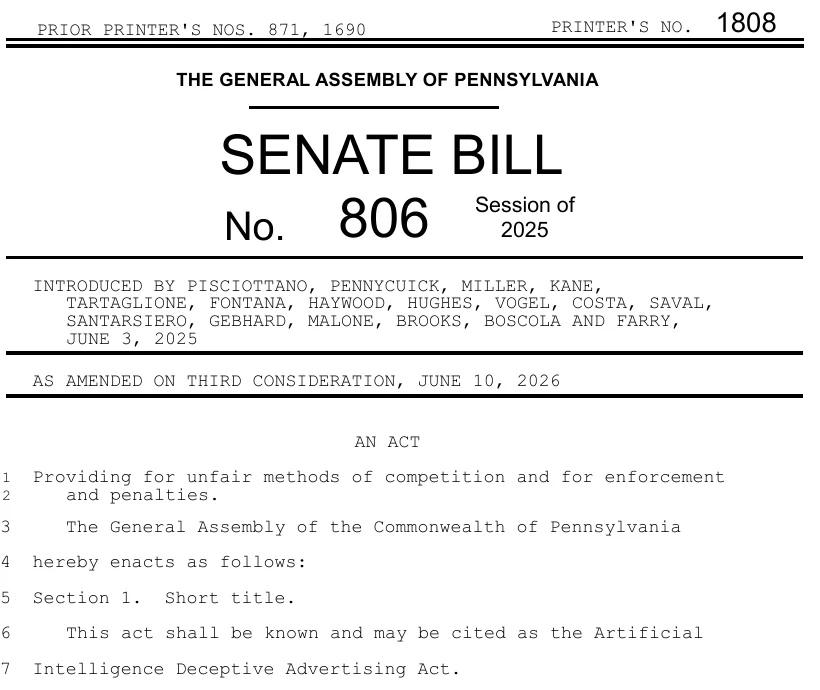
Screenshot: Senate Bill 806, PN 1808, Pennsylvania General Assembly.
What the bill actually prohibits
The core rule is one sentence in Section 4(a): "An advertiser may not knowingly, recklessly or willfully create and disseminate or cause to be created and disseminated an advertisement that uses synthetic content" in a way that creates a false consumer perception about the "nature, origin or authenticity of the goods or services being advertised," without clear and conspicuous disclosure.
Three pieces of that sentence decide whether your ad is covered.
- Synthetic content. The bill defines it as "Information, including an image, video, audio clip or text, that has been significantly modified or generated by artificial intelligence." The AI definition adds that "The term includes generative artificial intelligence."
- A false impression about the product. The trigger is a false perception about what the product is, where it comes from, or whether it is real. An AI background behind a real product photo is a different case from an AI image of a product that does not look like that.
- A mental state. Knowingly, recklessly or willfully. An honest mistake is not the target, but "recklessly" covers not checking.
What the label must say, and where it goes
The bill sets the wording: "A disclosure under this section must state that the advertisement contains content that was modified or generated using artificial intelligence."
It also sets placement. The disclosure must be "(1) Displayed in the first instance whenever the synthetic content is presented to the consumer. (2) Presented in the same medium as the synthetic content." And "To the extent technically feasible, permanent or extraordinarily difficult to remove from the synthetic content."
"Clear and conspicuous" has its own definition, with medium-specific tests. Audio must be "delivered in a volume and cadence sufficient for a consumer to hear and comprehend" it. A visual disclosure must be of a size and shade that "appears on the screen for a duration sufficient for a consumer to read and comprehend" it. And disclosures must be "presented in the language or other interaction used by the consumer to interact with or comprehend the synthetic content." A Spanish-language video ad needs a Spanish-language label.
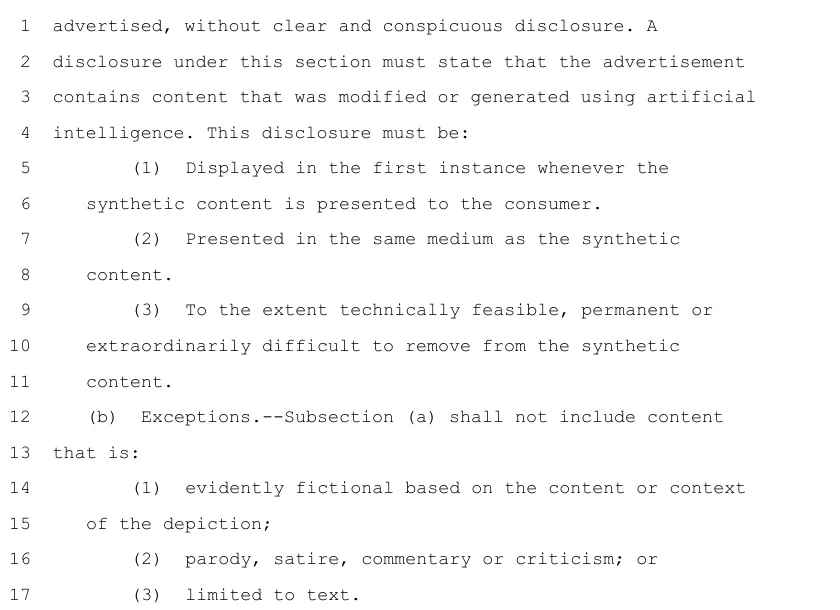
Screenshot: Senate Bill 806, PN 1808, Section 4, Pennsylvania General Assembly.
The three exceptions
Section 4(b) says the rule does not include content that is "(1) evidently fictional based on the content or context of the depiction; (2) parody, satire, commentary or criticism; or (3) limited to text."
The third one matters most for small teams. Ad copy, email subject lines and search ads written with an AI tool are text, so they fall outside this bill. The exceptions do not reach a realistic AI product image, a cloned voice reading a testimonial, or an AI video of a product demo.
Section 4(c) adds a limit in the other direction: disclosure "shall not be construed to limit any recourse under law." A label does not make a deceptive ad legal under other laws.
Enforcement and the $3,000 fine
Under Section 5, "the Attorney General or a district attorney may bring an action in the name of the Commonwealth against the person to restrain by temporary or permanent injunction" a violation, and either may bring a civil action. A court may award "(1) A civil fine that does not exceed $3,000. (2) Actual attorney fees and court costs."
The text names only the Attorney General and district attorneys. We found no private right of action in PN 1808. That was a deliberate change. The Pennsylvania Chamber of Business and Industry wrote to the Senate committee on May 6, 2026 to "share our support for Amendment A03233 to Senate Bill 806," saying it "establishes a clear enforcement framework limited to the Attorney General and district attorneys, with defined penalties, rather than expansive liability under the Unfair Trade Practice and Consumer Protection Law." The Chamber added that "additional changes may still be needed to provide clarity and ease implementation for the business community."
The bill does not say whether the $3,000 cap applies per ad, per day or per case. We do not guess.
Who supports it and who does not
Sen. Pisciottano, the sponsor, told MediaPost: "Consumers deserve to know if AI is being used to create a false impression about a product or service." He also said, "This legislation sets a commonsense transparency standard so Pennsylvanians can make informed decisions about what they are buying, while still allowing businesses to take advantage of this technology."
The tech industry group NetChoice opposed the bill in an October 4 letter to lawmakers, according to MediaPost. "Layering a parallel, AI-specific regime on top of these actively enforced laws does not enhance consumer protection," it wrote, and on the formatting rules: "Rules this prescriptive risk overwhelming short videos, small display ads, and audio spots." We could not read the letter itself.

Image: Pexels, used under the Pexels License.
Copy-paste: SB 806 ad review checklist
Run this on each ad that will be shown in Pennsylvania once the bill is signed. It follows the bill's structure. It is our checklist, not legal advice.
SB 806 AD CHECK  (ad name: ________  reviewer: ________  date: ________)

STEP 1. IS THERE SYNTHETIC CONTENT?
   [ ] Image, video or audio generated by AI?            yes / no
   [ ] Image, video or audio significantly modified by AI? yes / no
   If both are "no" (or the ad is text only): STOP, SB 806 does not apply.

STEP 2. DOES AN EXCEPTION APPLY?
   [ ] Evidently fictional from its content or context?   yes / no
   [ ] Parody, satire, commentary or criticism?           yes / no
   If yes: note which one and why, then STOP.

STEP 3. COULD IT MISLEAD ABOUT THE PRODUCT?
   Does the synthetic part shape what a viewer believes about the
   product's  [ ] nature  [ ] origin  [ ] authenticity ?
   Examples to flag: an AI product shot that differs from the real item,
   an AI "customer" or "expert", a cloned voice of a real person,
   an AI scene implying where the product is made.
   If none is ticked: record the reasoning and STOP.
   If any is ticked: change the ad or go to Step 4.

STEP 4. ADD THE LABEL
   Wording (from the bill):
   "This advertisement contains content that was modified or
    generated using artificial intelligence."
   [ ] Shown the first time the synthetic content appears
   [ ] Same medium (audio label in audio, on-screen label in video)
   [ ] Burned in or embedded, not a removable caption, where feasible
   [ ] Audio: normal volume and pace, not sped up
   [ ] Video: on screen long enough to read on a phone
   [ ] Same language as the ad

STEP 5. KEEP THE RECORD
   [ ] Save the final ad, the AI tools used and this sheet together.
Step 3 is where the judgment sits. The bill does not label every AI-assisted ad, so most of the work is deciding, and writing down, why a given ad does or does not create a false impression about the product.
What we do not know
- Whether and when the governor signs. The General Assembly site showed no executive action on October 9, 2026.
- How the fine is counted. Per ad, per run or per case is not stated.
- Out-of-state advertisers. The bill does not say how it applies to an ad made elsewhere and shown in Pennsylvania.
- The Senate Democrats' releases. pasenate.com blocks our region, so we rely on MediaPost's report of them.
Our take
SB 806 is a good example of a disclosure law written around deception rather than around AI. The trigger is a false impression about the product, the text-only exception removes most AI-written copy, and enforcement sits with public prosecutors only. For a small team, that means most ads will pass Step 1 or Step 3 of the checklist. The ads that will not are the ones that were risky anyway: AI product shots that flatter the product, AI people presented as customers, and cloned voices.
NetChoice's point that existing deception law already covers these ads is fair, and the bill itself says a label does not shield an ad from other law. The practical effect is narrower than the headlines: SB 806 adds a fixed wording and placement rule on top of a duty you already had. If your team already avoids misleading AI imagery, the new work is mostly the label format and a saved record.
Community reaction
We found no Reddit thread about SB 806 as of October 9, 2026, after searching r/Pennsylvania, r/marketing, r/advertising and Reddit site-wide for "SB 806", "Pennsylvania AI advertising" and "Pisciottano". We are not quoting a community reaction rather than borrowing one from another bill.
We did not embed a post or video: we found no video or X post from Sen. Pisciottano, the Senate Democrats or the House about this vote, and pasenate.com, where one might be posted, is blocked for us.
How we checked this
We built this article from 6 sources, checked on October 9, 2026: the text of SB 806 PN 1808 and the bill's status page on the Pennsylvania General Assembly site, the PA Chamber's May 6, 2026 memo, and two MediaPost reports from October 8 and October 9, 2026. palegis.us does not accept connections from our usual network, so we downloaded the bill page and PN 1808 through our own server the same day and matched every bill quote by hand against that copy. Every number and date in the article matches a quote in our source log.
Last reviewed: October 9, 2026.
Related Reading
- New York AI Synthetic Performer Ad Law: Disclosure Templates (Effective June 9, 2026)
- FTC AI Marketing Claims 2026: 8-Step Substantiation Checklist (Cox Media Group $930K)
- State Chatbot Disclosure Laws 2026: The Compliance Checklist Every SaaS Team Needs
- Multi-state AI compliance in 2026: operating across US and EU AI laws at once
- Washington AI Likeness Law: Now in Effect (June 10, 2026): Compliance Checklist
- SB 942 Enforcement: Midjourney Has No Watermark, Fines Begin