

The SEC's Division of Examinations publishes a list of priorities each fiscal year. AI sits in the emerging financial technology section, and the questions it implies are simple: are your AI claims true, do you supervise the AI tools you use, and does automated advice fit the client? The FY2027 list came out on October 23, 2026 and kept those questions while renaming the technology.
TL;DR: FY2026 priorities: examiners review AI capability claims for accuracy and check policies to supervise AI used in fraud detection, back-office work, AML and trading. FY2027 priorities: same tests for automated tools, AI now called "super intelligence (SI)", plus SI-driven phishing and deepfakes. Neither list is a rule. Have accurate disclosures and records of who reviews AI output.
What the FY2026 priorities say about AI
The FY2026 document puts AI under "Emerging Financial Technology." The Division said it would examine firms that offer "automated investment advisory services, recommendations, and related tools and methods," and assess whether:
- representations are fair and accurate;
- operations and controls are consistent with disclosures made to investors;
- algorithms lead to advice or recommendations consistent with investors' investment profiles or stated strategies;
- controls confirm that automated advice is "consistent with regulatory obligations to investors, including retail and older investors."
On AI specifically, it said it "will review for accuracy registrant representations regarding their AI capabilities or AI" and "will assess whether firms have implemented adequate policies and procedures to monitor and/or supervise their use of AI technologies, including for tasks related to fraud prevention and detection, back-office operations, anti-money laundering (AML), and trading functions." The cybersecurity section adds a look at the controls firms use against new risks from AI and polymorphic malware.
What changed in the FY2027 priorities
The FY2027 priorities, announced October 23, 2026, use a new term. They say registrants "are increasingly using super intelligence (SI) in core business operations and systems, including investment analysis, customer management, and code development," and that threat actors use it to automate cyberattacks.
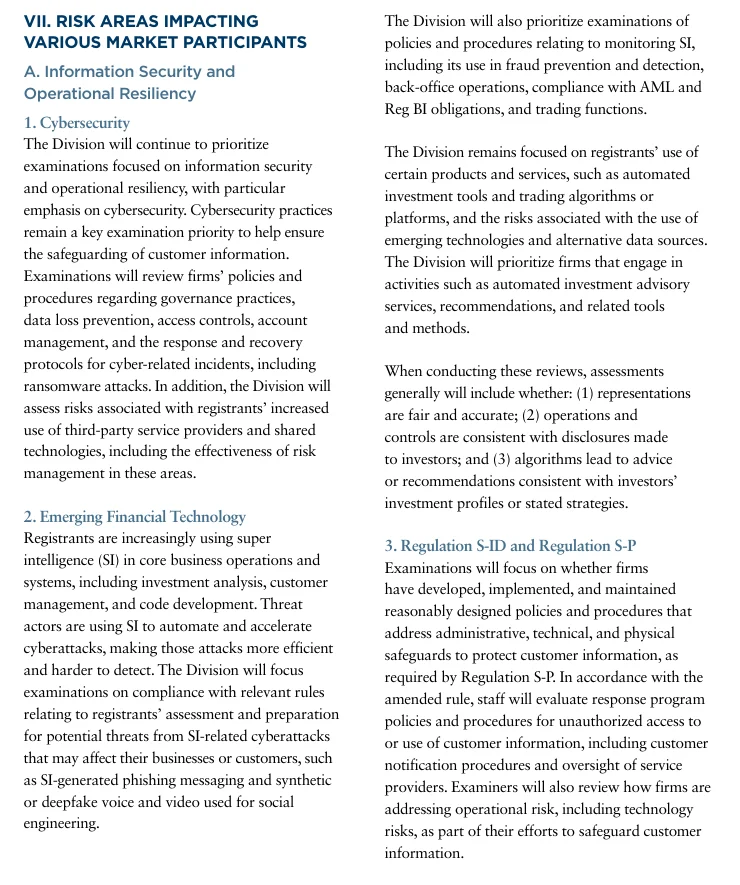
Screenshot: SEC Division of Examinations, Fiscal Year 2027 Examination Priorities, page 12. Captured October 31, 2026.
Three changes matter for a small adviser or broker-dealer:
- Threats, not only use. Examiners will look at how firms prepare for "SI-generated phishing messaging and synthetic or deepfake voice and video used for social engineering." The Regulation S-ID section asks whether identity theft programs address risks "related to SI and stolen credentials."
- Reg BI added. The supervision check now names "compliance with AML and Reg BI obligations" next to fraud prevention, back-office operations and trading.
- Three tests instead of four. The automated-tools review keeps fair and accurate representations, controls that match disclosures, and advice consistent with client profiles. The FY2026 item on retail and older investors isn't repeated, and neither is the separate sentence about reviewing AI capability claims, though accurate representations remain the first test.
The leadership message gives examples of SI use the Division sees: tools "to support research, drafting, coding, and client communications, as well as advisory and portfolio management functions, and compliance monitoring and surveillance." It says the Division is intensifying its efforts "to understand how the technologies influence outcomes."
Priorities aren't rules
Both documents open with the same disclaimer: the statement "has no legal force or effect: it does not alter or amend applicable law, and it creates no new or additional obligations." Your obligations come from the existing rules: the Advisers Act and its marketing and compliance rules, Regulation Best Interest, Regulations S-P and S-ID. The priorities tell you which of those obligations examiners will test against your AI use.
The SEC also dropped its one AI-specific rule proposal. On June 12, 2025 it withdrew the 2023 proposal on conflicts of interest from predictive data analytics, along with other pending proposals, and said it "does not intend to issue final rules with respect to these proposals."
AI washing is the enforcement precedent
The clearest signal of what examiners look for is enforcement. On March 18, 2024 the SEC settled charges against two investment advisers, Delphia and Global Predictions, "for making false and misleading statements about their purported use of artificial intelligence." They paid $400,000 in total civil penalties. The SEC said Delphia claimed in filings, a press release and its website that it used AI and machine learning on client data in its investment process when it didn't.
A small RIA's version of this risk is a pitch deck or website that says "AI-driven" about a process that's mostly rules and human judgment. Our AI enforcement guide covers the parallel FTC cases.
What examiners can ask, and what to have ready
The priorities don't publish a question list. This table maps each priority to the question we'd prepare for and the record that answers it.
| Priority text | Question to prepare for | Record to have ready |
|---|---|---|
| Representations are fair and accurate | Where do you say you use AI, and is it true? | Every AI mention in Form ADV Part 2A, website, pitch decks, client letters, with the tool behind each claim |
| Operations and controls consistent with disclosures | Does the process match what clients were told? | Process description for each AI tool, matched to the disclosure |
| Advice consistent with investment profiles | How do you check automated recommendations against client profiles? | Review log showing who checked AI-assisted recommendations and what they changed |
| Policies to monitor or supervise AI | Which AI tools do staff use, and who supervises them? | AI tool inventory with owner, use case and the policy that covers it |
| AI in fraud, back-office, AML, trading, Reg BI | How do you know the AI tool still works? | Monitoring results, error reviews, override records |
| SI-generated phishing and deepfakes (FY2027) | How would you catch a deepfake call asking to move money? | Call-back and verification procedure for transfer requests; staff training record |
Start with the inventory. Shadow use is the usual gap: a staff member pastes client data into a chatbot that no policy covers. The third-party AI tool risk assessment and the AI vendor due diligence checklist cover what to collect from vendors.
What practitioners say

Image: Pexels, used under the Pexels License.
On r/CFP, an adviser asked what tech compliance an SEC-registered RIA needs. u/roccomo replied: "If you're using social media, slack, texting, have a website, emailing, or AI, you'll want archiving for all of it. Ai is uniquely complicated if you're using Claude or ChatGPT, for privacy reasons."
In a thread on solo RIA compliance, u/NoConstant2905 wrote: "Most exams are pretty easy if you're reviewing things proactively. I did an audit in 2024 and it really was producing/moving docs around." That matches the AI table above: the work is having the records before the request arrives.
How an exam ends
The SEC Exam Handbook, published October 1, 2026, sets out the process. "Most examinations conclude with" a deficiency letter that details "findings of potential violations of federal securities law." Staff typically ask for a response within 30 days, aim to issue the disposition letter within 180 days after the onsite work is done and records are received, and try to comment on your response within 60 days. Prompt corrective action "may be a mitigating factor" when staff decide whether to refer a finding to the Division of Enforcement.
The SEC's roundtable on AI in the financial industry is worth watching for how the agency and firms talk about these risks:
Checklist (copy/paste)
- List every AI tool in advisory, trading, compliance and operations, including AI features inside existing platforms
- Name an owner and the supervising policy for each tool
- Collect every AI claim in Form ADV, website, decks and client letters; confirm each one against the actual process
- Keep a review log for AI-assisted recommendations: who checked, against which client profile, what changed
- Record monitoring results and overrides for AI used in AML, fraud detection or trading
- Confirm AI chat and note-taking tools are covered by your recordkeeping and Regulation S-P vendor oversight
- Add a call-back step for transfer requests received by voice or video, and train staff on deepfakes
- Prepare a one-page AI summary: tools, owners, policies, last review date, known issues
Our take
Read the two years together and the message is steady: the SEC isn't writing an AI rule, it's testing AI use against the rules you already follow. The FY2027 word change to "super intelligence" doesn't change what you need. A small firm that can show an accurate AI inventory, disclosures that match it and a log of human review is in better shape than one with a long AI policy nobody follows. The new item to act on is deepfake fraud: a call-back rule for money movement costs nothing and answers the FY2027 question directly.
Correction (October 31, 2026): Earlier versions said the SEC "embedded AI oversight into every FY2026 examination category," that the priorities require written supervisory procedures for every AI tool and fiduciary and suitability analysis of AI recommendations, that there is "no de minimis threshold," and that firms using AI without disclosing it face additional scrutiny. The FY2026 priorities cover AI mainly under emerging financial technology and cybersecurity, aren't rules, and contain none of those statements. A table of examiner checks attributed to the priorities has been replaced with our own mapping. The article now also covers the FY2027 priorities released October 23, 2026.