Image: Pexels, used under the Pexels License.
This is for small companies that sell, resell or build on a large language model in Department of War (DoW) contracts, including as a subcontractor. On October 20, 2026, the DoW's contracting policy office signed templates that turn Executive Order 14319, "Preventing Woke AI in the Federal Government," into solicitation and contract language. Our verdict: the paperwork is light, but it becomes a material contract term, so a gap can cost you the contract.
Event date: October 20, 2026, the digital signature date on memo USA001389-26-DPCAP from John M. Tenaglia, Principal Director, Defense Pricing, Contracting, and Acquisition Policy. First reported October 26, 2026 by ExecutiveGov and Federal News Network. We read the nine-page memo and OMB Memorandum M-26-04 in full.
Pick your model's paperwork
- Pick GPT if you need the freshest system card: OpenAI posted a GPT-6.1 Terra addendum on October 26, 2026. Plan for its new usage policy, which takes effect November 20.
- Pick Gemini if you want a short, stable usage policy: Google's Prohibited Use Policy was last modified December 17, 2024. Build your own feedback channel for work accounts.
- Pick Claude only after your contracting officer confirms it can be offered. Anthropic's policy fits item 4 best, but the D.C. Circuit upheld its supply-chain risk designation on September 25, 2026.
How the big three cover the four minimum documents
If the buy is an LLM, items 1 to 4 "must be included in both the solicitation and the resulting contract." We checked each developer's public documents on October 27, 2026.
| Required item | OpenAI (GPT) | Anthropic (Claude) | Google (Gemini) | Checked |
|---|---|---|---|---|
| 1. Developer's Acceptable Use Policy | Usage Policies, updated Oct 21, 2026, effective Nov 20, 2026 | Usage Policy, also called the AUP | Generative AI Prohibited Use Policy, last modified Dec 17, 2024 | Oct 27, 2026 |
| 2. Most current model, system or data card | Deployment Safety Hub: GPT-6.1 Terra addendum, Oct 26, 2026 | System cards: Haiku 5.5 (Oct 2026), Opus 5.5 (Sep 2026) | Model cards: Gemini 4 Argon, Oct 13, 2026 | Oct 27, 2026 |
| 3. End-user resources | Platform docs | Claude docs | Gemini API docs | Oct 27, 2026 |
| 4. Feedback route for outputs | Content reporting webform plus in-product reports | [email protected] and the in-product "report issues" button, named in the AUP | Response feedback in Gemini Apps, limited for work accounts with Pro access | Oct 27, 2026 |
| Status for DoW work | National security uses need OpenAI "review and approval" from Nov 20 | Section 4713 supply-chain risk designation upheld 2-1; en banc petition filed | No restriction found in the policy we read | Oct 27, 2026 |
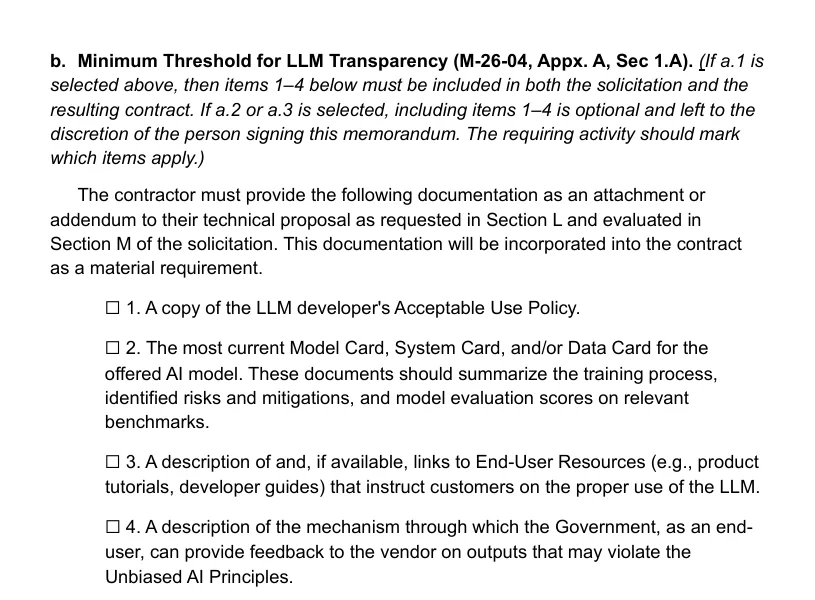
Screenshot: DoW memo USA001389-26-DPCAP, Attachment A, page 4. Captured October 27, 2026.
Item 4 is the one that needs thought. Anthropic's policy is the only one of the three that names the problem in plain words: "If you believe that our model outputs are potentially inaccurate, biased, or harmful, please notify us at [email protected]." OpenAI's reporting page is framed around content that may violate its Terms of Use or the law. Google's help page says "Users with a work account that has access to Pro, and users with a school account, will not be able to add additional feedback or attach content." If you deploy Gemini through a work account, describe your own channel too.
What the contract clause binds you to
The memo has three attachments: a form for the requiring activity (A), solicitation language for Section L (B) and contract language for the statement of work (C). Attachment C is the part a contractor lives with.
- Your proposal becomes the baseline. The documents you submit are "incorporated into the contract as a material requirement." Materiality lets the government terminate "for default when the contractor refuses to take corrective action."
- Changes trigger an update. "Significant Modifications" include "changes to training data and model architecture, and alterations to filtering and content moderation." After one, you must send updated documentation.
- A complaint starts a 15-business-day clock. You must investigate and answer with the findings, whether there was a violation, the likely cause, the fix and a timeline.
- It flows down. Primes must insert the requirements "in all subcontracts at any tier for the acquisition, development, or integration of LLMs."
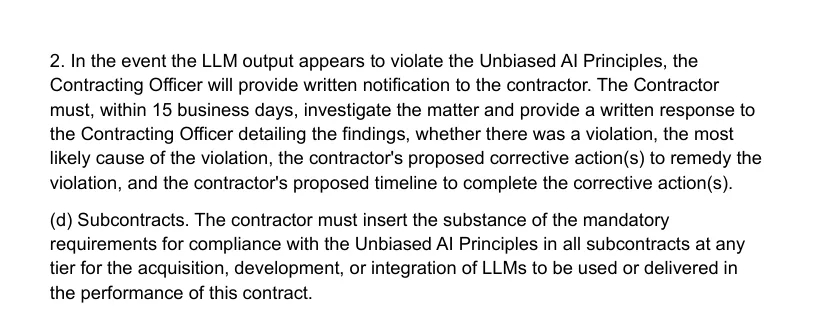
Screenshot: DoW memo USA001389-26-DPCAP, Attachment C, page 9. Captured October 27, 2026.
For riskier buys, the requiring activity can tick enhanced items: system prompts, the types of outputs filtered, red teaming for bias, "Details on any training or development that occurred outside the United States," and changes made for foreign governments. One item is aimed at resellers and integrators: "Disclosure of additional controls (e.g., classifiers, system prompts, fine-tuning, content moderation, filters) applied by a vendor who is not the direct developer." The executive order itself says vendors can meet the transparency duty with system prompts, specifications or evaluations, and that agencies should "avoid requiring disclosure of specific model weights or other sensitive technical data where practicable."
The memo is guidance. It says compliance with the order and the OMB memo "is mandatory" but use of the attachments "is not mandatory," and components may "revise, tailor, or supplement" the language. Expect variations between solicitations.
What is out of scope
OMB Memorandum M-26-04, dated December 11, 2025, sets the government-wide rules the DoW templates implement. Two of its limits matter to small contractors:
- It does not govern "AI used incidentally by a contractor during performance of a contract for administrative purposes." Using an AI assistant at your own option to draft a proposal or an email is outside it.
- Agencies "are not required to apply the requirements of this memorandum to LLMs acquired pursuant to a free, open-source license," though they should run due diligence on those models.
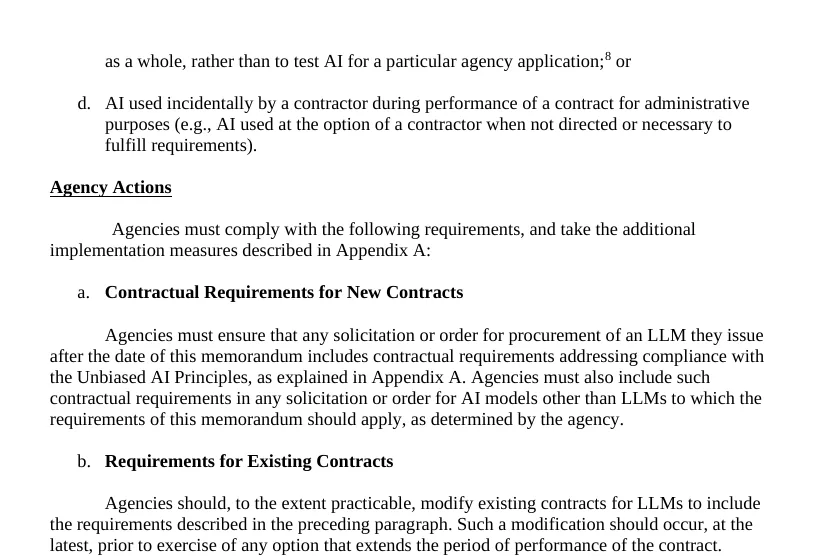
Screenshot: OMB Memorandum M-26-04, page 3. Captured October 27, 2026.
M-26-04 also tells agencies to modify existing LLM contracts, "at the latest, prior to exercise of any option that extends the period of performance." If you hold an option year, expect the clause at renewal.
What to do this week
- Build the four-document folder for each model you offer, with the version and the date you pulled it. For OpenAI, keep both the current usage policy and the one effective November 20.
- List your own layers. Write down every system prompt, filter, classifier and fine-tune you add on top of the developer's model. That list answers enhanced item 4a and tells you when a "significant modification" has happened. Our model card guide has a template.
- Write a 15-day response runbook. Who pulls the logs, who reproduces the output, who signs the answer. Fifteen business days is three weeks, and a small team loses a week just finding the conversation.
- Check the developer's own approvals. OpenAI's policy, from November 20, bars "national security, law enforcement, or intelligence purposes without our review and approval." For Claude, Anthropic's IPO filing says the designation cases may hurt its sales to "customers that sell products and services to the U.S. government." Ask your contracting officer before you bid it.
- Read the subcontract you sign. If a prime flows the clause down, your 15 days may be shorter in practice, because the prime needs time to answer the government. See our AI vendor contract red flags for terms to push back on.
What people said
Rep. Jimmy Patronis (R-Fla.) wants to put the order into law, Federal News Network reported. Drafting a bid with AI at your own option sits outside the memo. In an r/govcon thread on AI for bid writing, one contractor wrote: "AI makes life easier but you have to challenge it constantly."
No embed: the DoW posted the memo as a PDF with no announcement video or social post we could find, so we link the PDF and the reporting directly.
What we could not confirm
We found no live DoW solicitation using the templates yet, so we can't say how contracting officers will judge item 4 or which enhanced items they will tick. The memo doesn't say how it applies to national security systems, which M-26-04 excludes. We didn't ask OpenAI how its November 20 approval rule treats a reseller in a DoW subcontract. We also don't know whether Anthropic's en banc petition will change its status; see our earlier coverage of the Anthropic blacklist case.
Verdicts
- OpenAI (GPT): all four documents are public and current; plan for the November 20 approval rule.
- Google (Gemini): all four are public and the policy is stable; add your own feedback channel for work accounts.
- Anthropic (Claude): the strongest feedback route of the three, but clear the supply-chain designation with the contracting officer first.
Related Reading
- Judge Voids Pentagon Anthropic Blacklist: Vendor Guide
- DeepSeek Federal Ban: What Government Contractors Check Now
- AI Model Cards: What Regulators Expect and How to Write One
- FTC AI Accuracy Policy: 5 Questions for Your AI Vendor
- AI Vendor Contract Red Flags: 12 Clauses to Fix in 2026
- NIST AI Red Teaming: What It Tests and How to Run One