Image: Pexels, used under the Pexels License.
This is for teams that use AI voice agents or automated text messages for reminders, alerts or follow-ups in the US. The FCC's revised rule on how people revoke consent to robocalls and robotexts was published in the Federal Register on October 26, 2026, and takes effect November 25, 2026. Our verdict: it gives callers more control over opt-outs, but only if they set it up on purpose before the date.
Event date: October 26, 2026, Federal Register publication (91 FR 67214, FR Doc. 2026-21821). The FCC adopted the order, FCC 26-67, on September 30 and released it October 1.
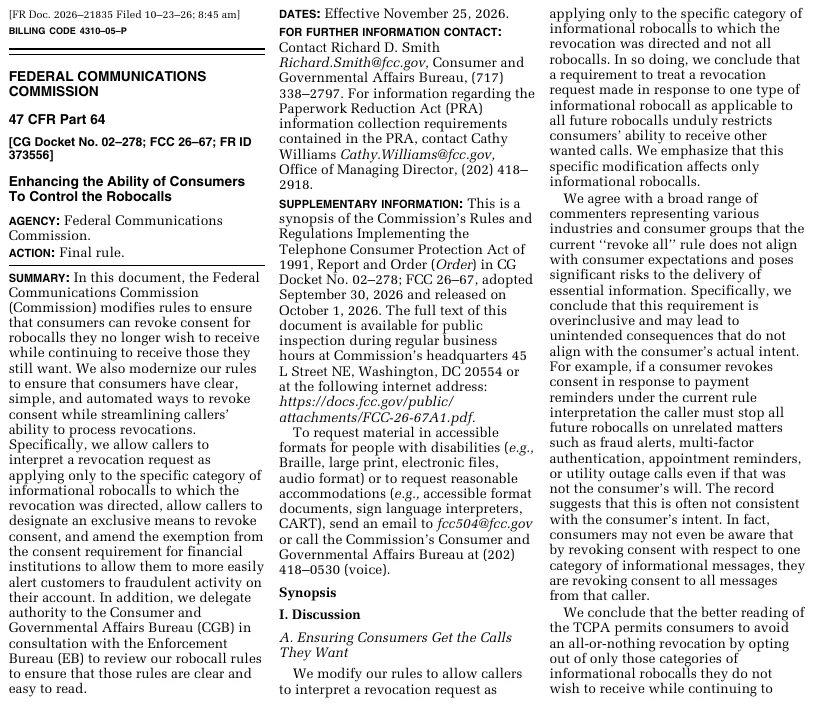
Screenshot: Federal Register, 91 FR 67214, October 26, 2026. Captured October 26, 2026.
Why this reaches AI voice agents
The TCPA restricts calls made with an "artificial or prerecorded voice." In February 2024 the FCC ruled that this covers AI: "callers must obtain prior express consent from the called party before making a call that utilizes artificial or prerecorded voice simulated or generated through AI technology." So an AI voice agent that phones customers is making robocalls for TCPA purposes, and the consent and revocation rules apply to it. The Federal Register text of the new order does not mention AI.
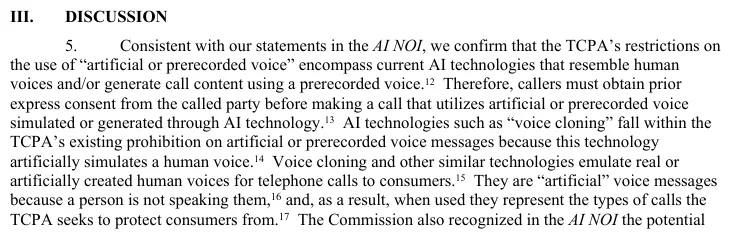
Screenshot: FCC 24-17, Declaratory Ruling, CG Docket No. 23-362, page 2. Captured October 26, 2026.
What changes on November 25
- Opt-outs from informational messages can stay narrow. Callers "may interpret a revocation request" made in response to an informational call or text "as applying only to the specific category" it was aimed at. An opt-out from payment reminders no longer has to stop fraud alerts or appointment reminders. Telemarketing works differently: an opt-out there still covers all of that caller's telemarketing.
- You can name one exclusive opt-out method. Three methods qualify: an automated, interactive voice or key-press opt-out on the call; a reply text with one of seven words ("stop," "quit," "end," "revoke," "opt out," "cancel," or "unsubscribe"); or a website or phone number you designate. You must "clearly and conspicuously disclose" it on the call or in the text. A text that names one of the words is enough, but you must honor all seven.
- No designation, no relief. Callers that don't name a method "must process revocation requests made by any reasonable means."
- The deadline stays. Opt-outs must be honored within "ten business days from receipt."
- Banks get more room for fraud alerts. Financial institutions using the exemption can text or call wireless numbers "obtained from a reliable source," such as a number an authorized family member supplied.
The order also ends a long wait. It supersedes the delayed revoke-all requirement "previously extended to January 31, 2027," and the FCC refused a request for a 12-month runway.
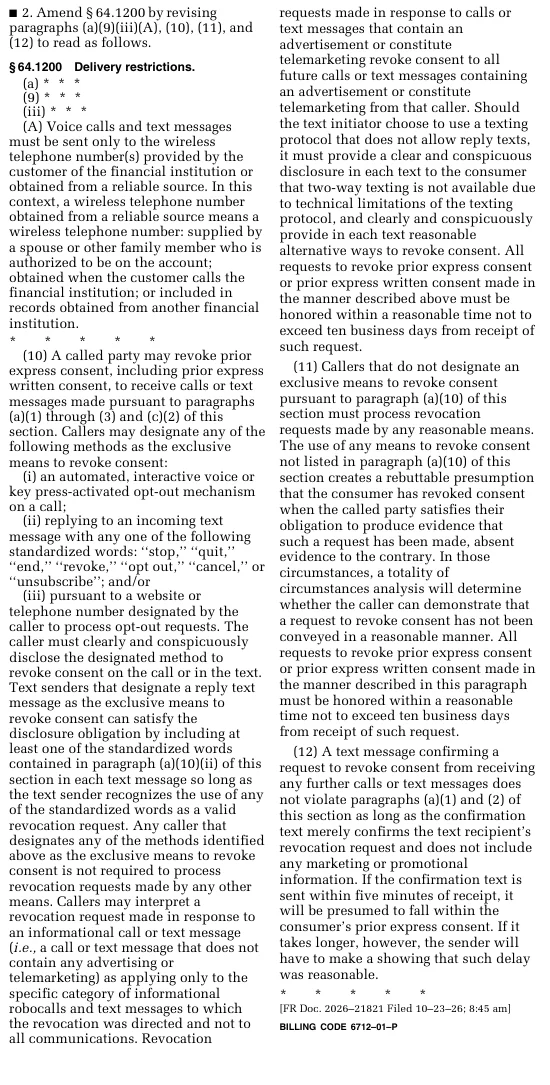
Screenshot: Federal Register, 91 FR 67219, amended 47 CFR 64.1200(a)(10) and (11). Captured October 26, 2026.
What to do before November 25
- Decide whether to designate. If your AI voice agent or texting platform can capture opt-outs automatically, naming that channel as exclusive cuts the "any reasonable means" exposure. Nixon Peabody's view is that this "should reduce litigation" over reasonable means.
- Test what your AI agent hears. An interactive voice opt-out only works if the agent catches it. Our take: test natural phrasing ("take me off your list," "don't call me again"), not just "stop," and log each catch to your suppression list.
- Name your categories. Write down which informational streams you run, such as payment reminders, appointment reminders and outage alerts, and record consent per stream. Keep sales language out of informational messages, or the narrower opt-out won't apply.
- Put the disclosure in the script, not the model's discretion. Our take: for AI agents, the opt-out disclosure should be fixed text played or sent every time, not something the model phrases on its own.
- Ask your vendors. Messaging platforms, dialers and call centers "will need to support exclusive-method disclosures and category-level suppression," per Nixon Peabody.
For the recording side of AI calls, see our AI call recording consent checklist.
What's still open
The FCC wants comments on further changes: a shorter window to honor opt-outs, two-way texting, requiring a revoke-all method, and how opt-outs apply to affiliates. Comments are due November 25, 2026 and replies December 28, 2026, in CG Docket No. 02-278.
The same docket holds a separate fight over AI. Club for Growth asked the FCC to let political callers use an artificial or prerecorded voice, "including an AI-generated voice," to call cell phones without prior consent. The reply period closed October 19. When we checked the docket on October 26, we found no ruling on it.
What people said
Individuals have filed short comments in that docket too. Celeste Kolodin wrote on October 19: "I think allowing AI generated political or other robocalls is misleading, annoying, and possibly dangerous." Stephen Oshrin's filing the same day was shorter: "I strongly oppose allowing AI generated robocalls regarding the 2026 elections."
No embed: we found no FCC video or social post about the Federal Register publication, so we link the filings directly.
What we could not confirm
We read the Federal Register text, not the full FCC order (FCC 26-67), which has more discussion. The rule does not say whether an AI agent that understands spoken requests counts as an "automated, interactive voice" mechanism; we think it does, but no court or FCC document we found says so. For other AI rules that touch customer contact, see the NYC chatbot doom loop rule and our state chatbot disclosure laws checklist.