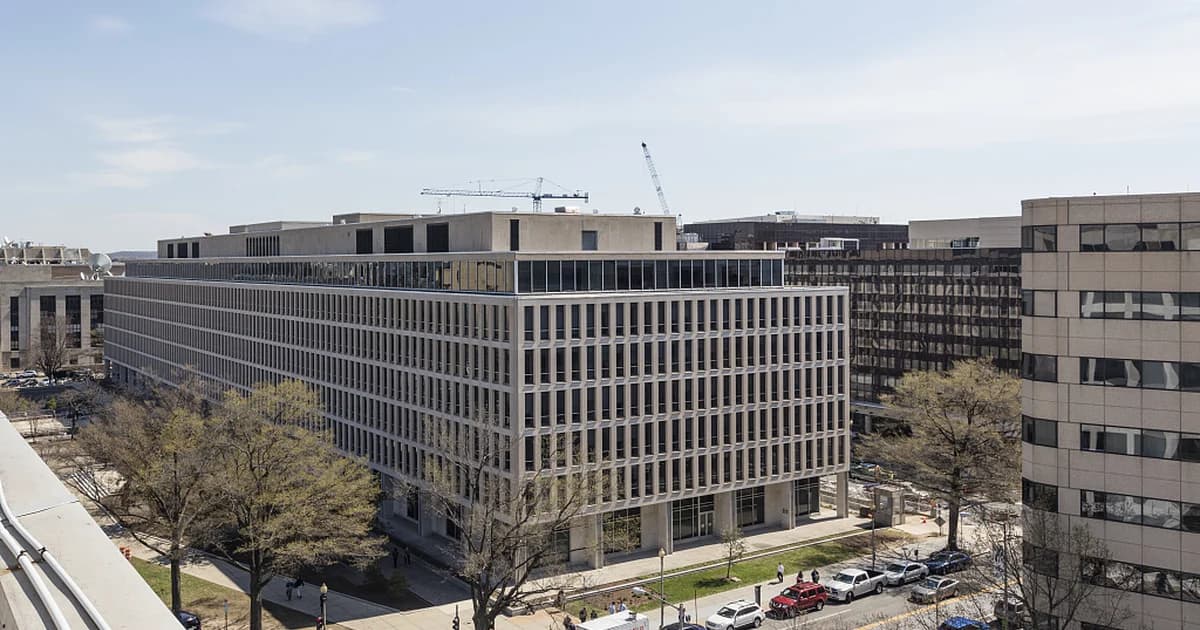
Picture a four-person nonprofit that trains hospital aides to use AI tools, with a federal application half written and "AI literacy" on every page. On November 5 the Education Department proposed calling that "SI literacy" and added five subparts that change what a strong application looks like. Comments are due December 7. Nothing is due from you this week: this is a proposal, and a priority earns points only when a competition notice cites it.
Event date: November 5, 2026, Federal Register 91 FR 69736, signed November 3 by Secretary Linda McMahon. What we read: the notice, the April 13 final notice it amends, the executive order behind the rename, four FY2026 application notices and the Labor Department framework the new subparts point to.
Super Intelligence (SI) is the federal executive branch's term for AI under Executive Order 14434. In the rest of this post we say AI and quote ED's wording only where the exact words matter.
What ED proposed
ED proposes changes to four existing sets of Secretary's Supplemental Priorities, and the AI priority is the one that gets new subparts. Here it is, old against new:
| Change | Final notice, April 13, 2026 (91 FR 18774) | Proposed, November 5, 2026 |
|---|---|---|
| Title | "Advancing Artificial Intelligence in Education" | "Advancing Super Intelligence in Education" |
| Defined term | "Artificial intelligence (AI)", meaning 15 U.S.C. 9401(3) | "Super Intelligence (SI)", defined as in the executive order, which points to the same statute |
| Literacy term | "AI literacy" | "SI literacy", plus a new clause on "understanding how SI works and how to use SI tools effectively and responsibly" |
| (a)(viii), new | not there | partnering with employers or industry associations to develop materials and training for industry or occupation specific SI literacy |
| (a)(ix), new | not there | SI literacy work aligned with the five content areas and seven delivery principles of DOL's February 13, 2026 AI Literacy Framework |
| (b)(iv), new | not there | SI projects "designed for all students" |
| (b)(xii) and (b)(xiii), new | not there | evidence-building on SI in education; developing and sharing evidence-informed frameworks, tools and models for integrating SI into education |
| (b)(xi), now (b)(xiv) | "The use of AI technology to improve program outcomes" | adds "a rigorous and specific deployment of the technology in teaching methods or student supports" |
| (a)(vii), dual enrollment | State and local education agencies | adds Tribal education agencies and Tribal organizations |
The notice amends four notices in all. The other three are "Evidence-Based Literacy, Education Choice, and Returning Education to the States" (one notice), "Meaningful Learning Opportunities" and "Career Pathways and Workforce Readiness". They get the SI and SI literacy definitions added wherever those terms appear. The education choice set also widens its STEM focus area to include "super intelligence (SI), SI literacy, and cybersecurity", per the notice.
The definition is the same statute in a new coat. 15 U.S.C. 9401(3) reads, in part, "a machine-based system that can, for a given set of human-defined objectives, make predictions, recommendations or decisions influencing real or virtual environments." ED says the rename keeps "the substantive focus of the priority", and its definition applies "unless and until it is superseded" by presidential action or an Act of Congress.
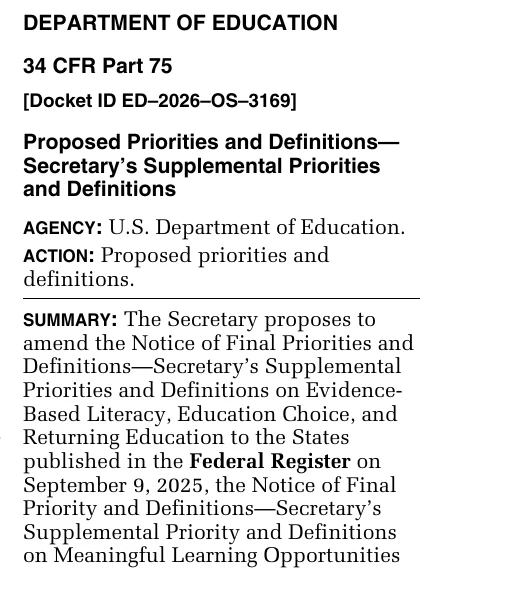
Source: Federal Register, vol. 91, no. 213, page 69736 (November 5, 2026), cropped by us. U.S. government work.
The order behind it, and a number that doesn't match
ED cites the executive order as its reason. Section 2(a) of the order tells agencies to use SI "in official correspondence, public communications, websites, reports, policy documents, and other nonstatutory documents". Section 2(b) adds: "Nothing in this section requires the alteration of previously issued regulations, Presidential actions, contracts, grants, or other historical documents." So ED is not compelled to reopen a final notice from April. It chose to.
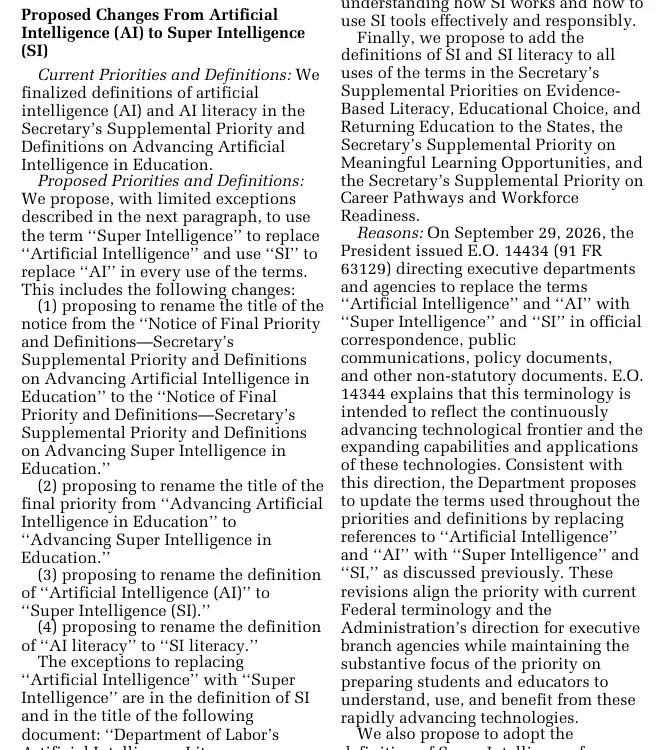
Source: Federal Register, vol. 91, no. 213, page 69738 (November 5, 2026), cropped by us. U.S. government work.
Look at the E.O. numbers in the crop. The notice writes "E.O. 14434 (91 FR 63129)" once and "E.O. 14344" four times, including where it adopts the definition. The Federal Register record for 91 FR 63129 is Executive Order 14434, signed September 29, 2026. If you comment, correcting that number is the cheapest useful comment you can file.
What the Labor Department framework asks for
Subpart (a)(ix) sends applicants to the Department of Labor's AI Literacy Framework, issued as Training and Employment Notice 07-25 on February 13, 2026. DOL's release says it "outlines five foundational content areas and seven delivery principles for AI literacy." We opened the framework on DOL's site and list the headings here:
| Five content areas | Seven delivery principles |
|---|---|
| Understand AI Principles | Enable Experiential Learning |
| Explore AI Uses | Embed Learning in Context |
| Direct AI Effectively | Build Complementary Human Skills |
| Evaluate AI Outputs | Address Prerequisites to AI Literacy |
| Use AI Responsibly | Create Pathways for Continued Learning |
| Prepare Enabling Roles | |
| Design for Agility |
Two things matter for an applicant. First, the framework is voluntary and says so: the notice that issued it says the framework "provides voluntary guidance", and DOL is "putting this framework forward as a starting point", and it defines AI literacy "with a primary focus on generative AI". Second, the loop is closed on both sides. The framework says it complements "the Secretary's supplemental grantmaking priority on advancing AI in education to develop an AI-ready workforce", so ED's new subpart points at a document that points back at ED's priority.
In practice, a curriculum outline that labels each module with one of the five content areas, and each teaching method with one of the seven principles, gives a reviewer the match they are looking for.
Where the priority has been used so far
The AI priority has been in live competitions since the April final notice. Searching federalregister.gov for its title turned up four FY2026 application notices that name it:
| Competition (Federal Register) | How the notice names the priority | Deadline |
|---|---|---|
| Supporting Effective Educator Development (91 FR 20989, April 20) | one of three competitive preference priorities | June 1, 2026 |
| Educational Technology, Media, and Materials, Accessible Education Video Projects (91 FR 23409, May 1) | "The competitive preference priority", on top of one absolute priority; award ceiling $1,050,000 for a 12-month period | June 26, 2026 |
| Strengthening Institutions Program (91 FR 31709, May 28) | listed among five priorities | June 23, 2026 |
| FIPSE Open Textbook Pilot (91 FR 31711, May 28) | listed among five priorities | June 23, 2026 |
A competitive preference priority works through points: ED either awards "additional points" or picks an application that meets it over one of comparable merit that doesn't. That is why the wording of the subparts matters more than the title. A subpart that names a project type you already run is a place to earn points. We don't know which FY2027 competitions will use the priority; ED says it announces them in the Federal Register, and this notice "does not solicit applications."
What to do
This week. Open your draft and mark every place it says "AI literacy". Pick one new subpart your project already fits and write the one sentence a reviewer could point to. Then put two dates on your calendar: November 28, when the White House's proposed SI definition is due to the President, and December 7, when comments close. If you plan to comment, have it drafted by December 1.
If you apply for ED money. Keep your current drafts. When an application notice cites the priority, copy its title and subpart letters into your narrative headings, because the notice, not this proposal, controls what your application is scored against. What gets scored is whether the project does what a subpart describes, not which word the title uses.
If you build classroom or training tools. The two evidence subparts, (b)(xii) and (b)(xiii), are the ones to read. As proposed, a team that builds a tool and tests whether it improves student outcomes now fits a named subpart, instead of squeezing under "improve program outcomes". The (a)(viii) subpart names employers or industry associations as partners, so line up that partner before a notice appears.
If you want to comment. Comments go through Regulations.gov, docket ED-2026-OS-3169 and must arrive on or before December 7, 2026. They are posted in full, so leave out anything confidential. ED says a campaign of near-duplicate comments may be posted as one sample with a count. It asks specifically for "high-quality comments supported with quantitative data" on its cost estimate, which says applicants would spend no more than before: "any potential costs to applicants would be de minimis." It certifies no substantial economic impact on small entities, and defines a proprietary institution as small below $7,000,000 in annual revenue.
What to watch. The executive order gave the Assistant to the President for Science and Technology 60 days from September 29 to send the President proposed legislative language for a federal SI definition. That puts the deadline at about November 28. If a new definition appears, ED's borrowed one moves with it.
Our take
By ED's own description the rename is cosmetic: same statute, same priority, new word. The news is the five new subparts, and the evidence ones are the best for a small team, because a tool builder with an efficacy plan can now point at a named line. Subpart (a)(ix) deserves a close read: it hands your literacy curriculum a checklist, the five areas and seven principles above, that its own author calls a starting point. A notice that gets the number of its own justifying order wrong four times is not one to treat as final text either. Write the application for the subpart, not the title, and the rename will never matter to your score.
What we could not confirm: the Regulations.gov docket refused our request, so we don't know how many comments have been filed. We read the full proposed text for the AI priority but only skimmed the other three notices apart from the definition and STEM changes above. We did not check whether other FY2026 competitions named the priority beyond the four above. We read the Labor Department framework's headings and its introduction, not every example under each heading.