On November 3, 2026, Advocate General Maciej Szpunar told the EU Court of Justice when a chatbot that fetches news reproduces an article. It happens in two situations: the chatbot got the article by getting around a paywall or a block aimed at scraping bots, or its answer keeps so much of the article's wording and structure that the reader no longer needs the original. Reporting the same facts in other words is allowed. The chatbot makes the article available to the public only if the article's form shows up systematically in its answers to related queries. Either way, the provider answers for those acts only if they are inherent to its business model or it failed to take the measures a reasonably diligent operator would (point 240). The opinion, in Case C-250/25 Like Company v Google Ireland, is not binding, and the judges will rule at a later date. In his view EU law can reach any chatbot offered to users in the EU, wherever the provider is based (point 165).
Event date: November 3, 2026 (CURIA press release No 155/26). First report: the same press release and the full opinion on InfoCuria (ECLI:EU:C:2026:919), both published on the day; IPKat had an analysis up the same morning.
No deadline, but a test you can design for
Nobody has a legal deadline today. The Court's press release says the opinion "is not binding on the Court of Justice" and gives no date for the judgment. It also calls this "the first generative AI case to reach the Court of Justice", and the opinion notes that the Court "has never before clarified the scope of the press publishers' right" (point 171). Until the judgment, this opinion is the reference point for how that right applies to retrieval-augmented generation (RAG).
The teams that should read it are those whose product fetches web pages at the moment a user asks something and answers users in the EU: news digests, research assistants, support bots with a web search tool switched on, sales tools that summarize press coverage of a prospect. Location doesn't help. Point 165 says Article 15(1) of the CDSM Directive can protect publishers against a chatbot provided to EU users "irrespective of the place where the chatbot provider is established or of the location of the servers from which it operates."
The right in play is narrower than copyright. Article 15(1), quoted in point 9, protects publishers established in a Member State against "the online use of their press publications by information society service providers". It does not apply to "private or non-commercial uses of press publications by individual users", or to "individual words or very short extracts".
The case: one Gemini summary of a Lake Balaton article
Like Company runs Hungarian web portals, including balatonkornyeke.hu, which publishes free articles about Lake Balaton and makes its money from ads (point 14). It sued Google before the Budapest Környéki Törvényszék (Budapest Regional Court), claiming that Bard and then Gemini infringed its rights between June 13, 2023 and May 31, 2024 (point 15). The example in the file is one exchange: a user asked Gemini for "a summary in Hungarian" of a July 21, 2023 article about the singer Kozsó's plan to bring dolphins to the lake, and got one (points 17 and 18). The Court heard the case on March 10, 2026, with written observations from both companies, nine national governments and the European Commission (point 21).
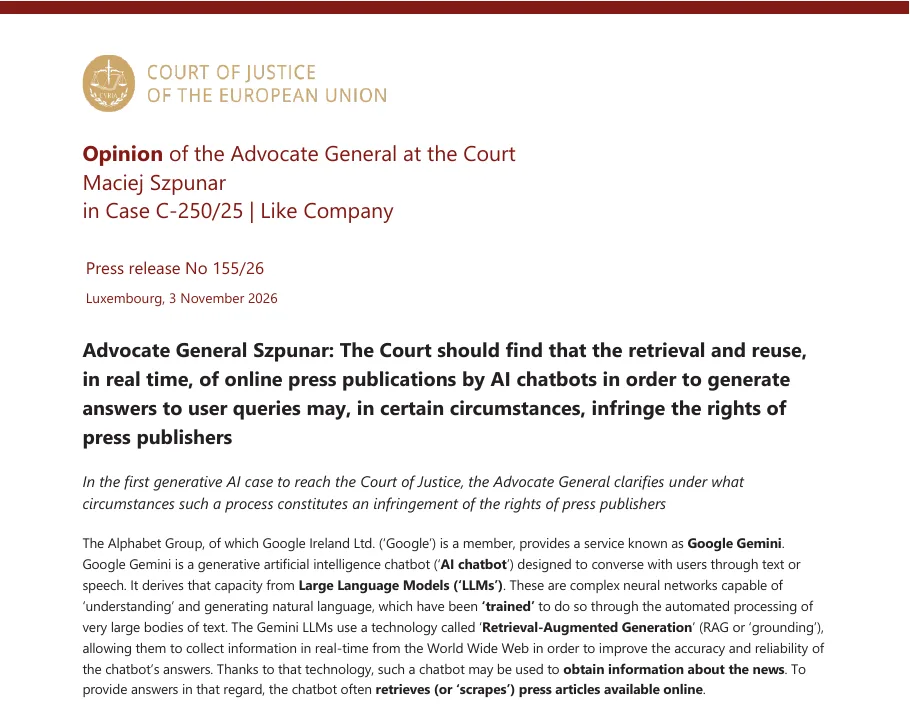
Screenshot: CURIA press release No 155/26, page 1, November 3, 2026. Captured November 4, 2026.
Szpunar's answers, in the order that matters for a team building on large language models:
- The two training questions are inadmissible. There is no evidence Like Company's articles were used to train Gemini, and training isn't an "online use" of a press publication, so the questions are hypothetical (press release; points 24, 56 and 58). He still gave a view: training on protected content is, "as a rule, freely permitted" under the text and data mining (TDM) exception in Article 4 of the CDSM Directive, provided the content was lawfully accessible and the rightholder hasn't opted out by machine-readable means (points 141 to 148).
- RAG is a separate act. Fetching an article to ground an answer is an "online use" (point 167), and the TDM exception doesn't cover it, because RAG isn't run to find "patterns, trends and correlations" (point 179). The copies made along the way can fall under the temporary-copy exception in Article 5(1) of the InfoSoc Directive, but only if the access was lawful and the answer doesn't reuse the article's form (points 187 to 189).
- The provider is liable when infringing use is "inherent to that provider's business model", or when it failed to put in place "the appropriate measures that can be expected from a reasonably diligent operator in its situation" (point 240). When a user directs the chatbot to do something infringing, "primary" liability "should generally lie with the user" (point 219).
- Leaving articles free doesn't mean consent. Google argued that a publisher with no paywall or bot block had implicitly consented to reuse. Szpunar: "I do not think that is the case" (points 224 and 225).
The headlines called this a setback for Google. On the facts of this case it reads the other way. Point 239 says that, subject to the Budapest court's findings, the conditions "would appear" not to be met: Like Company had no technical measures against scraping, the Gemini answer doesn't show the article's form of expression, the use isn't inherent to Google's business model, and "Google seems to have put in place appropriate measures".
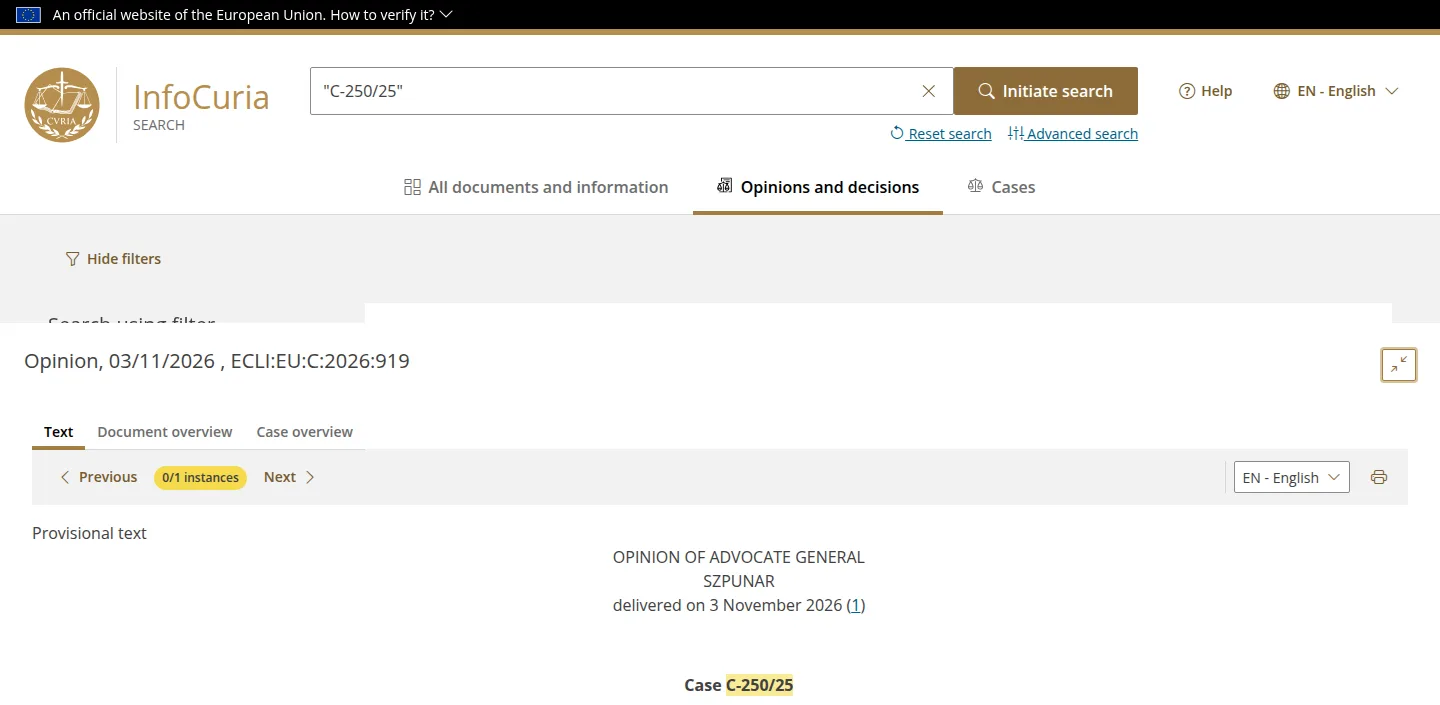
Screenshot: InfoCuria, Opinion of Advocate General Szpunar in Case C-250/25, provisional text. Captured November 4, 2026.
What "recognisable" means, in the AG's own examples
If your product never touches paywalls or bot blocks, the second condition is the one that matters to you. The press publishers' right covers the article's form of expression, meaning "the way in which those articles are arranged, structured and phrased", and not the facts it reports (point 199). Here is how the opinion sorts chatbot answers:
| What the chatbot's answer does | The AG's view | Point |
|---|---|---|
| Copies the article so closely that it replaces it | Reproduction "is obvious", though this "rarely happens nowadays" | 203 |
| Rephrases, but keeps "a distinctive arrangement, structure and general phrasing" of the article | Can still be recognisable "despite some degree of rephrasing" | 207 |
| Gives "a short summary of the factual content presented differently", or an outline drawn from "various sources" and restructured by the model | Not a reproduction | 208 |
| Falls between those two | Decided "on a case-by-case basis" | 209 |
| Synthesizes several sources it retrieved lawfully, reuses them in an "unrecognisable" way, gives links and urges users to read them | "should be able to operate freely" | 234 |
Two details from the same section help with calibration. Long analysis pieces are "more recognisable than purely informative reports of events" (point 206). And in the Like Company example, the Gemini answer "used different terms", with only the article's first sentence appearing in it (point 204).
Eleonora Rosati, writing on IPKat the morning of the opinion, called it "mandatory reading for anyone interested in AI and copyright", and added that "it may be questionable whether recognizability is the correct or even a workable criterion." We share the worry. For a team writing an output filter, "recognisable" has no number attached. The AG found Gemini's summary of one named article not recognisable (point 239), so the risk sits in answers that keep a distinctive structure or phrasing, especially of long analysis pieces (points 206 and 207). Our own cautious reading goes further than the opinion: a factual answer drawn from several sources, with links, is the easiest kind to defend.
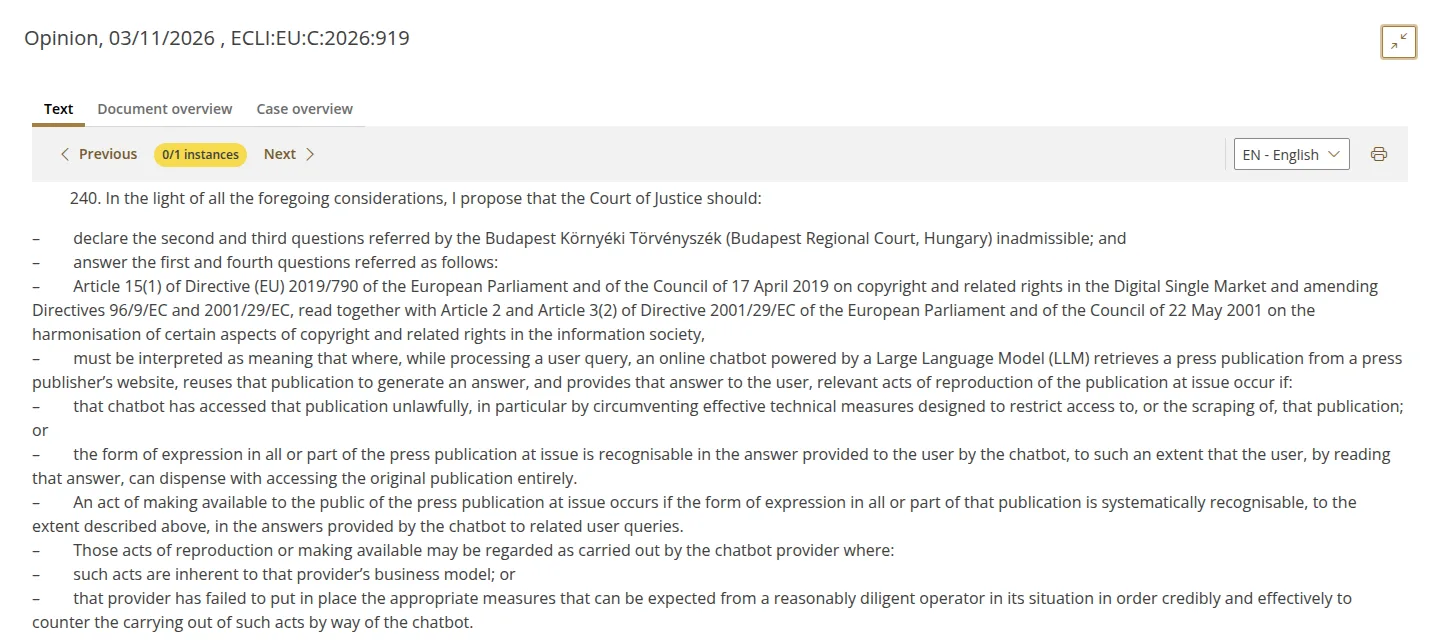
Screenshot: InfoCuria, Opinion in Case C-250/25, point 240 (the proposed answer to the Court). Captured November 4, 2026.
Your fetcher or your vendor's
The first condition, lawful access, lands differently depending on who fetches the page.
If you run your own fetcher (a scraper, a headless browser, a crawler feeding your own index), the access is yours. Point 188 says the chatbot must not have circumvented "effective technical measures", whether "a paywall or a measure designed specifically to prevent access and/or scraping by internet bots". Robots.txt sits awkwardly here. Footnote 153 says the protocol "does not technically prevent scraping" and only states the publisher's intention, yet point 222 expects providers to "programme the bots used during the RAG process to comply with measures put in place by press publishers". We would treat a robots.txt disallow as binding on a RAG fetcher. Ignoring it is hard to square with being a "reasonably diligent operator".
If you use a vendor's web search or grounding tool, the vendor's fetcher does the access. Here is what OpenAI, Anthropic and Google say about their own fetchers, read on November 4, 2026:
| Fetcher | What the vendor's page says | Does a publisher's robots.txt block stop it? |
|---|---|---|
| OpenAI ChatGPT-User | Visits a page "when users ask ChatGPT or a CustomGPT a question"; "Because these actions are initiated by a user, robots.txt rules may not apply." (OpenAI) | Not promised |
| Anthropic Claude-User | "Disabling Claude-User on your site prevents our system from retrieving your content in response to a user query" (Anthropic) | Yes, per Anthropic |
| Google-Extended (a robots.txt token; crawling uses Google's normal user agents) | Controls use "for grounding" in Gemini Apps and Grounding with Google Search on Vertex AI, and "does not impact a site's inclusion in Google Search" (Google) | Yes for those products, per Google. The AG says Google's claim "would need to be verified" (footnote 236) |
OpenAI's and Anthropic's pages describe their own chatbots. Neither names the agent behind their developer-API web search tools, so ask your vendor before you rely on a robots.txt answer. If you're on OpenAI, our piece on the USA Today v OpenAI lawsuit covers which plans carry an IP indemnity and what it excludes.
What to do now
- List every place your product fetches a page at question time. Vendor web search tools, your own fetcher, browser agents, "read this URL" features. One line each: who fetches, which user agent, whether EU users reach it.
- Never get around a block. No paywall bypass, no rotating proxies or faked browser fingerprints to beat bot blocking, and give your own fetcher a named user agent that obeys robots.txt. Footnote 191 adds that the source must be lawful too, "typically, the website of the press publisher", so don't fetch from mirrors or pirate copies.
- Be careful with one-article summaries. The AG found Gemini's summary of one named article not recognisable (points 204 and 239), so declining such requests is our cautious design choice and not a requirement in the opinion. The risk sits in summaries that keep an article's distinctive structure or phrasing, especially of long analysis pieces (points 206 and 207). Where you can, answer from several sources, keep quotes short, and link out. Point 234 describes the chatbot the AG wants left alone as one giving "hyperlinks to the webpages scraped and urging users to consult those sources".
- Add an overlap check. Compare each answer with the text you retrieved, and block or rewrite answers above a threshold you choose and write down. Point 222 names "output filters" as the kind of measure that should clear a provider of liability for "occasional" infringing answers.
- Log what you fetched. URL, time, robots.txt status, overlap score. Point 163 asks courts to "be lenient" on claimants' burden of proof because there is "no obligation of transparency" for scraped content, and footnote 242 proposes such obligations for chatbot providers. A log is your evidence if a publisher asks.
- Treat training on news as a separate question. The AG's view favours it under the TDM exception, but only for lawfully accessible content that hasn't been reserved. He does "not exclude" that a natural-language reservation in a site's terms counts, where it is "machine understandable", meaning bots can identify it "with a sufficient degree of reliability" (points 148 and 149). Read the terms of any site you build a training set from.
What we could not confirm
When the Court will rule, and whether it will follow the AG: the press release gives no date. Whether an internal research assistant used only by your own staff is an "online use" by an "information society service provider": point 168 ties online use to a service provided "at the individual request of a recipient of that service", and the opinion doesn't discuss internal tools. Whether ignoring robots.txt counts as circumventing an effective technical measure: footnote 153 and point 222 point in different directions. Which user agent the OpenAI and Anthropic developer APIs use for web search. We read the English opinion on InfoCuria, where it is marked "Provisional text", on November 4, 2026. EUR-Lex blocked our scripted requests, so we did not compare it against the EUR-Lex copy.
Related Reading
- USA Today Sues OpenAI: $250M Claim Over ChatGPT News Summaries
- Meta Commercial Terms: The AI Crawl Clause and What to Do
- SPUR Coalition Adds NYT and Economist: What AI Builders Must Log
- AI Companies Scraped the Web, Now Sue Scrapers: Vendor Risk
- AI Training Data Copyright 2026: DOJ Says Fair Use (Sept 1)
- Amazon v. Perplexity: CFAA Ruling and AI Agents