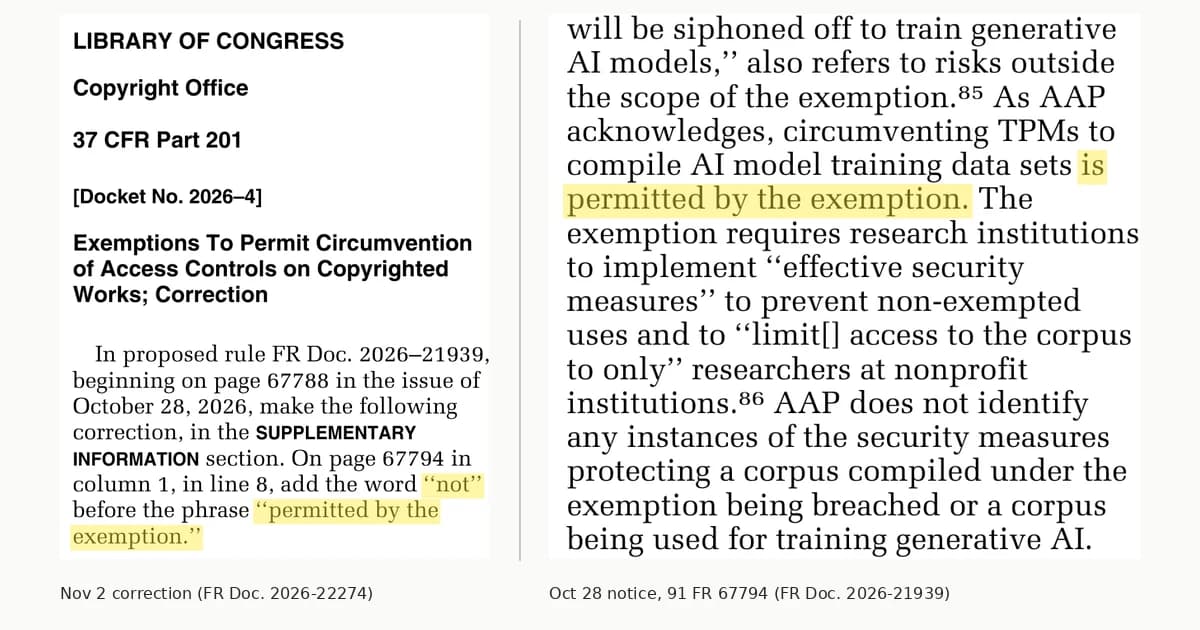
Source: Federal Register, 91 FR 68894 (November 2, 2026) and 91 FR 67794 (October 28, 2026), rendered and cropped by us on November 8, 2026. Highlighting is ours.
The answer is no. The DMCA text and data mining exemption does not cover compiling AI training data, and the Copyright Office says so in its October 28, 2026 notice, though only after a correction.
If you read that notice when it came out, page 67794 told you that "circumventing TPMs to compile AI model training data sets is permitted by the exemption." On November 2 the Office published a one-paragraph correction: "add the word 'not' before the phrase 'permitted by the exemption.'" Any summary written from the October 28 text alone could have repeated the sentence backwards.
I read the 21-page notice (91 FR 67788), the correction (FR Doc. 2026-22274), the exemption as codified in 37 CFR 201.40(b)(5), the publishers' opposition filed on September 28, the researchers' renewal petition filed on August 24 and the Office's 2024 recommendation. The headline version is "Copyright Office renews the text and data mining exemption in the AI era". For a team that trains or buys models, the text is narrower: the renewal changes nothing for you, and the one sentence that matters to you is the one that lost its "not".
What the exemption lets anyone do
"Circumvention" here means getting past a lock on a lawfully held copy, such as the DRM on an e-book. Section 1201 of the DMCA bans that, and the Copyright Office runs a rulemaking every three years to carve out exemptions. The ban carries statutory damages of $200 to $2,500 per act of circumvention under 17 U.S.C. 1203(c)(3)(A), which is the count in the Elvis lyrics complaint against Anthropic.
The literary works exemption has five conditions in 37 CFR 201.40(b)(5)(i). I read them against what a company building or buying a model would have to do:
| Clause | What the text requires | Where a company stands |
|---|---|---|
| (A) Who | A researcher affiliated with a nonprofit institution of higher education, or a student or IT staff member at that researcher's direction, acting "solely to deploy text and data mining techniques on a corpus of literary works for the purpose of scholarly research and teaching" | Not a nonprofit university: out at the first clause |
| (B) The copies | Each work "lawfully acquired and owned by the institution, or licensed to the institution without a time limitation on access" | Scraped or downloaded copies of unknown origin do not qualify |
| (C) Viewing | The person views the contents "solely to conduct text and data mining research or teaching" | Reading the corpus for any product purpose is outside |
| (D) Security | Effective measures against dissemination or downloading, and information to a copyright owner or trade association who asks | The institution must be able to describe them to an owner who asks |
| (E) Access | Corpus access only for the (A) persons or researchers at other nonprofit institutions, over secure connections, with authenticated credentials | A company's staff are not on the list |
The exemption also excludes computer programs and "compilations that were compiled specifically for text and data mining purposes."
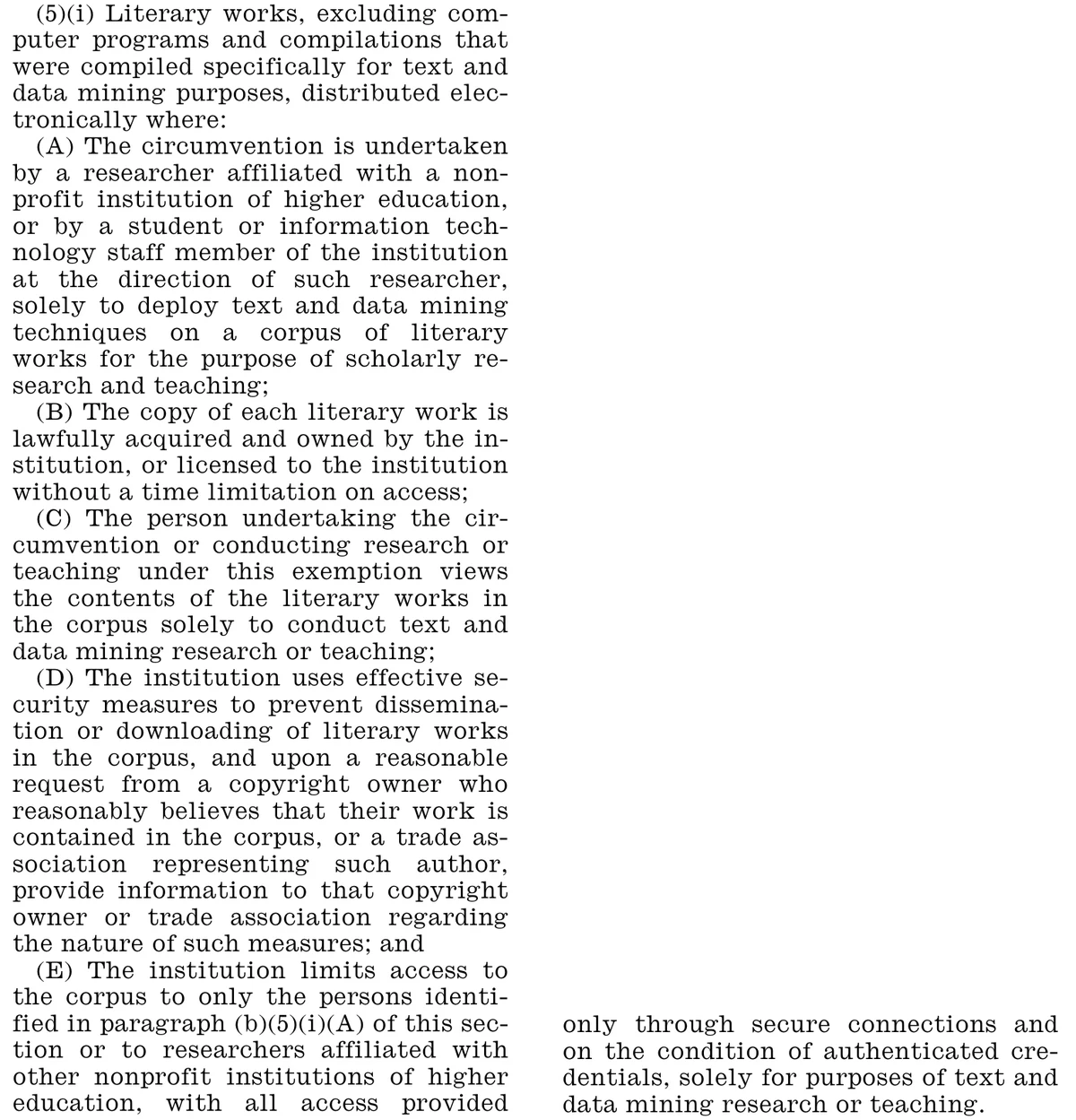
Source: 37 CFR 201.40, 2025 edition (revised July 1, 2025), from govinfo.gov, page 685, rendered and cropped by us on November 8, 2026.
Clause (E) is the one I would test in a vendor call. A university lab can share its corpus with researchers at other nonprofit institutions. Nothing in the clause lets it hand the corpus to a company, even a company that paid for the research. My reading: if your own engineers touch the corpus, the exemption is not covering you.
What the Office told the publishers
The Association of American Publishers (AAP) opposed renewal on September 28, 2026. Its filing makes the AI argument directly: "concerns that unprotected corpora created under the exemption will be siphoned off to train generative AI models are heightened and deserve full consideration in this rulemaking." It asked the Office to revise the exemption "to strengthen the security measures protecting TDM work corpora compiled under the exemption to prevent them from being used for generative AI training."
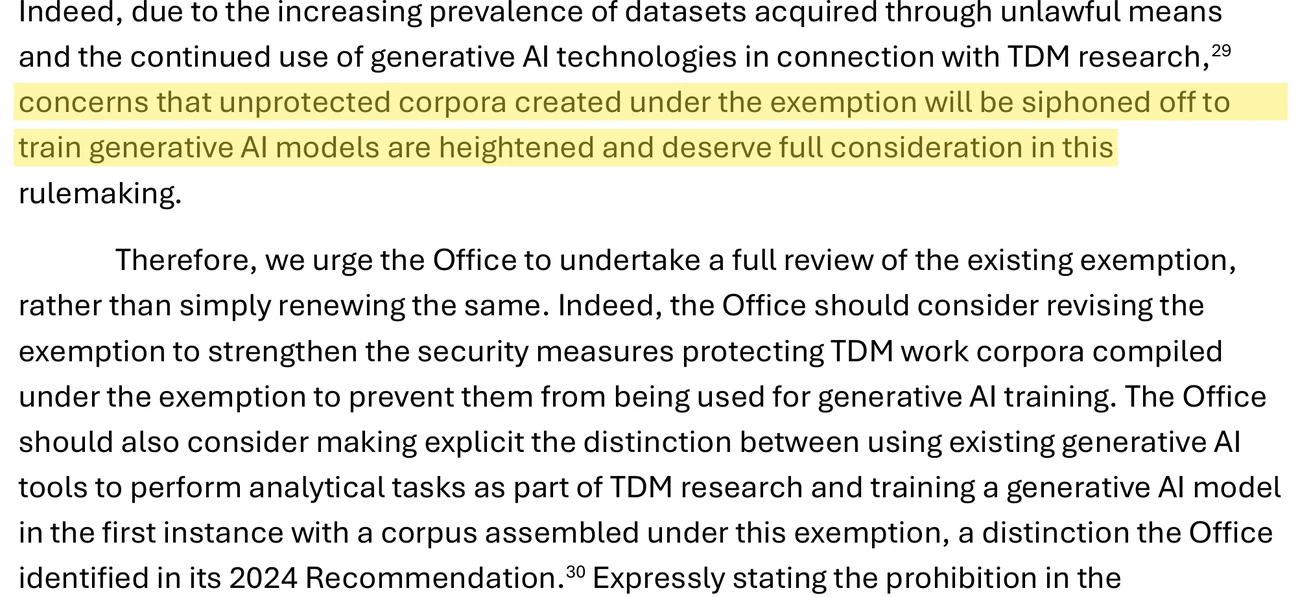
Source: AAP, "Opposition ... to the Petition for Renewal of the Exemption for Text and Data Mining for Literary Works", September 28, 2026, page 7, from copyright.gov. Highlighting is ours.
The Office did not accept that. It gave two answers, and they are about different things. AAP also argued about unlawful acquisition, meaning works obtained from shadow libraries or pirate sites. On that, the Office said the exemption "is written to specifically exclude such conduct," and added: "To the extent there is any doubt, we reaffirm here that the exception does not permit or sanction these types of acts" (page 67793). That passage is about acquisition, not about AI training.
The Office's statement on AI training is the sentence that was corrected, on page 67794: compiling AI model training data sets is not permitted by the exemption. On AAP's security argument it wrote: "AAP does not identify any instances of the security measures protecting a corpus compiled under the exemption being breached or a corpus being used for training generative AI. This serious but unsubstantiated possibility therefore does not provide a basis for the Register to refuse to recommend renewing the exemption."
The researchers' side agrees on the boundary. In the April 17, 2024 hearing John Bell, speaking for Authors Alliance, said: "I don't think that we are interested in the digital humanities and recreating Sora, right? Nobody wants to make a completely generative system out of this" (transcript, page 76). Authors Alliance and the Library Copyright Alliance asked for renewal on August 24, 2026, saying researchers "need to assemble and annotate their own research corpora."
The boundary itself is older than this notice. The Office's October 2024 recommendation (page 75) says the exemptions "include no terms specific to AI," and that "it would be outside the scope of these exemptions to circumvent TPMs in order to compile training data for use in the development of generative AI models and systems or to use corpora previously compiled for text and data mining research for that purpose." It adds that whether such uses are fair use "is beyond the scope of this rulemaking."
That last sentence is the one a small team should keep. Section 1201 is about locks. Even a lawful exemption would not settle whether training is infringement, which is the question in the DOJ's fair use brief and in the Bartz v. Anthropic settlement.
My judgment on the Office's reasoning: the boundary is solid, because it rests on the rule text and on the 2024 recommendation. The "no instances" answer is thinner. It says AAP has shown no breach, which is not the same as saying a breach cannot happen. And the reaffirmation sits in the preamble of a proposed rule. I found no new regulation text for this exemption in the notice's renewal section, so what AAP asked for, an explicit training prohibition in the rule itself, is not there yet. That is my reading, and the Office can still change course in the final recommendation.
What I would ask a vendor
- "Which exemption, which researcher?" A claim that a corpus was built "under the DMCA research exemption" has to name a nonprofit institution and a researcher under clause (A). If it cannot, the claim is marketing.
- "Who has touched the corpus?" Under clause (E), only the (A) persons and researchers at other nonprofit institutions. Your vendor's staff, or yours, are not among them.
- "Show me the copies." Clause (B) needs lawfully acquired and owned copies or a licence without time limit. The Office itself said a French project that downloaded millions of e-books from pirate sites "does not appear to satisfy" that requirement. A purchase record or licence is the document to ask for.
- "What do you disclose about training data?" California's AB 2013 is the place to start for what a developer must publish about its datasets.
If your problem is the opposite, you want licensed text for a model, the notice names the places publishers say they license for text mining: Wiley, Springer Nature and Elsevier APIs and ProQuest TDM Studio, according to AAP. The Office's own finding is that these cover scholarly, scientific and archival material, and that the record does not show "contemporary, in-copyright literary works (like mass market fiction)" are now available for licensed text mining. If your use is commercial, the question is a licence conversation, not an exemption.
If you cite a Federal Register notice in a vendor file, check its docket for a correction first. This one changed the meaning of a sentence.
What comes next, and what I could not confirm
The Copyright Office says the Register intends to recommend renewing all but one of the existing exemptions, and renewed exemptions would run from October 2027 to October 2030. The three comment rounds (December 7, 2026, February 22, 2027 and March 22, 2027) cover ten proposed classes, one of them the opposed renewal of medical device repair (Class 8). None of the ten concerns AI or text and data mining. The final rule comes from the Librarian of Congress, and I found no date for it.
The codified text I read is the July 2025 edition from govinfo.gov. The eCFR blocked my requests, so I did not check for changes since. I also did not read the 2026 renewal petitions or comments for the other literary-works exemptions, and the notice does not say whether the Register will take up AAP's training argument again in the final recommendation.