Image: Pexels.
Florida's attorney general wants AI chatbot operators to find out which of their users are minors and turn off the features that make a bot feel like a friend. James Uthmeier announced the Safe Screens Act on October 22, a package that also covers app stores, phone operating systems and teen social media accounts. The chatbot part is short, and the release speaks of "AI chatbot operators" in general, with no carve-out for small companies that we could see. It isn't law, and it isn't even a bill yet.
Event date: October 22, 2026 (announcement at Polk State College, Winter Haven). First reports: October 22, 2026, by Florida's Voice at 18:15 UTC and The Capitolist the same day, alongside the attorney general's own release.
Who would have to act, and by when
No one yet. The Capitolist put it plainly: "The proposal would require legislative approval before becoming law." We found no bill number, sponsor or text on October 23. Florida's next regular session convenes on March 2, 2027, the first Tuesday after the first Monday in March under the state constitution. If a bill passes in that session, its effective date will be in the bill.
If it passes in the form announced, the chatbot rules would reach any "AI chatbot operator" with Florida users under 18. The release doesn't define the term.
What the attorney general proposed
The release lists four parts. For chatbots, two matter. First, "AI chatbot operators and platforms must determine account holder's age," using "commercially reasonable, privacy-protective methods." Second, operators could not give minors features that do any of these:
- simulate companionship "through personification, emotional engagement, user-data retention, unsupervised therapy, sexual content, or other deceptive features";
- encourage self-harm, suicide, eating disorders or illegal activity;
- generate, describe or facilitate sexually explicit conduct;
- suggest the chatbot is a real human;
- "prioritize validation or engagement over user safety or guardrails";
- encourage isolation or discourage help from appropriate adults.
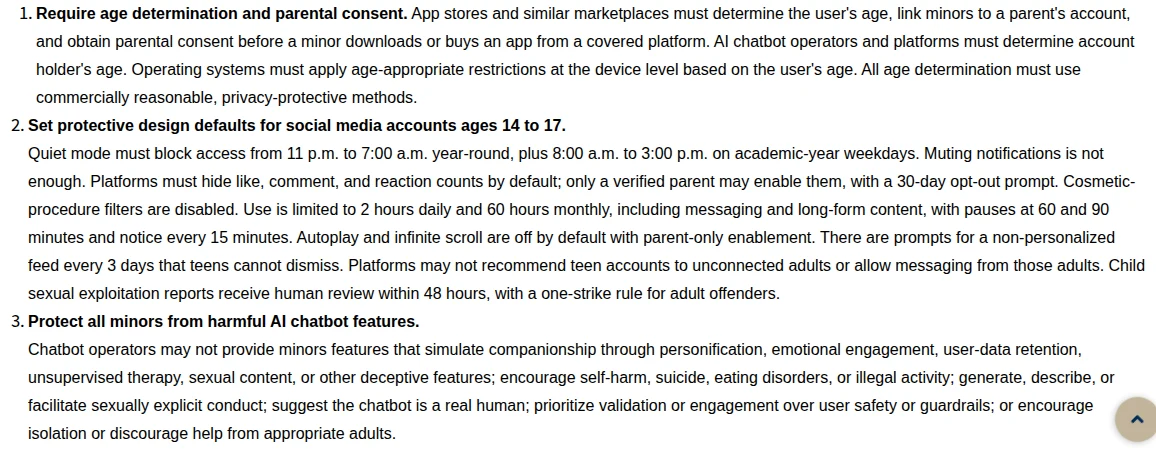
Screenshot: news release, Office of the Attorney General of Florida. Captured October 23, 2026.
The rest targets other layers. App stores would have to determine age, link minors to a parent's account and get consent before a minor downloads or buys an app. Operating systems would apply age limits at the device level. Social media accounts for 14- to 17-year-olds would get defaults, including a quiet mode from 11 p.m. to 7 a.m., a cap of "2 hours daily and 60 hours monthly," and autoplay and infinite scroll off unless a parent turns them on.
"Parents deserve real control, and companies must design for safety, not addiction," Uthmeier said. "If you invite Florida's children onto your platform, you have a duty to keep them safe."
The attorney general posted the full announcement:
The penalty, and the law it would plug into
Knowing or reckless violations would be "unfair practices under section 501.1736, Florida Statutes," at up to $50,000 per violation, and the office could seek damages and run a public website tracking incidents. Florida's Voice reported the penalties as coming under the state's Deceptive and Unfair Trade Practices Act.
We read section 501.1736 as it stands in the 2026 statutes. It is the 2024 social media law, known as HB 3: platforms must bar accounts for children under 14 and need a parent's consent for 14- and 15-year-olds. Its enforcement clause already has the same shape the release describes:
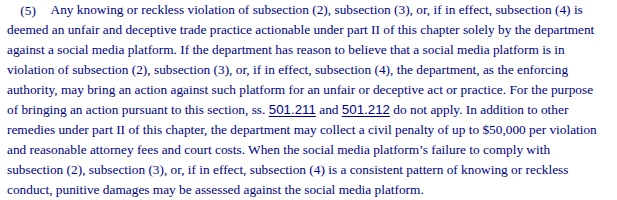
Screenshot: section 501.1736(5), 2026 Florida Statutes, Online Sunshine (Florida Legislature). Captured October 23, 2026.
That is the law the Eleventh Circuit said on October 14 is "likely constitutional," reversing an injunction won by tech industry groups. Uthmeier cited that ruling in his announcement. The challenge goes on in the trial court, and the Computer and Communications Industry Association warned the decision "risks imposing identity authentication on Floridian internet users of all ages."
Florida has tried the chatbot part twice this year
This is where we'd be careful about calling the proposal likely. The Florida Senate passed SB 482, titled the Artificial Intelligence Bill of Rights, 35-2 on March 4, 2026. It required "companion chatbot platforms to prohibit a minor from becoming or being an account holder unless the minor's parent or guardian consents." It died in House messages on March 13. The Senate tried again in an April special session with SB 2-D, which passed 37-1 on April 28 and died in a House subcommittee the next day.
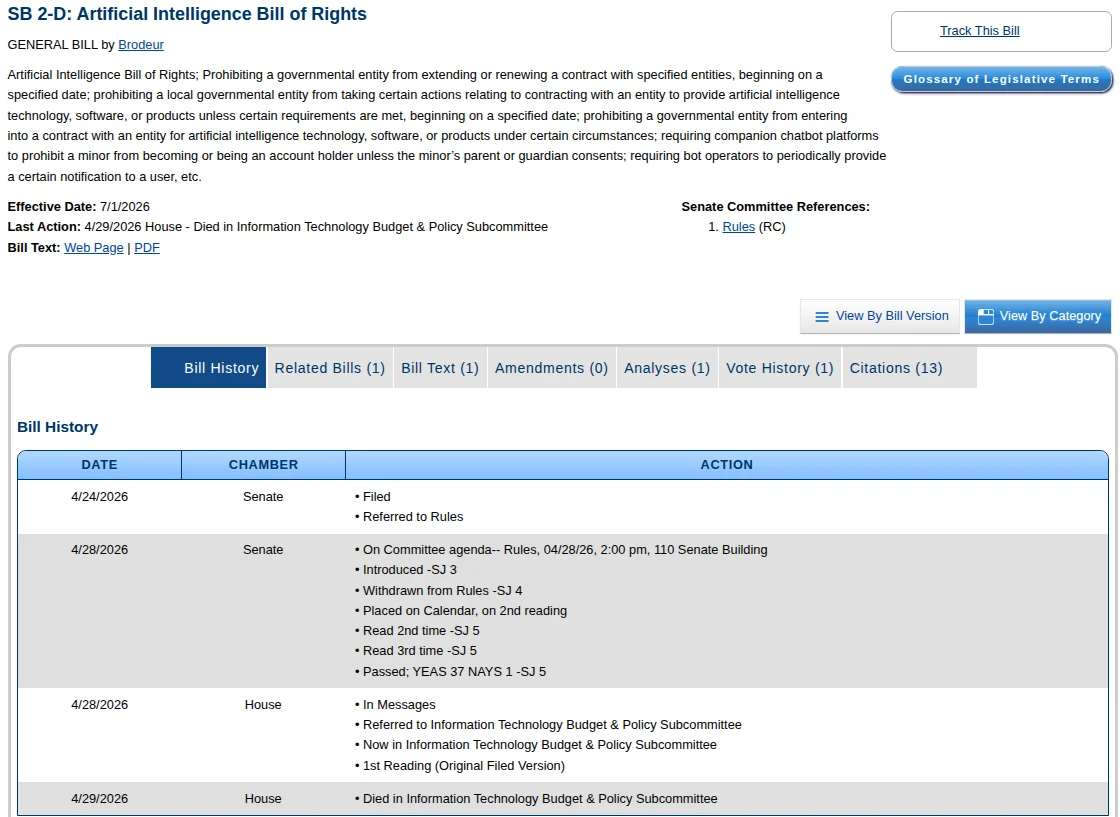
Screenshot: SB 2-D bill history, The Florida Senate. Captured October 23, 2026.
So the Senate is on record twice, and the House hasn't moved. Our reading is that the attorney general's version asks for more than either bill: the release names "AI chatbot operators" rather than "companion chatbot platforms," and it bars features rather than only requiring consent. That makes it a bigger ask of the same House.
What people said
Under FOX 13 Tampa Bay's report on YouTube, the reaction split the usual way. "Please pass this. No social media until you have graduated high school," wrote @vance836. Another viewer, @Olepolecat, asked: "How about let parents raise their own kids and don't turn that over to the state." None of the comments we read on October 23 mentioned chatbots. The public argument is about phones and social media; the chatbot rules are riding along.
What to do now
- Don't change the product for a press release. There is no text to comply with, and the final scope could be much narrower.
- Map your features against the list anyway. If teenagers can use your chatbot, note which features are a persona, emotional engagement, long-term memory ("user-data retention" is on the list) or anything that reads as therapy. Those are the features this proposal names first.
- Know how you'd tell a minor from an adult. Florida's version asks for age determination by "commercially reasonable, privacy-protective methods." If your answer today is a birthday field, write down what you'd do instead.
- Check the laws that have passed. Our guides to California's Adam's Law, Colorado's chatbot safety act and Georgia's chatbot law cover rules with real dates. Our state chatbot disclosure checklist covers the disclosure side.
- Watch Florida's courts, not only its Legislature. Florida is already suing OpenAI, and our state AG chatbot lawsuits tracker follows that case. The same office would enforce this act.
What we could not confirm
We couldn't find a bill number, sponsor or draft text, so we don't know how "AI chatbot operator" would be defined, whether general assistants and customer-service bots would be covered, or when the rules would start. We couldn't open Reuters, WFLA or Tampa Bay 28's stories from our location, so this piece relies on the attorney general's release, Florida's Voice and The Capitolist. The release says the Eleventh Circuit "upheld" the law; the court's ruling was on a preliminary injunction, and the case continues.
Related Reading
- State AG AI Chatbot Lawsuits Tracker
- State Chatbot Disclosure Laws 2026: SaaS Checklist
- California Adam's Law SB 1119: Chatbot Compliance Deadlines
- Colorado Chatbot Safety Act (HB 26-1263) Compliance Guide
- Georgia SB 540 AI Chatbot Law: What Operators Must Do
- Italy Fines Character.AI €158K Over Child Safety Failures