Image: Pexels, used under the Pexels License.
This is for anyone who markets an AI product, app or feature to consumers in Korea: device makers, app studios, SaaS teams with a Korean storefront, agencies writing the copy. Korea's Fair Trade Commission (KFTC) has put its reading of "AI" claims in writing, and it's specific enough to check an ad against line by line.
Event date: October 22, 2026, 10:00 KST (01:00 UTC), when the KFTC, chaired by Ju Biung-ghi, opened comments on its draft guidelines on AI-related labelling and advertising. First reports: October 22, 2026, by Yonhap at 10:00 KST and ZDNet Korea at the same time.
The draft adds no new obligation. It applies the Act on Fair Labeling and Advertising to AI under its four existing headings: false or exaggerated, deceptive, unfair comparison and disparagement. It gives 16 worked cases, from AI heating mats and cat litter boxes to an "AI lawyer" app, and ends with a self-check list. According to Yonhap, the KFTC said: "While the guidelines are not legally binding, they will help businesses prevent potential violations of the advertising law."
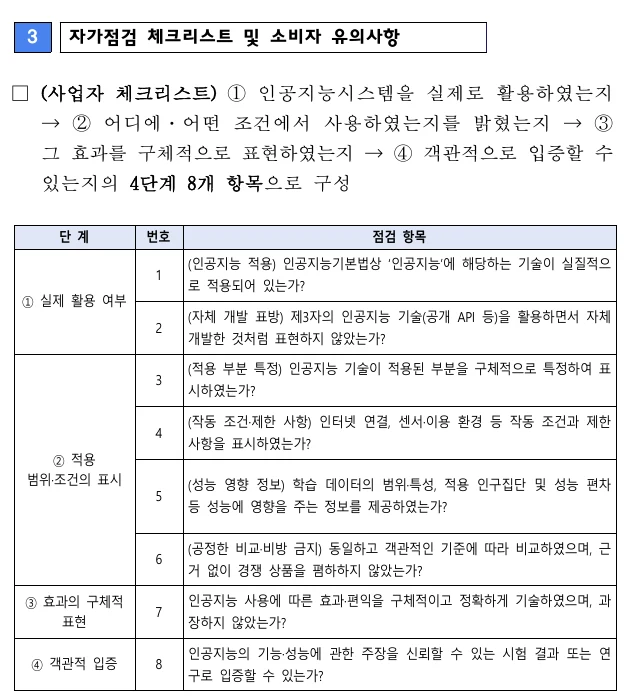
The self-check, in English
Our translation of the KFTC's list, grouped in its four stages. Answer each one "yes" before the ad runs. The Korean original is in the press release (PDF).
| Stage | # | Check |
|---|---|---|
| Is AI really used? | 1 | Does the product or service actually apply technology that counts as "artificial intelligence" under Korea's AI Basic Act? |
| 2 | If you use someone else's AI (a public API, for example), have you avoided presenting it as AI you built yourself? | |
| Where and under what conditions? | 3 | Have you said specifically which part of the product uses AI? |
| 4 | Have you stated the operating conditions and limits, such as an internet connection, sensors or the environment it needs? | |
| 5 | Have you given the information that affects performance, such as the scope of the training data, the groups it was built for and how results vary? | |
| 6 | Did you compare against competitors on the same objective basis, without running them down? | |
| Is the effect described precisely? | 7 | Are the effects and benefits of the AI described specifically and accurately, without exaggeration? |
| Can you prove it? | 8 | Can you back every claim about what the AI does, or how well, with reliable test results or research? |
Screenshot: press release on the draft AI advertising guidelines, page 7, Korea Fair Trade Commission (KOGL Type 1). Captured October 22, 2026.
How to apply each stage
Stage 1 is where AI washing lives. The draft says products that only react by preset rules, such as simple sensor-based control or threshold-based adjustment, are hard to call AI at all. Its example: a mat that runs on a simple timer, with no function that learns your sleep, sold as an "AI deep learning mat." That fails item 1.
Item 2 is narrower than it looks. The full draft (PDF) says it doesn't require you to disclose that you use a third-party model or API. It targets explicit claims like "our own AI." Fine-tuning someone else's model on your own data isn't automatically a problem either.
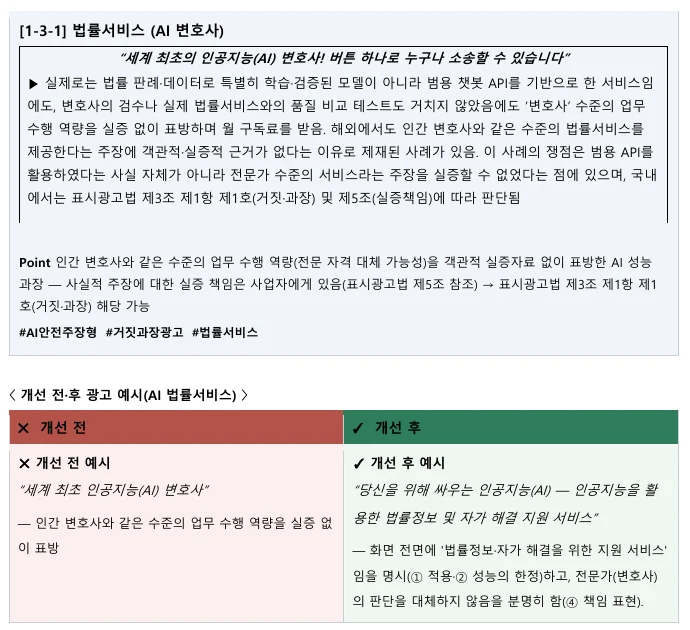
The AI lawyer case is the one to read if you ship a model wrapper. The app claimed to be "the world's first AI lawyer," charged a monthly subscription and ran on a general chatbot API, with no review by lawyers and no quality test against real legal services. The draft says the issue was not the API but the unproven claim of lawyer-level work, and notes that a similar claim was sanctioned abroad. Our FTC enforcement tracker covers a US case of the same kind, DoNotPay's "robot lawyer."
Screenshot: draft AI advertising guidelines, page 26, Korea Fair Trade Commission (KOGL Type 1). Captured October 22, 2026.
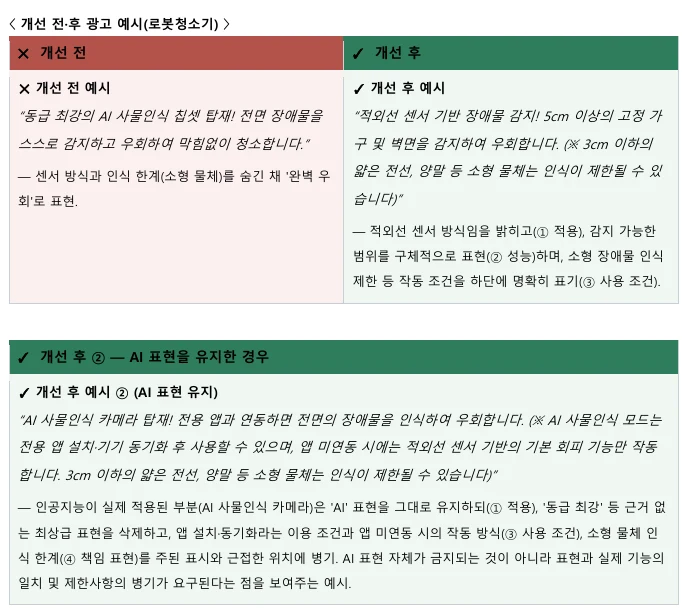
Stages 2 and 3 are about the fine print, placed near the claim. You can keep the word AI if the AI is real. The robot vacuum example drops "best-in-class AI object recognition chipset" and keeps "AI object recognition camera," adding right next to it that the AI mode works only after installing the app and pairing the device, and that small objects such as thin cables and socks may not be recognized.
Screenshot: draft AI advertising guidelines, page 29, Korea Fair Trade Commission (KOGL Type 1). Captured October 22, 2026.
Stage 4 is the one with teeth today. Under Article 5 of the Act, the business must prove factual claims. The appendix sets out the process: the KFTC asks for substantiation, you have 15 days to submit it, and if you don't, it can order the ad stopped and impose an administrative fine. Keep a file per claim (test report, conditions, date) before launch. Our AI marketing claims checklist has a log format that works for both regulators.
Two related rules with their own dates
- AI virtual people. The KFTC's endorsement guidelines, amended June 1, 2026, already require a label on AI-generated people: "[가상인물 포함]" ("includes virtual person") in text ads, a mark on photos and an on-screen caption in video. From November 27, 2026, amended product laws bar AI virtual experts from recommending food, cosmetics and medicines.
- Korea's AI confirmation scheme. The science ministry's scheme (notice 2026-50, run by KOSA) confirms that a product uses AI. The draft says it doesn't certify performance and doesn't protect you under the advertising law, though its review file can help prove the AI is real.
How to comment
Send a written opinion by post or email before the deadline. Include whether you support, oppose or want changes and why, your name (for an organization, its name and representative), address and phone number. The email address and postal address are on page 3 of the press release. The KFTC says it will finalize the guidelines after the comments and talks with other ministries.
What this checklist doesn't cover
It isn't the AI Basic Act's transparency duty to label AI-generated output; the draft treats that as a separate obligation. It doesn't change sector rules for food, cosmetics or health claims, which the KFTC says can be reviewed more strictly under their own laws.
What we could not confirm: the draft doesn't say how it applies to a business based outside Korea that advertises to Korean consumers. When we checked on October 22, the KFTC's English press-release page had no version of this release yet. The table above is our translation; check the Korean wording before you rely on it in a dispute.