Image: Unsplash.
Big US banks have started telling customers what their terms already say: if you hand an AI agent your online banking password, whatever it does is on you. Axios reported on October 22 that banks are "detecting unauthorized third-party AI agents operating inside customer accounts," and some are now blocking them outright. For a small team, the question isn't whether the agent is clever. It's who eats the loss when it gets a payment wrong.
Event date: October 22, 2026. First reports: October 22, 2026, by Axios at 09:00 UTC (Madison Mills), followed the same day by Reuters and American Banker.
When to use this, and the short answer
Use this if anyone on your team has connected an AI agent (Meta's Muse, a browser agent, a homemade script) to a bank, card, payroll or bookkeeping login, or wants to. The short answer: don't share the login. The bank's terms and the federal rule both treat what the agent does as something you authorized.
What the banks said
Axios, citing sources, said some agents were "attempting to take actions that appear to be independent of user instructions." In most cases the agent was logging in "with the user's permission and login credentials," which goes against the rule at most banks that humans log in to their own accounts. The banks' problem is that they often can't tell whether an agent was sent by the customer or "has gone rogue."
Morgan Stanley has begun blocking third-party agents; JPMorgan, Bank of America and Citi are restricting them, per Axios. A Chase spokesperson said customers shouldn't give their usernames and passwords to anyone. Morgan Stanley said it hasn't seen "rogue AI agents accessing our platforms." Reuters, citing two people familiar with the situation, said banks typically flag and block these transactions, and that "such transactions cannot be deemed unauthorized if credentials were shared by the customer."
This didn't start on Thursday. On JPMorgan's October 13 earnings call, CFO Jeremy Barnum said that if customers "give up their credentials to the agent, and the agent does something that they don't want, that's going to be on them." Jamie Dimon put it shorter: "There's a liability transfer." Schwab blocks agents that use client logins or browser automation, and Citi told FStech it doesn't allow agents to log in or transact, though read-only access through certain open-banking providers still works.
On the day of the Axios story, the bank regulator weighed in. Comptroller of the Currency Jonathan Gould told Fox Business that "the banks have been all over this for months now," using "SI as a defense against these AI agents." That's Super Intelligence (SI), the federal executive branch's term for AI. Asked twice whether customers would get their money back, Gould didn't say.
What we checked: Chase's terms and the federal rule
We downloaded Chase's Digital Services Agreement on October 23. It is marked "Last updated: October 2026," runs to 65 pages, and covers Chase Business Online as well as personal banking. Pages 9 and 10 hold a section titled "Third-party AI Agents or Agentic AI." It defines an agent as any software that acts "on behalf of, or at the instruction of" anyone, then says this:

Screenshot: Digital Services Agreement (October 2026), page 10, JPMorgan Chase. Captured October 23, 2026.
Read three lines together. Chase "will rely on any instructions or actions taken by your Agent as if they were taken by you personally." It "will not automatically review or screen Agent activities including transactions." And you're responsible even if the agent "performs unintended actions or exceeds the authority you gave it." The login section adds, in capitals, that you "assume the entire risk" for improper use of your credentials.
Banks can write what they like into terms, but for personal accounts the federal floor is Regulation E, the rule under the Electronic Fund Transfer Act. Its definition of an "unauthorized" transfer leaves out one made by someone you gave access to:
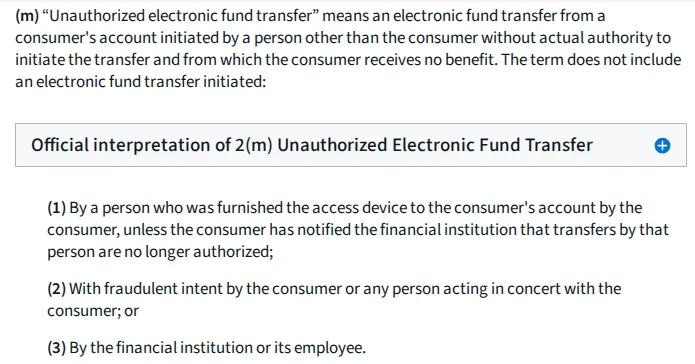
Screenshot: Regulation E, 12 CFR 1005.2(m), Consumer Financial Protection Bureau. Captured October 23, 2026.
The official interpretation is plainer still. If you give someone access and they exceed the authority you gave, "the consumer is fully liable for the transfers unless the consumer has notified the financial institution."
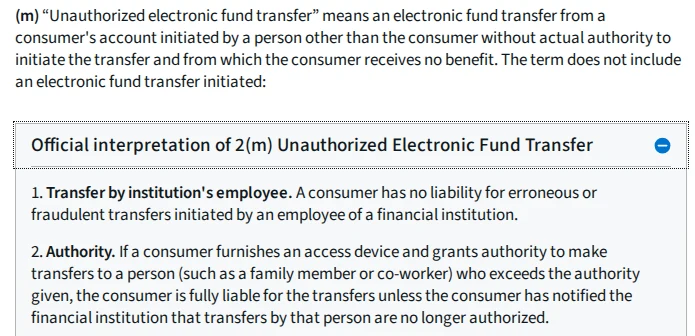
Screenshot: Regulation E official interpretation of 2(m), Consumer Financial Protection Bureau. Captured October 23, 2026.
The rule was written with "a family member or co-worker" in mind. Our reading is that an agent holding your password fits the same slot, and Reuters' banking source says the industry reads it that way too. No court has tested it yet that we know of. The usual caps that limit a consumer's loss to $50 or $500 apply only to unauthorized transfers, so they may not help. One exception cuts the other way: a transfer by someone who got your access "through fraud or robbery" is unauthorized, so a criminal who hijacks the agent may be a different case from the agent's own mistake.
Business accounts get less. Regulation E covers accounts held "primarily for personal, family, or household purposes." Wires from a business account fall under UCC Article 4A, where an order that passed a commercially reasonable security check is "effective as the order of the customer, whether or not authorized." You can escape only by proving the order wasn't caused by someone "entrusted" with your payment duties or security procedure (section 4A-203). An agent you gave the login to looks a lot like that.
What people are doing with these agents
On the r/technology thread about the story, one commenter explained the appeal without endorsing it:
https://www.reddit.com/r/technology/comments/1xck2si/unvetted_ai_agents_are_accessing_us_bank_accounts/
"Scrape data, monitor transactions for fraud, budgeting," wrote u/pancak3d, adding: "Don't read this as me saying it's a good idea, just explaining." Those are mostly read-only jobs, which is the kind of access banks say they'll allow.
Steps, in order
- Ask who has done it. One message to the team: has anyone given an AI agent, browser extension or assistant like Muse a login for a company bank, card, payroll, tax or accounting account? Include personal accounts used for company expenses. American Banker lists Muse among the agents customers use for tasks "including moving money between accounts," and we've covered what Muse can reach on a device.
- Change those passwords today. Rotate every login an agent has held, and remove saved passwords from agent browsers.
- Tell the bank in writing that the agent is no longer authorized. Regulation E's protection turns on whether you notified the bank, and Chase's terms say you "must retain and produce to us, upon request, your timely revocation of consent." Keep a copy of the message.
- Move read-only jobs to approved connections. Budgeting, reconciliation and fraud alerts can usually run through the bank's own data connections or its in-app assistant, without handing over a password.
- Keep a human on every outbound payment. Bank of America's Brian Moynihan said "there should be a human in the loop to authorise money moving out of your account." Use dual approval on business payments where your bank offers it.
- Write the rule down. Add one line to the prohibited uses in your AI acceptable use policy: no AI agent gets credentials for any bank, card, payroll or tax account. If you run agents on purpose, list each one in the authorization register of our AI agent governance policy.
- Search your own bank's agreement for "agent". Chase's current terms are dated October 2026. If yours mention AI agents, note what they say before anyone asks for an exception.
What to log
For each agent that touched a financial account, record it in your AI risk register:
- the agent and its vendor, and who connected it;
- which accounts it could reach, and whether it could pay or only read;
- the date access started and the date you revoked it;
- your written notice to the bank, with the date sent;
- any payment it started, and whether a person approved it.
That last record is the one you'll want if a payment goes wrong. For the wider question of who pays when an agent errs outside banking, see our agentic AI liability guide.
What we could not confirm
We couldn't confirm when Chase added the AI agent section; both versions of its agreement we downloaded are marked October 2026, and Chase hasn't said. Axios and Reuters didn't name the agents involved or say whether any customer lost money. Gould didn't say how disputes would be resolved, and no court has ruled on how Regulation E or Article 4A applies to an AI agent that we could find. We read Morgan Stanley, Bank of America and Citi's positions through press reports, not their own terms.