LangChain's new LangSmith Terms of Service let it train its models on your traces from December 1, 2026, on the self-serve Free, Developer, Startup, Premier and Plus plans, unless you opt out in your settings. Enterprise agreements don't change, so if your team signed up online without an order form, turn the training opt-out on before December 1 and rerun your vendor check, because LangChain now acts as a controller for the data it uses this way.
This checklist is for a team of 5 to 50 that traces an agent or chatbot in LangSmith Cloud and has never signed an order form with LangChain. Our verdict: opt out, and keep masking sensitive fields, since the opt-out is a setting you can toggle, not a promise in your contract. If you are picking a model API rather than a tracing tool, our list of AI APIs that don't train on your data is the better starting point.
What the LangSmith terms of service change on December 1
The Terms of Service the Wayback Machine captured on November 13, last updated June 2, 2026, covered every LangSmith customer, free tier included, and said LangChain "will not use Customer Data to train on, develop, or otherwise improve its products". Today there are two sets of terms, Standard and Enterprise, both last updated November 19, 2026; LangChain's support FAQ says the self-serve Terms, Privacy Policy and DPA change together on December 1.
| Document (read Nov 23, 2026) | What it now says | Applies to |
|---|---|---|
| Standard Terms of Service, Section 4.2 | LangChain "may use Customer Data to (a) train and develop its models, and (b) improve and enhance the LangSmith Platform, unless Customer opts out" | Self-serve plans |
| Enterprise Terms of Service, Section 4.2 | Keeps the old promise: "will not use Customer Data to train on, develop, or otherwise improve its products" | Customers with an order form |
| Standard DPA, Section 2.3 | When LangChain uses personal data to improve its products and models, it "acts as an independent Controller", subject to your opt-out | Self-serve plans |
| Standard DPA, Section 3.3 | The DPA "does not apply to any special categories of personal data or sensitive data" without a separate written agreement | Self-serve plans |
| Privacy Policy | "Depending on the terms that apply", personal information may be used "to develop, train, and fine-tune" LangChain's models | All users |
Both sets of terms define "Customer Data" as data "submitted or generated by Customer", "including all inputs and outputs"; LangChain's FAQ on the update adds "the inputs, outputs and steps in your traces".
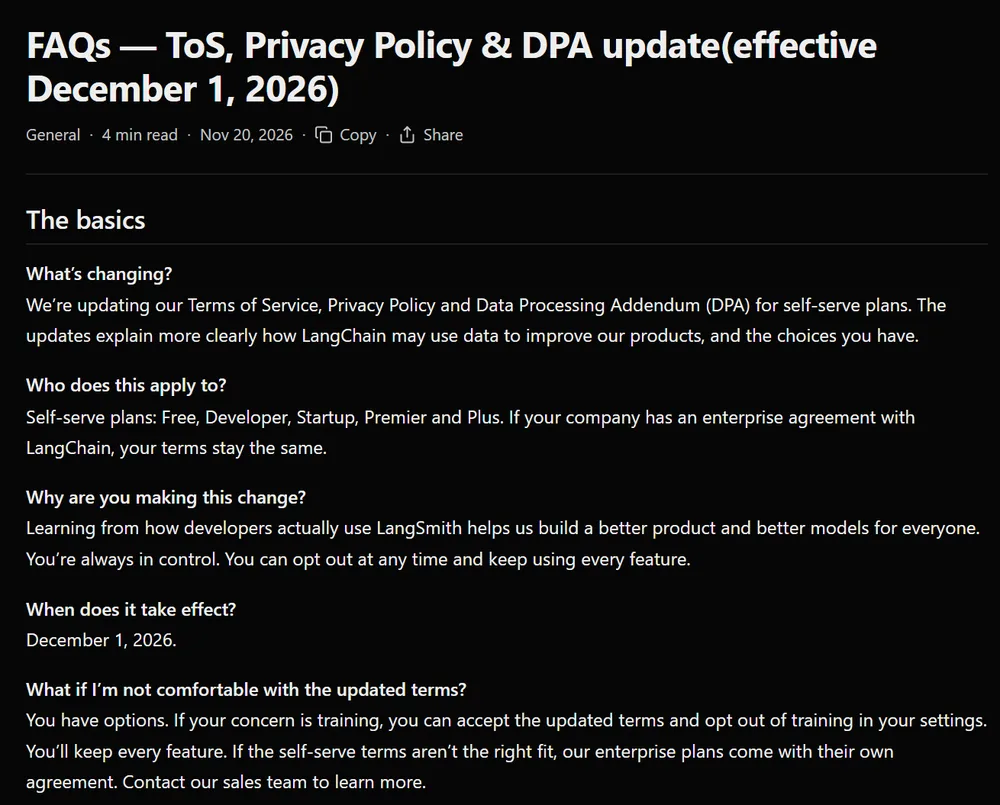
Source: FAQs: ToS, Privacy Policy & DPA update, LangChain Support, captured November 23, 2026.
Per the FAQ, data sent before December 1 isn't used; data sent on or after it is, unless you have opted out. Opting out later "stop[s] using your data for training going forward", but models already trained "may still reflect that earlier data". Those rules come from the FAQ alone; the terms set no start date.
LangChain's own pricing page still says it won't train
On November 23, three LangChain product pages still answered the training question the old way. The pricing page FAQ says: "No. LangSmith does not use your data to train models."
The observability and evaluation pages say "We will not train on your data". All three link to langchain.com/terms-of-service, which now carries the Enterprise Terms, the version that doesn't apply to self-serve plans.
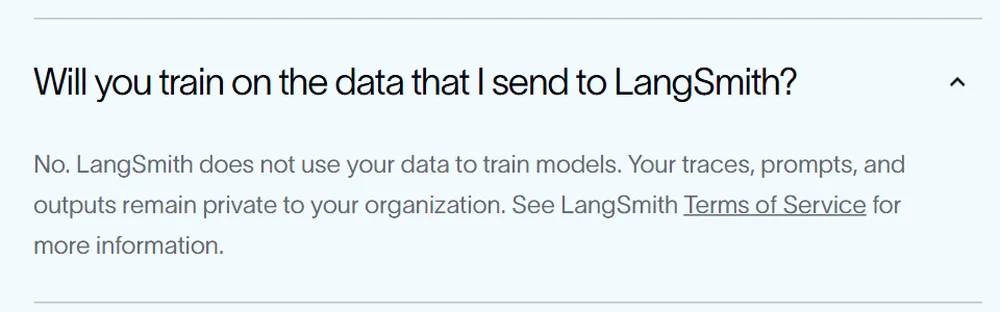
Source: LangSmith Plans and Pricing, LangChain, captured November 23, 2026.
If someone on your team approved LangSmith by reading that FAQ, the approval rests on a statement the Standard Terms no longer support. When the page and the terms disagree, the terms win: Section 10.10 says the Agreement "supersedes all prior communications, representations". Save a copy of the Standard Terms, not the marketing page, in your vendor file.
Who needs this checklist
You need it if any of these is true for a LangSmith organization your team uses:
| Your setup | Training from Dec 1? | What to do |
|---|---|---|
| Developer (free, 1 seat) or Plus ($39 per seat per month), signed up online | Yes, unless opted out | Every item below |
| Startup or Premier plan | Yes, per LangChain's FAQ | Every item below |
| Enterprise order form | No; the FAQ says your agreement "doesn't allow training on your data" | Confirm your order form references the Enterprise Terms, then stop |
| A contractor or agency traces your app in its own LangSmith org | Depends on their plan | Ask them which terms they're on |
LangChain's pricing page has columns for Developer, Plus and Enterprise and mentions a Startup Plan in its FAQ; Premier isn't on it, so we can't tell you what a Premier plan includes.
The last row is the one teams miss. If a vendor's or freelancer's LangSmith project receives the spans from your agent (our TypeScript AI agent observability and tracing modules show what those spans carry), their opt-out choice decides whether your users' prompts end up in training.
Settings and masking: the first five checks
Work through it per LangSmith organization. We have no LangSmith account on a self-serve plan, so we have not seen the opt-out control; where a step depends on the screen, we say what the source says and nothing more.
- List every LangSmith org and its plan. LangChain's pricing page sends Developer users to
smith.langchain.com/settings/paymentsto upgrade, so that settings page is where to read each org's plan. Include personal Developer orgs that developers point production keys at. - Turn training off in settings, and check again on December 1. The FAQ's whole instruction is "Go to your settings. You can change your choice at any time after 12/1." It names no setting, no scope (organization or workspace) and no date before which the choice can be made. Look now, and if there's no control yet, look again on December 1 before your agents send their first traces that day.
- Decide on AI features separately. The FAQ says opting out of training "doesn't turn off any features" and that turning AI features off is "a separate setting". The Privacy Policy adds that "for all in-product AI features, you can opt-out of model training within our platform".
- Know what Engine does with traces. Engine, LangSmith's issue-finding feature, is documented as opt-in and "never trains on your data"; its model subprocessors (OpenAI, Anthropic, Fireworks and Baseten) run under zero data retention, per the Engine security page.
- Mask what you can't afford to have used. Setting
LANGSMITH_HIDE_INPUTS=trueandLANGSMITH_HIDE_OUTPUTS=truekeeps inputs and outputs out of traces entirely, and the SDK'shide_inputsandhide_outputshooks let you redact per field, per LangChain's masking docs. This works whatever the setting says, and it's the step we'd do first for any project that touches customer records.
DPA, retention and proof: the last four checks
- Keep special-category data out of self-serve LangSmith. Section 3.3 of the Standard DPA says it "does not apply to any special categories of personal data or sensitive data" (under GDPR, that means data such as health records) unless you sign a separate agreement, and it makes you "solely responsible for ensuring no such data is submitted". From December 1, a clinic or HR tool tracing raw conversations on a Plus plan has no DPA cover for that data, training or not; the October 31, 2025 DPA that langchain.com/DPA still points to lets customers submit special categories.
- Record LangChain's new role in your DPA file. Under Section 2.3, LangChain is your processor for running LangSmith and an independent controller when it uses personal data to improve its products. Add that line to LangSmith's row in your AI vendor DPA tracker. Our read, not legal advice: if you promised clients that vendors process their data only on your instructions, a vendor acting as controller for its own product work is the gap the opt-out closes.
- Shorten retention where you can. On LangSmith Cloud, base traces are kept 14 days and extended traces 180 days, per LangChain's usage and billing docs. Neither the terms nor the FAQ say whether data selected for training follows those periods, so treat shorter retention as limiting what sits in LangSmith, not what may already be in a training set. Your AI data retention policy should name both periods.
- Screenshot the opt-out with the date. LangChain's notice period for changes to free access is 30 days by written notice, under Section 2.5 of the Standard Terms, with "continued use constituting acceptance". A dated screenshot is your evidence of what you chose and when.
Google announced on November 16 that new settings in the Gemini app will let you keep your chat history while opting out of generative AI model training, rolling out globally in the coming weeks, and our Gemini training opt-out guide shows what changes when one switch becomes two.
Fitting the LangSmith terms of service into client contracts
The FAQ is direct about the limit of the settings route: "If you'd like that commitment written into a contract, our enterprise plans include it." Enterprise pricing is custom, per the pricing page, so there's no list price to compare against Plus.
For most small teams there are three realistic options:
- Stay self-serve, opt out, and mask. Fine for internal tools and test data. Update your AI policy's vendor list to say "LangSmith: training opt-out on, set [date], by [name]".
- Stay self-serve but stop sending client data. Use the hide settings or conditional tracing for client projects, and trace only synthetic or internal runs.
- Move client work to an enterprise agreement. You need this if your client contracts say a subprocessor may use their data only on your instructions. A training clause with an opt-out instead of a default "no" is the first item in our AI vendor contract red flags, and Section 4.2 of the Standard Terms is exactly that.
Option 2 is where we'd land for a services firm on Plus with a handful of client projects: masking is free, it holds even if a setting gets switched back, and it doesn't wait on a sales call. Whatever you pick, log it in your AI vendor due diligence checklist with the November 19 terms version.
On November 22, a developer merging an architecture change in the public Layover repository on GitHub wrote that its framework's "sensitive-data setting stays off until LangSmith's region, retention and terms are checked". The pull request doesn't mention the December change, but it's the right default for anyone who hasn't read the new terms yet.
What this checklist doesn't cover
- Self-hosted and BYOC deployments. Both sets of terms define them, but LangChain's FAQ talks only about self-serve plans and enterprise agreements. We didn't check how a self-hosted licence on Standard Terms is treated.
- Other vendors' trace tools. For direct links to the privacy and DPA pages of the larger AI vendors, see our enterprise AI vendor privacy pages list.
- Other December terms changes. Etsy's AI training clause and who can opt out covers a change taking effect on December 16, where only EEA and UK sellers get a way to object.
Checked November 23, 2026: LangChain's Standard and Enterprise Terms, Privacy Policy and DPAs, the support FAQ, the June 2 Terms in the Wayback Machine, the pricing and product pages, and the LangSmith docs cited above.
Before December 1: the order we'd do it
- Tuesday, November 24: list every LangSmith org and plan, including contractors' orgs that receive your traces.
- Wednesday, November 25: set
LANGSMITH_HIDE_INPUTSandLANGSMITH_HIDE_OUTPUTSon any project that handles customer or employee data, and remove special-category data from traces. - Thursday, November 26: look for the training setting in each org and turn it off if it's there; screenshot it.
- Friday, November 27: add the Section 2.3 controller line and the opt-out date to LangSmith's row in your DPA tracker, and email any client whose contract bars vendor training.
- Tuesday, December 1, before your first deploy: open settings again, confirm the opt-out shows as on, and save the screenshot with that date.
References
- LangChain, Standard Terms of Service, last updated November 19, 2026.
- LangChain, Enterprise Terms of Service, last updated November 19, 2026.
- LangChain, Terms of Service, last updated June 2, 2026, Wayback Machine capture of November 13, 2026.
- LangChain, Standard Data Processing Addendum and Enterprise Data Processing Addendum.
- LangChain, Privacy Policy, last updated November 19, 2026.
- LangChain Support, FAQs: ToS, Privacy Policy & DPA update (effective December 1, 2026).
- LangChain, LangSmith Plans and Pricing, observability and evaluation pages, read November 23, 2026.
- LangChain docs, Usage and billing (retention periods).
- LangChain docs, Prevent logging of sensitive data in traces.
- LangChain docs, LangSmith Engine security.
- LangChain docs, Conditional tracing.
- olaheavy-dev/layover, pull request #77, merged November 22, 2026.
- LangChain, Customer DPA V.2 2025.10.31, the signed template that langchain.com/DPA redirects to, read November 23, 2026.
- Google, Updating controls in the Gemini app, November 16, 2026.