Source: Unsplash stock photo, free to use under the Unsplash license.
On November 23, three days after telling The New York Times it would "share the revised terms directly with sellers soon," Etsy posted revised Terms of Use marked "Last updated on Nov 23, 2026." The new Section 5C, still effective December 16, 2026, says Etsy "and our partners and vendors, may use Your Content to develop, train, test and improve artificial intelligence and machine learning technologies" for purposes it lists "for example": search and discovery, seller tools, customer support, advertising, and security and fraud. It adds that Etsy won't train models "designed to replace your creativity or to create copycat versions of the items you sell on Etsy," and the line about "opt-out rights described in our Privacy Policy" is gone.
Our read: the rewrite spells out purposes, while who can train and for how long stay the same. The license is still perpetual and irrevocable, and the partners and vendors are still unnamed, the same gap our comparison of AI vendors' training defaults flags for other tools. The EEA and UK objection, the arbitration email for the Americas and the Section 6F listing check work the same under the new text. Save the October 26 wording from the Internet Archive now, because the newest capture of Etsy's own page shows only the November 23 version.
What Etsy said from November 16 to 23, and what it left out
Etsy's November 20 statement came the day The New York Times reported shop closures, among them Cognitive Surplus, which had sold stationery and home goods on Etsy for 13 years, according to TNW and Quartz.
| Reported | Where | What Etsy said | What it didn't say |
|---|---|---|---|
| Nov 16 | Community post by James Ossman, VP of Customer Operations | "We do not use your content to train AI models designed to copy your original work or replace your creativity." Lists fraud models, search and recommendations, seller tools | No opt-out, no change to the Terms |
| Nov 20 | Statement to The New York Times, reported by The Verge, TNW and Quartz | Etsy will "share the revised terms directly with sellers soon"; sellers' creative work belongs to them; per Quartz, "we should have done more to explain how we use their content" | No date, no draft wording |
| Nov 21 | Statement to CBC News | Sellers' "creative work belongs to them"; Etsy "should have done more" to communicate the changes | No date, no draft wording |
| Nov 23 | Update to the Community post and revised Terms ("Last updated on Nov 23, 2026") | Terms updated "based on your feedback"; new 5C lists example uses and rules out copycat models | No opt-out; effective date still December 16 |
None of the Etsy statements quoted by The Verge, TNW, Quartz or CBC mentions a US opt-out or a new effective date, and the November 23 Terms add neither.
Some coverage reads more into this than Etsy said. Engadget's November 21 headline was "Etsy says it will not use sellers' content to train AI," but the line its article quotes from Ossman is the narrow one: no models "designed to copy your original work or replace your creativity." The November 16 post lists its three uses under the heading "How we use your content to train AI models," and says vendors with Etsy's permission to access your content include "services that help us detect fraud and advertising partners that help buyers discover your items off Etsy."
What Section 5C says now, and what it said on October 26
The license itself did not change. The version in force through December 15 already granted Etsy and third parties it authorizes "a non-exclusive, worldwide, royalty-free, irrevocable, sub-licensable, perpetual license" to use, edit, reproduce and distribute what you post. That paragraph used to end at "to the extent Your Content contains any personal information." The October 26 version adds this:
This also includes the right for us and our third party partners and vendors to use Your Content to develop, train, test and improve artificial intelligence and machine learning technologies, including to improve the Services and/or help keep them safe, subject to any applicable opt-out rights described in our Privacy Policy.
The November 23 version replaces that sentence. Etsy "and our partners and vendors" may still train AI on Your Content, now "to help us provide, operate and improve the Services," with five example purposes, a promise against copycat models, and no mention of opt-out rights. It also drops the old sentence on Etsy's "legitimate interest" in personal information and ends with a pointer to the Privacy Policy instead.
"Your Content" covers "shop names, profile pictures, listing photos, listing descriptions, reviews, comments, videos, usernames, etc." The license is royalty-free, so nothing in it pays sellers for training use. The clauses that changed around it:
| Clause | Through December 15 | Revised text, from December 16 |
|---|---|---|
| 5C license | Ends at personal information | Same license, plus an AI training sentence: Oct 26 named "third party partners and vendors" and opt-out rights; Nov 23 lists example uses, rules out copycat models, drops the opt-out pointer |
| Scraping ("Don't Steal Our Stuff") | 6C: "crawl, scrape, or spider" only | 6E: no use of Etsy content "by automated or manual means" for training or "prompting" AI |
| AI tools and manipulation | No such parts | 6D: you own the risk of Etsy AI output; 6F: prompt injection ban |
| 11.F batch arbitration | 25 or more claimants | 10 or more claimants |
Etsy owes sellers little warning before a revision. Section 13, worded the same in all three versions, says that for material changes "we'll let you know in advance by posting the changes through the Services and/or sending you an email or message," and that using Etsy after the effective date "constitutes your acceptance." It sets no minimum number of days. Only the arbitration agreement carries a 30-day notice rule, in Section 11.H.
Where the right to object lives: one legitimate-interests row
The October 26 text pointed to "opt-out rights described in our Privacy Policy"; the November 23 text only says the Privacy Policy explains "the choices available to you." Neither is a toggle. The Privacy Policy, published October 26 alongside the Terms, lists AI training in its legitimate-interests table, under "To understand how you use our Services and improve your experience on Etsy". It names "listing information, product reviews, and community posts" and gives "AI listing tools or AI review summaries" as the features it builds.
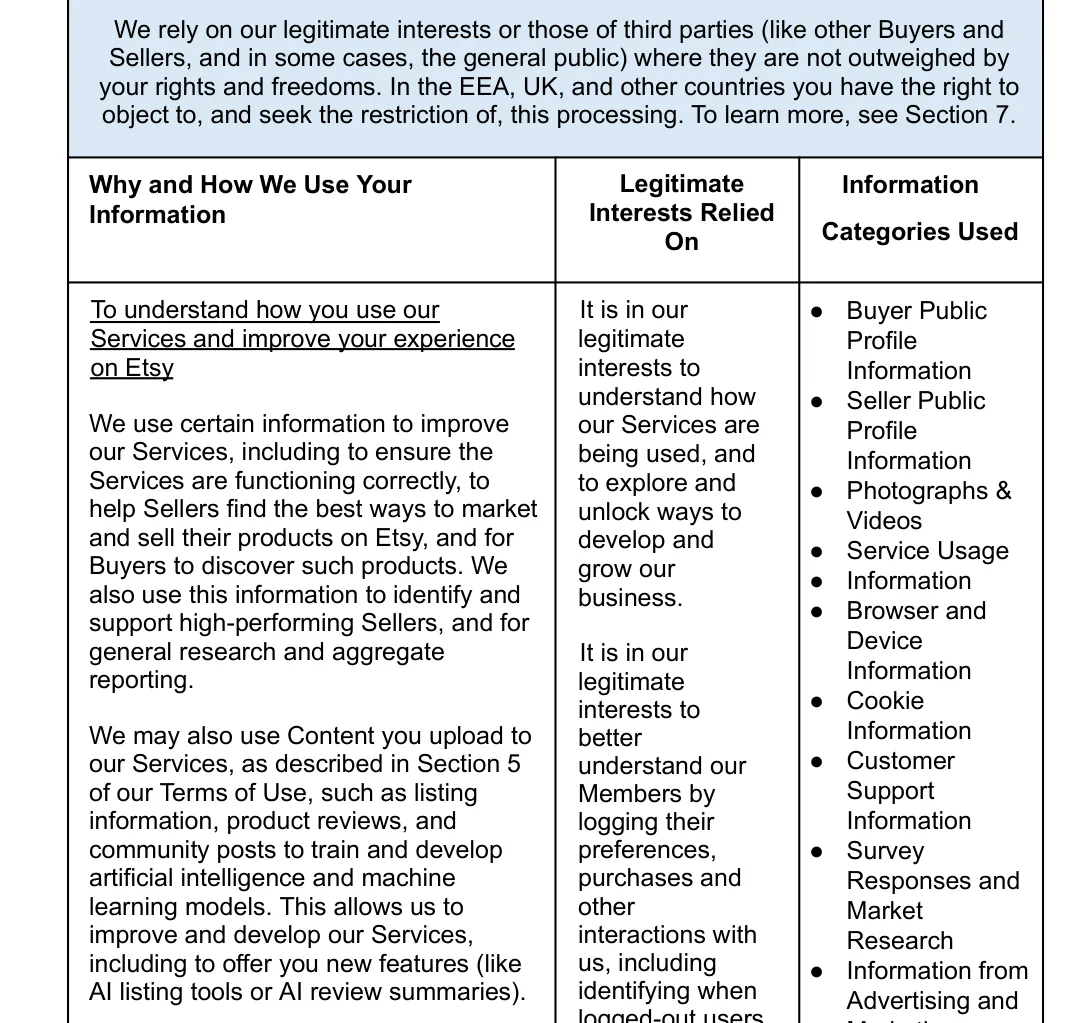
Source: Etsy Privacy Policy, US English PDF, page 17, published October 26, 2026, effective December 16, 2026.
The banner above that table says "In the EEA, UK, and other countries you have the right to object to, and seek the restriction of, this processing." Section 7 sets the outcome: Etsy will stop "unless we have compelling legitimate grounds to continue processing or where it is needed for legal reasons." The policy doesn't say whether an objection reaches a photo of a mug with no personal data in it. Value Added Resource's October 29 report reads it the same way: those protections "do not necessarily cover every type of creative content."
How to object from the EEA or UK
Outside the Americas, the Etsy company behind the service is Etsy Ireland UC. Section 12 of the Privacy Policy lists the Help Center, chat, a postal address in Dublin and an email to the Data Protection Officer. Use the email, which leaves you a dated copy and works the same under the November 23 Terms.
- From the address on your Etsy account, write to [email protected] with the subject "Objection under Section 7 of the Privacy Policy: AI training".
- Give your name, username, shop name and country, then one sentence: "I object under Section 7 of your Privacy Policy to Etsy and its partners and vendors using my content, including listing photos, descriptions and reviews, to train or develop AI and machine learning models as described in Section 2 of the Privacy Policy and Section 5C of the Terms of Use. Please confirm you will stop, or tell me the compelling legitimate grounds you rely on to continue."
- Keep Etsy's reply. The policy says "we will confirm receipt of your request."
- If Etsy refuses or goes quiet, the policy names the Information Commissioner's Office for the UK and Ireland's Data Protection Commission. This is a summary of Etsy's documents, not legal advice.
US sellers: no AI switch, and one arbitration email
The Privacy Policy sends US residents to the US Regional Privacy Policy. The newest copy of that page we could read says "Last updated on Mar 6, 2026" and lists access, correction, deletion, and opt-outs for targeted advertising, "sales" and profiling for significant decisions. None of them mentions AI training, which is also how Shopifreaks read both documents on October 31.
The arbitration rules moved too, and they have a clock. Section 11 covers North and South America. In the October 26 text, unchanged on November 23, it calls arbitration "mandatory, confidential, individual", and the batch threshold drops from 25 claimants to 10.
The rejection right comes from the Terms in force today. Their Section 11.H says Etsy will notify you of material changes "at least 30 days before they become effective", and that you may reject them by emailing [email protected] "within 30 days after you receive notice, including your name, email address associated with your account, your username, and shop name (if applicable)." A rejection leaves you on "the most recent version of the Arbitration Agreement before the change you rejected."
Etsy hasn't said whether it treats its October update email as that notice. If the email reached you on October 26, day 30 is November 25. The email does nothing about AI training.
Section 6E reaches staff who paste Etsy content into chatbots
Section 6E bans using content "obtained from the Services" for "developing, training, fine-tuning, evaluating, benchmarking, testing, prompting, distilling" AI without Etsy's permission, "whether by automated or manual means." Etsy keeps outsiders off the content it trains on itself, the same double standard our piece on AI labs that scraped the web and now sue scrapers tracks.
"Manual" and "prompting" put a VA who pastes a competitor's listing, or a batch of buyer reviews, into ChatGPT for a summary inside the wording. Section 6F bans instructions "whether hidden or visible, within listings, descriptions, images, messages" aimed at Etsy's systems, and 6D makes Etsy AI tool output your problem: "You are responsible for reviewing, evaluating, and determining the appropriateness of any AI-generated output". The November 16 post restates the ban on scraping "to train AI models" but says nothing about 6D or 6F. Put two lines in your team's AI rules; section 4, Prohibited Uses, of our AI acceptable use policy template is the place for them.
Five lines to compare: October 26 vs November 23
Etsy said the revision would go "directly" to sellers, and its Help Center says it emails all active members before significant policy changes, so watch the inbox tied to your shop. Whether or not that email has reached you, the November 23 text is already posted. Set it next to your saved copy of the October 26 Terms.
| Where | October 26 wording | November 23 text |
|---|---|---|
| Terms 5C, last sentence | "our third party partners and vendors" may use Your Content to "develop, train, test and improve" AI | Rewritten: "our partners and vendors" may still train AI, for five uses given "for example" |
| Terms 5C, end of sentence | "subject to any applicable opt-out rights described in our Privacy Policy" | Opt-out pointer removed; no setting, no US route |
| Top of the Terms | "This policy is effective on December 16, 2026." | Unchanged: still effective December 16, 2026 |
| Privacy Policy, legitimate-interests row | "listing information, product reviews, and community posts" | We found no capture newer than November 20; that copy still lists them |
| Terms 11.F and 11.H | 10 claimants; 30-day rejection by email | Unchanged |
What isn't settled yet
- Whether Etsy emails the November 23 Terms to sellers before December 16, and whether it treats that email as new notice.
- Whether "for example" leaves room for training uses beyond the five Etsy lists.
- Whether an objection covers listing photos with no personal data in them, or only personal information.
- Which partners and vendors have trained on seller content, and whether content uploaded under the old Terms was already used.
- Whether the Privacy Policy changed on November 23 as well. The newest capture we found is from November 20.
- Whether Etsy has updated the US Regional Privacy Policy since July 27, 2026, the newest readable capture of the page the new Privacy Policy links to. That capture shows the March 6, 2026 version.
Checked on November 23, 2026: Etsy's November 16 Community post, updated November 23 to say Etsy had "updated our Terms of Use based on your feedback" (the reply it points to did not load for us); The Verge (November 20), TNW and Engadget (November 21), CBC News (November 21), Snopes (November 22) and Quartz (November 23, written before the revised text). etsy.com refused our requests from two networks and the Internet Archive's save service that evening, so the Terms were read from Internet Archive captures dated November 23 at 14:12 UTC (revised text), November 20 (October 26 text) and November 2 (text in force through December 15); the Privacy Policy from Etsy's own PDF and a November 20 capture; the US notice from a July 27 capture.
Before December 16: what to send and what to keep
- Today: save the Internet Archive captures of the October 26 Terms and the November 23 Terms as PDFs, with dates in the file names. The newest capture of Etsy's page shows only the newer text.
- By November 25, if you sell from the Americas: find the date of Etsy's October update email in your inbox. If you want to reject the arbitration changes, the email to [email protected] goes out within 30 days of that date.
- This week, if you sell from the EEA or UK: send the objection to [email protected] and file Etsy's receipt.
- Before December 15: read every listing description and any text inside listing images for lines written to an AI rather than a buyer, and delete them (Section 6F).
- Before you delete listings or close the shop, run the five-line check above on the November 23 text. Neither step ends the license over content you already posted.
If you also run a shop site outside Etsy, the robots.txt AI training line is the control you hold there; edit that file after the Terms PDFs are saved.
Related reading
- Meta Commercial Terms paused: the AI crawl clause is another platform that rewrote its terms around AI and then paused them.
- Gemini training opt-out: why History off now means 2 months shows what a training setting you can check looks like, the thing Etsy's Terms still lack.
- Who owns AI-generated content? covers what you can protect in designs you make with AI tools.