New York's state bar now tells hourly billers to charge the time spent prompting an AI tool and checking its output, never the hours it saved, and to treat the firm's AI subscription as overhead. The guidelines, adopted by the NYSBA House of Delegates on Saturday, October 31, 2026 (NYSBA release), don't amend the Rules of Professional Conduct, but they are the state bar's reading of Rule 1.5, the fee rule.
Report: the Committee on Artificial Intelligence and Emerging Technologies, chaired by Vivian Wesson. Coverage: the NYSBA release (October 31), Law360 (November 2) and the ABA Journal (November 3).
Screenshot: NYSBA report cover, page 1 (cover illustration cropped out).
Guideline 5A, line by line: what goes on the invoice
Guideline 5A is the fee section of the 106-page report and applies Rule 1.5. This is the operative text, page 12:
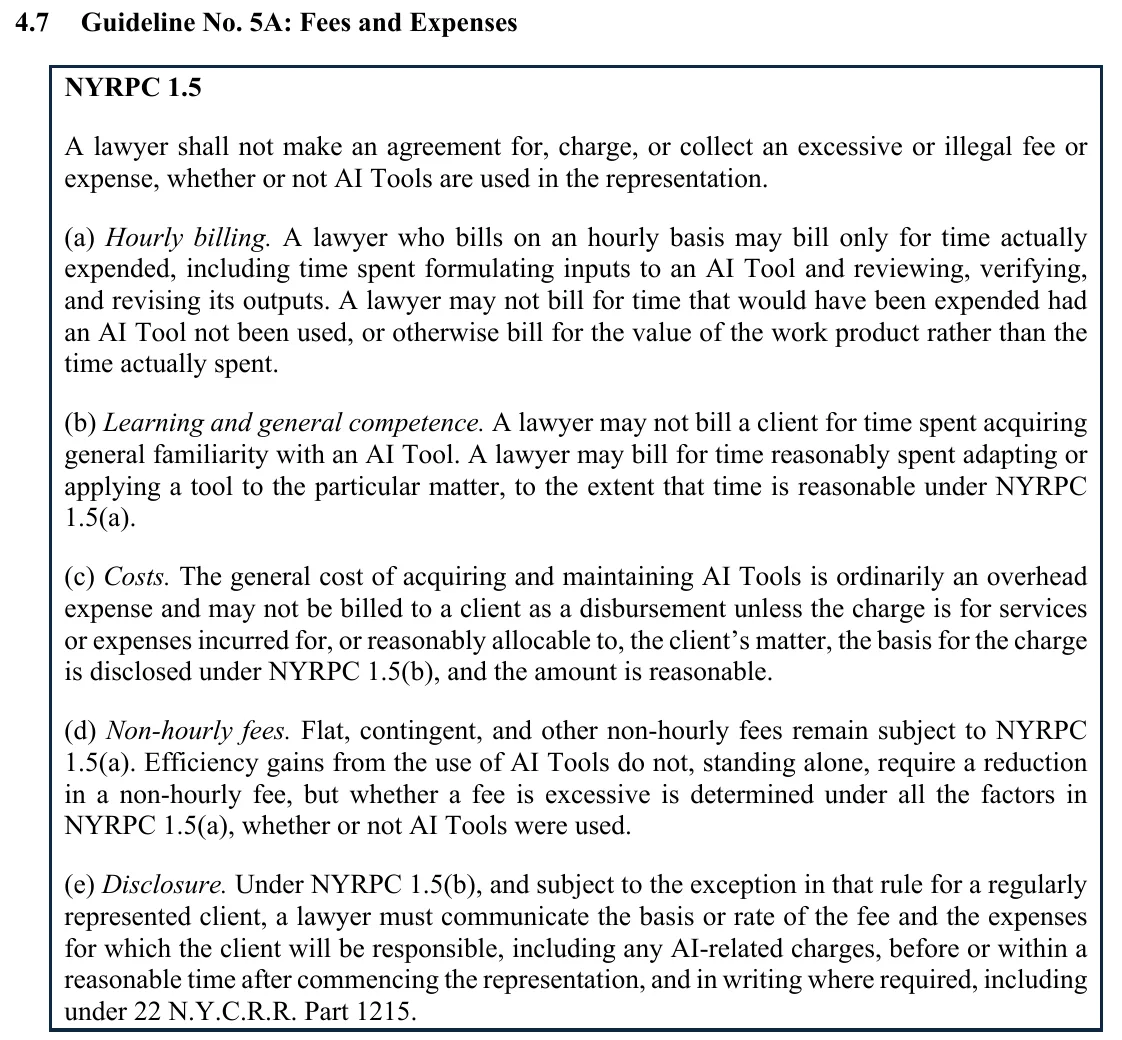
Screenshot: NYSBA, Legal Ethics Guidelines for Lawyers' Use of Artificial Intelligence, Section 4.7, page 12 of 96 (Version 7, October 23, 2026).
We turned it into the question a billing partner actually asks, line by line. The examples in brackets are ours, not NYSBA's.
| Work on the matter | Bill it? | Paragraph |
|---|---|---|
| Writing prompts for this client's matter | Yes, actual time | 5A(a) |
| Reviewing, verifying and revising the output | Yes, actual time | 5A(a) |
| The time the task would have taken without AI [a draft that took three hours and now takes one] | No. Bill the one hour | 5A(a) |
| Billing for the "value" of the work product instead of the time | No, on an hourly bill | 5A(a) |
| Learning the tool in general [vendor webinars, practice prompts] | No | 5A(b) |
| Adapting or applying the tool to this matter | Yes, if the time is reasonable under Rule 1.5(a) | 5A(b) |
| The firm's AI subscription | No. Overhead | 5A(c) |
| A charge incurred for this matter [a vendor fee invoiced for one case] | Only if allocable to the matter, its basis is disclosed under Rule 1.5(b), and the amount is reasonable | 5A(c) |
| A flat or contingent fee where AI cut the work | No automatic cut; the Rule 1.5(a) factors decide | 5A(d) |
| Telling the client about AI charges | Before or within a reasonable time after the work starts, in writing where required, including under 22 NYCRR Part 1215 | 5A(e) |
The sentence that changes timesheets is the second one in 5A(a): "A lawyer may not bill for time that would have been expended had an AI Tool not been used." An associate who drafts in one hour now logs one hour, and a partner can't write it up to three because that's what the draft is "worth". A flat fee is the one place 5A lets the firm keep some of the speed, since "efficiency gains" alone don't force a reduction.
The weak spot is 5A(c). "Reasonably allocable to the client's matter" isn't defined anywhere in Section 4. Until someone tests it, we wouldn't pass through any per-seat subscription, and we'd only bill AI charges that appear on a vendor invoice for one matter.
How New York compares with ABA Formal Opinion 512 and North Carolina
New York lands close to the two opinions small firms already cite: softer than the ABA on flat fees, stricter than North Carolina on tool costs. Sources: ABA Formal Opinion 512 and the ABA's release (July 29, 2024), North Carolina's 2024 Formal Ethics Opinion 1 (adopted November 1, 2024), and the survey of fee opinions in Section 8.5 of the NYSBA report.
| Question | ABA Formal Opinion 512 | North Carolina 2024 FEO 1 | NYSBA guidelines (2026) |
|---|---|---|---|
| Hourly: what counts | The 15 minutes spent entering information into the tool, plus the time reviewing the draft | Actual time only: a lawyer billing $300 an hour may not bill three hours when one hour was spent | Prompting, reviewing, verifying and revising; never the time saved |
| Learning the tool | In most circumstances not billable | Not addressed in the passages we read | Not billable; adapting the tool to the matter is |
| Flat fees | Charging the same flat fee with and without AI may be unreasonable | Allowed if not clearly excessive and the client consents | Efficiency alone does not require a reduction |
| Tool costs | Overhead if the tool works like office equipment, unless the client is told otherwise in advance; a third-party tool charged per use for one client's matter can be billed at actual cost | Billable if accurate, not clearly excessive and the client consents, preferably in writing | Overhead, unless allocable to the matter, disclosed and reasonable |
New York and the ABA agree that a charge tied to one client's matter can go on the bill (the ABA's example is a per-use service reviewing thousands of contracts, billed at actual cost). They part ways on general tools. The ABA treats them as overhead only "absent a contrary disclosure to the client in advance", so a firm that tells the client first can charge for them; New York's 5A(c) keeps the general cost of AI tools in overhead and only lets through a charge allocable to the matter. North Carolina goes further and allows a general administrative fee that covers technology expenses, AI included, if the client consents. On flat fees, in our reading, New York is friendlier to the firm than the ABA. If you practice in both New York and North Carolina, pass through only matter-specific charges and get the client's signature on them, which covers New York's disclosure and North Carolina's written consent in one engagement letter.
An AI paragraph for your engagement letter
This is our drafting, not NYSBA text. Each sentence answers one guideline, listed in the table under it. Bracketed parts are optional; delete what your firm doesn't do.
Use of AI tools. We may use artificial intelligence tools in your matter,
for example for research, drafting and document review. A lawyer reviews and
verifies material AI output before we rely on it or send it to you, a court
or anyone else.

If we bill you by the hour, we bill only the time we actually spend,
including time spent instructing an AI tool and checking its output. We do
not bill for time a tool saved us, or for time spent learning a tool. The
general cost of our AI software is part of our overhead and is not charged
to you. [We will charge you for (describe the charge) because it is incurred
for your matter. The charge is (amount or basis).]

Before we use an AI tool with your confidential information, we make
reasonable efforts to understand and control where that information goes,
including whether the tool keeps it, trains on it or can make it available
in other clients' matters. We will not record or transcribe our
conversations with you using an AI tool without your consent.
[You agree that we may record and transcribe our calls with you using (tool).
You may withdraw this consent at any time.]

You may ask us at any time whether and how AI tools are being used in your
matter.
| Sentence | Answers |
|---|---|
| A lawyer reviews and verifies material AI output | 3A: verify material output before relying on it or sending it to a client, court, opposing counsel or third party |
| Only actual time, including instructing and checking | 5A(a) |
| No time saved, no learning time | 5A(a) and 5A(b) |
| Software is overhead | 5A(c) |
| The optional matter charge | 5A(c) and 5A(e) |
| Reasonable efforts on where your information goes | 6B: where a tool sends out, retains, trains on or can reach across matters with client information, make reasonable efforts to understand and control those data flows before use |
| No recording without consent; optional standing consent | 3B(b): consent per conversation or, for routine recording, in the engagement agreement |
| Ask us any time | 4A(a)(i): disclosure is required when the client asks |
Where Part 1215 requires a written letter of engagement, the paragraph goes in that letter; 5A(e) names Part 1215. For your own staff, the time-entry rule fits on one line: log the minutes spent prompting and checking, don't round up to what the task used to take, and put tool training on a non-billable code. Your firm-wide AI rules for staff go in an acceptable use policy; the engagement letter only has to cover what the client is told.
Four lines for the firm's AI policy that aren't about money
Billing got the headlines (the ABA Journal's was "New York State Bar Association tells lawyers not to bill for time saved by AI"). These four sections of the report change more of a small firm's day.
| Situation | What the guidelines say | The policy line we'd write |
|---|---|---|
| An AI notetaker on a client call | 3B: New York and federal law allow recording with one party's consent (18 U.S.C. 2511(2)(d)); some states need every party, 13 by RecordingLaw's count. Get the client's consent. Know whether the vendor trains on the recording or shares it. "Absent a particular reason to record, the better practice is not to record." | AI recording is off by default; turn it on only with the client's consent on file and a tool that doesn't train on the content |
| Filing in a New York state court | 22 NYCRR Part 161, in force since June 1, 2026, does not require you to disclose AI use. A judge may adopt the Appendix A model rule, under which your signature certifies the paper was reviewed for fabricated content. Guideline 8A: confirm every cited authority and quotation exists and supports the point | A person pulls and reads every citation before filing; check the judge's part rules for an AI rule each time |
| An AI agent that can act | 9E(b): lawyer approval before any consequential or not readily reversible action, including filing or serving a document, transferring funds, and changing a deadline or calendar entry. 9E(c): keep a record of what the system did, when, and on whose instruction | Agents draft; a lawyer sends, files, pays and moves deadlines. Keep the agent's action log with the matter |
| A chatbot on the firm's website | 12A(d): a system that gives prospective clients substantive information about their rights or remedies should say it is an automated program, not a lawyer. A bot that only collects contact details, schedules, routes or sends a clearly automated acknowledgment is outside this, unless it is presented so that a reasonable person would think they are talking to a lawyer | The bot's first message says it is automated and is not a lawyer, and it has no lawyer's name, photo or voice |
On court filings the release says more than the rule does. NYSBA president Taa Grays said the guidelines help lawyers avoid "failing to notify clients or the courts of AI use", but Part 161.3 says attorneys "should not be required" to tell a state court they used AI. What gets lawyers sanctioned is a citation that doesn't exist, and our AI hallucination sanctions tracker shows what that costs case by case.
For the notetaker row, our Zoom AI Companion vs Otter vs Fireflies comparison lists which tools train on recordings, and the Fathom alternatives review covers retention. For the agent row, what happened when Claude sent police a fake tip is the case for a human approval step.
What the guidelines don't settle
They aren't binding. Section 4.1 says they "do not amend the NYRPC, create independent disciplinary obligations, or require a lawyer to use any particular technology." Any discipline would rest on Rule 1.5 itself. The guidelines tell you how the state bar reads that rule, and nothing we read says how much weight a disciplinary committee will give them.
Expect the text to move. The committee recommends an annual review, and between House meetings the Executive Committee can approve updates. Put a reminder for the first anniversary, October 31, next to your engagement letter template.
The version on nysba.org is labelled "Version 7 (October 23, 2026)", and its file name ends in "with comments". The cover says the House of Delegates approved it on October 31, and so does the release. We could not confirm whether any text changed on the floor. If you quote a paragraph in a client letter, quote the PDF and give its date.
For in-house teams, the legal teams guide covers privilege and confidentiality, and the UK judiciary's AI rules are worth a look if you appear in English courts.
Related Reading
- AI Hallucination Sanctions Tracker 2026: Fines by Case
- AI governance for legal teams: privilege and confidentiality
- UK Judiciary AI Position Statement: 5 Rules Law Firms Can Copy
- Zoom AI Companion vs Otter vs Fireflies: Privacy Compared
- Fathom Alternatives for an Enterprise Security Review
- AI Acceptable Use Policy Template: Free Copy for Small Teams