Image: Unsplash, used under the Unsplash License.
Update, October 13, 2026. We rechecked this story against the Federal Register text of EO 14409, the Congressional Research Service summary, and Anthropic's own statement. The first version said the order "forces a 30-day White House review before frontier AI models ship" and that Fable 5 and Mythos 5 were blocked under it. Neither holds up. The order asks for a voluntary framework and rules out preclearance in so many words. The model suspension came from a separate export control directive. What follows is the corrected account.
TL;DR: EO 14409 (signed June 2, 2026) told agencies to design a voluntary framework under which developers would give the government access to covered frontier models up to 30 days before releasing them to other trusted partners. Section 3(c) rules out mandatory preclearance. The pause of Fable 5 and Mythos 5 came from an export control directive on June 12, lifted June 30. The White House says the framework was done by August 1 and has not published it.
What EO 14409 actually says
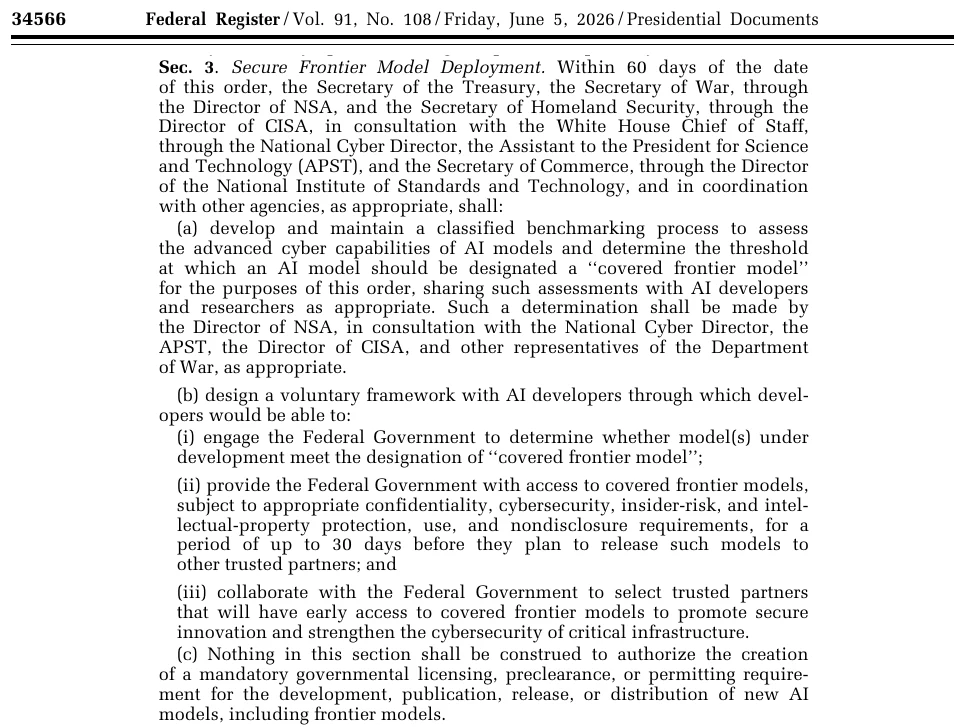
Screenshot: Executive Order 14409, Federal Register Vol. 91, No. 108, page 34566.
The order was signed June 2, 2026 and published in the Federal Register on June 5. Section 3, "Secure Frontier Model Deployment", gives the Secretary of the Treasury, the Secretary of War through the NSA, and the Secretary of Homeland Security through CISA 60 days to do three things:
- build a classified benchmarking process that sets the threshold for a "covered frontier model", with the NSA Director making the call;
- design a voluntary framework through which developers would give the government access to covered models "for a period of up to 30 days before they plan to release such models to other trusted partners";
- work with developers to select trusted partners that get early access.
Commerce appears only as a consultee, through NIST. And Section 3(c) closes the door the first version of this article walked through: nothing in the section "shall be construed to authorize the creation of a mandatory governmental licensing, preclearance, or permitting requirement for the development, publication, release, or distribution of new AI models, including frontier models."
The order does more than this. Section 2(d) gives Treasury 30 days to form an AI cybersecurity clearinghouse "in voluntary collaboration" with industry and critical infrastructure operators. Section 2(c) asks CISA to help get covered frontier models to "rural hospitals, community banks, and local utilities".
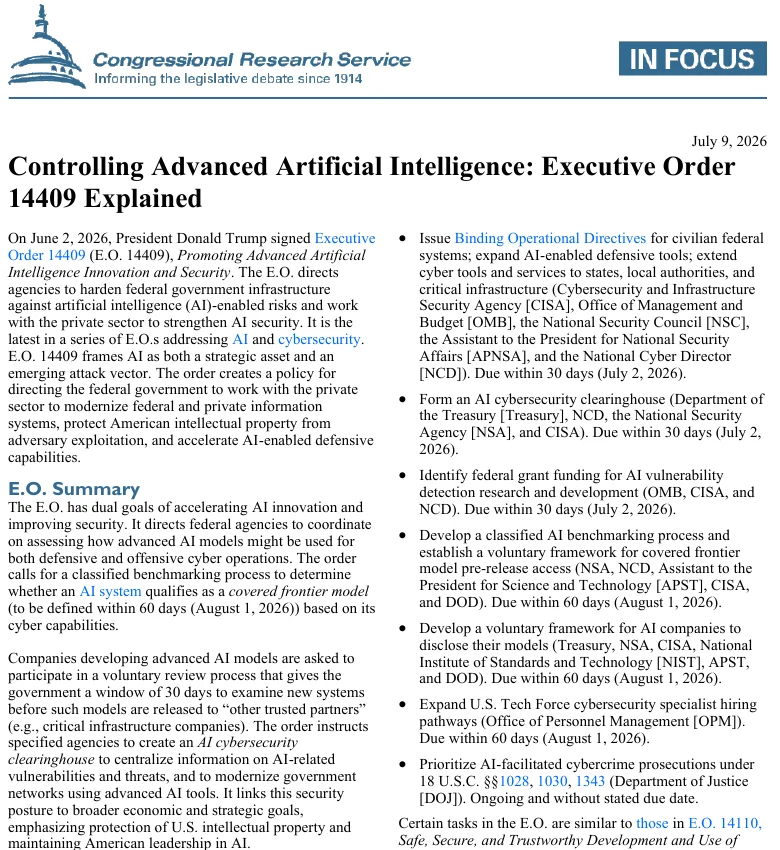
Screenshot: Controlling Advanced Artificial Intelligence: Executive Order 14409 Explained (IF13268), Congressional Research Service.
The Congressional Research Service reads it the same way. Its July 9 summary puts the 60-day deadline at August 1, 2026, describes the 30-day window as running before models go to "other trusted partners", and says the order stops "short of formal licensing or requiring preclearance". It also notes the obvious weakness: a voluntary structure "potentially creates coverage gaps if major developers decline to participate".
What actually paused Fable 5 and Mythos 5
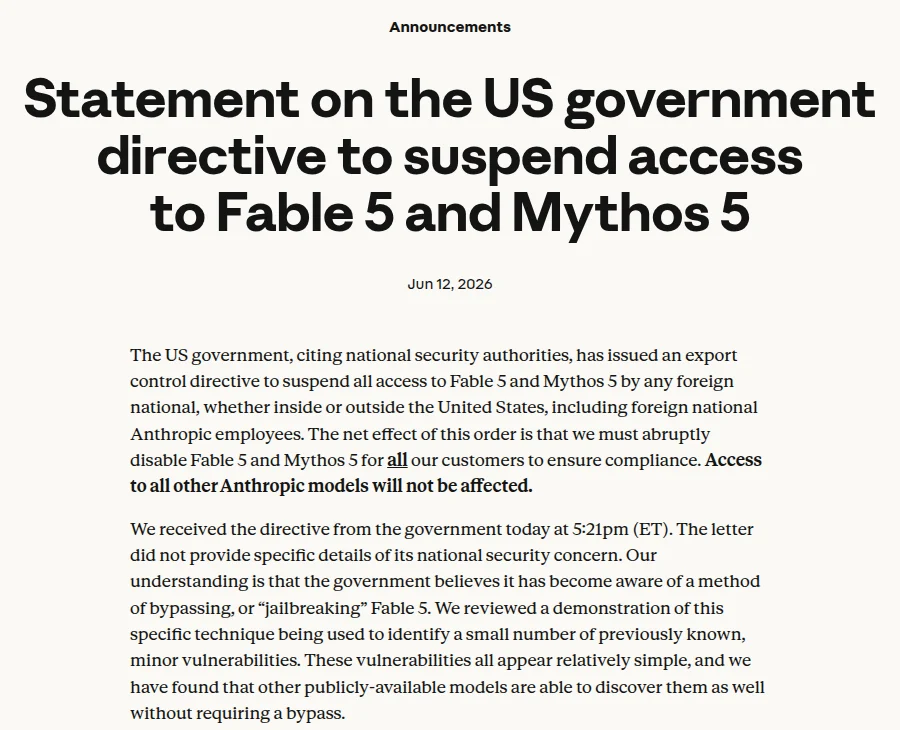
Screenshot: Statement on the US government directive to suspend access to Fable 5 and Mythos 5, Anthropic.
On June 12, 2026, Anthropic received an export control directive that suspended access to Fable 5 and Mythos 5 "by any foreign national". Anthropic said the net effect was that it had to disable both models for all customers, and it published a statement that day. Its other models were not affected. "The letter did not provide specific details of its national security concern," Anthropic wrote. It added that while the government should be able to block unsafe deployments through "a statutory process that is transparent, fair, clear, and grounded in technical facts", this action did not meet that standard.
CNBC reported on June 30 that the Commerce Department had lifted the export controls. Fable 5 went back to global users. Mythos 5 had already been restored for some US organizations following government approval on June 26.
On June 26, OpenAI said it was complying with a government request to limit its new models, including GPT-5.6, to a "small group of trusted partners" at first. Its own comment: "We don't believe this kind of government access process should become the long-term default."
So the hard stop in June came from export control law, not from EO 14409. For a buyer that difference matters. The order's framework is voluntary and pre-release. The export control hit models that were already on sale.
The partner lists, Gold Eagle and the unpublished framework
On July 17, CNBC reported, citing two people familiar with the matter, that the administration was now "dictating which companies and entities are allowed access to the latest frontier models". Until then, Anthropic's Project Glasswing and OpenAI's Daybreak decided who got their cyber-capable models. According to one source, future rollouts "will require explicit government approval for which partners can be involved". A White House official told CNBC the government "doesn't provide approvals for AI releases" and that "decisions on timing and scope of releases rest entirely with the companies".
The same week the White House launched Gold Eagle, the clearinghouse the order called for. It pulls together the White House, Treasury, CISA and the Department of War. It named no participating companies at launch, and TNW, citing Nextgov, found nothing suggesting it can force any company to fix a flaw. CNBC's source said it would put the White House in charge of greenlighting which companies can access new models. That is a source's account, not something in the order or the launch.
On August 3 the White House said the Section 3 framework "was complete by the deadline". It has not published it. The cyber benchmarks are classified, so is the coverage threshold, and OpenAI, Anthropic and Google commented on a draft. "Just because things are unclassified that doesn't mean we are going to broadcast them to everyone," an official said.
Daybreak has since changed shape. On August 10 OpenAI split it into Daybreak Blue and Daybreak Red, with a new GPT-5.6-Cyber model for Red users, and recommended Blue as the starting point for most organizations.
Image: Pexels, used under the Pexels License.
What this means for your AI vendor planning
You can't see whether a model you use is "covered". The threshold is classified. What you can plan for is the June scenario: a model you depend on goes dark for weeks with no warning and no published reason.
- List your hard dependencies. Which workflows break if one named frontier model disappears tomorrow? If the answer is "we'd switch to the previous model", test that switch now.
- Pin versions and keep a fallback warm. Production systems should call a pinned model version, with a tested route to a second model or provider.
- Ask for disclosure in the contract. Require the vendor to tell you about any government hold, delay or restriction that affects availability, feature scope or release timing, even where the underlying process is confidential.
- Read your force majeure clause. Check whether a government-ordered suspension lets the vendor stop service without credits, and whether you can exit.
- Add the scenario to your vendor risk register as its own line, separate from outages. The AI vendor due diligence checklist and the GenAI vendor risk assessment framework have the rest of the questions.
Don't spend effort trying to join Glasswing or Daybreak unless you do defensive security work. They exist for that.
Our take
I got this one wrong the first time, and the error is instructive. The order's text is mild: voluntary, pre-release, no preclearance. The events around it were not: an export control that pulled two shipping models for everyone, and partner lists that sources say now go through the White House. If you read only the order you would underrate the risk; if you read only the headlines you would think EO 14409 was a licensing regime, which its own Section 3(c) denies. For a small team the practical answer is the same either way. Treat "the model is suddenly unavailable" as a real vendor risk with a tested fallback, and get the disclosure duty into the contract while you can still ask for it at renewal.
How we checked this: we read EO 14409 in the Federal Register, the CRS In Focus IF13268, Anthropic's June 12 statement, CNBC's reports of June 30, July 17 and August 10, and TNW's reports on Gold Eagle and the August framework. We took the three screenshots above. Last reviewed: October 13, 2026.
Related Reading
- Australia's AI committee letter to Albanese: 11 safeguards and vendor questions
- One Big Beautiful Bill: What the AI Preemption Clause Means for State Law
- Trump AI Executive Order June 2026: What Compliance Teams Need to Know
- Dario Amodei on AI Policy and the Exponential Growth Problem
- AI vendor due diligence checklist 2026
- GenAI vendor risk assessment framework 2026
- AI spend governance for small teams
- Vetting AI tools: fake packages, malware, and typosquatting risks
- OpenAI Astra: What the Critical Cyber Threshold Means for Vendor Risk