Data breach notices are familiar. AI incident reporting is newer and works differently: it's triggered by harm from what a system did, whether or not personal data leaked, and the duty often sits with the vendor that built the system rather than the company using it. This guide maps who reports what, to whom, and how fast.
TL;DR: Under the EU AI Act, providers of high-risk AI systems report serious incidents within 15 days, 2 days or 10 days depending on the harm. Deployers tell the provider first. Providers of the largest general-purpose models report to the EU AI Office. GDPR breach notices run separately. In the US, bank, medical device and automated vehicle rules apply; there's no general AI incident law.
| Regime | Who reports | Trigger | Deadline | To whom |
|---|---|---|---|---|
| EU AI Act Art. 73 | Provider of a high-risk AI system | Serious incident (Art. 3(49)) | 15 days after awareness; 2 days for widespread infringement or critical-infrastructure disruption; 10 days after a death | Market surveillance authority where it happened |
| EU AI Act Art. 26(5) | Deployer of a high-risk AI system | Identifies a serious incident | Immediately | Provider first, then importer or distributor and the authority |
| EU AI Act Art. 55(1)(c) | Provider of a GPAI model with systemic risk | Serious incident | Without undue delay | AI Office and, as appropriate, national authorities |
| GDPR Art. 33 | Controller | Personal data breach, unless unlikely to result in a risk | Without undue delay, 72 hours where feasible | Data protection authority |
| US bank rules (12 CFR 53.3 and matching Fed, FDIC rules) | Banking organization | Notification incident | 36 hours after determining it occurred | Primary federal regulator |
| FDA MDR (21 CFR 803) | Device manufacturer | Device may have caused or contributed to death or serious injury, or a malfunction that could | 30 calendar days; 5 work days if remedial action is needed | FDA |
| NHTSA Standing General Order | Vehicle makers and operators | Crash involving ADS or Level 2 ADAS | Most severe crashes within five days; less severe monthly | NHTSA |
EU AI Act Article 73: who reports
Article 73 puts the duty on providers: "Providers of high-risk AI systems placed on the Union market shall report any serious incident to the market surveillance authorities of the Member States where that incident occurred."
If you use a vendor's high-risk system rather than build one, you're a deployer, and Article 26(5) sets your part. When you identify a serious incident, you "immediately inform first the provider, and then the importer or distributor and the relevant market surveillance authorities." If you can't reach the provider, Article 73 applies to you as it would to the provider. Put the provider's incident contact in your vendor file now; you don't want to look for it during an incident.
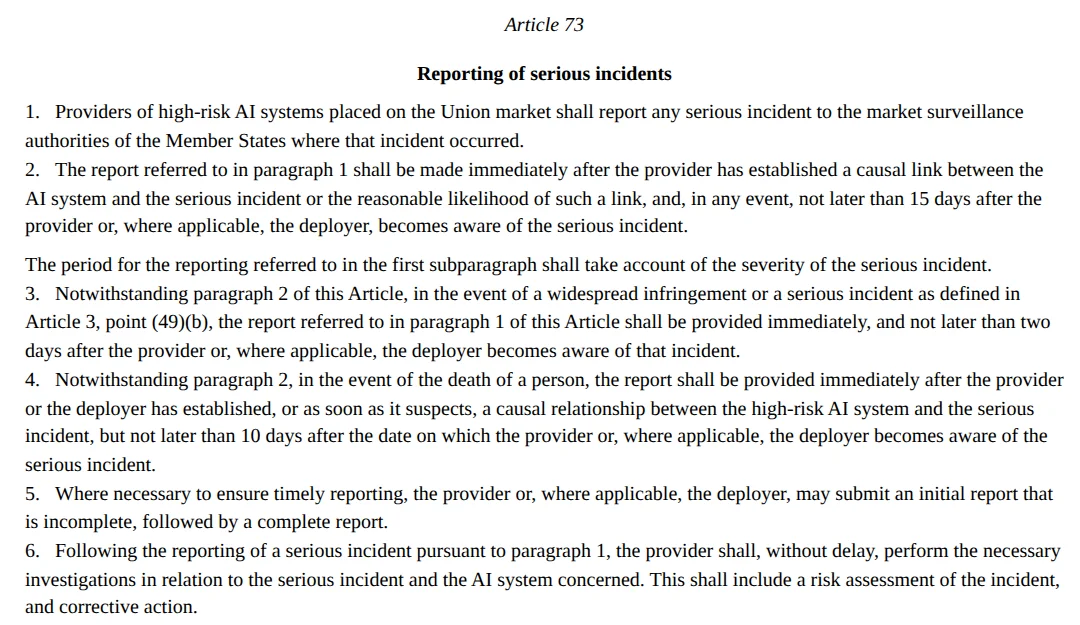
Screenshot: EUR-Lex, Regulation (EU) 2024/1689, consolidated text of July 27, 2026, Article 73. Captured October 31, 2026.
What counts as a serious incident
Article 3(49) defines a serious incident as an incident or malfunction of an AI system that directly or indirectly leads to:
- the death of a person, or serious harm to a person's health;
- a serious and irreversible disruption of the management or operation of critical infrastructure;
- the infringement of obligations under Union law intended to protect fundamental rights;
- serious harm to property or the environment.
A wrong output on its own isn't a serious incident. It becomes one when it leads to one of those harms. A hiring tool that systematically screens out a protected group could fall under the fundamental-rights limb; an error caught before anyone acted on it usually won't.
Deadlines
The report is due "immediately after the provider has established a causal link between the AI system and the serious incident or the reasonable likelihood of such a link," and no later than 15 days after awareness. Two shorter limits apply:
- 2 days for a widespread infringement or a critical-infrastructure disruption under Article 3(49)(b);
- 10 days after a death, starting from when the provider or deployer becomes aware.
The provider "may submit an initial report that is incomplete, followed by a complete report." After reporting, the provider has to investigate, including "a risk assessment of the incident, and corrective action," and can't alter the system in a way that affects the investigation before telling the authorities.
When it applies
Article 73 is in a part of the Act that applies from August 2, 2026, but it only covers high-risk AI systems. The Chapter III rules that classify systems as high-risk apply from December 2, 2027 for Annex III uses (hiring, credit, education and the rest) and August 2, 2028 for AI in products covered by Annex I, after the amendment in Regulation (EU) 2026/1744. Use the time to set up the provider contact and the log, not to wait.
General-purpose AI models with systemic risk
Providers of general-purpose AI models with systemic risk have a separate duty under Article 55(1)(c): "keep track of, document, and report, without undue delay, to the AI Office and, as appropriate, to national competent authorities, relevant information about serious incidents and possible corrective measures." A model is presumed to have systemic risk when its training compute exceeds 10^25 floating point operations. These obligations have applied since August 2, 2025.
That's a duty for the model provider, not for a company calling its API. On r/LocalLLM, u/Herr_Drosselmeyer read it the other way: "my reading is that an LLM acting as a chatbot wouldn't be considered a high risk model (not the same as systemic risk btw), and it seems to me that the serious incident reporting obligation concerns only those." The first half is a fair reading for most chatbots. The second half misses Article 55, which applies incident reporting to systemic-risk model providers whether or not a deployment is high-risk.
GDPR Article 33 runs in parallel
GDPR requires the controller to notify the data protection authority "without undue delay and, where feasible, not later than 72 hours after having become aware of it," unless the breach is unlikely to result in a risk to people. An AI incident that also exposes personal data can trigger both GDPR and the AI Act, with different reports to different authorities.
Example: a high-risk hiring system exposes candidates' health information to the wrong recruiters. That's a personal data breach under GDPR. If it also infringes candidates' fundamental rights, the provider has an Article 73 report to make, and you, as deployer, tell the provider first. Record both clocks from the same awareness timestamp.
US: sector rules, no general AI law

Photo: Unsplash, used under the Unsplash License.
Banking
Banks have a hard deadline, but it comes from the computer-security incident notification rule, not from model risk guidance. A national bank must notify its OCC supervisory office "no later than 36 hours after the banking organization determines that a notification incident has occurred" (12 CFR 53.3; the Federal Reserve and FDIC have matching rules). A notification incident is a computer-security incident that "has materially disrupted or degraded, or is reasonably likely to materially disrupt or degrade" the bank's operations. An AI system failure that meets that test is reportable; a drifting model that doesn't disrupt operations isn't.
Model risk guidance is where an AI credit or fraud model gets governed. On April 17, 2026 the Federal Reserve, OCC and FDIC replaced SR 11-7 with SR 26-2. It sets no reporting duty, says it doesn't set enforceable standards, is aimed at banking organizations with over $30 billion in assets, and leaves generative and agentic AI out of scope.
Medical devices
AI software that's a medical device falls under FDA's Medical Device Reporting rule. A manufacturer reports within 30 calendar days of becoming aware of information that a device may have caused or contributed to a death or serious injury, or has malfunctioned in a way that would be likely to do so if it recurred. A 5-work-day report is due when an event "necessitates remedial action to prevent an unreasonable risk of substantial harm to the public health," or when FDA asks for one in writing.
Automated vehicles
NHTSA's Standing General Order requires crash reports for vehicles with automated driving systems or Level 2 driver assistance. The third amended order, in effect since June 16, 2025, "Makes reports of the most severe types of crashes due within five days, and reports of less severe crashes due monthly."
FTC
The FTC has no AI incident reporting rule. Its proposed policy statement on suppressing accuracy in AI systems, published July 7, 2026, says steering an AI system to undisclosed objectives "may deceive consumers in violation of section 5 of the FTC Act." Comments closed July 31, 2026, and a Federal Register search on October 31, 2026 still showed only the proposal. It doesn't require reports, but if a vendor discloses that it changed how its model behaves, log it and check whether outputs from that period fed client work. Our FTC AI accuracy policy guide covers the vendor questions.
New York's generative AI notice bill
New York's A3411-B passed both houses by March 9, 2026 and, on October 31, 2026, still showed no delivery to the governor. If signed, a missing "may be inaccurate" notice on a generative AI interface could cost up to $1,000 per violation, with each user who doesn't get the notice counted separately, from the 90th day after it becomes law. That's a compliance gap to fix rather than an incident to report, but log the dates if you find one. The New York three-bill guide has the status of all three bills.
One process for every regime
Most of these deadlines run from when you became aware of the incident or determined it had happened, so the most important field in your log is when someone first knew. Here's how we'd set up the process.
Classify first
- Is a high-risk AI system under the EU AI Act involved? If you're the deployer, notify the provider; if you're the provider, start the Article 73 clock.
- Is a general-purpose AI model with systemic risk involved, and are you its provider? (Article 55)
- Is personal data involved? (GDPR Article 33, US state breach laws)
- Is the system in a regulated US sector: banking, medical devices, automated vehicles?
- Is there consumer harm that a regulator could treat as deceptive or unfair?
Log fields
- Awareness date and time, and who became aware
- What the AI system did or failed to do, and how it was detected
- System name, version, provider, deployment context
- High-risk status under the AI Act, with the Annex III category if any
- Personal data involved (categories, approximate number of people)
- Harm caused or risk of harm (health, safety, property, fundamental rights)
- Immediate containment
- Reporting decision for each regime, with deadline and owner
- Provider notified (date, contact, reference)
- Root cause and corrective action
Severity tiers we use
| Tier | Example | Likely obligations |
|---|---|---|
| Critical | AI output contributed to a death or serious injury | Provider: Art. 73 (10 days after a death). Deployer: tell the provider now. Sector rules (MDR) if a medical device |
| High | Systematic discriminatory outputs in a high-risk use | Possible Art. 73 report through the provider (15 days); GDPR if data exposed |
| Medium | Client-facing hallucination, vendor breach touching AI inputs | GDPR if personal data breach; internal record |
| Low | Error caught internally, no user impact | Internal record only |
Watch the Commission's guidance under Article 73(7) for how authorities read "serious." Until then, when you're unsure whether something crosses the line, document the reasoning at the time; that record is what you'll be judged on.
Marko Grobelnik of the OECD explains how the OECD's AI Incidents Monitor collects and classifies reported AI incidents, which is a useful reference for building your own taxonomy:
Our take
For most small teams, the AI Act obligation that matters is the deployer one: tell the provider, fast, and keep the evidence. That needs a provider incident contact in every high-risk vendor file and a log that records awareness time. Don't build a reporting desk for Article 73 before December 2027; do build the habit of logging AI failures now, so the first serious incident isn't also the first time anyone looked.
Correction (October 31, 2026): Earlier versions put the Article 73 filing duty on deployers (it's on providers; deployers inform the provider first under Article 26(5)), described a 72-hour initial notice for life-threatening incidents (the Act sets 2 days for widespread infringements or critical-infrastructure disruption and 10 days after a death), cited Article 73(5) for general-purpose AI models (the duty is in Article 55(1)(c); 73(5) allows an incomplete first filing), claimed Article 73 obligations "apply now" (the high-risk rules apply from December 2, 2027 and August 2, 2028), gave NHTSA deadlines of 24 hours and 10 days (the order amended in 2025 sets five days for the most severe crashes and monthly for others), claimed aviation crews must file through ASRS, and claimed the FTC, FDA and EU AI Act all require AI incident filings (the FTC doesn't). The content list attributed to Article 73 had no source and is now presented as our recommended log.
Correction (October 15, 2026): An earlier version said New York's generative AI notice bill passed in June 2026, must be signed by December 31, carried a flat $1,000 penalty per output and would take effect January 1, 2027. It passed both houses by March 9, 2026, had not reached the governor as of October 15, carries a penalty of up to $1,000 per violation (each user not given the notice counts separately), and would take effect 90 days after becoming law.
Correction (October 22, 2026): An earlier version said SR 11-7 requires banks to report material model failures to their regulators. SR 11-7 contained no reporting duty, and the agencies replaced it on April 17, 2026 with SR 26-2, which also has none (SR 26-2). The banking section now cites the 36-hour computer-security incident notification rule (12 CFR 53.3).
Related reading
- AI incident response plan template 2026
- UK AI minister Kanishka Narayan: AI agent incident and near-miss log
- TRAI draft AI guidelines: critical and high-severity AI incidents reported by Indian telecom operators
- EU AI Act deployer evidence gaps for SMEs
- Are you a GPAI provider? Five-question self-test
- EU AI Act August 2026: what's delayed and what still applies
- GDPR Article 30 AI tools record of processing activities template
- Korea's 72-hour breach report after an AI-assisted hack: the ARTEX case
- Australia's AI committee letter to Albanese: 11 safeguards and vendor questions
- OpenAI wants stricter AI rules on itself: what that means for you
- Pentagon, Grok and autonomous weapons: what it means for enterprise AI governance
- EU AI Act compliance checklist
- AI governance for small teams, complete guide