A UK employee who connects a work inbox to Meta's Muse makes exactly the same promises as a US user: section 7 of the two sets of terms is word for word identical. The UK version differs from the US one in four places, and all four concern Meta's side of the deal. We compared the UK terms, effective November 23, 2026, with the US terms of November 17 line by line on November 26.
For a UK firm, the catch is that Muse has no business account with admin controls, in the UK or anywhere else. Muse for Small Business is a set of skills and connectors added to a personal Muse, and Meta's page says it is "Available today to people in the US and Canada". So when a UK employee links a work inbox, they do it on a personal account, and the promises are theirs.
This page is about UK terms and work email. For agents holding bank logins, see our notes on unauthorized AI agent payments and Citi's Section H. If staff already used Muse, read the share links leak first.
The four sections where the UK terms differ
Each row compares the two documents as published on muse.ai, read on November 26, 2026.
| Section | US terms, effective November 17, 2026 | UK and EU terms, effective November 23, 2026 |
|---|---|---|
| Preamble | Meta Platforms Inc., plus an arbitration notice for US and Canadian residents | Meta Platforms Inc. for UK users (same as US); Meta Platforms Ireland Limited for the EU; no arbitration notice |
| 14, warranties | "As is" and "as available" | Meta "will use reasonable skill and care" |
| 15, liability | No liability for indirect losses, including unintended or unauthorized actions | Six listed exclusions, "provided that we have acted with reasonable skill and care" |
| 19, disputes | Individual arbitration, class actions waived | Meta's general terms, plus "Preservation of statutory rights" |
| 4, restrictions (33 items) | Same text | Same text |
| 7, what you promise | Same text | Same text |
| 10, Meta may keep logs of actions | Same text | Same text |
The CMA says that "following our engagement, Meta has made changes to their terms and conditions to make them fairer for consumers". It doesn't list which clauses changed, and Meta hasn't either. So read the table as the gap between the current US and UK versions, not as a record of what the regulator won.
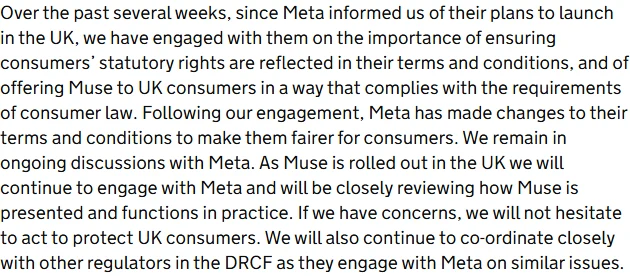
Source: CMA statement on UK launch of Meta Muse, November 24, 2026, captured November 26, 2026.
What the UK liability clause rewards: proof of oversight
Section 15 is where the UK version helps a user, with a condition attached. Exclusion (iv) says Meta isn't responsible for actions that matched your instructions where you "failed to exercise appropriate oversight, review, and correction as described in Section 7(f)". Section 7(f) asks for "meaningful human oversight" and says not to send communications or execute financial transactions without review.
Read together, a user who can show they reviewed what Muse did keeps more room to complain than one who let it run. The waiver in 7(g), "You expressly waive any claim against Meta arising from AI-generated content or actions of AI agents", is the same in both versions, including its exception for liability that "cannot be excluded under clause 15 or applicable law". Because the UK clause 15 is narrower, that exception does more work for a UK user.
One limit for employers: the UK terms apply to anyone living in the UK, but the strongest of the statutory rights they preserve are consumer rights. The Consumer Rights Act 2015 defines a consumer as an individual acting "wholly or mainly outside that individual's trade, business, craft or profession". A staff member running your client inbox through Muse may not count, so those consumer rights may not reach that use. We are not giving legal advice on where that line falls.
What an employee promises when they connect a work inbox
The promises in section 7 are identical in both versions. The user confirms "full legal authority" over "any accounts you connect" (7(a)). They confirm they have the rights and, "where applicable", a proper legal basis for the data they connect, "including consents (where required)" from third parties whose personal information may be processed (7(b)).
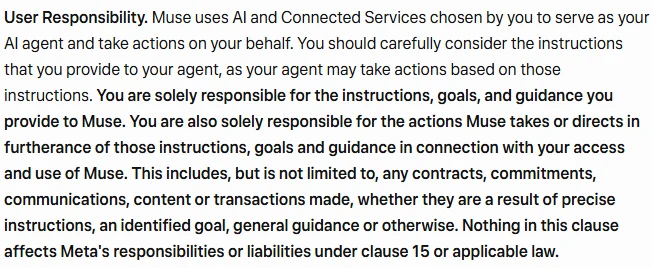
Source: Muse Supplemental Terms of Service (EU/UK), section 7(d), captured November 26, 2026.
A work inbox belongs to the firm, and the people in it are your clients, suppliers and colleagues. The ICO defines a controller as the body that "determines the purposes and means of the processing of personal data", and for a company mailbox that is normally your business, not the employee. An employee can't give section 7(a)'s promise about an account the company owns; your policy should say so before anyone tries.
Three ways work email reaches Muse
The obvious route is a connector. A user signs in to Gmail or Outlook inside Muse and grants access; Meta lets them allow reading without sending. Your admin console can stop this: Google Workspace lets an admin mark a third-party app as Trusted, Limited or Blocked, and Microsoft Entra lets an admin restrict or switch off user consent to apps.
The second route needs no connector. Every Muse can have its own @muse.ai address, and Meta's help page says users "can forward selected emails" to it. A forwarded client email lands in Muse without any OAuth prompt your admin would see.
Admin settings for automatic forwarding stop a mailbox rule from sending everything on, but not one email forwarded by hand. For that you need a rule on the domain itself: in Microsoft 365, a mail flow rule where "The recipient domain is" muse.ai with the action "Reject the message with the explanation"; in Google Workspace, a content compliance rule on outbound messages, matched against any envelope recipient, with "Reject message".
The third route is a verified address. A user can add an email address they own, after which Muse treats instructions from it as coming from them. Meta warns: "Anyone with access to that account can send your Muse instructions." A shared mailbox such as accounts@ or hello@ should never be verified, because every person with access could then direct one employee's agent.
Where the data goes, by Meta's own description
If staff use Muse with work email, assume what they forward can end up in Meta's training data unless they switch the setting off. The AI training setting is on when a user starts. Meta's help page says emails sent to a Muse's @muse.ai address "may be used to develop and improve our AI models, depending on the user's settings". The privacy policy puts connector data and "communications that Muse has with other people on your behalf" under the same toggle.
Meta's UK post adds that it doesn't use interactions containing private messages, "such as emails", to train its models. We can't reconcile that line with the help page, so treat the toggle as the control that counts.
Memory outlasts the source. The privacy policy says data from a disconnected service "may remain in Muse's memories and your conversation history". The help page says the same for deleted emails, and that Muse forgets on request "to the best of its ability". Add Muse to your AI data retention policy as a store your firm can't empty on its own.
Seven rules for a UK team of 10 to 50
Paste these into your AI acceptable use policy. They follow the joint CMA and ICO tip to start with the most limited mode.
- No work inbox, calendar, chat or client system goes into a personal Muse account without written approval that names the account and the purpose.
- No shared mailbox is ever verified with Muse, and nobody forwards client email to an @muse.ai address.
- In Google Workspace, review Muse under app access control and set external auto-forwarding to internal only; in Microsoft 365, restrict user consent in Entra and keep automatic external forwarding off. Neither setting stops a single email forwarded by hand, so add a rule that rejects outbound mail to muse.ai (a mail flow rule in Microsoft 365, a content compliance rule in Google Workspace).
- Where use is approved, connect read-only, switch AI training off under Data controls, and approve every send.
- No company cards or payment wallets in Muse. Section 7(h) leaves "all risk of financial loss" with the user.
- No hiring, firing or credit decisions and no bulk marketing. Section 4(7) bars using Muse to decide employment or credit "without meaningful human review", and 4(10) bars bulk messages without the consents the law requires.
- Keep evidence of review. Approving each send under rule 4 is the core of the oversight section 7(f) asks for; Muse also records what it has done, and checking that record and the memory files each week adds evidence.
When someone leaves, ask them to disconnect work accounts and to ask Muse to forget client details, then revoke the app's token from the admin console. Our shadow AI policy covers the conversation, and the Muse zero-day note covers devices.
When a customer's Muse emails or buys from you
An email from a customer's agent may not look like one. Meta's help page says emails "genuinely sent with Muse use an @muse.ai address" and asks recipients to check the full address. The same page lets a user tell Muse to send from their own connected account instead, so an agent-written refund request can arrive from a normal Gmail address. It still needs a route to a person, the point of California's AB 1609 handoff rule, which doesn't bind UK firms.
Partners don't get a pass when a customer uses an agent. According to Resultsense, the Digital Regulation Cooperation Forum's letter of November 16 says retailers' and other partners' obligations "continue to apply when customers use personal AI agents". The CMA expects similar products "in the coming months".
If you hold FCA permissions, such as credit broking for instalment payments at checkout, the FCA's agentic AI page of November 24 applies to you. It asks how you establish you are dealing with an agent, what consents are in place, and whether you accept payments an agent instructs. Our FCA good practice checklist covers the wider rules.
What the regulators said on launch day
For a small firm, launch day told you what regulators expect of Meta and where to report problems. The ICO's statement says Meta "has committed to a voluntary monitoring and reporting scheme with the ICO" and that users must be able to "meaningfully understand and control" how their data is used. ICO guidance on agentic AI follows in spring 2027, after a call for evidence we covered in our ICO agentic AI explainer. The CMA remains in discussions with Meta and set up a form to report problems.
Politico, citing Reuters, reported that Meta staff had raised concerns about "undesired actions" by the agent since its US launch. A Meta spokesperson called them "isolated incidents". We could not read the Reuters report itself.
What we couldn't confirm
- Whether Meta will offer business accounts with admin controls, in the UK or elsewhere, and when.
- How Meta's line about not training on private messages fits the help page on @muse.ai email.
- Which clauses Meta changed after the CMA's engagement.
- How refunds and disputes work for purchases Muse makes in the UK.
Checked: Meta's two UK newsroom posts of November 23, 2026; the Muse US terms (November 17), UK and EU terms (November 23), privacy policy, small business page and email help page; the ICO statement, blog and controllers guidance, the CMA statement and the FCA agentic AI page of November 24; Google Workspace and Microsoft admin docs, including mail flow and content compliance rules; the Consumer Rights Act 2015; Politico and Resultsense, all on November 26, 2026.
References
- Meta, Introducing Muse in the UK: A Personal AI Agent You Control and Muse Now Available in the UK: Muse Does the Work, You Stay in Control, November 23, 2026.
- Meta, Muse Supplemental Terms of Service (EU/UK), US terms, Muse Privacy Policy, Muse for Small Business and About Muse email addresses.
- Competition and Markets Authority, CMA statement on UK launch of Meta Muse, November 24, 2026.
- Information Commissioner's Office, Statement on UK launch of Meta Muse and Developers creating agentic AI services for consumers reminded to meet their data protection responsibilities, November 24, 2026.
- Financial Conduct Authority, Our approach to Agentic AI, first published November 24, 2026.
- Google Workspace Admin Help, Control which apps access Google Workspace data, automatic forwarding and content compliance rules; Microsoft, Configure how users consent to applications, Control external email forwarding, mail flow rule conditions and mail flow rule actions.
- Consumer Rights Act 2015, section 2; ICO, What are controllers and processors?
- Politico, Meta's AI agent Muse launches in UK; Resultsense, Three regulators, one launch day, November 25, 2026.