Anthropic opened Enterprise Frontier Safeguards (EFS) as a public beta on November 23, 2026, and it is now the documented way to call Claude Fable 5.2 or Mythos 5.2 without Anthropic keeping your prompts. The trade is concrete: encrypted copies of your traffic go to an S3 or Google Cloud Storage bucket you own, and your own team answers any Safety Case within 7 calendar days.
GitHub Copilot's zero retention exemption for Fable ends with 2026, while Bedrock's runs through at least June 30, 2027. Claude Platform, Claude Platform on AWS, Amazon Bedrock, Google Cloud and GitHub Copilot also describe a different retention period and a different rule for what happens when your bucket breaks.
On November 26, 2026 we read Anthropic's announcement and seven of its EFS and retention docs, AWS's blog and user guide, and Google's page, and put the differences in one table. We have no EFS tenant, so nothing below is a screenshot of a console or a case we handled.
If you are still choosing between vendors rather than setting up Anthropic's option, start with our comparison of AI APIs that don't train on your data. This page assumes you have already picked Claude.
First, check whether you need EFS at all
Six models carry Anthropic's 30-day retention requirement: Claude Fable 5.2, Mythos 5.2, Fable 5.1, Mythos 5.1, Fable 5 and Mythos 5. Anthropic calls them Covered Models. If your team only calls models outside that list, your existing setup still applies and EFS is optional.
If you do call a Covered Model, your current arrangement decides what happens next. In a Legacy ZDR workspace on Claude Platform, a request to a Covered Model fails with a 400 error unless Anthropic has authorized your organization; Anthropic's FAQ says Legacy ZDR workspaces stay where they are, and to use EFS you create a new workspace. On Anthropic-managed storage, the model works and the data is kept for 30 days, which is the default for Covered Models and is not zero retention. Bedrock, Google-managed Claude on Google Cloud and GitHub Copilot each grant an interim exemption for current Fable models, with different end dates (see the table and the Bedrock, Google and GitHub section).
Eligibility is the gate a small team hits first. Anthropic's FAQ says an organization gets access only once Anthropic confirms it is eligible. If the Programs page in the Claude Console doesn't list EFS, you ask your account team or fill in the EFS request form, and an Organization Admin then accepts the terms. Anthropic developed EFS with over 100 customers, including a quarter of the Fortune 100, so expect the first approvals to favor large accounts.
Who can't get EFS yet, and what turning it on changes
Two published conditions rule many small teams out. Anthropic's setup page says "EFS is currently available for your organization's internal use only", so a product you sell to customers on top of Claude doesn't qualify yet. And "If your organization has HIPAA readiness turned on, it can't get EFS", so a team handling health data keeps its current arrangement. Some Anthropic access programs can't be combined with EFS either.
Setting up EFS also switches on Access Transparency, which records Anthropic staff access to your data. On Claude Platform it turns on the first time you start connecting a bucket, attach a customer-managed key or turn off Anthropic Human Review; elsewhere it turns on when you get access. The setup page says you can't turn it off once it's on, and it applies to every workspace in the organization. Don't plan a launch around EFS until the Programs page shows it.
Five platforms, five sets of numbers
Each row quotes the provider's own page as read on November 26, 2026. The cells disagree because each provider wrote its own page; where the gap matters to you, ask that provider in writing.
| Claude Platform | Claude Platform on AWS | Amazon Bedrock | Google Cloud (Anthropic managed) | GitHub Copilot | |
|---|---|---|---|---|---|
| EFS status | Public beta | Public beta | Public preview | Listed in Anthropic's beta announcement as "Claude on Google Cloud" | Required after the exemption; setup in Copilot not yet documented |
| Interim zero retention for current Fable models | Legacy ZDR only if Anthropic authorizes it | Same as Claude Platform | "Through at least June 30, 2027" | Same as Claude Platform: first-party retention policy | "Through the end of the calendar year" |
| Retention of sealed data in your bucket | "Up to 28 days" | "Up to 28 days" | "Your lifecycle rules apply, 30 days minimum" | "Up to 28 days" | n/a |
| Bucket provider | S3 or Google Cloud Storage | S3 | S3 | Google Cloud Storage | n/a |
| If the provider can't reach your bucket | Requests keep working for up to 24 hours, then may be refused | Up to 24 hours | Stops serving Covered Models 24 hours after losing access; retries writes for up to 72 hours | Up to 24 hours | n/a |
| If your customer-managed key is revoked | Requests can keep succeeding for up to an hour, then fail | Not stated on the pages we read | Stops serving Covered Models 24 hours after losing access to the key | Not stated on the pages we read | n/a |
| Safety Case clock | 7 calendar days from created_at |
7 days from when the case is sent | 7 days from when the case arrives; "in certain cases" service may stop sooner | 7 days from when the case is sent | n/a |
Bedrock, Google and GitHub: the dates to act on
On Bedrock, joining the preview can switch your protection off. AWS's user guide says joining the EFS preview "turns zero data retention (ZDR) off for the accounts or projects you add", and the same page tells you to use a test account and send only test traffic, with no PII or PHI. Your other AWS accounts keep the interim exemption, and AWS turns it back on if you leave.
So the safe order on Bedrock is a separate test account first, production later. The preview is also open only to customers already enrolled in EFS ZDR.
Google's own EFS page covers a different product: Claude models that Google manages in Model Garden. There EFS is in Preview, and enrolled projects get Legacy ZDR by default "through June 30, 2027"; after that, Google says you need EFS ZDR to keep zero retention. Check which of the two Google routes your project uses when you read the table above.
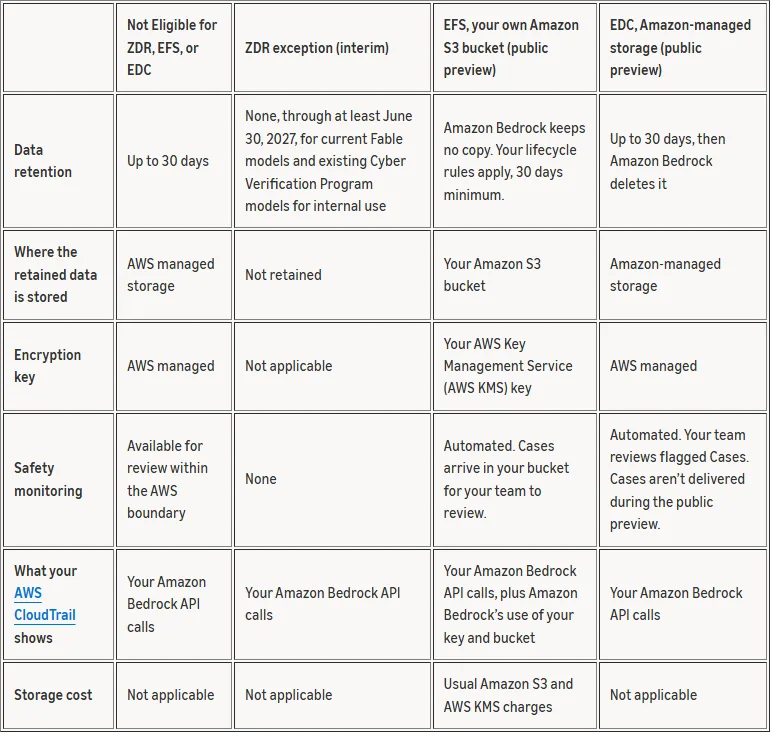
Source: AWS Machine Learning blog, November 23, 2026, Table 1, captured November 26, 2026.
GitHub's deadline comes first. Its November 9 changelog says eligible Copilot customers can use Fable 5.2, Fable 5.1 and Fable 5 with zero retention through the end of the calendar year under a time-bound exemption, and that "continued use of the models will require EFS" after that. GitHub hasn't documented how EFS will work inside Copilot, or whose bucket holds the data. If Copilot is how your developers reach Fable, put a reminder on December 1 to ask GitHub.
Enterprise Data Controls (EDC) looks close but isn't the same. On Claude Platform you get a customer-managed key and can switch off Anthropic Human Review, but Anthropic still stores your Sealed Safety Data, so its FAQ says plainly that this setup "isn't EFS and isn't ZDR". On Bedrock, EDC Cases aren't delivered during the public preview.
What EFS leaves out
EFS covers requests to the Messages API in an EFS workspace, for every model in that workspace. Anthropic's FAQ lists what it does not cover, even inside a Messages API request:
- code execution containers
- Files API uploads
- Batch API results (EFS doesn't support the Batch API at all, because there is no Transcript for your team to review)
- Claude Managed Agents sessions, which won't run in a workspace with Anthropic Human Review off; an existing session there stops accepting new messages
For a small team, the Batch line is the one that breaks things. An overnight job that summarizes tickets or classifies documents through the Batch API has to move to single Messages API requests or stay in a separate workspace without EFS, and an agent built on Managed Agents stops taking new messages once Anthropic Human Review is off.
EFS applies to a whole workspace, so to keep some traffic out of it you use a separate workspace and choose it by API key. And attaching a customer-managed key is permanent and turns off some features, per the FAQ. Read the coverage page before you attach one.
What lands in your bucket, and who should read it
Three kinds of data can arrive. Sealed Safety Data is prompts, responses and model reasoning in Anthropic's encrypted format, and your team can't read it even in your own bucket. Transcripts are readable copies. Safety Correspondence is the Safety Cases, Safety Notices and your responses, and it never contains prompts.
Anthropic's storage page warns that Transcripts "might include requests that never lead to a Safety Case, so plan who can read your bucket." In practice your bucket becomes a readable store of what staff typed into Claude, so it belongs in your AI data retention policy next to chat logs. Limit s3:GetObject and kms:Decrypt to the people who review cases, with the read permission scoped to the transcripts/flagged/ prefix as Anthropic's file guide shows.
Retention differs by prefix. Flagged Transcripts expire after up to 30 days, so copy any you need to keep. Safety Case files, notices and your responses stay 2,555 days (about 7 years) by default. On Bedrock, AWS adds one more caveat: Transcripts store responses as they were before Guardrails ran, so masked content can appear there unmasked.
What the bucket costs: a worked estimate
Anthropic doesn't charge for EFS. Your cloud provider bills storage, requests and key use. We priced S3 Standard in us-east-1 from the AWS Price List API file published November 25, 2026: $0.023 per GB-month for the first 50 TB, $0.005 per 1,000 PUT requests. AWS KMS charges $1 per key per month plus $0.03 per 10,000 requests.
Our assumptions, which you should replace with your own: each request leaves 80 KB in the bucket (a 40 KB sealed record plus a 40 KB Transcript), and with about a month of retention the bucket holds roughly one month of traffic.
| Requests per month | Data held | Storage per month | PUTs if every record is its own object (2 per request) |
|---|---|---|---|
| 10,000 | 0.8 GB | $0.02 | $0.10 |
| 100,000 | 8 GB | $0.18 | $1.00 |
| 1,000,000 | 80 GB | $1.84 | $10.00 |
The formula is requests × KB per request ÷ 1,000,000 × $0.023 for storage, plus requests × objects per request ÷ 1,000 × $0.005 for writes. Anthropic doesn't say how many records it packs into one object (its S3 guide says it deletes an object "once everything in it is past the retention period", which suggests batching), so treat the PUT column as a ceiling.
Then add the $1 key and KMS request charges: AWS's Bedrock setup turns on an S3 Bucket Key, which cuts them, and without one 2 million requests would cost $6. Add the 3-day noncurrent versions that bucket versioning keeps, and transfer fees if your bucket sits outside the region the provider writes from. At a million requests a month, these assumptions put the bill under $20. We did not price the Google Cloud Storage route.
Who checks the Safety Case queue, and how often
Automated safety monitoring looks for serious misuse, such as attempts at offensive cyber or biological capabilities, and can open a Safety Case that your team reviews. Anthropic expects cases to be rare and says it doesn't ask for 24/7 coverage: "Send alerts to a queue that someone checks every working day." Respond within 7 calendar days of created_at. If a case stays unanswered, Anthropic may suspend access.
Nothing tells you a case exists. Anthropic sends no notification and no webhook; you poll the Safety Cases API (Claude Platform only, in beta) or watch the bucket.
On Amazon Bedrock, AWS documents an S3 Event Notification on the review-cases/ prefix. For Claude Platform and Claude Platform on AWS, Anthropic says it doesn't recommend changing the bucket's own notification settings and suggests a scheduled ListObjectsV2 job on review-cases/ and review-notices/, or CloudTrail data events matched by an EventBridge rule. Wire that alert before the first production request, and route it to the same queue as the rest of your AI incident response plan.
Anthropic's guide sorts most cases into four outcomes: authorized work (your red team), a user acting against policy, an external user or stolen credential, or a false positive. You answer violation or no_violation; you don't have to send names or Transcripts, and the first valid response is final.
Log the msg_ id of each Messages API response next to your own user ID, starting now, because the log only covers requests from the day you start; our audit trail patterns show where to put it. And don't paste Transcripts into Claude to triage them: Anthropic warns that this can open another Safety Case.
Our staffing assumption, not a measured figure: 10 minutes per working day to check the queue is a little over 3 hours a month, before any real case. At almost any hourly rate, that costs more than the storage in every row of the table above.
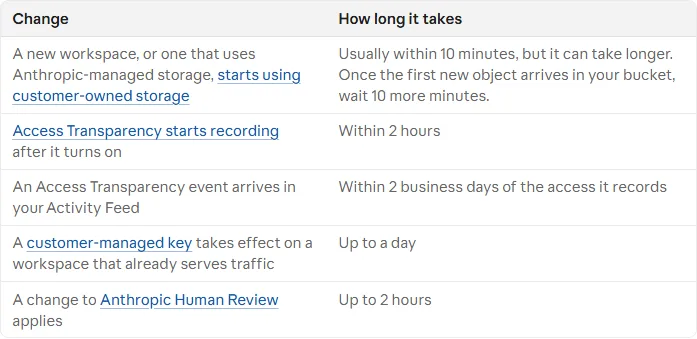
Source: Anthropic, Enterprise Frontier Safeguards FAQ, "How long changes take", captured November 26, 2026.
Setup order for a team of 10 to 50
- List which apps and keys call Covered Models, and through which platform. Copilot, Bedrock and the Claude API each follow a different row of the table.
- Confirm eligibility on the Programs page, or ask your account team. Stop here if Anthropic says no.
- Start logging
msg_ids with your user IDs. - Create the bucket and key in your own cloud account with the provider's template; don't edit its lifecycle rules afterward, which Anthropic's check treats as a fault.
- Create a new EFS workspace. Don't convert a Legacy ZDR workspace, and move Batch jobs and Managed Agents to a non-EFS workspace.
- Restrict bucket read access to named reviewers, and record the bucket in your AI vendor DPA tracker as a new data store.
- Wire the Safety Case alert and name a primary and a backup reviewer.
- Send test traffic. Anthropic says a workspace usually starts writing to your bucket within 10 minutes; once the first new object arrives, wait 10 more minutes before relying on it. Data written before setup stays where it was until it expires.
If your agents also act under their own credentials, pair this with the identity rules in our AI agent access control guide, since a stolen key is one of the four Safety Case outcomes.
What we couldn't confirm
- Whether Anthropic will extend Legacy ZDR authorizations for Covered Models, or for how long.
- How EFS will work inside GitHub Copilot after December 31, 2026, and whose bucket will hold the data.
- Whether Bedrock's "30 days minimum" and Anthropic's "up to 28 days" describe the same objects. AWS's sample lifecycle expires Transcripts and review summaries after 30 days and sets only a 3-day noncurrent-version rule on the sealed
slab/prefix; Anthropic's Bedrock page says retention there "can differ" during the beta. - When EFS reaches Microsoft Foundry. Anthropic says only "coming soon".
Everything here describes a beta as documented on November 26, 2026. Settings and behavior can change, and Anthropic says so on its EFS pages.
Checked: Anthropic's EFS announcement and its overview, FAQ, Safety Case, customer-owned storage, Safety Case files, Bedrock setup and data retention docs; the AWS blog and Bedrock user guide; Google Cloud's EFS page; GitHub's November 9 changelog; the AWS S3 price list and KMS pricing, all on November 26, 2026.
Related reading
- Anthropic vs OpenAI GDPR compliance for the contract side of using Claude in the EU.
- The OpenRouter ZDR incident checklist, for why a ZDR label is only as good as whoever holds the data.
- Microsoft 365 Copilot's Anthropic subprocessor change, if Claude reaches you through Microsoft.
- Claude Sonnet 5.5 vs Sonnet 5 migration for model-change paperwork.
References
- Anthropic, Zero data retention with Enterprise Frontier Safeguards is now in beta, November 23, 2026.
- Anthropic developer docs: EFS overview, Set up in the Claude Console, FAQ, Review Safety Cases, Customer-owned storage, Safety Case files, EFS on Amazon Bedrock, API and data retention.
- AWS, Introducing the Amazon Bedrock Trusted Access API, November 23, 2026, and the Bedrock EFS and EDC user guide.
- Google Cloud, Enterprise Frontier Safeguards for Claude, last updated November 23, 2026.
- GitHub, Claude Fable 5.2 in GitHub Copilot, November 9, 2026.
- AWS S3 price list (us-east-1) and KMS pricing, read November 26, 2026.