Image: Pexels, used under the Pexels License.
Some small businesses run on free @gmail.com addresses: the founder's account, a shared bookings@ inbox, a contractor who forwards client mail to a personal address. Google's October 16 privacy policy change lands on exactly those accounts. It doesn't touch Workspace business accounts, because the feature that triggers it isn't offered there.
So the useful question isn't "is Google reading my email for ads". It's "which of our accounts can turn on Personal Intelligence, and who decides".
Evergreen comparison, not a news item. The policy changed on October 16, 2026 and was first reported on October 23. Checked against Google's own policy pages and help centers on October 26, 2026.
Pick Workspace if, stay on free Gmail only if
Pick Workspace if any customer, patient, applicant or supplier data lands in your email or Drive. Personal Intelligence isn't available there, your prompts are customer data under Google's Cloud Data Processing Addendum, and one admin can set the smart-feature default for everyone.
Stay on free Gmail only if the account holds nothing but the owner's own business, and you accept that each person controls their own settings. Nobody can enforce them for you.
The comparison
| Question | Workspace Business, Enterprise, Education | Free personal Gmail | Checked |
|---|---|---|---|
| Can the user turn on Personal Intelligence? | No. Google: "No. Personal Intelligence is a beta feature which enables eligible personal Google accounts" | Yes, if 18 or over and in an eligible country | Oct 26, 2026 |
| Can connected Gmail, Drive or Photos data shape ads? | Not through Personal Intelligence, which isn't offered | Yes, after the user connects apps (policy effective Oct 16, 2026) | Oct 26, 2026 |
| Who controls cross-product smart features? | Super admin sets a default; users can override it | The user, account by account | Oct 26, 2026 |
| Default for "smart features" | Off in the EEA, Japan, Switzerland and the UK; on elsewhere | Set per account | Oct 26, 2026 |
| Prompts used for model training? | Not without the customer's permission (Cloud DPA) | Search Services History can be used for training, even after you disconnect apps | Oct 26, 2026 |
| Human review of uploads | Not without permission in the Gemini app | Uploads to AI Mode may be reviewed by humans, depending on settings | Oct 26, 2026 |
| Gemini Personal Intelligence in the EEA, UK, Switzerland, Nigeria | Not available | Not available | Oct 26, 2026 |
The last row matters if you're in Europe. Google's Gemini help page says Personal Intelligence is "Not available in the European Economic Area,Nigeria, Switzerland, or the United Kingdom." For a UK or EU team on free Gmail, the Gemini route is shut today. We couldn't find an equivalent country list for Personal Intelligence in Search, so don't assume you're covered there.
What changed on October 16
We read Google's own comparison page, which shows the October 1 policy against the October 16 one with deletions struck through. One bullet in the advertising section changed. On October 1 it read, in full: "We don't show you personalized ads based on your content from Drive, Gmail, or Photos."
The October 16 version keeps that sentence and adds an exception: "unless you choose to make data from these services available to other Google services that support personalized ads."
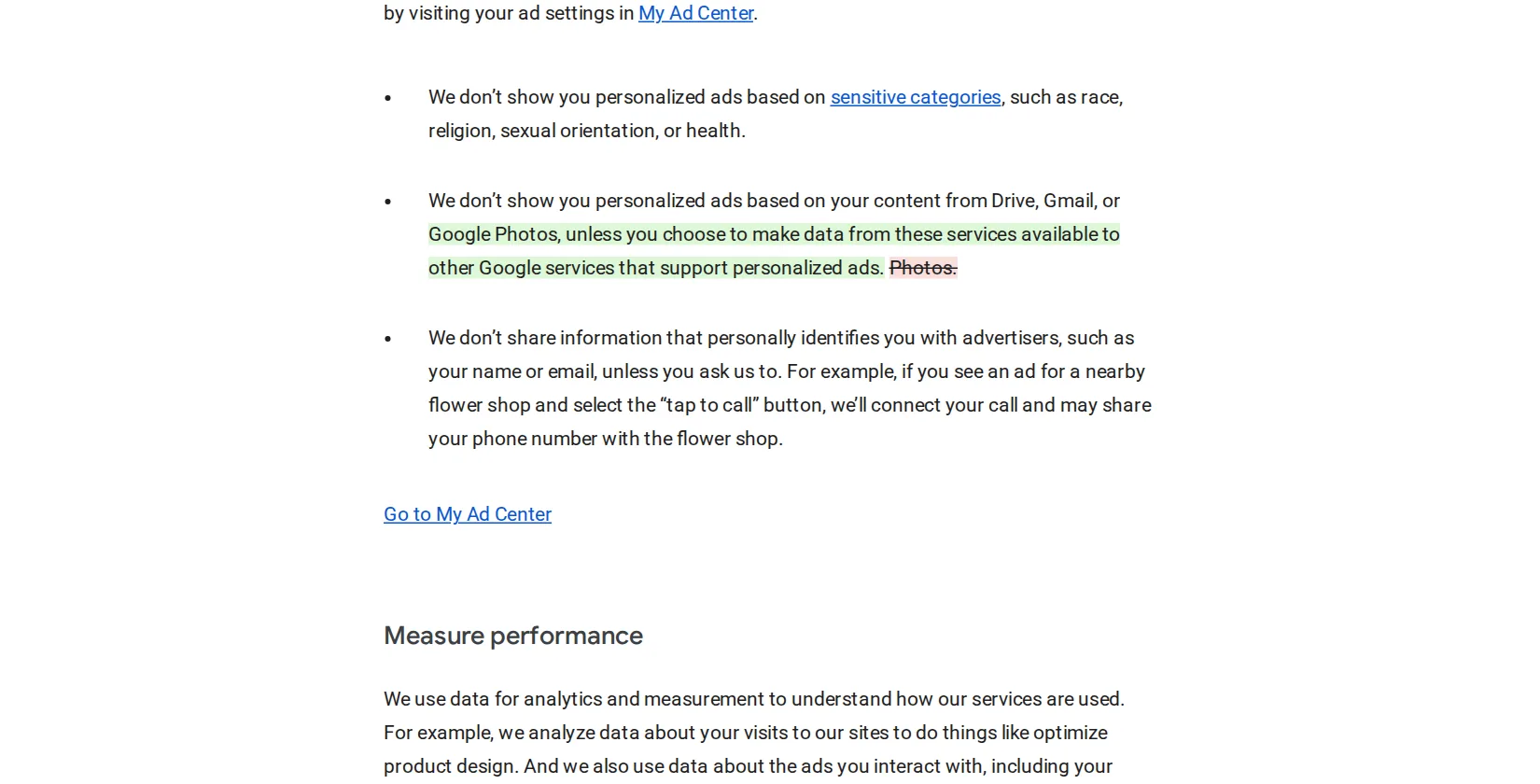
Screenshot: Google Privacy Policy archive, comparison of October 1 and October 16, 2026 versions. Captured October 26, 2026.
The same policy names the mechanism a few sections later: "If you choose to allow certain services to process data from other services, including for features such as Personal Intelligence, the same data may be used to personalize your experience."
Ars Technica reported that a Google spokesperson said the clarification "does not indicate a change in how it handles your data with respect to its advertising partners." That's true as far as it goes. Advertisers still don't get your mail. The change is about what Google itself can use to pick the ad.
What Google says the exception means
Google's Search help page answers the ads question directly. We'd read all three paragraphs, because the first one is the headline and the second one is the catch.
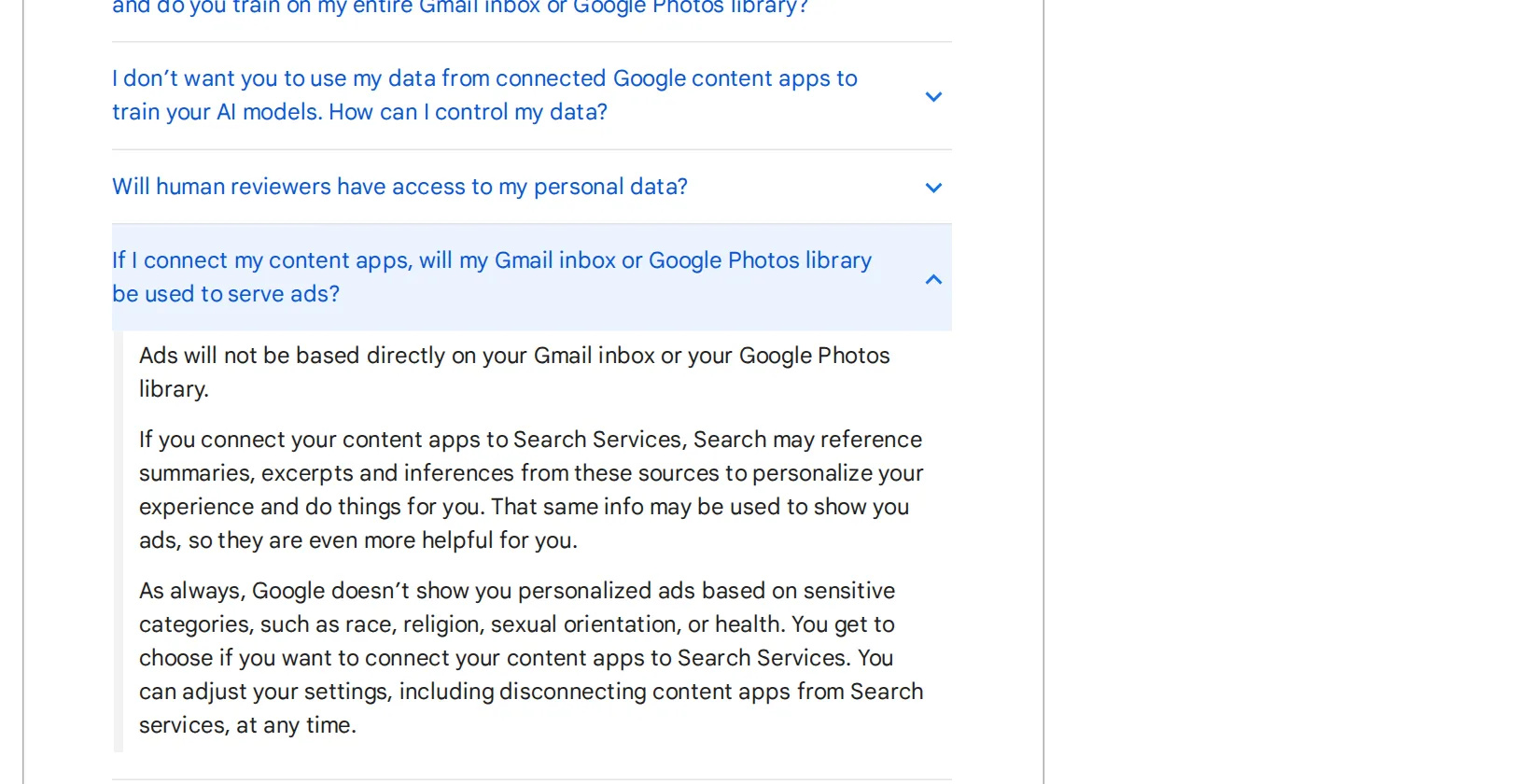
Screenshot: Google Search Help, Personal Intelligence in Search services, ads FAQ expanded. Captured October 26, 2026.
"Ads will not be based directly on your Gmail inbox or your Google Photos library." But once apps are connected, "Search may reference summaries, excerpts and inferences from these sources," and "That same info may be used to show you ads." Google also says it won't use sensitive categories such as health or religion for ads, and that "advertisers will not have access to your Gmail inbox or Google Photos."
For a business, "inferences" is the word to worry about. An inference drawn from a client's email is still derived from the client's email. If that inbox holds anything you promised a customer you'd keep confidential, you don't want it feeding a consumer ad profile, however indirectly.
Two more lines from the same page belong in your policy:
- Connecting is all-or-nothing across Search: "all Search services will be permitted to access" Gmail, Calendar and Photos. That list covers AI Mode, Discover, Maps, Shopping, Flights, Hotel, Translate and News.
- Disconnecting later "doesn't delete any data from your Search Services History," and that history can still be used for "training generative AI models."
The Workspace side
Google's Workspace Privacy Hub has had a question about this since January 14, 2026, and the answer is one word long before it explains itself.
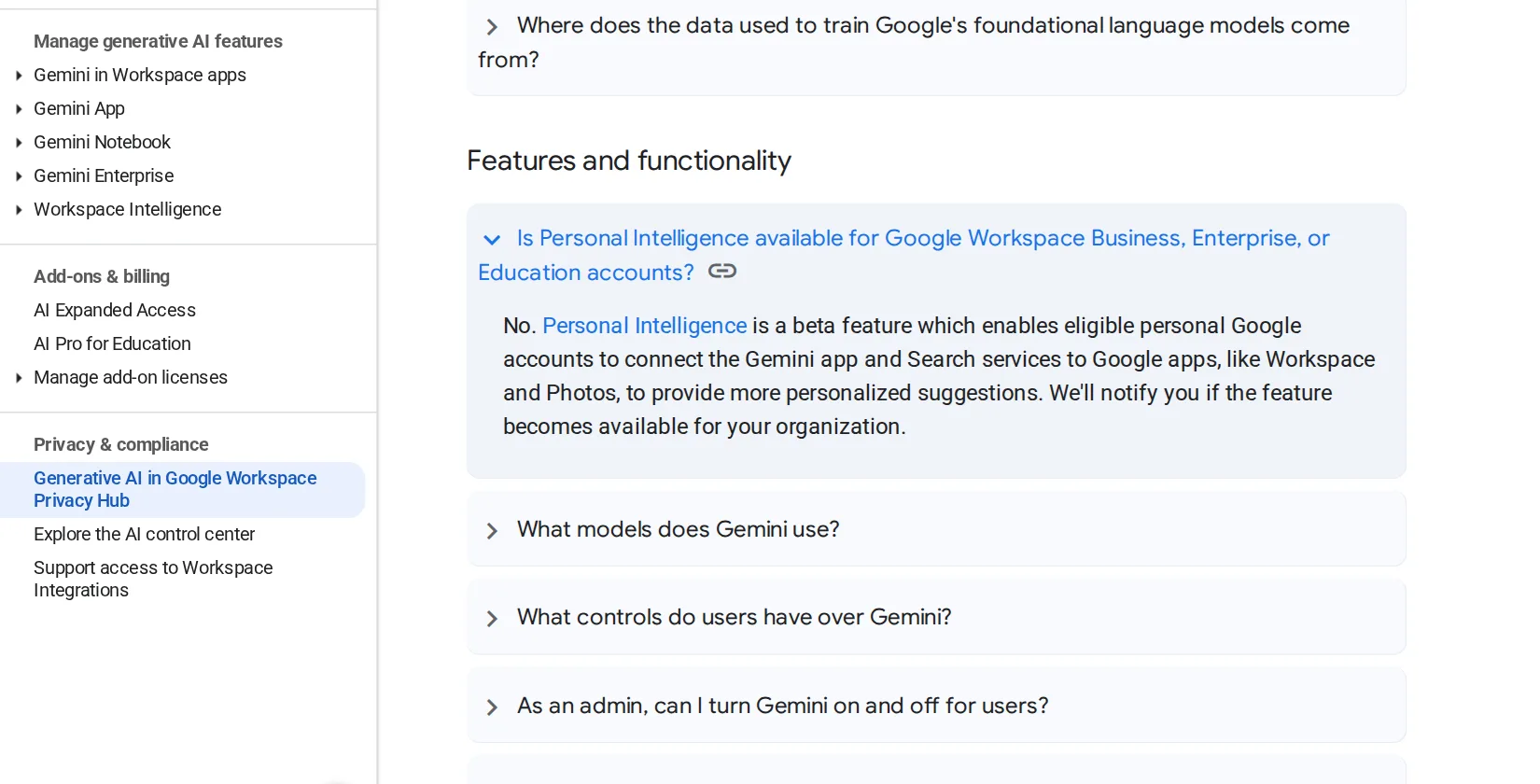
Screenshot: Generative AI in Google Workspace Privacy Hub, Features and functionality. Captured October 26, 2026.
Google adds: "We'll notify you if the feature becomes available for your organization." Gemini's own help page agrees from the other direction: Personal Intelligence "isn't available when you sign in to a work, school, or supervised Google Account."
What you get instead is contract language. Workspace treats prompts as "customer data under the Cloud Data Processing Addendum" and "does not use customer data for training models without customer's prior permission or instruction." Chats and uploads in the Gemini app under a Workspace account "won't be reviewed by human reviewers or otherwise used to train generative AI models without your permission."
There's one Workspace setting worth a look anyway. In the Admin console go to Account > Account settings > Smart features for Google Workspace (super admin only). The "Smart features in other Google products" option lets Google "use your Workspace content and activity to personalize your experience in other Google products." Outside the EEA, Japan, Switzerland and the UK it is on by default, and users can override whatever default you set. If you want it off, set the default and tell people why.
If you're staying on free Gmail: four switches per account
Each person has to do this on their own account. Put it in your onboarding checklist and your shadow AI policy, because nobody else can see whether it's done.
- Gemini: disconnect apps. In the Gemini app, open the Personal Intelligence settings and disconnect Gmail, Drive and Photos. Turning Personal Intelligence off for one chat isn't enough: Google says that "doesn't stop your chat from being saved to Gemini Apps Activity."
- Search: turn off Personalized Recommendations. Go to google.com/search-personalization and switch it off. That stops Search services from using connected apps.
- Gmail: turn off cross-product smart features. In Gmail, Settings, See all settings, General tab, find "Google Workspace smart features" and choose "Manage Workspace smart feature settings". Turn off "Smart features in other Google products". Gemini "can't connect to Google Workspace when this setting is off."
- Clear what's already there. Disconnecting doesn't delete Search Services History. Review and delete it at activity.google.com if client data went through AI Mode.
And a rule for everyone, on any account type: don't upload client files to AI Mode from a personal account. Google says uploads "could be used to improve Google services with the help of human reviewers," whether or not apps are connected.
What people noticed
The r/google thread on the change was posted on October 23, the day the reports came out. Two comments get at the practical problem. User rdbpdx described how hard Gemini pushes people to connect apps and added: "it's also super easy to accidentally create a data leak if you're not being deliberate." User fruitloops6565 pointed at the granularity: "And you can't enable Gemini only for some apps. It's all or nothing."
https://www.reddit.com/r/google/comments/1xdphel/
That second point is why we don't think a written rule ("only connect Calendar") will hold on personal accounts. People will click the prompt. The account type is the control that survives a busy Tuesday.
Verdicts
- Workspace Business or higher: Our pick for any team handling other people's data. The feature isn't available, the training terms are contractual, and the admin console gives you a default.
- Free Gmail for one founder's own admin mail: Fine, if the four switches are off and checked every quarter.
- Free Gmail as a shared customer inbox: Skip this. Move that inbox to Workspace before someone connects it.
If you're comparing Google's AI terms against Microsoft's, our Microsoft 365 Copilot vs Google Workspace comparison covers the business plans side by side, and the vendor training policy comparison puts Google next to the other big vendors.
What we read, and what we couldn't confirm
On October 26, 2026 we read the October 1 and October 16 versions of Google's privacy policy and Google's comparison page between them, Google Search Help on Personal Intelligence and Personalized Recommendations, the Gemini Apps help page, the Workspace Privacy Hub and the Workspace admin page on smart features. The Privacy Hub hides its answers in collapsed panels, so we opened it in a headless browser and expanded the question to read it. We did not turn Personal Intelligence on: the desk doesn't have an eligible personal account set up for it, so nothing above describes using the feature.
We couldn't confirm three things. Google's policy says that for significant changes it gives "a more prominent notice (including, for certain services, email notification of Privacy Policy changes)," but we found no copy of an email about this one. Google's Search help lists countries for Personal Intelligence only in Ask Maps, so we haven't listed Search countries. And none of Google's pages explain how it decides which inferences feed ads.