Source: Cables Connected on Server by Brett Sayles on Pexels, free to use under the Pexels license.
The OpenRouter Zero Data Retention (ZDR) pool lost 125 endpoints on November 22, 2026, when OpenRouter off-boarded three inference providers and notified customers it thinks may be affected. It acted after Dragos research showed prompts at some providers were stolen or kept, including requests marked ZDR. If your team sends prompts through OpenRouter, check your Logs against the four provider notices published so far, rotate any secret that sat in a matching prompt, and move ZDR from the request into account settings with a provider allowlist.
OpenRouter says it found no breach of its own systems, and it hasn't named the providers it dropped. That leaves the provider notices as the only dated evidence a customer can match. Our read for a team of 10 to 50: keep using the router if it is your only route to the models you need, but stop treating the ZDR label as a promise. It is a filter over what providers declare, and this month showed declarations failing at the provider, after the router hop.
If you are still choosing an API rather than cleaning up after one, our comparison of AI APIs that don't train on your data covers retention terms by vendor.
The four provider notices and their exposure windows
OpenRouter's announcement keeps a live list of provider write-ups. On November 23 it held four. We read each one and put the parts a customer can act on in one table.
| Provider (notice date) | Models named | Window | Says OpenRouter traffic was included? | What the provider tells you to do |
|---|---|---|---|---|
| Phala (Nov 10) | DeepSeek V4 Flash 0731 | Oct 21, 2026 00:00 UTC to Nov 8, 2026 05:35 UTC | Yes, "routed to Phala by OpenRouter" | Treat request contents as exposed; rotate keys, tokens and passwords in them |
| Together (Nov 21) | MiniMax M3, GLM-5.2, Kimi K2.6 | Mainly June 24, July 4, July 8 and July 14, 2026 | Not stated | Turn on ZDR in Together account settings; write to [email protected] |
| Novita (Nov 22) | MiniMax models | May 28 to Nov 11, 2026 | Yes, "routed to Novita through OpenRouter" | Revoke or rotate live credentials sent in those requests |
| Atlas Cloud (Nov 23) | MiniMax M3, M2.7, M3.1 Flash | "Q3 and early Q4 2026", no exact dates | Not stated; Atlas took all its models off OpenRouter | Treat any secret sent to these models as exposed |
The incidents are different in kind. At Phala an attacker took over an inference server and could see request data "during processing". Together had stored prompt samples for testing, and a credential an AI coding agent committed to a public GitHub repository let someone download them.
Novita had a routing configuration error that forwarded MiniMax requests to MiniMax's official API. Atlas Cloud says Dragos saw a third party open links from prompts that reached MiniMax's official API. Three of the four involve MiniMax models; if you use Chinese-developed open models, our China AI export controls explainer covers the separate access risk for Qwen, GLM and similar models.
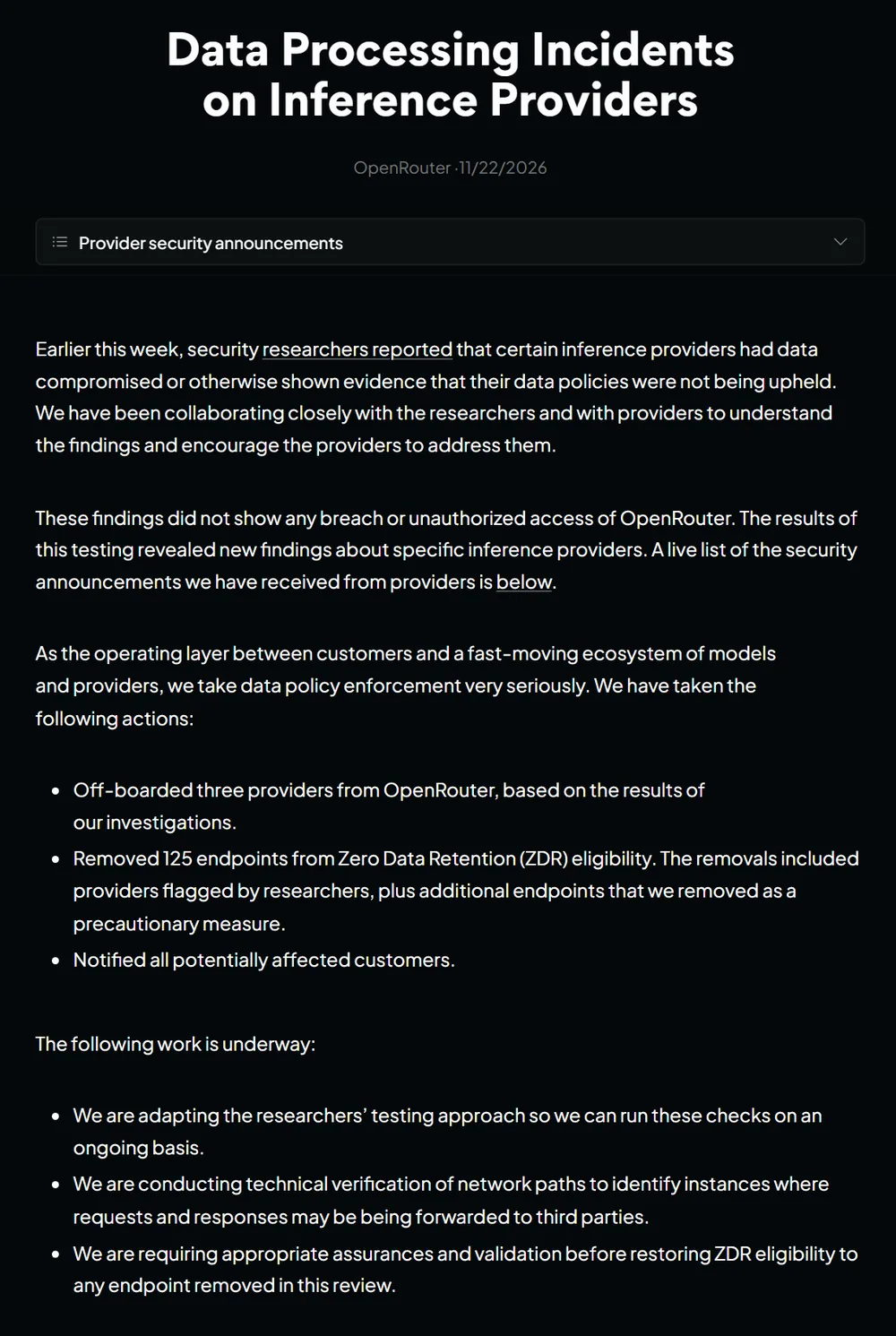
Source: Data Processing Incidents on Inference Providers, OpenRouter blog, November 22, 2026, captured November 23, 2026.
What OpenRouter and Dragos haven't named
What nobody has said is which three providers OpenRouter removed. Dragos hasn't named the three it found breached either, and The Hacker News noted on November 22 that neither has said whether they are the same three. On Hacker News, one developer wrote that day that they were "trying to figure out if I ended up routing to one of the affected "ZDR" endpoints", which is the question this checklist answers as far as the public record allows.
Match your OpenRouter Logs against the windows
OpenRouter says it notified "all potentially affected customers", including those of providers with no public post. Search the inbox of whoever owns the OpenRouter account first. Then check the logs yourself, because a notice tells you that you were in scope, not which of your requests or keys.
- Open Logs and stay on the Generations tab. OpenRouter's Logs documentation says each row shows the date, model, final provider, generation ID, API key and latency, and the filter bar narrows by provider and API key.
- Filter provider = Phala, date October 21 to November 8. Then provider = Novita, date May 28 to November 11. Then provider = Atlas Cloud with MiniMax models from July 1, since Atlas gives only "Q3 and early Q4". Note which API keys appear.
- Open the Upstream Requests tab for the same dates. It lists every routing attempt, including retries and fallbacks, so a request that tried a provider before landing elsewhere shows up here.
- Don't use the Activity page for this. Its exports group by model, API key or org member, not by provider.
- For each key you found, list what the app or agent behind it sends: customer records, source code,
.envfiles, cloud keys.
Step 5 is where most small teams get stuck. Logs show "only metadata about each generation" unless Input & Output Logging was on when the request was made, so you usually can't read the prompt to see whether a secret was in it. Assume it was if the key belongs to a coding agent or anything that reads config files, and rotate. Our AI agent API token leak playbook has the revoke, rotate and blast-radius steps.
Why we'd rotate for the whole Phala window
The researcher's canary credentials sent to Phala were misused only from requests on October 21 and 22; the longer window is Phala's precaution, because the test sampled traffic. We'd still rotate for the whole window. The cost is an afternoon, and Phala's timeline records the most recent misuse of stolen data on November 9, after containment.
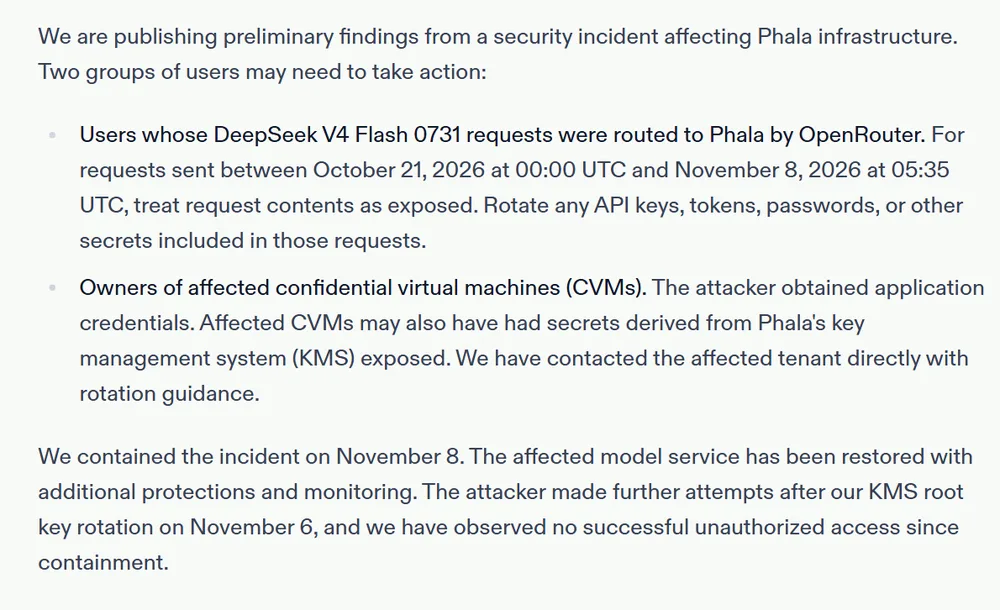
Source: Phala November Preliminary Incident Report, Phala, November 10, 2026, captured November 23, 2026.
The OpenRouter status page won't show this incident
Don't wait on the OpenRouter status page. Its history feed, read on November 23, has no entry for this incident; the newest item is a November 1 maintenance window.
OpenRouter Zero Data Retention settings to lock this week
ZDR on OpenRouter can be set in four places, and they stack differently. The request-level zdr: true works as an "OR" with account and guardrail settings, and when it is false or missing "it has no effect on routing". A script that forgets the flag goes to the default pool.
Our picks assume a team handling client data, with no enterprise contract.
| Setting | Where | What it does, per OpenRouter's docs | Our pick |
|---|---|---|---|
| ZDR per model group | Settings > Privacy (account) or a guardrail | Separate toggles for Anthropic, OpenAI, Google, SpaceXSI and "All other models" | On for All other models, where the open-weight hosts sit; decide the big three one by one |
| Safety Retention | Same places, chosen for Google and for all other models | "Allow" lets ZDR traffic use endpoints that may keep prompts from any request to prevent abuse; self-serve accounts default to Allow | ZDR only for all other models; for Google, ZDR only removes most Google models, so weigh it |
| Allowed providers | Settings > Privacy (account-wide) | Acts as a ceiling; a request's only list narrows inside it, and a request with no allowed provider fails with a 404 |
Name the hosts whose policy you have read; accept the lost fallbacks |
Training opt-out / data_collection: deny |
Settings > Privacy, or per request | Excludes providers that store and may train; separate from ZDR | On, but it doesn't replace ZDR |
| Guardrails | Workspace > Guardrails | Provider allowlist, ZDR per group, Sensitive Info redaction, custom regex block; "enforces nothing until it is assigned" | Set the workspace default guardrail so it covers every key in the workspace |
| Input & Output Logging | Settings > Observability | Stores prompts on OpenRouter for at least 3 months; org admins can read all of them | Off for keys that carry client data, on for test keys |
| Data discount logging | Settings > Privacy | Lets OpenRouter use your inputs and outputs for a 1% discount | Off |
The logging trade-off, and the one guardrail rule to add first
The logging row is a real trade-off. With it off, you can't read the prompt in an incident like this one; with it on, OpenRouter keeps a copy for at least three months, which is the retention you were trying to avoid. For keys that send client data we'd keep it off and rely on rotating secrets, and use the API Keys Filter to log only internal test keys.
Add one guardrail rule even if you change nothing else: a custom content filter that blocks requests matching key formats you use, such as AWS access key IDs. A blocked request returns a 403 "before it reaches the model". Dragos's stolen AWS keys were tested within hours in some cases, so this is the cheapest control on the list.
Why the OpenRouter Zero Data Retention flag didn't protect these requests
OpenRouter's ZDR documentation defines ZDR as "no routine storage of prompts or responses after processing". In practice it is a routing rule: when enforced, requests go only to endpoints on OpenRouter's ZDR list. Whether the provider behind an endpoint honors its policy is outside what that rule can see.
The Dragos report, published November 19 by HD Moore, shows three ways that gap opened. Attackers inside providers copied requests, and "some of the stolen requests were marked as ZDR". A Chinese AI lab fetched secret URLs from about two-thirds of the requests sent to its models that were marked "no data collection" or ZDR, including prompts sent to US hosts that resell its models.
And one router quietly forwarded some of its traffic to a marketplace, a hop its customers weren't told about. Moore's summary for customers is the line to put in your vendor file: "a privacy flag only binds the first hop".
OpenRouter's own docs list three more limits worth knowing before you promise a client anything. In-memory prompt caching is "not considered "retaining" data". ZDR "does not apply to plugins and tools you choose to enable, such as web search". And for private endpoints, OpenRouter records your ZDR declaration and "does not independently verify the upstream's contractual behavior".
None of this makes direct contracts automatically safe; Together's leak came from samples it stored itself. But it does change what a ZDR line in your records means. It means "OpenRouter routed this request to an endpoint whose provider said it keeps nothing", and after November 22 you should write it down that way.
On the same Hacker News thread, another user made the small-team case plainly: "If you're not an "enterprise", your only way to get even purported ZDR with anything close to frontier models is to use a router."
Vendor policy lines for routers and inference hosts
Most small-team AI policies have one vendor line per tool. A router needs more, because it is several vendors you don't pick per request. Add these to your AI vendor due diligence checklist and record the answers next to the router's row in your AI vendor DPA tracker.
- Ask the router, in writing, which providers serve each model you use, and whether any of them forwards to the model developer's own API. Novita's notice is the reason: a forwarding path meant for some customers applied "more broadly".
- Save the ZDR list monthly.
https://openrouter.ai/api/v1/endpoints/zdris public; on November 23 at 06:14 UTC it held 934 endpoints from 60 providers, none from Phala, Novita or Atlas Cloud, and 26 from Together. That is not a list of the three providers OpenRouter dropped: OpenRouter hasn't named them, all three still appear in its/api/v1/providerslist, and Atlas Cloud says it pulled its own models. A dated copy shows what you were routing to if the next notice arrives. - Ban live credentials in prompts and agent context, and back the rule with the guardrail filter above. Phala, Novita and Atlas Cloud all tell customers to rotate or revoke secrets sent in affected requests.
- Seed a canary. Dragos suggests a free Thinkst Canarytoken placed in the context your agents already send, with any use treated as an incident.
- Put a notice clause in any paid router or host contract: written notice when an endpoint you used loses ZDR eligibility. That is our suggested wording, not a term OpenRouter offers today. Our agentic AI vendor contract clauses have the surrounding language.
What we couldn't confirm
- Which three providers OpenRouter off-boarded, and whether they are the three Dragos found breached. Neither has said.
- Whether Together's leaked samples include requests that came through OpenRouter. Together's notice doesn't mention routers; OpenRouter lists it anyway.
- What OpenRouter's customer notice says. We have no OpenRouter organization account, so nothing here describes the email or the Settings screens from our own use.
- Atlas Cloud's exact dates. Its notice gives quarters only.
Checked: OpenRouter's November 22 announcement, its ZDR, provider routing, provider logging, guardrails, Logs, Input & Output Logging and Activity Export docs, the public ZDR endpoint and provider APIs, the status page history feed, the Dragos report, and the Phala, Together, Novita and Atlas Cloud notices, on November 23, 2026.
What to do before December 4
- Thursday, November 26: search the account owner's inbox for an OpenRouter notice, then run the Logs filters above for Phala, Novita and Atlas Cloud. Write down every API key that appears.
- Friday, November 27: rotate every secret those keys' apps could have sent, starting with cloud and database credentials. Check AWS CloudTrail for the user agents Dragos named,
artex-agentandartex-judge-r121. - Monday, November 30: in Settings > Privacy, enforce ZDR for all other models, choose ZDR only, set allowed providers and turn off data discount logging. Set the workspace default guardrail with the key-format block.
- Friday, December 4: send the router the provider question in writing and save the first dated copy of the ZDR list.
Log the whole thing as a vendor incident in your AI incident response plan, with the provider notices as evidence, so the next notice starts from a record instead of a search.
Related reading
- AI vendor supply chain security checklist maps exposure and access when a vendor's vendor is breached.
- LiteLLM supply chain attack checklist covers the self-hosted gateway side: what to check and pin when the router runs on your own servers.
- Enterprise Frontier Safeguards setup checklist covers Anthropic's direct zero retention route for Fable and Mythos, where the retained copy sits in a bucket you own.
References
- OpenRouter, Data Processing Incidents on Inference Providers, November 22, 2026.
- OpenRouter, Zero Data Retention, documentation.
- OpenRouter, Provider Routing, documentation.
- OpenRouter, Guardrails, documentation.
- OpenRouter, Logs and Input & Output Logging, documentation.
- OpenRouter, Provider Logging, documentation.
- OpenRouter, status history feed, read November 23, 2026.
- Dragos, Three breaches, endless leaks: Your AI supply chain needs canaries, HD Moore, November 19, 2026.
- Phala, November Preliminary Incident Report, November 10, 2026.
- Together AI, Security event: Prompt leakage for requests in June and July of 2026, November 21, 2026.
- Novita, Privacy Notice Regarding MiniMax Requests on Novita, November 22, 2026.
- Atlas Cloud, Security notice: MiniMax's official API and how we protect your data, November 23, 2026.
- The Hacker News, OpenRouter Drops 3 Providers After Researchers Catch Months of Prompt Theft at AI Hosting Firms, November 22, 2026.
- Hacker News, Data Processing Incidents on Inference Providers, November 22, 2026.