If your business uses Citi Online, Section H of Citi's Online User Agreement says that once you give a third-party AI agent your login, "Citi will consider any access and actions taken by the agent as authorized by You," and the same holds for anyone who gets that login after the agent leaks it. The agreement's "you" includes "consumers, sole proprietors and other eligible small businesses signers and users," so a small firm that lets an outside agent pay bills or move money through Citi Online carries the loss, while AI tools Citi provides itself are carved out.
A notice at the top of the agreement says it "was last updated November 2026" to add the section. Digital Watch dates the revision to November 18, when the first reports ran, but the Internet Archive puts it earlier: its November 7 copies of citi.com/tandc, the page and its printable version, already contain Section H, and its October 17 copy does not. Citi hasn't given a date, so the clause went up between those two days. We read the live page on November 23.
Citi AI agent terms and PNC's December 19 rules side by side
Citi wasn't alone; our October post on unauthorized AI agents in bank accounts covers Chase's terms and the banks already blocking agent logins. PNC changed its terms on November 18, according to Counsel House, and its new Digital Services Agreement, marked "Version Effective 12/19/2026", has its own Third-Party AI Agents section, which Data Phoenix also covered. We read both banks' texts. They take different routes to the same place: Citi warns you off and then puts every outcome on you; PNC writes the ban into the contract.
| Clause | Citi Online User Agreement, Section H | PNC Digital Services Agreement |
|---|---|---|
| In force | "last updated November 2026"; present in Archive copies from Nov 7 | Version effective Dec 19, 2026 |
| Giving an agent your login | "cautioned against"; if you do, the agent's access and actions are "authorized by You" | Not allowed: no User ID, password or one-time passcode to any agent |
| Login leaks onward | Access by other people or agents is still "authorized by You" | No leak clause in the AI section; you answer for access you permit in breach of its rules, "to the extent permitted by applicable law" |
| Agent starts a payment | Your risk; Citi has no duty to investigate, even when the action conflicts with your prompts | Not permitted unless PNC expressly allows it for that service |
| Screen scraping, browser automation | Not mentioned | Barred as a way around PNC's connection rules |
| The bank's own AI | Excluded from Section H | Covered in a separate "Artificial Intelligence Features" section |
| Cutting agents off | "at any time without notice" | May block, restrict, delay or ask for extra confirmation |
| Your data at the agent | Citi Privacy Notice "does not apply" to the agent | The agent's own terms and privacy practices govern it |
Checked November 23, 2026 against citi.com/tandc (live page and Internet Archive copies) and PNC's PDF.
Here is the Citi text as citi.com served it to us:
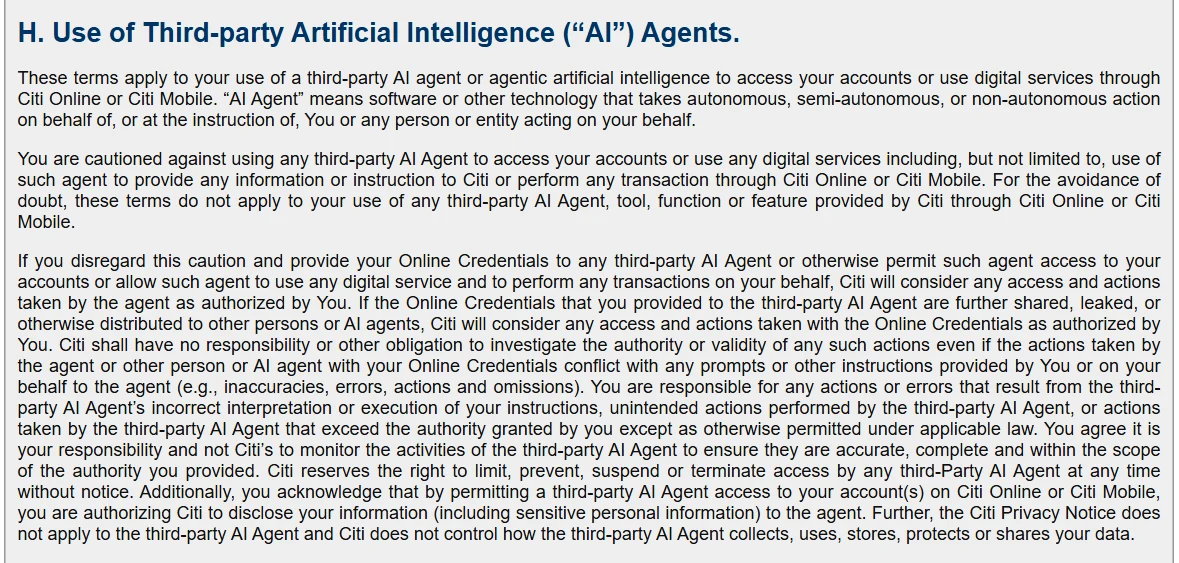
Source: Citi Online User Agreement, Section H, page as served on November 23, 2026 at 16:05 UTC, rendered from our saved copy.
What the Citi clause adds for a small business
Read Section H next to two older parts of the same agreement, both already present in the October 17 copy.
The business-account section (now Section J, Section I before the renumbering) says each person with Citi Online access has "general authority from your business," and that "You accept responsibility for unauthorized access to Citi Online or Citi Mobile App with your Online Credentials by your employees and associates or by third parties." So a business was already on the hook for a login used by someone it didn't mean to authorize. Section H closes the gap an owner might have argued over: an agent's misreading of instructions, "unintended actions," and actions beyond the authority you gave are yours "except as otherwise permitted under applicable law." The agreement also says monitoring the agent is "your responsibility and not Citi's."
The second part matters to sole proprietors. Citi lets you link consumer and business accounts under one User ID and password, "at your sole risk." An agent holding that one login reaches both sets of accounts, and Section H applies to whatever it does in either.
Two things Section H doesn't say. It names no agent, allowed or blocked, and it says nothing about bank feeds that run through an aggregator rather than your Online Credentials; Agentic Commerce Atlas also reads it as written around agents using a customer's online banking login. For consumer accounts, how the "applicable law" qualifier meets Regulation E is unsettled, as Counsel House notes; our earlier post walks through that rule and Chase's October terms. Business accounts sit outside Regulation E, which covers accounts held "primarily for personal, family, or household purposes" under 12 CFR 1005.2(b).
PNC's business terms, Citizens, and the Fed
PNC's agreement goes further for business customers in its security-procedure clause. Instructions that pass PNC's checks bind you "regardless of whether you, a Delegate, Third-Party AI Agent, or any Authorized Representative actually authorized the instruction." Its Account Delegation section, for businesses only, lets an owner give named people limited access instead of sharing a login, and says "you shall be liable for all actions of any Delegate." That is the route to use for a bookkeeper, not a shared password typed into an agent.
Citizens Bank emailed customers that they are responsible for what their AI assistants do, according to Digital Watch and Counsel House. We couldn't confirm it: Citizens' digital terms page returned HTTP 403 to us on November 23, its newest Internet Archive copy is from July 18, and we haven't seen the email. Both outlets also say JPMorgan Chase and Bank of America announced similar policies in October.
The Federal Reserve has the same problem in view. Governor Michael Barr said in a November 16 speech that "major banks now report finding AI agents attempting to take actions in retail customer accounts, without the bank being able to verify authenticity, consent, and alignment with customer instructions." He called for "explicit consent verification for specific actions," which is close to what PNC wrote down.
What we couldn't confirm
The exact day Citi published Section H; whether Citi treats any agent or connection type differently; what Citizens' terms say; and whether any customer has lost money under these clauses. We did not search court records. Who else is writing agent liability rules, from Congress to the AI vendors, is in our AI agent liability tracker.
What to change this week
- Ask who has done it. Everyone with Citi Online or PNC access, including your bookkeeper: has an AI agent, browser agent or assistant held the login, or worked in a browser signed in to the bank? Our AI browser agent policy keeps agents in a profile with no banking sessions. Logins found this way are shadow AI, so handle them without blame.
- Change those passwords and tell the bank. Citi's agreement says to notify it "immediately" if a password may be compromised; its Customer Service section lists CitiPhone Banking at 1-800-374-9700. Note the date and time you called.
- Split personal and business logins if you share one User ID across them.
- Write the rule down. Add "no AI agent gets credentials for any bank, card or payroll account" to section 4 of your AI acceptable use policy, and keep payments behind a human, the third red line of our AI agent governance policy.
- For PNC customers. Before December 19, when PNC's agent rules take effect, give any bookkeeper their own access through Account Delegation instead of a shared login.
- Log it. Record each agent that touched a bank account in your AI risk register: who connected it, which accounts, and the date you revoked access.
Start with step 1 today, and make the step 2 call the same day for any login an agent has held. If a vendor contract is the next question, our guide on who pays when an AI agent errs covers the clauses to ask for.