Source: Unsplash stock photo, free to use under the Unsplash license.
California AB 1609 binds only businesses with more than $500 million in gross annual revenue nationally, and its duties start on January 1, 2027. The signed text calls them a "large private business," and both Hunton Andrews Kurth and Hogan Lovells give the same start date. A covered business may not pass its customer service chatbot off as a human, must let California customers ask for a person on every service channel, and must make a good faith effort to connect them within 15 minutes or give them a specific appointment time within one business day. The revenue line keeps most small teams out, though vendors whose chatbots and contact-center tools those companies run will meet these duties through their contracts.
Governor Newsom approved the bill on September 28, 2026, and it was filed as Chapter 733, adding Sections 22625 to 22629 to the Business and Professions Code (chaptered text on leginfo; Governor's release). It is one of the bills in our California 2026 AI bills roundup. The work lands on the vendors whose chatbot, phone tree or contact-center tool a covered company runs, because a company cannot show a good faith effort on a clock it never measured.
Does California AB 1609 cover your company?
Section 22625 has eleven definitions, (a) to (k). Five of them decide whether you are in scope.
| Term | What Section 22625 says | What it does to scope |
|---|---|---|
| Large private business, (g) | More than $500,000,000 in gross annual revenue nationally; provides goods and services to customers | Revenue is counted nationally, not in California. Hunton says the law reaches businesses located inside and outside the state |
| Customer, (b) | "a natural person residing in California"; residence "refers to the customer's account address" | A person with a California account address. A company buying from you is not a "customer" in this sense |
| Customer service chatbot, (d) | An AI system with a natural language interface giving "adaptive, human-like responses," used for direct customer service or support | Sets the reach of the disclosure duty in 22626 |
| Services, (j) | Paid by one-time payment, subscription, fee or recurring charge; excludes services that "offer a free option" | Raises a freemium question, below |
| Exclusive business lines, (e) | Channels "intended solely for use by employees of the business or by other entities for business-to-business communications" | Out of the law under 22628(g)(2) |
Section 22628(g) adds four exemptions: services regulated under the CPUC's General Order 133 (telecommunications) or General Order 103-A (water) where the business complies, exclusive business lines, hospital communications about health care, and consumer reporting agencies under the Fair Credit Reporting Act. Hogan Lovells lists the same carve-outs for regulated utilities, hospital communications and consumer reporting agencies.
Two readings matter for a smaller company. Hunton notes the law applies across channels "including telephone and digital systems, rather than solely to AI-powered tools," so a covered retailer with no bot at all still owes the 15-minute effort on its phone line. And if every buyer you have is a business, the definitions point away from you: a customer is a natural person and business-to-business lines are excluded. That second point is our reading of 22625(b) and (e); neither firm addresses it.
The clocks in Section 22627
| Duty | Section | Limit (good faith effort) | Not required, or excused, when |
|---|---|---|---|
| Offer a way to ask for a person | 22627(a) | At least during regular business hours, on all platforms used for customer service | The business need not start customer service on a platform it had not made available to customers as of January 1, 2027, 22627(e)(2) |
| Connect after the request | 22627(b)(1)(A) | A customer service agent within 15 minutes | The request came by email, web form or voicemail, 22627(e)(1) |
| Or give an appointment | 22627(b)(1)(B) | A specific time within one business day | Not addressed: 22627(e)(1) lifts only the 15-minute limit for email, web form or voicemail |
| Holds once connected | 22627(c) | No single hold or wait over 15 minutes; cumulative holds, waits or escalation queues no more than one hour total | Unforeseen circumstances, or emergencies including IT or telecom outages, 22628(f) |
| Phone number on the website | 22627(d) | Businesses selling online that run a phone line post the number "clearly and conspicuously" | A business with no phone service as of January 1, 2027 need not add one, but must offer a way to "promptly connect" with an agent, 22628(e) |
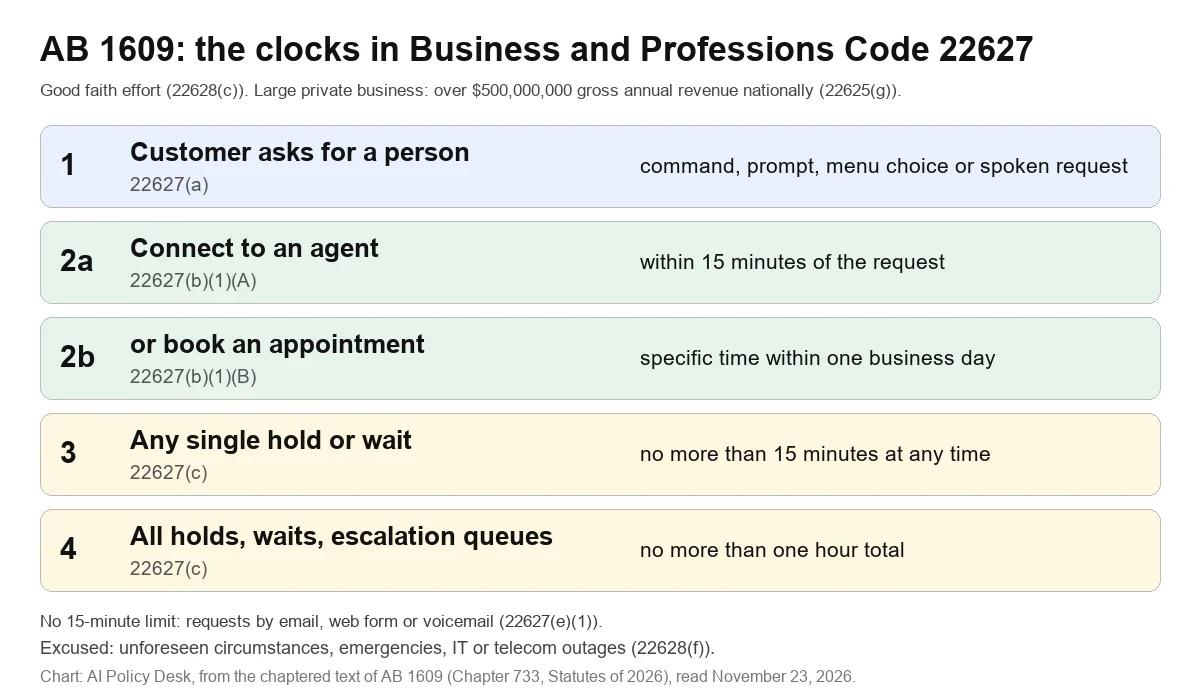
Source: AI Policy Desk chart, built from Sections 22625, 22627 and 22628 of the chaptered text of AB 1609, read November 23, 2026.
The request feature passes if customers can ask "through commonly understood commands, prompts, menu selections, or verbal requests during the customer interaction." Hunton reads that as a voice command, chat prompt or menu choice that lets the customer "exit the automated loop."
If you build or resell the support bot: what to ship before January 1, 2027
A covered client will push these into the contract, so put them on your roadmap first.
| Ship | What it needs to do | Section it answers |
|---|---|---|
| A human-request intent on every channel | "Agent," "representative," "human" and "person" reach the handoff in chat and voice, plus a menu option, during at least the client's service hours | 22627(a) |
| An automated-agent disclosure in the bot's own medium | Spoken for a voice bot, written for chat. We would put it in the first message, which the statute does not require | 22626(b) and (c) |
| Timestamps per contact | Request time, connect time, each hold start and end, and a running total, so the client can test every contact. Hunton tells covered retailers to check that vendors "can track hold durations, schedule callbacks, and log escalation times" | 22627(b) and (c) |
| A callback scheduler | When the queue estimate passes the connection target, offer a specific appointment time | 22627(b)(1)(B) |
| An outage log | Start and end times of IT and telephony outages, since those delays are excused | 22628(f)(2) |
| A guarded handoff | If the bot or the agent behind it can reset passwords or change emails, our account takeover post lists six controls, including re-authentication before sensitive actions | Not in AB 1609; account security |
Then write the service levels into the client agreement. Clause 11 (SLA with financial remedy) in our AI vendor contract redline template is the closest starting point; add handoff and hold metrics next to uptime. Start this week with one test: export a week of chat and phone logs for one client and try to compute request-to-agent time for every handoff. Missing fields go to the top of the backlog, ahead of any copy change.
What "good faith" and "regular business hours" mean in AB 1609
"Good faith" has a definition. Under 22628(c), "commercially reasonable and practicable standards that are designed and intended to achieve compliance" satisfy it, and Hunton's November 17 note says the statute "does not impose strict liability for every missed timing benchmark." That is the reason logs matter: a missed target is defensible only if the business can show the standard it was running.
"Regular business hours" is defined in 22625(i) as the hours the business keeps customer service open, excluding days it is closed and state or federal holidays, and it "includes a 10-hour period per day over a five-day week or 8 hours per day for a full seven-day week." That is 50 or 56 hours a week. The statute does not say whether those figures are a floor or an example. Hogan Lovells' note says the law sets "the hours that a human representative must be available" but does not cite 22625(i), and Hunton and the Governor's release don't address the figures.
Where the summaries and the signed text disagree
The wait-time display
The signed text has no duty to display wait times: the word "display" does not appear, and the only website duty is posting the phone number under 22627(d). A Hacker News comment that sits in Google's top five for "ab 1609" (one commenter, October 15, 2026) says businesses over the threshold "must display wait times." The same comment says businesses must connect customers "within 15 minutes"; the text asks for a good faith effort, with the appointment option beside it.
The one-hour callback
Hogan Lovells' November 19 note says a business "may also satisfy this requirement by returning a phone call within one business hour." Section 22627(b)(2) gives that option only to "A large private business subject to Section 1707.2 of Title 16 of the California Code of Regulations." That section is the Board of Pharmacy's "Duty to Consult" rule (Cornell LII, which files it under Division 17, California State Board of Pharmacy), which already requires a pharmacist to be available "within an average of ten (10) minutes or less, unless a return call is scheduled to occur within one business hour." A retailer or a software company cannot use the one-hour route.
The freemium definition
Section 22625(j) says "services" are ones a customer pays for, and "does not include services or parts of services that offer a free option to persons with an opportunity to pay, subscribe, or otherwise provide monetary consideration for the service or upgraded services at a future time." Read literally, the free tier of a freemium product is not a "service," and maybe the whole product is not. The statute is the only source here: Hunton, Hogan Lovells and the Governor's release don't mention it. We would not build a plan on it without counsel, because "goods" are still covered and the paid tier is a separate question.
Penalties and who can sue
Section 22628 lets "a public prosecutor" bring an action, caps the civil penalty at $5,000 for an initial violation and $10,000 for each subsequent one, and says the chapter "does not establish a private right of action." The statute doesn't say what one violation is: one missed callback, one customer, or one day of a broken menu.
Hunton adds a risk that only it raises: plaintiffs "may still rely on an alleged statutory violation as a predicate for a claim under the 'unlawful' prong" of California's Unfair Competition Law. Section 22629 says the chapter's duties are "cumulative" to other law, which does nothing to close that route.
How California AB 1609 sits next to SB 243 and New York City's proposal
California already had a chatbot law that skipped support bots. SB 243 covers companion chatbots and excludes "A bot that is used only for customer service," as our SB 243 guide quotes from Section 22601. AB 1609 fills that gap, but only for companies over the threshold.
Its disclosure rule in 22626 is narrower than a label on every chat: a "clear and conspicuous disclosure" is owed when a reasonable person "is likely to be misled," in the same medium the bot uses. Our state chatbot disclosure checklist explains why an "I'm an AI assistant" opener that stays visible is the safer version in Utah and under SB 243.
New York City is drafting the stricter version. DCWP's proposed rule wants a "single-step transfer mechanism" (§ 5-310), and the NYC Rules page lists December 18, 2026 as the comment deadline; our NYC doom loop checklist has the details. AB 1609 accepts a menu selection, so a flow built for New York's one step should also satisfy California's request feature on our reading. If the same bot places outbound calls or texts, the FCC's revised TCPA opt-out rule is a separate duty, in force from November 25 (our TCPA post).
The other January 2027 dates are in the AI regulation deadline calendar.
What we could not confirm
- Whether the 10-hour and 8-hour figures in 22625(i) are minimum service hours.
- What counts as one violation for the $5,000 and $10,000 penalties.
- Whether a freemium product's paid tier is a "service" under 22625(j).
- Whether an earlier version of the bill required wait-time display. leginfo's bill history and version PDFs returned a Cloudflare 403 to our scripted requests on November 23, so we read only the chaptered text.
- Any regulator guidance. We found none, and the chapter gives no agency power to write rules.
Checked on November 23, 2026: the chaptered text of AB 1609 on leginfo.legislature.ca.gov; the Governor's September 28 release; Hunton Andrews Kurth's November 17 note (hunton.com refused our connection, so we read the same text republished by The National Law Review); Hogan Lovells' November 19 note on JD Supra; 16 CCR 1707.2 on Cornell LII; the NYC Rules page; the Hacker News comment.
References
- California Legislature, AB 1609, chaptered text (Chapter 733, Statutes of 2026), leginfo.
- Office of the Governor, release on bills signed September 28, 2026, including AB 1609.
- Hunton Andrews Kurth, note on California's new chatbot law and human customer service access, The National Law Review, November 17, 2026.
- Hogan Lovells, note on California's new human customer service requirements, JD Supra, November 19, 2026.
- Cornell LII, Cal. Code Regs. tit. 16, § 1707.2, Duty to Consult.
- NYC DCWP, Automated customer service systems (proposed rule), NYC Rules.
- Federal Register, FCC rule on revoking consent to robocalls and robotexts, document 2026-21821, October 26, 2026.
- Hacker News, comment 50111136, October 15, 2026.