The FCA published "Our approach to Agentic AI" on November 24, 2026, the day Meta's Muse agent launched in the UK, and asked regulated firms "how you establish that you are dealing with an agent". For a small financial adviser or broker, email is where that question gets hard: Meta's help page tells Muse users that if they want an email "to come from your personal account instead, tell your Muse which connected account to use."
So the client's agent can write to you from the client's own Gmail address, and Meta's documents describe no label marking it as agent-written. Below are the four FCA questions answered for an IFA, a credit broker and an insurance broker. For an AI agent holding a small business's bank login, see our notes on unauthorized AI agent payments and Citi's Section H.
What the FCA page adds, and what it doesn't
The page sets out expectations "for firms, technology providers and social media platforms looking to develop and deploy agentic AI products in the financial services sector." It adds no new rule. The framework "is principles-based and outcomes-focused and applies when regulated firms use AI", and the FCA says it "will provide regular updates on this webpage", so check back.
On your own AI: if you deploy agentic AI or rely on a third party's, "responsibility for complying with regulatory obligations remains with you and senior managers within your firm." Senior managers are responsible for AI models in their area "whether these are developed in house or by a third party."
On your customers' AI, you should consider "how you establish that you are dealing with an agent, what consents are in place, what an AI agent is allowed to do, and how customers can get support if something goes wrong."
On payments, you should consider "any liabilities that may arise from accepting instructions" and "whether it is appropriate to accept payments instructed by an AI agent, or from a digital wallet controlled by an AI agent."
The FCA also plans an Agentic Policy Sprint for firms, policymakers and tech providers; you register interest by emailing [email protected]. Our FCA AI good practice checklist covers the rules for AI you run yourself.
Three DRCF and FCA texts in four weeks, read for a small firm
The FCA page is the third text in the Digital Regulation Cooperation Forum line since October 30. The CMA and ICO also published on launch day, aimed at Meta and at agent developers rather than at regulated firms. We couldn't open the DRCF originals, so the first two rows rely on Computer Weekly and Resultsense.
| Document | Aimed at | Key line for firms | What changes for a small firm |
|---|---|---|---|
| DRCF joint statement, Oct 30 | Firms building personal agents | Existing law applies, including "financial services, payments and cyber security requirements" | Nothing new to do; confirms no carve-out |
| DRCF letter, Nov 16 | Government and regulated partners | Partners' obligations "continue to apply when customers use personal AI agents" | You can't treat an agent's request as outside your rules |
| FCA page, Nov 24 | Regulated firms and tech providers | The four customer-agent questions; agent-instructed payments; the five regulated activities for tech providers | You need written answers to the four questions |
The only text that hands a small firm specific questions is the FCA page. That is the one to file with your Consumer Duty records.
What you see when a customer's Muse acts
We mapped each route a Muse can use to reach a firm against what Meta's own documents say the firm will see. Meta's documents and one trade report are the only sources here; we have not tested Muse ourselves.
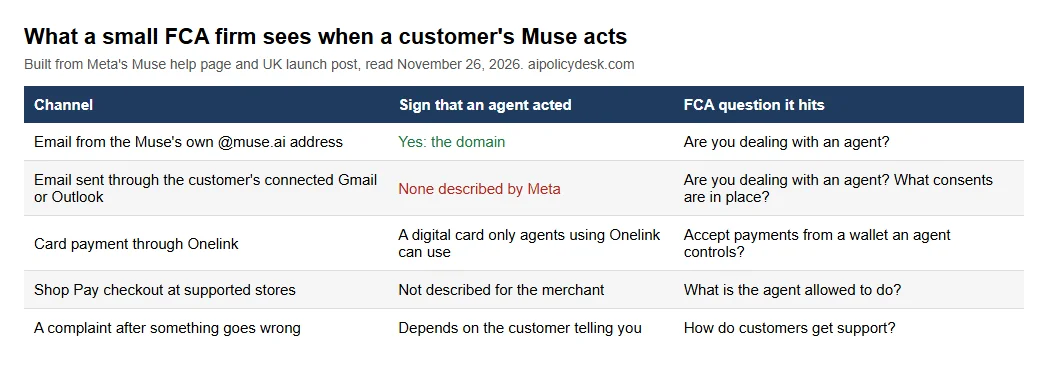
Source: aipolicydesk.com table built from Meta's Muse email help page, Meta's post Introducing Muse in the UK and Agentic Commerce Atlas, November 26, 2026.
| Channel | Sign that an agent acted | FCA question it hits |
|---|---|---|
| Email from the Muse's own @muse.ai address | Yes: the domain | Are you dealing with an agent? |
| Email through the customer's connected Gmail or Outlook | None described by Meta | Are you dealing with an agent? What consents are in place? |
| Card payment through Onelink | A digital card only agents using Onelink can use | Accept payments from a wallet an agent controls? |
| Shop Pay checkout at supported stores | Not described for the merchant | What is the agent allowed to do? |
| A complaint after something goes wrong | Depends on the customer telling you | How do customers get support? |
Email from a client's Muse: @muse.ai or their own inbox
The @muse.ai route is the easy one. Meta says "Emails genuinely sent with Muse use an @muse.ai address" and tells recipients to check the full address. A rule that flags that domain in your inbox costs nothing.
The connected-account route is the gap. Muse user guides from chaen.ai and agentmsgr, both on November 22, already noted that Muse can send from a connected Gmail; neither looked at it from a regulated firm's side. Meta's help page puts the two options side by side:

Source: Meta Help Center, Muse email, captured November 26, 2026.
Meta describes no header, footer or label on those emails. Its Connectors page says "By default, Muse will not take many important actions, like sending an email, without your approval", and adds that users "can change when Muse asks for your approval in your Settings". So you can't assume the client read the email before it went.
One limit cuts the other way, and only for mail sent to Muse. Meta says Muse may "refuse to action requests about sensitive topics over email, including requests about financial information". That covers what people send to a Muse, not what a Muse sends to you.
When a client's Muse pays: Onelink and Shop Pay
Meta says Onelink, built by Stripe, "generates a unique, digital version of your card that's only accessible to agents using Onelink", and Agentic Commerce Atlas reports that purchases need the user's approval every time. Muse can also pay with Shop Pay at supported stores. Neither source says what the merchant sees.
Sample answers to the four questions, by firm type
These are drafting starters for your own file, not regulatory advice. Each one avoids relying on detection, since the email route above may give you nothing to detect.
| FCA question | IFA (advice, investments) | Credit broker | Insurance broker |
|---|---|---|---|
| Dealing with an agent? | Flag @muse.ai; treat any email instruction to switch, withdraw or change bank details as unverified until confirmed by phone | Flag @muse.ai; ask in the application whether an AI agent is filling it in | Flag @muse.ai; ask at renewal whether the client uses an agent for admin |
| What consents? | Record whether the client authorises an agent to send instructions, and for what | Record that the applicant, not an agent, confirmed affordability answers | Record who may change cover or cancel |
| What may the agent do? | Book meetings, request documents; no trades or transfers on email alone | Gather quotes; no signing of credit agreements | Request quotes and documents; no cancellations on email alone |
| Support if wrong? | Complaint route names agent errors; client can reverse within your usual process | Same, with a named contact | Same, with a named contact |
The FCA page says the customer-agent questions also cover "information provided to consumers through agentic chatbots or where agents are used to help resolve complaints." If a client's agent files a complaint, it still goes through your complaints process.
How two brokers limited agents they let in
Two retail brokers chose limits over a ban: eToro caps what an agent can spend, and ThinkMarkets lets an agent trade without touching client money. Both designs scale down to a small firm's policy.
Finance Magnates reported in July that eToro runs investors' own agents "inside funded sub-accounts capped at set budgets". It said ThinkMarkets' ChelseaAI can place trades but not touch client funds, and Fazzaco described ChelseaAI in October as an MCP server that can block a trader's assistant from client funds. Finance Magnates' research arm counted at least ten brokers and platform vendors connecting agents to live client accounts in the first half of 2026.
The shared idea: decide in advance the most an agent can do, and keep money movements behind a step only the human completes. A firm without engineering staff gets the same effect with a rule: an agent may ask, a person confirms.
What we couldn't confirm
- Whether Muse marks emails sent through a connected account in any way Meta doesn't document.
- The wording of the DRCF statement and letter, which we read only through Computer Weekly and Resultsense.
- What the Agentic Policy Sprint will produce, and when.
- How Muse's earlier problems, such as public share links and a zero-day in agent permissions, bear on UK firms receiving its messages.
Six steps before the FCA updates its page
- Add an inbox rule that tags mail from @muse.ai and routes it to a named person.
- List the instructions you will act on from email alone. Anything moving money, changing bank details or cancelling cover goes on the "confirm by phone" list, whoever sent it.
- Add one question to onboarding and annual reviews: does the client use an AI agent to contact you, and what may it do?
- Decide your position on agent-only card payments such as Onelink, and tell whoever takes payments.
- Name the senior manager responsible, because the FCA page puts responsibility on "senior managers within your firm."
- Log every case where you spot an agent or learn one acted. Add a line to your AI incident response plan for agent instructions that turn out to be wrong.
If a client's agent chases you for a human and gets a loop, that is the failure New York City's proposed rule targets; our customer service doom loop guide covers the handoff. The ICO's work on agents is in our agentic AI call for evidence explainer.
Start with step 2 this week: the "confirm by phone" list covers the email gap whatever the FCA adds. If you want a say in what comes next, register interest in the Agentic Policy Sprint at [email protected], and recheck the FCA page when it next updates.
Checked: the FCA agentic AI page of November 24, 2026; Meta's Muse email and Connectors help pages and its UK launch post; the CMA statement and ICO blog of November 24; Computer Weekly, Resultsense, Agentic Commerce Atlas, Finance Magnates, Fazzaco, chaen.ai and agentmsgr, all on November 26, 2026.
References
- Financial Conduct Authority, Our approach to Agentic AI, first published November 24, 2026.
- Financial Conduct Authority, AI: good practice and areas for improvement.
- Meta Help Center, Muse email and Muse Connectors.
- chaen.ai, Muse Email Address: How It Works and Business Caveats, November 22, 2026; agentmsgr, Your Muse email address: the free @muse.ai inbox, the handle to pick, and what to use it for, November 22, 2026.
- Meta, Introducing Muse in the UK: A Personal AI Agent You Control, November 23, 2026.
- Agentic Commerce Atlas, Meta's Muse Launches in the UK and Can Pay With Onelink and Shop Pay, November 24, 2026.
- Competition and Markets Authority, CMA statement on UK launch of Meta Muse, November 24, 2026; Information Commissioner's Office, Developers creating agentic AI services for consumers reminded to meet their data protection responsibilities, November 24, 2026.
- Computer Weekly, UK regulators call for tight control of personal AI agents, November 17, 2026.
- Resultsense, Three regulators, one launch day: can existing UK law keep up with consumer AI agents?, November 25, 2026.
- Finance Magnates via TradingView, FCA's landmark AI review lands after the agents already arrived, July 6, 2026.
- Fazzaco, FCA plans AI-driven supervision, no new rules for chatbots, October 15, 2026.